DVD-quality lessons (including tabs/sheet music) available for immediate viewing on any device.
Take your playing to the next level with the help of a local or online banjo teacher.
Weekly newsletter includes free lessons, favorite member content, banjo news and more.
Premier Sponsors


|
Please note this is an archived topic, so it is locked and unable to be replied to. You may, however, start a new topic and refer to this topic with a link: http://www.banjohangout.org/archive/405533
janolov - Posted - 10/16/2025: 04:23:17
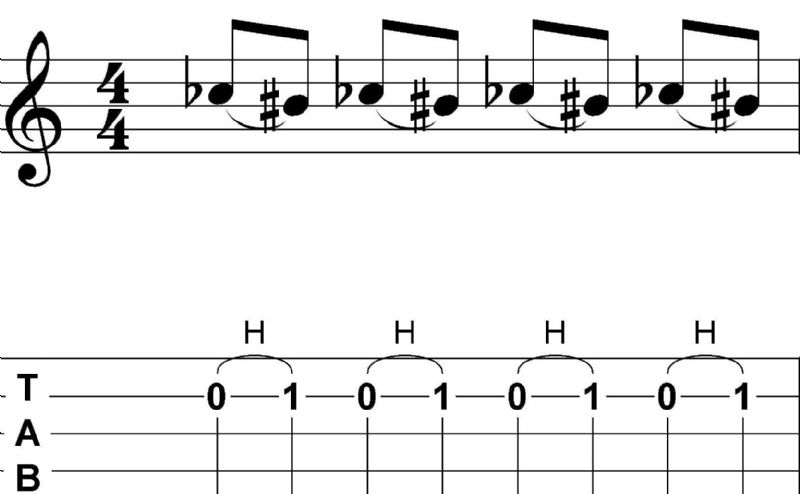
What is the interval between B# and Cb?
I saw this question on Facebook, and there were a lot of wrong answers by people who thought they knew music theory. So what would you answer?
Zachary Hoyt - Posted - 10/16/2025: 04:42:37
I imagine it's 1/2 step, or maybe -1/2 step if one is permitted the use of negative numbers in this context.
banjobob36 - Posted - 10/16/2025: 05:47:37
This is a diminished second , the smallest possible interval in Western music theory. B# is enharmonically equivalent to C natural, and Cb is enharmonically equivalent to B natural. So you are measuring from C to B c which goes down a semi tone , creating a diminished second interval.
slou92 - Posted - 10/16/2025: 06:13:34
I guess a half step? At least on a fretted instrument … half step (1 fret) up from B is C so a B# is C and a Cb is B
Edited by - slou92 on 10/16/2025 06:15:34
sean curran - Posted - 10/16/2025: 06:35:04
B# is C. C flat is B. Yes, the distance between those two is a half step. It's the kind of question a jokester would ask, looking for people who might think B and C are a whole step apart.
jsinjin - Posted - 10/16/2025: 07:22:14
It’s like “How many cups in a stick of butter?” Asking the question with the “s” on “cups” implying that it is plural and assuming more than one but technically 1/2 is still a number of cups.
Chemistry uses it all the time with “how many moles in x grans of stuff”
How many moles in a guacamole?
-Avacados number
RB-1 - Posted - 10/16/2025: 09:35:29
B# is different from C in a similar way the fourth fret 3rd string is different from the second string open.
Close, yet different....
Edited by - RB-1 on 10/16/2025 09:36:05
banjo bill-e - Posted - 10/16/2025: 10:15:14
B# is C on a fretted instrument, but is that also true with violins and other fretless instruments? Or put another way, is G# really the same note as Ab, or just as close as we can get with frets?
BigFiveChord - Posted - 10/16/2025: 10:33:47
quote:
Originally posted by banjo bill-eB# is C on a fretted instrument, but is that also true with violins and other fretless instruments? Or put another way, is G# really the same note as Ab, or just as close as we can get with frets?
If a string quartet was playing (or for that matter a barbershop quartet were singing) a G major chord, the person playing the third would tune that note to align with the natural overtones. This is "just intonation," as opposed to say a piano or banjo, which is structured for "equal temperament." It's still called a B, though. You can call it a Cb or whatever, that's linguistics (or sometimes theory), it doesn't change what the note is. This would also be true in the key of B, they'd just adjust the D#. Still a D#, though. You could call that the key of Cb, which I guess would make that note an Eb, but that's just linguistics (as is the initial question).
janolov - Posted - 10/16/2025: 10:33:55
quote:
Originally posted by banjobob36This is a diminished second , the smallest possible interval in Western music theory. B# is enharmonically equivalent to C natural, and Cb is enharmonically equivalent to B natural. So you are measuring from C to B c which goes down a semi tone , creating a diminished second interval.
If I have understood the music theory a diminished second is the interval between B and Cb, or between B# and C. The interval between B# and Cb should be a minor second (between 4th and 5th fret on third string in standard G tuning), or a major seventh (between 1st and 12th fret on second string).
250gibson - Posted - 10/16/2025: 11:58:46
quote:
Originally posted by banjobob36This is a diminished second , the smallest possible interval in Western music theory. B# is enharmonically equivalent to C natural, and Cb is enharmonically equivalent to B natural. So you are measuring from C to B c which goes down a semi tone , creating a diminished second interval.
That is a minor second. A diminished second is enharmonic to a unison.
Edit: Said above. However you usually don't mix sharps and flats like that. It would be more proper to refer to as the interval between B# and Ax(##) or Cb and Dbb
Edited by - 250gibson on 10/16/2025 12:07:29
Brian Murphy - Posted - 10/16/2025: 14:18:49
Sir, this is a banjo forum. We don't allow music questions here :-)
banjoboyd - Posted - 10/16/2025: 16:10:09
My last comment got messed up, but I wanted to elaborate a bit anyways...
It's important to know that conventions of musical "spelling" are rooted in 16th-17th century practice, and by extension, the class of temperaments known as meantone. In the standard form of meantone—that is, 1/4-comma meantone—a stack of three just major thirds (C E G# B#) falls short of the octave by about 41 cents. This gap is called a diesis, which is a particular type of comma. In this system, a whole tone contains 5 dieses, whereas a semitone contains 3. E.g.:
A Bbb A# Bb A## B Cb B# C Dbb C# Db C## D...
Meaning that the interval between Cb and B# is indeed one diesis.
What happens in equal temperament is that the diesis betwween B# and C (as well as between B and Cb) is "tempered out"; that is, made to be 0 cents. In fact, the single-diesis interval is not represented at all in equal temperament. The two-diesis interval is sort of represented, but it's conflated with the three-diesis interval. Compare A-A# (two-diesis) and A-Bb (three-diesis); same sound, different spelling.
Then there is a convention that emerged later on, once things were largely limited to 12 tones (not necessarily equal temperament): each of the letters A through G should appear only once in a given scale, and only in order. Meaning that, no matter what sharps or flats you attach, the D of your scale must be higher in pitch than the C, the E must be higher than the D, and so on. This is also related to why key signatures contain either sharps or flats but not both, even when the actual scale being used is mixed (e.g., C D Eb F# G A Bb C).
So while it is tempting to say that "B#=C and Cb=B, therefore they form a semitone / minor 2nd" and leave it at that, in practice, you would never see B# and Cb in conjunction because it violates the above convention.
banjoy - Posted - 10/17/2025: 04:38:43
I googled the question and came up with the same braniac reply posted several posts above.
This kind of thing is what I find distasteful about music theory. Who, if anyone here or in that FaceBook thread, has ever needed this information? And for what practical purpose? It's interesting from a mathematical point of view (and music is definitely mathematical). But music is more emotion than math. It's a mental exercise that has no meaningful application in real life. It only involves how something was arrived at, and not the final destination which in my opinion, is more important than how you got there.
Also, context is missing. If the trip landed me on the same fret, then there is no space between them. It's like asking what is the space between (-1+1) and (+1-1). Theoretically they arrive at the same answer from different directions. The answer is the same.
Music theory is not intended to describe what is about to happen, but what has just happened. It's a descriptive language, not a hard set or rules which excludes the emotional aspect of music, which by the way, could also be described in theoretical terms. But the experience of something, and thinking about and analyzing something, are not really the same...
Edited by - banjoy on 10/17/2025 04:48:21
banjoboyd - Posted - 10/17/2025: 06:02:58
Music theory is just "thinking about music." A lot of it is framed in a more analytical/mathematical way, but discussions of musical style and how people experience playing/listening to music are also music theory. Yes, most (I wouldn't say all) music theory is basically descriptive, but--same as with actual language--descriptions have to be interpreted. The more distant (in terms of time, culture, or whatever else) the description is from our own experience and understanding, the more interpretive work we have to do.
That interpretive process both informs how we recreate historical music and inspires the creation of new music. Those are real impacts. When someone observes that "B# and C are the same fret/key," they can either conclude that's just the way it is (and couldn't possibly be any other way), or they investigate. Maybe that prompts them to look into historical practice and/or non-Western traditions, and that opens up musical worlds they otherwise wouldn't know exist. That's a real impact. Maybe if they are a composer or improviser, that process of investigation changes the way they think about harmony. That's a real impact. Or maybe it doesn't have any externally observable effect, but it influences a person's experience of music they're already familiar with, thus increasing or renewing their appreciation. That's another real impact.
Bill Rogers - Posted - 10/20/2025: 23:48:28
My sister, music major and theory whiz, says they are the sane note in standard-scale Western music. If you venture into other scales or other notation systems, it can be different. So you arrive at the lawyer’s answer: “It depends.”
Alex Z - Posted - 11/09/2025: 10:13:47
Visually, the first perception is that the starting B and the starting C are right next to each other.
Suppose they are not? Suppose the starting B is just below middle C and the starting C is an octave above middle C.
Then sharp the B, flat the C, and what is the interval in between?
Or suppose the B is above the C, with middle C the starting note and B the first B above middle C.
Then flat the C, sharp the B, and what is the interval in between?
A sytem for figuring intervals with sharps and flats should be able to work on any two notes. What that system might be, I don't know. 
Alex Z - Posted - 11/09/2025: 22:16:04
"Negative" -- that is, directionality -- could be in the system of identifying intervals. If you go from Bb to the next upward C#, and then to the next upward Bb, shouldn't the sum of the two intervals be an octave? Or at least a unison?
banjoak - Posted - 11/10/2025: 05:24:40
To get from context of Cb to context of B# would be 19 perfect fifths.
Cb Gb Db Ab Eb Bb F C G D A E B F# C# G# D# A# E# B#
banjoboyd - Posted - 11/16/2025: 17:30:56
quote:
Originally posted by Alex ZVisually, the first perception is that the starting B and the starting C are right next to each other.
Suppose they are not? Suppose the starting B is just below middle C and the starting C is an octave above middle C.
Then sharp the B, flat the C, and what is the interval in between?
Or suppose the B is above the C, with middle C the starting note and B the first B above middle C.
Then flat the C, sharp the B, and what is the interval in between?
A sytem for figuring intervals with sharps and flats should be able to work on any two notes. What that system might be, I don't know.
In contemporary nomenclature, any mixing of sharps and flats tells you it's a diminished/augmented interval of some sort (as opposed to minor/major).
B to C in the octave above is a minor 9th. B to Cb is a diminished 9th. B# to Cb is therefore a double diminished 9th (yes, that is a real term). The inverse of this interval, Cb to B#, is a double augmented 7th. The somewhat confusing thing is that a double diminished 9th sounds like a major 7th, whereas a double augmented seventh sounds like a minor 9th.
The existing system is actually very comprehensive, it just doesn't account for "negative" intervals (or maybe it does, but you'd never see it in practice).
Alex Z - Posted - 11/16/2025: 21:46:47
Makes sense.
Start with a double augmented 7th and add a double diminished 9th on top, and you get two octaves.
What can be added to a double augmented 7th to get one octave?
banjoboyd - Posted - 11/17/2025: 05:49:15
Alex - That's the problem; you can't reduce an interval by adding to it because all intervals are assumed to have a positive value. In a one-octave framework, the inverse of a double augmented 7th is technically a double diminished 2nd. But the latter interval (and it's enharmonic equivalent, the diminished unison) don't actually exist because they have a negative value (i.e., the "upper" tone is below the "lower" tone). All we can do is un-augment the double augmented 7th once or say that we are reducing it by a semitone/m2.
Jan - C to Cb can be a diminished octave (sounds like a major 7th), but it cannot be a diminished unison.
janolov - Posted - 11/17/2025: 07:21:08
Diminished Unison - that would be a good name for a progressive Bluegrass group!
Alex Z - Posted - 11/17/2025: 12:13:35
Only positive intervals. No negative. Makes sense. Thanks, Mr. banjoboyd.
It took several centuries for negative numbers to be accepted and used in mathematics, other than simply to to take away something small from a larger pile. And that was around the time we call the beginning of the "common practice period" in music. Negative numbers allowed you to take something large from a smaller pile
Maybe 500 years from now, maybe in a parallel universe, people will be hearing what a "negative interval" sounds like.
Thanks.
Nopix - Posted - 11/17/2025: 12:52:13
quote:
Originally posted by Alex ZOnly positive intervals. No negative. Makes sense. Thanks, Mr. banjoboyd.
It took several centuries for negative numbers to be accepted and used in mathematics, other than simply to to take away something small from a larger pile. And that was around the time we call the beginning of the "common practice period" in music. Negative numbers allowed you to take something large from a smaller pile
Maybe 500 years from now, maybe in a parallel universe, people will be hearing what a "negative interval" sounds like.
Thanks.
The introduction of negative numbers was simultaneous with the introduction of debt. One caveman to another,"You owe me two rocks."
Ira Gitlin - Posted - 11/18/2025: 06:37:05
Upon further consideration, this would have been a question for Carlton Haney.
reubenstump - Posted - 11/18/2025: 07:16:47
There's a large field of mathematics which revolves around imaginary numbers, and which has applications to all sorts of physics and engineering. Just wait until composers and banjos discover imaginary numbers... 
Edited by - reubenstump on 11/18/2025 07:24:35
Terms of Use | Privacy Policy | Privacy Consent (EU/GDPR Only)
Copyright 2026 Banjo Hangout. All Rights Reserved.