
DVD-quality lessons (including tabs/sheet music) available for immediate viewing on any device.
Take your playing to the next level with the help of a local or online banjo teacher.
Weekly newsletter includes free lessons, favorite member content, banjo news and more.
Premier Sponsors


|
Please note this is an archived topic, so it is locked and unable to be replied to. You may, however, start a new topic and refer to this topic with a link: http://www.banjohangout.org/archive/404250
Page: 1 2
mdp67 - Posted - 07/21/2025: 23:25:41
Hi,
I've been playing a super cheap Harley Benton HBJ-25 for a year. It's got good intonation and plays nice for learning.
I've not got the funds to upgrade to a pricier model (saving up for that), but i was wondering if any of you had experience changing out guitar tuning machines for planetary style machines, changing the head to a Renaissance style, a different tailpiece and swapping out a nicer armrest.
I realize this isn't a free undertaking, but small upgrades over time will help me understand how the banjo is constructed and improve the aesthetics (for me) and maybe the sound.
If you were to make a modification, what would the first thing be? Like low risk-high reward? :)
Thanks!
Edited by - mdp67 on 07/22/2025 00:45:12
martyjoe - Posted - 07/22/2025: 01:16:37
Probably the first thing I would do is double up on the J hooks on the banjo. I’ve done this with a similar Chinese cheapie be sure to have plenty of spare J hooks and put plenty of lubricant (WD40) on them. Invest in a drum dial and get plenty of tension back into the head evenly all the way round. I think swapping out tuners & arm rest would be a waste of money. I have put a brass hoop tone-ring of my own design into a couple of these that has made a significant improvement to the tone but it is very complicated and hard to describe. The ring kind of suspends in the centre of the head and actually compromises of two brass rings.
mdp67 - Posted - 07/22/2025: 01:53:08
quote:
Originally posted by martyjoeProbably the first thing I would do is double up on the J hooks on the banjo. I’ve done this with a similar Chinese cheapie be sure to have plenty of spare J hooks and put plenty of lubricant (WD40) on them. Invest in a drum dial and get plenty of tension back into the head evenly all the way round. I think swapping out tuners & arm rest would be a waste of money. I have put a brass hoop tone-ring of my own design into a couple of these that has made a significant improvement to the tone but it is very complicated and hard to describe. The ring kind of suspends in the centre of the head and actually compromises of two brass rings.
When you say to double up on the J hooks, do you mean that I should swap them out for new hooks? Thanks for the drum dial suggestion.
GrahamHawker - Posted - 07/22/2025: 02:02:48
Swapping heads is fine. It won't really improve such a banjo but it's good practice. One of my regrets is waiting too long to start taking banjos apart. Soon swapping heads becomes a simple job. While you won't be improving the sound much it's good practice. I'm not sure what Martyjoe means by doubling up considering it already has 24 hooks.
These cheap banjos do sound better with a really tight head.
davidppp - Posted - 07/22/2025: 02:54:51
Aesthetics are your business. E.g., your original tuners should work just fine. You could paint the head...
Before actual improvements, I suggest working on your ears. Try a variety of bridges and a range of head tensions and tailpiece settings to listen for the changes in the sound. (The tailpiece in the Harley Benton ad I saw has an adjustment screw which can alter the "break angle" [of the strings going over the bridge].)
mdp67 - Posted - 07/22/2025: 03:50:37
quote:
Originally posted by davidpppAesthetics are your business. E.g., your original tuners should work just fine. You could paint the head...
Before actual improvements, I suggest working on your ears. Try a variety of bridges and a range of head tensions and tailpiece settings to listen for the changes in the sound. (The tailpiece in the Harley Benton ad I saw has an adjustment screw which can alter the "break angle" [of the strings going over the bridge].)
Thanks. I just found this article: banjonews.com/2010-07/more_str...gles.html on string break angles.
Pretty interesting. I do have an adjustment screw on my HB banjo. I'll work on my ears, as you say. :) It's good advice generally and specifically regarding any banjo modifications.
mdp67 - Posted - 07/22/2025: 03:55:03
quote:
Originally posted by GrahamHawkerSwapping heads is fine. It won't really improve such a banjo but it's good practice. One of my regrets is waiting too long to start taking banjos apart. Soon swapping heads becomes a simple job. While you won't be improving the sound much it's good practice. I'm not sure what Martyjoe means by doubling up considering it already has 24 hooks.
These cheap banjos do sound better with a really tight head.
I like the idea of working on the banjo setup and understanding the instrument a bit more. Thanks for the pointer on head tension.
KCJones - Posted - 07/22/2025: 04:50:40
If your goal is learning how a banjo is built and how to work on a banjo, that's different than specifically wanting to improve tone or playability.
If you want to learn how a part works, replace it. That's how you learn. For the most part, most changes won't affect tone much. But if your goal is to learn, just do it.
If you really want to change the tone, change your bridge and tailpiece. The bridge is the #1 way to change banjo tone with minimal work. An adjustable tailpiece can help you learn how downpressure affects tone.
Pick-A-Lick - Posted - 07/22/2025: 05:04:16
quote:
Originally posted by mdp67
If you were to make a modification, what would the first thing be? Like low risk-high reward? :)
First thing that I would swap out and that will make the biggest difference in sound would be the bridge.
Most tuners found on inexpensive instruments are junk, which means they have a lot of play internally and they do not hold a tuning very well and so I would replace them. If you buy quality replacement tuners such as Gotoh and then at some point decide to upgrade to a better banjo you can swap the Gotoh tuners to your new banjo if needed.
Swapping out your banjo head to a REMO USA is always a good upgrade in my opinion. Make sure the banjo head is tensioned correctly. Drum dials are a bit spendy but well worth the investment if you intend to pursue your banjo playing journey well into the future.
I would stop upgrading the current banjo at this point and start saving money for a better banjo.
Any other parts that you buy such as an armrest or tailpiece, would probably not improve your banjo in sound or playability but on the upside might be transferable to a better quality instrument should you decide to upgrade in the future.
Edited by - Pick-A-Lick on 07/22/2025 05:07:06
Bart Veerman - Posted - 07/22/2025: 05:42:44
quote:
Originally posted by mdp67Hi,
changing out guitar tuning machines for planetary style machines, changing the head to a Renaissance style, a different tailpiece and swapping out a nicer armrest
The cost of doing that plus a new bridge will easily exceed your budget and actually add up to the price, if not more, of a great used banjo...
mdp67 - Posted - 07/22/2025: 06:14:42
quote:
Originally posted by Bart VeermanThe cost of doing that plus a new bridge will easily exceed your budget and actually add up to the price, if not more, of a great used banjo...
And as stated by fellow players above, maybe trying out a different bridge (or two) will make the difference I'm looking for. I'm keen on spending more time with my crappy banjo and working on it like Frankenstein's monster, bit by bit.
bill t - Posted - 07/22/2025: 06:27:13
If you want to improve the sound of your banjo, practice, practice, practice.
Hang on to your money and keep looking for a better, used banjo. Do you
want to be a banjo player or a banjo tinkerer?
pfalzgrass - Posted - 07/22/2025: 06:27:17
mdp67 Do you know that there is a bluegrass jam in Strasbourg? If not, send me a PM and I connect you to the organizer of the jam. You could discuss your setup questions with other banjo players in person.
mdp67 - Posted - 07/22/2025: 06:33:07
quote:
Originally posted by bill tIf you want to improve the sound of your banjo, practice, practice, practice.
Hang on to your money and keep looking for a better, used banjo. Do you
want to be a banjo player or a banjo tinkerer?
HA! Both ;)
davidppp - Posted - 07/22/2025: 06:53:13
It's more serious than what most people would call tinkering, but in the category of inexpensive Do-It-Yourself you could make bridges and mount a skin head. (I would recommend a source for skins to stretch yourself, but the only one I know is in the US.)
(To resonator banjo purists who choose mylar over skin, I recall that the giants of early bluegrass chose mylar over skin when it became available only for practical reasons. By and large, they didn't fancy the new sound.)
Eric A - Posted - 07/22/2025: 07:07:40
quote:
Originally posted by pfalzgrassmdp67 Do you know that there is a bluegrass jam in Strasbourg? If not, send me a PM and I connect you to the organizer of the jam. You could discuss your setup questions with other banjo players in person.
This is what I love about the BHO. No matter if it's different states, or different countries, there is always someone who can help.
Eric A - Posted - 07/22/2025: 07:10:29
The thing about trying some different bridges is that it's not a wasted cost if/when you upgrade to a better banjo. (assuming the same standard height 5/8"). You'll still have those bridges to try on the new one.
Edited by - Eric A on 07/22/2025 07:12:02
Dean T - Posted - 07/22/2025: 07:31:36
Definitely go to that jam! Banjo players are tinkerers, and tinkerers love to help other tinkerers, and usually have lots of stuff left over from all their tinkering
mdp67 - Posted - 07/22/2025: 08:01:41
quote:
Originally posted by Dean TDefinitely go to that jam! Banjo players are tinkerers, and tinkerers love to help other tinkerers, and usually have lots of stuff left over from all their tinkering
I will definitely go to the jam. Next week is the La Roche Bluegrass festival–I hope to meet heaps of fellow banjoists there and learn new tunes.
Owen - Posted - 07/22/2025: 08:08:30
.... and once more, my outlier's perspective  :
None of the six or eight modestly priced bridges* I've tried on my modestly priced banjos has made a difference worth mentioning. They all sound "okay" to my tin ear. But, but, but, even I can detect a diff with my efforts at bridge making .... those ones all sound real crappy.
* A couple are Grovers, but most have no maker's mark .... I guess the 100% cherrywood Emerson Power Bridge is my top-of-the-line [.... money-wise].
Old Hickory - Posted - 07/22/2025: 09:05:28
Here's another vote for starting with the bridge. Lucky for you, some of the best bridges in the world are made in the EU by Silvio Ferretti in Genoa, Italy. So you can order direct from him. Contact page has his email. He's a member here, of course.
Before changing the head, I'd be sure the current head is at a good tension. If you hear a note when you tap the head, try to tune it to G# or A. If you can't hear a note, search this site for discussion of the Steve Davis coin and stick method of measuring head deflection. There has been some discussion of which non-US coins work.
If you're going to be a serious banjo tinkerer, you might consider buying a DrumDial. This device gives you specific index number of your head's tightness. The mechanical version is not very expensive. Here in the States, they're available used for less than the price of new.
Drilling hols in your rim to add new shoes for more hooks strikes me as overkill and an investment in parts you can't take take to another banjo.
I have replaced the guitar-style tuners on one banjo with inexpensive Asian-made planetary tuners from eBay. I had to ream out the peg holes for the new tuners to fit. Took a few minutes per hole. Because a reamer is tapered, I had to go at it from both sides. The peghead is a bit thicker than typical so only a short amount of the tuner post clears the peghead face. It's enough to function, but it looks a little odd.
Good luck with whatever you do.
davidppp - Posted - 07/22/2025: 09:19:14
The clearest difference in bridge sound comes from different weights. So, you have to explore. Next comes stiffness for a given weight. Those variations come mostly from having different designs. So, radically different ones will sound different. Examples: "spillway" or even solid bottoms, two-feet vs. three.
steve davis - Posted - 07/22/2025: 09:22:59
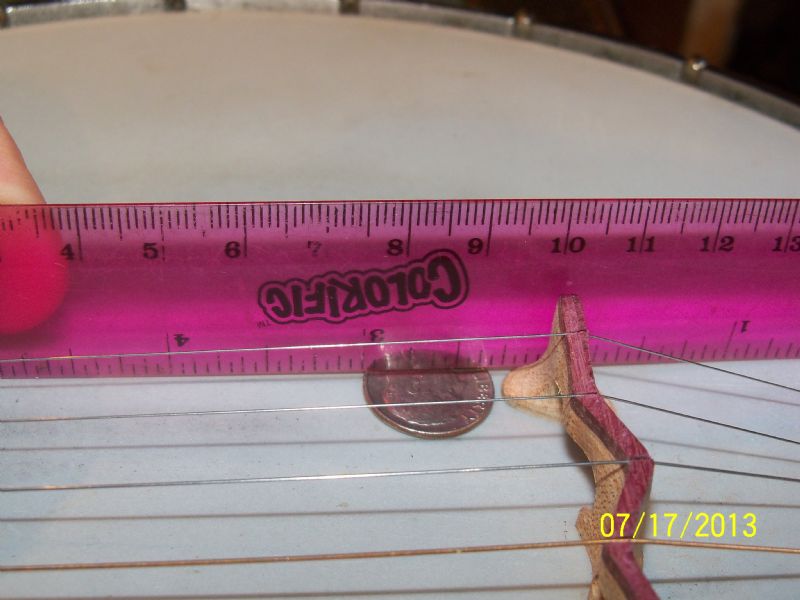
You don't need to get a drum dial to achieve performance level head tension.
A dime and a 6" ruler (2" mark at the bridge) will give an 11" head a tension of G#.
Even tension is achieved by starting with the hoop showing and maintaining the same amount of "reveal" above the head as you progress with the tightening or loosening.
Tighten (for instance) by starting with a nut closest to the neck heel and progressing in order around the pot,turning each nut the same amount such as 1/4 turn of the wrench.
When you get to the last hook on the other side of the heel you have lowered the hoop evenly by the 1/4 turn of each nut.
This "once around the nuts" is repeated until the dime has a touch of "drag" under the edge of the ruler.
As you get close to dime contact with ruler you may want to reduce the "once around" to 1/8th turn,each.
A too tight head would get loosened the same way,but in reverse.
Goal is both ends of the ruler and contact with the dime all happening at once.
Edited by - steve davis on 07/22/2025 09:26:00
KCJones - Posted - 07/22/2025: 10:04:40
One thing to note on swapping heads. To my knowledge, Remo is the only manufacturer of banjo heads in the world at this point. So you won't find much difference in replacing like-for-like banjo heads. You can swap various models, Renaissance, Fiberskyn, Clear, or 'black suede', will all sound different than standard top frosted. A old/worn head might sound different than a new/fresh one. But for the most part, all the heads within the same model are going to be the same regardless of where you buy it. One exception is specific store orders. AMB sells remo heads with slightly different coating/thickness than you'd typically get elsewhere. I think (but have never measured) that Deering has their own proprietary remo head coating/thickness. Others may as well. But for the most part, a Remo head is a Remo head.
mdp67 - Posted - 07/22/2025: 10:16:00
quote:
Originally posted by Old HickoryHere's another vote for starting with the bridge. Lucky for you, some of the best bridges in the world are made in the EU by Silvio Ferretti in Genoa, Italy. So you can order direct from him. Contact page has his email. He's a member here, of course.
Before changing the head, I'd be sure the current head is at a good tension. If you hear a note when you tap the head, try to tune it to G# or A. If you can't hear a note, search this site for discussion of the Steve Davis coin and stick method of measuring head deflection. There has been some discussion of which non-US coins work.
If you're going to be a serious banjo tinkerer, you might consider buying a DrumDial. This device gives you specific index number of your head's tightness. The mechanical version is not very expensive. Here in the States, they're available used for less than the price of new.
Drilling hols in your rim to add new shoes for more hooks strikes me as overkill and an investment in parts you can't take take to another banjo.
I have replaced the guitar-style tuners on one banjo with inexpensive Asian-made planetary tuners from eBay. I had to ream out the peg holes for the new tuners to fit. Took a few minutes per hole. Because a reamer is tapered, I had to go at it from both sides. The peghead is a bit thicker than typical so only a short amount of the tuner post clears the peghead face. It's enough to function, but it looks a little odd.
Good luck with whatever you do.
Thanks for the lead on bridges.
CaseyJones - Posted - 07/22/2025: 10:54:18
I started my banjo journey about a year and a half ago, and began tinkering right away too. Arthur Hatfield’s banjo assembly and set up DVD really helped me out a lot and gave me the courage to start tearing banjos apart and putting them back together the correct way. I highly recommend it as a good start on your banjo tinkering journey. I also highly recommend Arthur as a luthier when it comes time to upgrade your banjo.
He sells the DVDs on his website:
hatfieldbanjos.com/multimedia.asp
Happy pickin’ and happy tinkering!
martyjoe - Posted - 07/22/2025: 10:55:44
The J hooks on your banjo aren’t very good quality. If you are going to increase the head tension it’s a good idea to have more of them. I bought an extra 2 sets of them from eBay, drilled holes in between each J hook and put in the new ones. I made sure the threads on all the J hooks were well lubricated and carefully/gradually tightened them up to where the banjo sounds good to you going around one quarter of a turn on each hook. I agree 100% that it’s good to try some quality bridges but this is something that I’d do after setting tension because increasing tension raises the height of the bridge and I know from experience that if you want to have any hope of getting decent tone you’re going to have to make the head really tight. Another thing is make sure to measure the head if you’re going to try a new head! Most of those Asian banjos have pots slightly bigger than 11” so it could become a special order for the renaissance. I think the tuners on your banjo are pretty good as they are, I would only change them if I had a problem with the old ones.
pinenut - Posted - 07/22/2025: 11:26:15
quote:
Originally posted by martyjoeProbably the first thing I would do is double up on the J hooks on the banjo. I’ve done this with a similar Chinese cheapie be sure to have plenty of spare J hooks and put plenty of lubricant (WD40) on them. Invest in a drum dial and get plenty of tension back into the head evenly all the way round. I think swapping out tuners & arm rest would be a waste of money. I have put a brass hoop tone-ring of my own design into a couple of these that has made a significant improvement to the tone but it is very complicated and hard to describe. The ring kind of suspends in the centre of the head and actually compromises of two brass rings.
It has 24 hooks; that should be plenty. harleybenton.com/product/hbj-25/
Those hooks are definitely the so-so variety. A notched hoop might fit the existing spacing with new round hooks but... Components are a rabbit hole that will exceed the potential of this banjo; a used banjo upgrade will give a better return.
Lubricate the hooks with paste wax or an equivalent dry/semi-dry lube. Lubricants always move around and the aromatic lubricants are hard on finishes (even poly).
A drum dial is a solid investment. Get one sooner.
Edited by - pinenut on 07/22/2025 11:28:04
mdp67 - Posted - 07/22/2025: 11:33:54
@pinenut Do you think new hooks without a new rim would improve things?
I really do like my crappy banjo and play it a lot. There's a lot to learn and I'm in for the long-haul.
Owen - Posted - 07/22/2025: 12:00:12
Couple "... help me understand how the banjo is constructed and improve the aesthetics (for me) and maybe the sound." from the OP with, "I really do like my crappy banjo... " and I'm wondering if there's any room for "leave well enough alone."
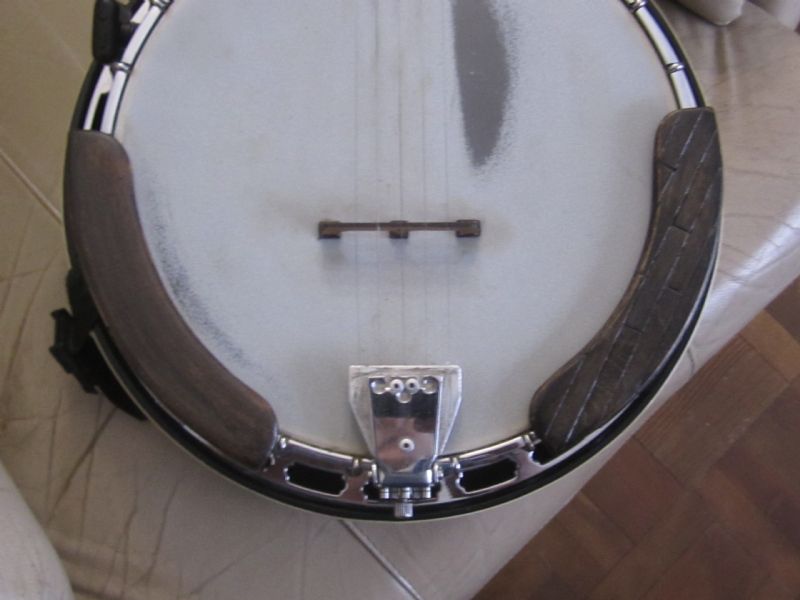
I guess the biggest upgrades I did to my modestly priced banjos was to "improve the aesthetics (for me)" by making some wooden covers for the UG-LEE original armrests. [Fwiw, only one in the pic is mounted; t'other one just sitting there for illustration.... though I do see that I also riveted an aluminum do-hickey under the tailpiece, 'cause the other banjo has a "straight-line" and that seemed to make sense, to me.]
martyjoe - Posted - 07/22/2025: 12:14:39
quote:
Originally posted by pinenutquote:
Originally posted by martyjoeProbably the first thing I would do is double up on the J hooks on the banjo. I’ve done this with a similar Chinese cheapie be sure to have plenty of spare J hooks and put plenty of lubricant (WD40) on them. Invest in a drum dial and get plenty of tension back into the head evenly all the way round. I think swapping out tuners & arm rest would be a waste of money. I have put a brass hoop tone-ring of my own design into a couple of these that has made a significant improvement to the tone but it is very complicated and hard to describe. The ring kind of suspends in the centre of the head and actually compromises of two brass rings.
It has 24 hooks; that should be plenty. harleybenton.com/product/hbj-25/
Those hooks are definitely the so-so variety. A notched hoop might fit the existing spacing with new round hooks but... Components are a rabbit hole that will exceed the potential of this banjo; a used banjo upgrade will give a better return.
Lubricate the hooks with paste wax or an equivalent dry/semi-dry lube. Lubricants always move around and the aromatic lubricants are hard on finishes (even poly).
A drum dial is a solid investment. Get one sooner.
I'm not looking for any argument. I'm just giving my opinion based on the fact that I imported banjos of this quality in from China and found that to get the tension required to suit my taste I needed to add More J hooks. The 24 that came with the original banjos were insufficient for me to pass on a quality product. The few mods I put on those banjos made a huge improvement to their sound. Now I just make them.
pinenut - Posted - 07/22/2025: 12:22:40
quote:
Originally posted by mdp67@pinenut Do you think new hooks without a new rim would improve things?
I really do like my crappy banjo and play it a lot. There's a lot to learn and I'm in for the long-haul.
Hooks and hoops are mostly aesthetic changes. The HBJ-25 banjo has 24 hooks in the advertisement; that's plenty to do the job, even if they are of a lesser variety. Replace, with better if they give any problems or because it suits you. (note: if the tension hoop is of the rounded top variety; other hooks struggle or won't grip properly)
I like compensated bridges with steel strings. The compensated bridges like the Grover Tune-Kraft and the better heavy Moon bridges serve me well. Most banjos use 5/8", always measure the existing bridge and decide on string action height when selecting a different bridge. Too tall can be sanded down and/or dished, too short is always too short.
I strongly prefer a brass tailpiece to what the HBJ-25 appears to have. The Golden Gate P-118 Presto is my favorite bang for the buck.
The DrumDial is a good investment that I have not grown out of (mine was ebay/used; it's fine).
My current favorite banjo is crappy, modded, imported, and old. Just play and enjoy the journey.
When BAS strikes, get something that speaks to you personally when you play it.
Edited by - pinenut on 07/22/2025 12:39:50
Eric A - Posted - 07/22/2025: 12:43:04
quote:
Originally posted by CaseyJonesI started my banjo journey about a year and a half ago, and began tinkering right away too. Arthur Hatfield’s banjo assembly and set up DVD really helped me out a lot and gave me the courage to start tearing banjos apart and putting them back together the correct way. I highly recommend it as a good start on your banjo tinkering journey. I also highly recommend Arthur as a luthier when it comes time to upgrade your banjo.
He sells the DVDs on his website:
hatfieldbanjos.com/multimedia.asp
Happy pickin’ and happy tinkering!
Is Arthur still in business? I don't want to repeat the whole saga here, but he's had an incredible string of bad luck these past couple years. I had assumed he was pretty much done.
mdp67 - Posted - 07/22/2025: 12:47:00
@martyjoe
Thanks for your input. I appreciate everyone's perspective. It's all so informative and I'm taking it all in.
My banjo mind is expanding!
CaseyJones - Posted - 07/22/2025: 12:49:24
quote:
Originally posted by Eric Aquote:
Originally posted by CaseyJonesI started my banjo journey about a year and a half ago, and began tinkering right away too. Arthur Hatfield’s banjo assembly and set up DVD really helped me out a lot and gave me the courage to start tearing banjos apart and putting them back together the correct way. I highly recommend it as a good start on your banjo tinkering journey. I also highly recommend Arthur as a luthier when it comes time to upgrade your banjo.
He sells the DVDs on his website:
hatfieldbanjos.com/multimedia.asp
Happy pickin’ and happy tinkering!Is Arthur still in business? I don't want to repeat the whole saga here, but he's had an incredible string of bad luck these past couple years. I had assumed he was pretty much done.
Last I heard, he rebuilt his shop. I saw pictures and it looks good..... but now I am editing this because I just heard he is dealing with some serious health issues right now.
So maybe that is not an option.
Edited by - CaseyJones on 07/22/2025 12:58:55
Old Hickory - Posted - 07/22/2025: 13:38:43
quote:
Originally posted by steve davisYou don't need to get a drum dial to achieve performance level head tension.
A dime and a 6" ruler (2" mark at the bridge) will give an 11" head a tension of G#.
She's in Fance. U.S. dimes and 6-inch rules are probably not common. Hence my comment on previous mention of EU coins.
Do you happen to know which euro coins are the most appropriate to work with?
It appears that 15 cm rulers are a thing, so that's a start. I think the 15 cm rule should be placed with the 5 cm mark at the bridge. But what coin to test with, I don't know.
Old Hickory - Posted - 07/22/2025: 13:40:48
quote:
Originally posted by martyjoeProbably the first thing I would do is double up on the J hooks on the banjo. I’ve done this with a similar Chinese cheapie be sure to have plenty of spare J hooks
Just to be clear:
Are you suggesting to add extra hooks (there are already 24), or simply to buy extra hooks to have as spares ready-to-go because the originals are prone to failure?
steve davis - Posted - 07/22/2025: 15:53:04
quote:
Originally posted by Old Hickoryquote:
Originally posted by steve davisYou don't need to get a drum dial to achieve performance level head tension.
A dime and a 6" ruler (2" mark at the bridge) will give an 11" head a tension of G#.She's in Fance. U.S. dimes and 6-inch rules are probably not common. Hence my comment on previous mention of EU coins.
Do you happen to know which euro coins are the most appropriate to work with?
It appears that 15 cm rulers are a thing, so that's a start. I think the 15 cm rule should be placed with the 5 cm mark at the bridge. But what coin to test with, I don't know.
A dime measures .052 inches thick. This equals 1.35 mm at 17.8 diameter.
6 inch ruler length is 152 mm.
I would think it to be fairly easy to find a dime and 6" length of anything straight around the world,but I don't know for sure.
Old Hickory - Posted - 07/22/2025: 18:44:16
quote:
Originally posted by steve davis
A dime measures .052 inches thick. This equals 1.35 mm at 17.8 diameter.6 inch ruler length is 152 mm.
I would think it to be fairly easy to find a dime and 6" length of anything straight around the world,but I don't know for sure.
Thanks. Now we're getting somewhere.
As I said above, 15cm rules are common in Europe, so Melissa is in luck. Probably available where school or art supplies are sold. Probably at a "NORMAL" store -- my favorite cheap but good stuff store from my European vacation last year.No euro coins are as thin as a US dime. BUT, an acoustic guitar sixth string from a set of D'Addario phosphor bronze lights, is .053. Close enough for human ears. You can buy a single Ernie Ball .052 electric guitar string.
So with the 5 cm mark on the 15cm rule lined up with the outside of the bridge at the first string end, try to slip a section of .052 guitar string between the ruler and the head. When it just passes, that's G#. While that's a widely accepted consensus, I like an A note. So I go a little tighter.
Good luck.
pfalzgrass - Posted - 07/22/2025: 23:08:10
quote:
Originally posted by mdp67quote:
Originally posted by Dean TDefinitely go to that jam! Banjo players are tinkerers, and tinkerers love to help other tinkerers, and usually have lots of stuff left over from all their tinkering
I will definitely go to the jam. Next week is the La Roche Bluegrass festival–I hope to meet heaps of fellow banjoists there and learn new tunes.
La Roche festival always has the banjo setup area, where luthiers help with common issues for free.
steen - Posted - 07/23/2025: 02:26:47
The tuners can wait. Guitartuners are often superior to banjotuners (if they work). Steen
steve davis - Posted - 07/23/2025: 05:36:01
Learning to hear the note the head is producing foregoes all the tools.
KCJones - Posted - 07/23/2025: 06:37:17
quote:
Originally posted by steenThe tuners can wait. Guitartuners are often superior to banjotuners (if they work). Steen
Good point. Generally speaking a low-quality guitar tuner will be better than a low-quality planetary tuner. You basically have to buy top-quality planetaries for them to be useful, and those would cost more than the entire value of the banjo. (Explanation to OP: Guitar tuners are 14:1 ratio, planetary "banjo tuners" are 4:1, so guitar tuners generally hold a tuning much better)
In reality, most of us should be swapping our planetaries for guitar tuners on our banjos, even the top quality ones, and it'd be a better setup. But heaven forbid we upset traditional aesthetics.
banjopaolo - Posted - 07/23/2025: 06:55:02
quote:
Originally posted by Old HickoryHere's another vote for starting with the bridge. Lucky for you, some of the best bridges in the world are made in the EU by Silvio Ferretti in Genoa, Italy. So you can order direct from him. Contact page has his email. He's a member here, of course.
Before changing the head, I'd be sure the current head is at a good tension. If you hear a note when you tap the head, try to tune it to G# or A. If you can't hear a note, search this site for discussion of the Steve Davis coin and stick method of measuring head deflection. There has been some discussion of which non-US coins work.
If you're going to be a serious banjo tinkerer, you might consider buying a DrumDial. This device gives you specific index number of your head's tightness. The mechanical version is not very expensive. Here in the States, they're available used for less than the price of new.
Drilling hols in your rim to add new shoes for more hooks strikes me as overkill and an investment in parts you can't take take to another banjo.
I have replaced the guitar-style tuners on one banjo with inexpensive Asian-made planetary tuners from eBay. I had to ream out the peg holes for the new tuners to fit. Took a few minutes per hole. Because a reamer is tapered, I had to go at it from both sides. The peghead is a bit thicker than typical so only a short amount of the tuner post clears the peghead face. It's enough to function, but it looks a little odd.
Good luck with whatever you do.
Yes Silvio's Scorpion Bridge are a great improvement for every kind of banjo, Silvio is a supernice guy, a master crafter and also a great friend for me, I'm happy owner of two scorpion banjos (one tenor and one five string both open back) and all my other banjo are equipped with scorpion bridge and personally set up by Silvio :-)
Here's a Scorpion bridge in action on a Scorpion banjo
Old Hickory - Posted - 07/23/2025: 09:05:35
quote:
Originally posted by mdp67If you were to make a modification, what would the first thing be? Like low risk-high reward? :)
Repeating myself in part of this . . .
Head tension first. Near-zero risk, no cost, high reward. Only risk is breaking the head. That's rare and unlikely. Also rarely risk your hooks are cheap anc could fail.
DrumDial I mentioned earlier may not be a low-cost option. I looked at European eBay and new or used they nearly all ship from the U.S. at high cost. So learn to adjust the head by ear and maybe the method of passing something under a short stick aligned with the bridge.
Bridge. Zero risk, moderate cost, high reward. Every bridge from an independent maker is likely to sound better than the generic bridge you already have. This means no eBay bridges. Use Silvio's information on Scorpion bridges as a starter then maybe see what else is available in Europe. Or stop right there. I highly recommend Silvio's Scorpion bridges.
It's been mentioned already that bridge weight is a major contributor to sound. Since you asked about a Renaissance head, I take that to mean you want a warmer sound. So I think you'll want a bridge weighing 2.2 g or maybe more. I hope others will chime in. All the bridge makers can hit exact weights. And they usually write the weight on one of the feet.
Be sure to get the right height. Probably 5/8 inches.
Tailpiece. Zero risk, potentially low cost, moderate to high reward (crap shoot in my experience). Your beginner's banjo has one of the most basic designs and lowest cost components for banjos. Tailpieces don't get any simpler. But I think some high quality banjos used to use this type of tailpiece many many years ago.
I also think that not all tailpieces work with the thin tension hoop. Some heavier tailpieces I might suggest like a Waverly style or clamshell have a bracket base that helps them sit on a thick notched tension hoop. That might not work on your banjo. Not sure. Maybe the best replacement would be a "floating" tailpiece: one that doesn't have any mechanism for sitting on or grabbing the hoop. It's just held in place by its anchor bolt pulling down on the tailpiece to resist the forward pull of the strings.
Maybe try an inexpensive Presto style tailpiece. This one probably doesn't come with an anchor bolt and nut. I assume your current tailpiece mounts with a bolt, so you can reuse that.
Heavier tailpieces can contribute to better sound and great stability. And this type with no parts to rattle might be worth trying. This is the Asian copy of the formerly patented Price Straightline tailpiece. The front end is wider so the strings approach the bridge in a straight line. I have one on one banjo and can't hear what difference it makes.
I like the so-called Kershner style tailpiece. It mounts and works like the one above, but the front end is not wide, so the strings flare out approaching the bridge.
Here's a Waverly style (misidentified as clamshell) so you can judge for yourself if it mounts the same as your current tailpiece. These add a bit of weight and mass, while not having parts to rattle. Most of the pictures show a Waverly. One photo of a guy's banjo shows a clamshell.
Head. Zero risk, moderate cost, possible high reward. Or maybe you'll hear no difference. I'm not familiar with the sound of a Renaissance head. I assume it will sound different than what you have now. Specs at the Harley Benton website say your banjo has a low crown head (there's an "L" in the part number). So be sure to get that. Medium crown might work. But high crown probably won't.
Edited to add: All the tailpieces are also available from Amazon in Europe should you prefer that to eBay, but lately my messages with Amazon links have failed to post. Also, you can use my eBay links as references and find the same things elsewhere.
Edited by - Old Hickory on 07/23/2025 09:09:00
steve davis - Posted - 07/23/2025: 09:15:01
I wouldn't worry about getting fine quality planetary tuners.
They will work perfectly and when you upgrade your banjo just put the good tuners on it and sell the cheapo banjo with the cheapo tuners it came with.
I use Keith twisters on 2 and 3 and Keith standard (non-twisters) on 1 and 4.
Precision quality removes all tuner issues because we banjo players have more important things to think about.
My other banjos have StewMac tuners.They also work great.
pinenut - Posted - 07/23/2025: 10:39:42
Inexpensive parts are much harder to come by in France; it probably makes the extra cost from Prucha reasonable (they are the finest).
This one says it is brass (not steel). Iff it's brass, it would be a noticeable improvement. I have not used the Waverly type; I prefer a brass Presto on lighter weight steel string banjos...
amazon.fr/-/en/Golden-Gate-GR1064
davidppp - Posted - 07/23/2025: 11:21:19
Yo, tinkerer: you can make tailpieces yourself out of wood or brass.
mdp67 - Posted - 07/23/2025: 12:25:36
quote:
Originally posted by Old Hickoryquote:
Originally posted by mdp67If you were to make a modification, what would the first thing be? Like low risk-high reward? :)
Repeating myself in part of this . . .
Head tension first. Near-zero risk, no cost, high reward. Only risk is breaking the head. That's rare and unlikely. Also rarely risk your hooks are cheap anc could fail.
DrumDial I mentioned earlier may not be a low-cost option. I looked at European eBay and new or used they nearly all ship from the U.S. at high cost. So learn to adjust the head by ear and maybe the method of passing something under a short stick aligned with the bridge.
Bridge. Zero risk, moderate cost, high reward. Every bridge from an independent maker is likely to sound better than the generic bridge you already have. This means no eBay bridges. Use Silvio's information on Scorpion bridges as a starter then maybe see what else is available in Europe. Or stop right there. I highly recommend Silvio's Scorpion bridges.
It's been mentioned already that bridge weight is a major contributor to sound. Since you asked about a Renaissance head, I take that to mean you want a warmer sound. So I think you'll want a bridge weighing 2.2 g or maybe more. I hope others will chime in. All the bridge makers can hit exact weights. And they usually write the weight on one of the feet.
Be sure to get the right height. Probably 5/8 inches.
Tailpiece. Zero risk, potentially low cost, moderate to high reward (crap shoot in my experience). Your beginner's banjo has one of the most basic designs and lowest cost components for banjos. Tailpieces don't get any simpler. But I think some high quality banjos used to use this type of tailpiece many many years ago.
I also think that not all tailpieces work with the thin tension hoop. Some heavier tailpieces I might suggest like a Waverly style or clamshell have a bracket base that helps them sit on a thick notched tension hoop. That might not work on your banjo. Not sure. Maybe the best replacement would be a "floating" tailpiece: one that doesn't have any mechanism for sitting on or grabbing the hoop. It's just held in place by its anchor bolt pulling down on the tailpiece to resist the forward pull of the strings.
Maybe try an inexpensive Presto style tailpiece. This one probably doesn't come with an anchor bolt and nut. I assume your current tailpiece mounts with a bolt, so you can reuse that.Heavier tailpieces can contribute to better sound and great stability. And this type with no parts to rattle might be worth trying. This is the Asian copy of the formerly patented Price Straightline tailpiece. The front end is wider so the strings approach the bridge in a straight line. I have one on one banjo and can't hear what difference it makes.
I like the so-called Kershner style tailpiece. It mounts and works like the one above, but the front end is not wide, so the strings flare out approaching the bridge.
Here's a Waverly style (misidentified as clamshell) so you can judge for yourself if it mounts the same as your current tailpiece. These add a bit of weight and mass, while not having parts to rattle. Most of the pictures show a Waverly. One photo of a guy's banjo shows a clamshell.
Head. Zero risk, moderate cost, possible high reward. Or maybe you'll hear no difference. I'm not familiar with the sound of a Renaissance head. I assume it will sound different than what you have now. Specs at the Harley Benton website say your banjo has a low crown head (there's an "L" in the part number). So be sure to get that. Medium crown might work. But high crown probably won't.
Edited to add: All the tailpieces are also available from Amazon in Europe should you prefer that to eBay, but lately my messages with Amazon links have failed to post. Also, you can use my eBay links as references and find the same things elsewhere.
Hey Ken, Thanks for the thorough explanation and information on where to find some of the pieces.
A few days ago I wrote to Thomann, they said that a Remo 11" Renaissance Medium Collar would be the right fit for my model.
Page: 1 2
Terms of Use | Privacy Policy | Privacy Consent (EU/GDPR Only)
Copyright 2026 Banjo Hangout. All Rights Reserved.


