DVD-quality lessons (including tabs/sheet music) available for immediate viewing on any device.
Take your playing to the next level with the help of a local or online banjo teacher.
Weekly newsletter includes free lessons, favorite member content, banjo news and more.
Premier Sponsors


|
Please note this is an archived topic, so it is locked and unable to be replied to. You may, however, start a new topic and refer to this topic with a link: http://www.banjohangout.org/archive/404009
Saltlick Mountain - Posted - 07/05/2025: 13:28:46
Hello fellow banjo players, So I've been playing clawhammer banjo for about a year and a half now. I know this is a topic that has already been covered, but I thought I would reach out anyway and give some specifics, in hopes of maybe getting some help. I've asked several players how to fix the tension in my right hand, and all have given good advice, however, the problem is still there. My right claw hand is tense and it causes me pain after I play anything with very much speed. With the advice of other banjo players, I have already switched my right hand to hit the index nail at the 10 to 11 clock position, and I've changed my right hand to the knocking motion. These two adjustments have helped. I've also switched my strings to 10 11 12 20 10, so as to be able to play with lighter gauge strings. This has maybe helped a little too. I also have tried drills and playing songs very slowly, in which I can play with no tension, but as soon as I gradually get up to any speed at all, my right hand tenses up again, no matter how long I play slowly beforehand. I am hoping maybe somebody on here has went through this and can give me very detailed explanations of exactly how to fix this problem. I also realize this may just take time and a balance between having enough tension to get a good strike vs. no more tension than that. I love playing the banjo, but feel that I cannot continue learning new tunes with this problem hanging over me, holding me back. There has got to be something that I am missing, that type of thing that eventually clicks in your brain, and then you 'get' it. Maybe someone on here knows what that is. Thanks so much in advance!
banjered - Posted - 07/05/2025: 14:23:21
Well as a good start you are aware of the problem. Pain has a way of getting one's attention. You are on the right track and some of these CH things take time. Too much sugar in the diet can cause muscle lactic acid fatigue. Get enough magnesium. Hand/arm stretches are good along with keeping healthy in general. Grant some patience to yourself, that time thing again. Best! banjered
Silver_Falls - Posted - 07/05/2025: 20:09:34
Have you tried playing with your middle finger rather than your index?
I play with middle finger and leave my index finger fairly relaxed. That is, my index finger isn't curled into the claw, nor is it pointed straight either. It just sort of floats, sometimes gets used for brushing.
Point being, less of my hand gets locked into the claw position, with less overall hand tension.
Also, middle finger seems to lock more firmly and naturally into the claw, with less effort, and gives a stronger and more controlled attack.
The middle versus index finger topic is one that can be debated endlessly here. Can't hurt to give it a try though.
Bill Rogers - Posted - 07/05/2025: 21:28:12
I play the inside strings with my index; the first string with my middle. My hand is loosely in a claw, but it flexes. Otherwise it would cramp after a while. Walt Koken is one of the great players. Note how relaxed his right hand is. It’s always flexing, but works out of a claw position. That's what to work toward.
m.youtube.com/watch?v=-PRE9CkX...vIGJhbmpv
Edited by - Bill Rogers on 07/05/2025 21:33:08
banjered - Posted - 07/06/2025: 06:47:27
Good pic, Bill. It really illustrates your point. Way back when I was trying to learn CH by books only (I had no other resource!) I recall some of the books instructing the importance of having a "rigid" claw right hand. Some talked about "not flicking the fingers, keep them rigid." Yet you see in Walt's demo how he "violates" these rules and yet somehow manages to play masterfully! I think the trick is that over time you learn how to have rigid fingers/thumb only when you are actually striking the strings but otherwise the hand etc. is relaxed and very fluid. Ultimately we are all wired differently, nerve wise, muscle wise, bone wise, and general attitude wise. Some go more wrist, others flailing arm, some appear to barely move their hand yet all the wonderful music pours out. It really is different strokes for different folks. I think in the beginning your hand is naturally tense as you are trying to learn and "do it right" but as time goes by you become more relaxed about the whole process of playing and so do your hands, no "death grip" with the left hand either. By the time you can play a hundred songs/tunes your right hand will have sorted itself out, especially since you are already focused on it. "Flail onward!" banjered
SatCotM - Posted - 07/06/2025: 07:44:15
It's worth considering how you're thinking/feeling about it beforehand and while you're playing. If you're anxious about being tense and causing yourself pain, this is going to make you tense -and- increase the perception of discomfort after the fact. Make a conscious effort to be calm and pragmatic. Acknowledge that you will develop more relaxed posture with time. Trust the process; trust yourself. Don't anticipate failure.
Owen - Posted - 07/06/2025: 08:04:08
I'm no expert, but my take is that it's the players noggin accounts for probably 99% of the tension, with the strings. positioning, motion, etc., etc. accounting for the remaining 1%. I acknowledge that reps [in the specific situation] isn't particularly fruitful advice, but I've got nothing more to offer.... though I might get around to investigating the supplement "L-theanine" which was mentioned in another thread.
Saltlick Mountain - Posted - 07/06/2025: 17:12:43
quote:
Originally posted by banjeredGood pic, Bill. It really illustrates your point. Way back when I was trying to learn CH by books only (I had no other resource!) I recall some of the books instructing the importance of having a "rigid" claw right hand. Some talked about "not flicking the fingers, keep them rigid." Yet you see in Walt's demo how he "violates" these rules and yet somehow manages to play masterfully! I think the trick is that over time you learn how to have rigid fingers/thumb only when you are actually striking the strings but otherwise the hand etc. is relaxed and very fluid. Ultimately we are all wired differently, nerve wise, muscle wise, bone wise, and general attitude wise. Some go more wrist, others flailing arm, some appear to barely move their hand yet all the wonderful music pours out. It really is different strokes for different folks. I think in the beginning your hand is naturally tense as you are trying to learn and "do it right" but as time goes by you become more relaxed about the whole process of playing and so do your hands, no "death grip" with the left hand either. By the time you can play a hundred songs/tunes your right hand will have sorted itself out, especially since you are already focused on it. "Flail onward!" banjered
So, everyone has given some great advice! Thanks to all!! I watched the YouTube video that Bill posted of Walt Koken, and I see how relaxed his hand is and how he kinda flicks it (which I got excited to maybe try). However, I too had heard that you are to keep your claw rigid and not flick, so in general, is flicking okay, or is flicking not okay? And if I am to keep it rigid only when striking strings, otherwise relaxed and fluid, wouldn't that be almost all the time, since in Old-Time you are playing the melody the biggest part of the song? Sorry if dumb questions. I got excited to watch Walt's video and see that I can flick, but then saw this that maybe I can't. Just hoping to figure this out, as I don't want to relearn a new way if it is not okay. All and any thoughts are greatly appreciated as I sort this out! LOL!
Dan Gellert - Posted - 07/06/2025: 18:16:00
When someone asks me "How hard is it to learn to play?", my stock answer is: "It's way easier than walking or talking." That sounds ridiculous at first, until you think about how much struggle, trial and error, and loads of time you put into internalizing those fundamental and complex skills before they became habitual enough to be truly useful, IOW they just happened without any conscious effort.
You rewired your brain, and that's what you're trying to do now. It's not easy, but that's what a human brain is made for, so be patient and trust in the super-powers of your subconscious. Don't be afraid of mistakes; every one has something to teach you. Remember that the "learning curve" isn't a straight path up a hill with a goal at the top; It's a colossal spreading tree with innumerable branches. You never know where you're going to end up, and can be sure you'll have to back out of lots of blind alleys and wander along a few crooked detours along the way. None of it is wasted effort.
I can rant on for hours on the subject of mechanical efficiency and economy of motion in any kind of music, and rapping the banjo is a particularly multidimensional hobbyhorse of mine. I'm not going to get started on that here, but there are dozens of variables you can tinker with that will expand your understanding and control of what your right hand is doing on the banjo.
pmiller510 - Posted - 07/07/2025: 05:52:35
Here's a link to a Reed Martin master class video that I found helpful as I get back to playing the banjo after spending way too much time trying to learn how to fiddle. Some great basic stuff at the beginning which I think addresses the tension issue you talk about. I have a bit of the same issue using the index finger and found going to the 2nd and 3rd fingers to make a big difference. Anyway, for what it's worth:
youtube.com/watch?v=IqrLzJXpkg0
writerrad - Posted - 07/07/2025: 07:00:34
I am not acquainted with the idea of having the hand "rigid." The hand really needs to be firm in its confidence that it is going to doits job, and its knowledge--apart from what the player's intellect thinks--of what it is to do. Though I have been playing the banjo since 1998, I had been accumulating wrong ideas about banjo playing as a guitarist since around 1963. Good frailers have a rhythmic confidence in them that gets transferred to their hand and arm.
The only response i have is that it takes life-long PRACTICE AND CARE OF THE STROKE, and being conscious of how you are stroking as a separte entity from how to play this or that tune. I relentlessly look around every few months from new instruction videos on how to play the basic strokes, and then I practice them. By practicing them, I dont mean playing a claw hammer tune well. I mean just practice the strokes over and over for an hour each day NOT TRYING TO PLAY A TUNE, just thinking about how I do a bump diddy, a double thumb, and the other strokes one after one. I take my model from whatever of a number of videos that I have downloaded from the Net or remain on DVDs from when i was first learning the banjo.
The thing that got me over the hump about 2001 or 2 was being told to do this by esteemed local banjo master I know whohas taught or help get over their humps some great banjoists around here. This gentleman, knowing I was aspiring to be banjoist, invited me to his house, and watched me play. He told me to do what I have since learned is an approach often repeated when banjos were traditionally played. He told me dont try to play any tunes claw hammer, that I can finger pick quite well being a long timed guitarist.
He gave me a beginning Video tape from Bob Carlin. He told me to watch it, and then practice each stroke for 10 or 15 minutes after it was explained in the video, and to not even try to play the tune taught in it which I think was Shortening bread. I would then practice each strike the bump dididy, the the drop thumb, and the double thumb for a half hour each night and compare myself to the video for 2 weeks of this.
Luckily, or unluckily, this was in the last years of my single life before I found my wonderful wife and the one semester between the fall of 1999 and my retirement in 2010 that I did not have 2 English comp classes to teach at the community college on evenings. I did not try any tunes, and just listened to how the strokes went. I came back to him once and he corrected me a little, and did this another 2 weeks. Every now and then I revert to this.
In my research on banjo history, I have found this approach and practice is not uncommon. Joe Thompson told me that his brother who played the banjo was similarly instructed by their father (there was a family band involving Joe's father and brother and his Uncle and his son Odell). The young banjoist was not allowed to tune the banjo for this exercise but to untune it so it had little tension. He was to practice the strokes for pure rhythm without playing a tune until it met the Father's satisfaction.
The problem we all have, especially starting out, is we want to get to playing tunes and songs. We dont want to focus enough on the basic technique. Clawhammer or frailing comes from a completely different approach to playing an instrument than finger picking or flat picking which I had been doing on the guitar for about 35 years before I got a banjo. We have to be patient enough to practice the basic strokes for themselves.
Of course, it is important to have a teacher or mentor or pal who will advise you or look at what you are doing. A person can waste mnuch time working on the banjo if you dont have another banjoist who can tell you when you are not doing the right thing, or worse intensely practicing the wrong thing.
But stroking the banjo needs to be practiced in and of itself. The more you do that, the better you will get. The calmer you will get. Practice it enough so it becomes automatic, relieve the tension.
One thing that can help if you know a lot of banjo players. This is something a scoutmaster taught me and a bunch of other scouts when I was about 14 back in 1961 or 2. Think of someone you know of plays the banjo who is otherwise a jerk or a fool. Give yourself the confidence that you are neither a jerk or a fool, so you should be able to figure it out too.
Please let us know once you work this problem out what solution worked for you. I have been coming here now for about 15 years where people raise a problem like you raise. However, the person never checks in and says what helped what did not. The banjo world needs to know what works here. Perhaps, the banjo world may need to know that every word I have typed in this post was stupid.
Let us know what you happens to you after all of our typing!
Thanks for being a banjo player. The world needs more banjo players!
Edited by - writerrad on 07/07/2025 07:13:06
lawnboss - Posted - 07/08/2025: 04:58:38
When I started out, I added a clawhammer pick to my index finger to get the volume I thought I needed without having to “play harder”. At some point, I wanted the more neutral sound of my natural nail and dropped the pick… a couple months of pain (presumably from tension) ensued until I built up endurance and also accepted a bit less volume. All was well until I started playing with a jam group and realized that my base state volume would not carry in the larger session. I found myself playing much harder and again producing some pain and fatigue (presumably from tension). Again, it was a matter of building up endurance. Indeed, if I go away for a while and come back to the jam, I find I have lost some of the endurance and have to build it back up again. I think the tension and pain result from a sense of wanting more volume than your technique is prepared to deliver?
writerrad - Posted - 07/08/2025: 07:05:54
A lot of issues of banjo volume can be a result of the setup of the banjo regardless of what your hands are doing especially with clawhammer. Have a banjoist who knows about such things take a look at your setup. Consider head tension, choice of strings and other factors. Especially with clawhammer hitting the banjo harder is not necessarily going to produce more volume.
Strings loose their zip in with time, and strings can lose their zip faster if you play them with stuff on your hands. When I first got a banjo I worked in a place where buses were repaired and I was picking up and moving around a lot oily stuff from buses. I was so excited to get home to my first Good Time that I sometimes didnt wash my hands before I got out my banjo. Being taught to wash my hands before I played has extended the life of the banjo. Likewise, learn to periodically clean the banjo head. If grime and gunk from your hands accumulated on the banjo head, it wont vibrate as much and will not produce sound as well.
Problems of volume may also come from not having sufficient head tension. You would be surprised how many banjoists know nothing about maintaining head tension. I have been handed banjos with the brackets so loose that they were falling off by otherwise knowledgeable people, once by a head librarian at a state University library for me to perform at a concert and memorial meeting after Dena Epstien died. Do you keep your head tight? Do you even know what I am discussing? I did not know much about that until years after I started playing a banjo.
Finally, some banjos are not as loud as others. LOL for years when I first started out, I wanted to make my Enoch Tradesman which has no tone ring sound louder more like the banjos I now know have tone rings. Now I know if I wanted a tone ring sound I needed a tone ring banjos and I get it out of my tubaphones and my banjo with a whyte lady tone ring. On the other hand, the Enoch sounds louder now with lighter strings than I was using back then and with a hide head.
I dont know your age but if you re a senior like I am, it is not uncommon for folks I play with in both bluegrass and old time jams and get togethers here in the Palm Beach area often called the Lord's Waiting room to have hearing loss and not recognize it. You ca both think you are not playing loud enough and play too loud if you have hearing loss and do not know that. I faced that myself, and finally broke down to get a hearing aid when an ace musician I was sitting next to at our bluegrass jam playing guitar told me I wasn't hearing the fiddle and the mandolin solos right and needed to get my ears checked. That was a godsend.
There is nice and generous advice here. On the other hand, my whole experience as a banjoist has continued to astound me with how helpful and generous other banjoists in my area can be, especially when I was starting out and had all the band stupid idiot wrong ideas about banjo playing that about 40 years of playing the guitar behind banjoists had given me. Try to find more experience banjoists in your area who can give you advice. Twenty five years later I still cannot believe how generous and kind and patient local banjoists here in South Florida were to me when I first tried to learn the banjo and had every idiot idea guitarists have about the banjo. Reach out and find someone. Like as not they have gone through the same problems you face and found a solution.
Finally, like everyone who comes here with a problem like this: PLEASE COME BACK TO THE HANGOUT AND POST HERE EXPLAINING WHAT YOU DID THAT SOLVED YOUR PROBLEM WHEN YOU SOLVE IT. People never do that. Folks need to know that after putting in time responding.
GET TO KNOW OTHER BANJOISTS IN YOUR AREA. Like as not they have had every problem you have and learned a solution! BANJOISTS ARE FRIENDLY PEOPLE, even old grumps like me lighten up when someone else is joining the tribe of Banjo!
Edited by - writerrad on 07/08/2025 07:16:00
Owen - Posted - 07/08/2025: 08:23:02
Tony: "....POST HERE EXPLAINING WHAT YOU DID THAT SOLVED YOUR PROBLEM WHEN YOU SOLVE IT. People never do that. Folks need to know that after putting in time responding."
Give that man a see-gar!

I notice a few people do, but for the most part you hit the nail on the head. I suspect it reflects what m-a-n-y see as who the important participants in the exchanges actually are. 
Edited by - Owen on 07/08/2025 08:23:47
LyleK - Posted - 07/12/2025: 05:15:41
Yes, lots of good advice here, and I especially agree with Tony's comment about letting us know what worked for you. But in the meantime, it would be very useful if you could post a video showing what your right hand/forearm are doing. I played a three hour dance last night and I kept looking down at my right hand/forearm thinking "what am I doing?" and "could I do this with a 'rigid' hand?" (no). And more specifically, "what would 'Saltlick Mountain's' " right hand/forearm look like?"
P.S. - A three hour dance is not three hours of playing because of all of the walkthroughs for the dancers. But it is all fast (at least 120 bpm) though without the problem of volume because of mics.
slc - Posted - 07/17/2025: 17:08:30
It sounds like you're doing it right - claw shape, move fingers as needed etc. I think the "flicking" thing is more about how it appears than about reality. I've sometimes looked at my hand (esp when playing quickly or with abandon) and thought "interesting - it looks like I'm using my fingers far more than it feels". Maybe rather than "flicking" it could be described as letting the fingers reach for or expand towards for the strings, by letting the hand open more. A practical result is this adds a little extra momentum for the strike. Think gently flicking the clawed hand - not just the fingers - toward the string to shake off drops of water.
I'm solidly in the relaxed (vs rigid) camp. It's like using a hammer or throwing a ball - the whole arm is engaged starting (subtly) at the shoulder through the elbow to the hand to the fingers. The hand rotates slightly at the wrist and forearm as you strike, just like it would if you were hammering a nail. That could be something to think about: maybe the tension is starting further upstream from the hand, perhaps pressing the forearm hard on the rim or tightening the shoulder.
One detail I've more recently noticed: when holding the 'claw' at that 45-degree angle, then relaxed, it will DROOP slightly, so there's more of a straight line or even downward curve going from from the forearm to the hand. It's subtle, but perhaps if one tried to keep the hand "straight" that could introduce uneccessary tension. I think one naturally does this over time, but might be useful think about.
Finally, a couple things NOT to worry about. It's fine to let the fingers and/or thumb whack into the head - no need to pull back. And if one is resisting being too loud (What? A banjo?? Loud???), shove a sock or pillow or sleeping bag into the back - let that mute the volume instead of holding back with your playing.
writerrad - Posted - 07/17/2025: 17:25:10
quote:
I do similarly. I was first taught to use the index, then I came under the influence of someone who believed it was more old timey to use the middle. Now, I try to lead and brush with the index, but can get in a note with the middle. Thanks for bringing attention to Walt K who seems to be forgotten nowadays. The amount of work and dedication he has put into both his banjo and fiddling is an inspiration.
Saltlick Mountain - Posted - 07/17/2025: 20:03:11
quote:
Originally posted by LyleKYes, lots of good advice here, and I especially agree with Tony's comment about letting us know what worked for you. But in the meantime, it would be very useful if you could post a video showing what your right hand/forearm are doing. I played a three hour dance last night and I kept looking down at my right hand/forearm thinking "what am I doing?" and "could I do this with a 'rigid' hand?" (no). And more specifically, "what would 'Saltlick Mountain's' " right hand/forearm look like?"
P.S. - A three hour dance is not three hours of playing because of all of the walkthroughs for the dancers. But it is all fast (at least 120 bpm) though without the problem of volume because of mics.
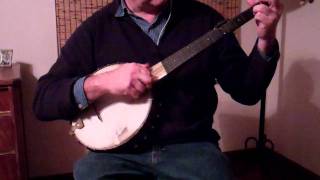
Hello, I am sorry I just now saw this response. Here is a link to a video of my playing:
I 'feel' like I am playing softer than I 'look'. I'm trying to play as relaxed as I can, but as you can see, I'm not doing so good! LOL! Anyone's thoughts and tips are greatly appreciated. Thanks in advance!
LyleK - Posted - 07/18/2025: 05:05:19
Thanks for posting that video. It is very helpful to see what your right hand is doing. That hand does look stiff. I think what you want to shoot for is a loose fist rather than a rigid claw. I attached one of my videos, which does not show my right hand very closely, but you can see that more fist-like appearance. Also note that my fourth and fifth fingers are more tightly flexed as they are just "tucked" out of the way. I checked videos from Adam Hurt, Victor Furtado, Leroy Troy, Walt Koken, Allison de Groot, and Abigail Washburn. While they vary in how tight a fist they use (mine is pretty tight), all do use more of a fist than a "claw."
Another thing that might help is to use more of a propulsive force for that "fist." That comes easier when playing at higher tempos, which you can practice now by not worrying what your left hand is doing.
carlb - Posted - 07/18/2025: 05:37:33
quote:
Originally posted by Saltlick Mountainyoutu.be/YhbU6LYny5EI 'feel' like I am playing softer than I 'look'. I'm trying to play as relaxed as I can, but as you can see, I'm not doing so good! LOL! Anyone's thoughts and tips are greatly appreciated. Thanks in advance!
I've always liked Phoeba Parsons' right hand motion. Her hand never stops moving. Remember, play the 5th string when you hand is moving upward.
pghmatt - Posted - 07/20/2025: 21:25:45
quote:
Originally posted by slcIt sounds like you're doing it right - claw shape, move fingers as needed etc. I think the "flicking" thing is more about how it appears than about reality. I've sometimes looked at my hand (esp when playing quickly or with abandon) and thought "interesting - it looks like I'm using my fingers far more than it feels". Maybe rather than "flicking" it could be described as letting the fingers reach for or expand towards for the strings, by letting the hand open more. A practical result is this adds a little extra momentum for the strike. Think gently flicking the clawed hand - not just the fingers - toward the string to shake off drops of water.
I'm solidly in the relaxed (vs rigid) camp. It's like using a hammer or throwing a ball - the whole arm is engaged starting (subtly) at the shoulder through the elbow to the hand to the fingers. The hand rotates slightly at the wrist and forearm as you strike, just like it would if you were hammering a nail. That could be something to think about: maybe the tension is starting further upstream from the hand, perhaps pressing the forearm hard on the rim or tightening the shoulder.
One detail I've more recently noticed: when holding the 'claw' at that 45-degree angle, then relaxed, it will DROOP slightly, so there's more of a straight line or even downward curve going from from the forearm to the hand. It's subtle, but perhaps if one tried to keep the hand "straight" that could introduce uneccessary tension. I think one naturally does this over time, but might be useful think about.Finally, a couple things NOT to worry about. It's fine to let the fingers and/or thumb whack into the head - no need to pull back. And if one is resisting being too loud (What? A banjo?? Loud???), shove a sock or pillow or sleeping bag into the back - let that mute the volume instead of holding back with your playing.
Throwing a ball is a great analogy. Because in addition to what you were talking about, the grip of the ball mustn't be too tight. Makes you less accurate and strains muscles that you don't even need to be using. Same for your bowhand with a violin. The way that was taught to me was if you can't hold that position comfortably just sitting on the couch, you can't expect it to feel good while actually playing. I imagine that same principle applies to banjo
Mister Lucky - Posted - 08/17/2025: 11:05:08
You mentioned that the pain starts when you play fast. Well, to me, an obvious solution would be to not play fast. In fact, when I watch youtube videos of clawhammer banjo players they are playing too fast. What is the need for speed? Perhaps it is because they want to play fiddle tunes and hit every note the fiddle plays. Lots of people take this approach to playing, but not me. If it only hurts when you play fast, perhaps the message is "don't play fast."
LyleK - Posted - 08/17/2025: 13:35:57
quote:
Originally posted by Mister LuckyYou mentioned that the pain starts when you play fast. Well, to me, an obvious solution would be to not play fast. In fact, when I watch youtube videos of clawhammer banjo players they are playing too fast. What is the need for speed? Perhaps it is because they want to play fiddle tunes and hit every note the fiddle plays. Lots of people take this approach to playing, but not me. If it only hurts when you play fast, perhaps the message is "don't play fast."
I still think it is a matter of using more of a fist than a claw shape for your hand. Here is a "fast" tune. It is 120 bpm. Our local contra dance group asks that we keep tunes to between 110 and 125 bpm, so this Youtube is not over the "legal speed limit" for a dance. I am playing more of the melody than I would with a fiddler at a dance, but playing like that causes me no pain. Notice that you cannot see the extensor tendons on the back of my hand. I think it is the muscles pulling on the extensor tendons that are causing pain. Those are weak muscles compared to the flexor muscles.
Mister Lucky - Posted - 08/17/2025: 13:52:31
Could be. However, pain shows a need for some kind of adjustment, either in technique or speed. And from my perspective, if you have only been playing for a year and a half, I would take the speed down a notch until there is no pain. Good luck in your journey.
Terms of Use | Privacy Policy | Privacy Consent (EU/GDPR Only)
Copyright 2026 Banjo Hangout. All Rights Reserved.