DVD-quality lessons (including tabs/sheet music) available for immediate viewing on any device.
Take your playing to the next level with the help of a local or online banjo teacher.
Weekly newsletter includes free lessons, favorite member content, banjo news and more.
Premier Sponsors


|
Please note this is an archived topic, so it is locked and unable to be replied to. You may, however, start a new topic and refer to this topic with a link: http://www.banjohangout.org/archive/402225
mmuussiiccaall - Posted - 03/07/2025: 08:43:48
Here’s the query, why do you,95% of the time play, not play the first fret in open G tuning on the banjo?
Corwyn - Posted - 03/07/2025: 09:16:03
With the exception of the C, much of the first fret isn't notes that frequently appear in the often Gmajor key that bluegrass and other genres commonly use. Which makes sense as the 0th fret is a G-chord, half a step up is going to be a bit discordant.
Thank you kindly.
Edited by - Corwyn on 03/07/2025 09:17:00
Old Hickory - Posted - 03/07/2025: 10:05:32
Because D# and G# are not common notes in the keys of G, C or D, in which I'm most likely to play without capo.
But they're not totally unheard of.
One fingering for B7 is 2-0-1. Old Home Place. I play this more often than sliding up to 4-4-4 as many do.
In licks, however, if I want a D# note I'll usually get it at 4th fret of 2nd string and often in between 1st string open and 1st string at 2nd fret (E) for chromaticism, in either direction: D D# E or E D# D. I haven't been able to write text tab in a forum post for years, so this description is all I can offer.
I also sometimes hit the 1st string at 1st fret leading into 1st string at 2 for the E minor in the B part of Cherokee Shuffle (played as if in G with capo at 2). I think that's called "voice leading."
I play G# on 3rd string on those rare occasions when I need an E Major chord. Such as in Salty Dog. There are other songs in G, C and D that go outside the key and turn E minor (diatonic to all three keys) into Major. Can't name any at the moment, but two just came up at a jam this week. Maybe one song was played in D because the vocalist chose it.
I use G# at 1st fret in a jazz-inspired turnaround in my own arrangement of On The Street Where You Live that goes G6 (4-5-0) E7 (1-0-0) Am (2-1-2). There's an implied V chord after this implied in the next few notes of melody. I don't fret the chord. An accompanying instrument would play it.
BobbyE - Posted - 03/07/2025: 10:52:29
Chords are composed of a combination of musical notes that make up a given scale, named after a letter in the alphabet. Banjos tuned to open G don't produce many notes in the G scale when fretted at the first fret, as others have noted.
Bobby
Old Hickory - Posted - 03/07/2025: 19:53:57
First string E-flat for C minor, F7 and F minor 7. I use these, though not much.
mmuussiiccaall - Posted - 03/08/2025: 12:18:43
Great answers so far! For those who use the hunt and Peck method to figure out melodies, etc. take note that those first Fritz are hardly ever going to come in to play so don’t waste your time packing on them ha ha.
Let’s keep the first fret talk going with a little quiz. What country or culture uses the third string first fret instead of the third string second fret for their music?
RB3 - Posted - 03/08/2025: 13:32:55
If you take a detour down Tin Pan Alley, you'll need those first fret notes.
banjoak - Posted - 03/09/2025: 01:12:05
quote:
Originally posted by mmuussiiccaallHere’s the query, why do you,95% of the time play, not play the first fret in open G tuning on the banjo?
Not sure your question, or confusion about fret numbers? They just represents a note, relative to the open string. Not sure where came up with 95%.
First should mention that G tuning is not necessarily the key of G major; nor limited to only diatonic notes/chords to G major.
If asking about playing in key of G, the C note (first fret on second string) is part of the diatonic scale, so not that rare; melodically nor chordal. (Cmaj, D7, Am, Fmaj). The other first fret notes (Eb, G#/Ab), not in the diatonic key of G major. But again that's not to say G tuning is limited to key of G, or those diatonic notes/chords. Such as E7, Amaj7, B7, Fm, Eb; and chromatic notes, or part of slides; for example Eb to E.
What country or culture uses the third string first fret instead of the third string second fret for their music?
Again, not sure what asking about? As above, the frets just represents a note, relative to the open string; so if given 3rd string is tuned to a G note; so are asking about using an Ab flat rather than an A note?
Those notes are not really used specifically to any country or culture; naturally occur if you play in the key of Eb major; F minor, Bb mixolydian for example; which are pretty widespread, not jus one country/culture. As well, find use as a b5, like in D minor blues/jazz, but can show up other music; including Western European Art music.
I can go try into more little more detail if you don't understand some of that.
Edited by - banjoak on 03/09/2025 01:29:05
Laurence Diehl - Posted - 03/09/2025: 13:25:28
quote:
Originally posted by mmuussiiccaallGreat answers so far! For those who use the hunt and Peck method to figure out melodies, etc. take note that those first Fritz are hardly ever going to come in to play so don’t waste your time packing on them ha ha.
Let’s keep the first fret talk going with a little quiz. What country or culture uses the third string first fret instead of the third string second fret for their music?
Maybe you're thinking of the C harmonic minor scale which falls quite nicely under the fingers, especially in chromatic playing (but more likely you would play the sixth fret on the D string, fourth fret on the B). Much used in klezmer music and Eastern European, gypsy and other cultures.
mmuussiiccaall - Posted - 03/10/2025: 11:54:37
Yeah, I forgot to specify open G tuning AND key of G Major third string first fret would be the b2 of that key. What is it possibly used for?
banjoak - Posted - 03/10/2025: 14:19:16
quote:
Originally posted by mmuussiiccaallYeah, I forgot to specify open G tuning AND key of G Major third string first fret would be the b2 of that key. What is it possibly used for?
Major scale doesn't use a b2.
But songs can modulate or introduce notes/chords outside it's scale. For example; a fairly common uses involve a secondary dominant VI7, for G major would be E7. The minor four v also comes up - Cm in this case.
Chromatic notes can also be used as linear fills, leading or bent notes.
Edited by - banjoak on 03/10/2025 14:27:27
janolov - Posted - 03/11/2025: 00:44:37
The b2 note is used in the Prygian mode and the Locrian mode. According to Wikipedia Spanish Gypsy music is based on a dominant Phrygian mode (with 3 steps between the b2 and 3).
250gibson - Posted - 03/11/2025: 05:06:36
quote:
Originally posted by janolovThe b2 note is used in the Prygian mode and the Locrian mode. According to Wikipedia Spanish Gypsy music is based on a dominant Phrygian mode (with 3 steps between the b2 and 3).
I thought this also, but the Phrygian and Locrian modes related to G major are B Phrygian and F# Locrian. Neither of these use a G#/Ab which I think is what the question is?
janolov - Posted - 03/11/2025: 07:21:15
quote:
Originally posted by 250gibsonquote:
Originally posted by janolovThe b2 note is used in the Prygian mode and the Locrian mode. According to Wikipedia Spanish Gypsy music is based on a dominant Phrygian mode (with 3 steps between the b2 and 3).
I thought this also, but the Phrygian and Locrian modes related to G major are B Phrygian and F# Locrian. Neither of these use a G#/Ab which I think is what the question is?
Phrygian mode starting with G has the notes G Ab Bb C D Eb F G and is based on Eb major scale.
Locrian mode starting with G has the notes G Ab Bb C Db Eb F G and is based on Ab major scale.
Both uses a Ab (=b2).
Sometimes it is confusing how to name modes because they have two different tone centers, first the starting note (in this case G) and then which major scale they are based on (Eb and Ab in this case).
250gibson - Posted - 03/11/2025: 07:39:26
quote:
Originally posted by janolovquote:
Originally posted by 250gibsonquote:
Originally posted by janolovThe b2 note is used in the Prygian mode and the Locrian mode. According to Wikipedia Spanish Gypsy music is based on a dominant Phrygian mode (with 3 steps between the b2 and 3).
I thought this also, but the Phrygian and Locrian modes related to G major are B Phrygian and F# Locrian. Neither of these use a G#/Ab which I think is what the question is?
Phrygian mode starting with G has the notes G Ab Bb C D Eb F G and is based on Eb major scale.
Locrian mode starting with G has the notes G Ab Bb C Db Eb F G and is based on Ab major scale.
Both uses a Ab (=b2).
Sometimes it is confusing how to name modes because they have two different tone centers, first the starting note (in this case G) and then which major scale they are based on (Eb and Ab in this case).
The tone center is the root/tonic of the scale.
The way I interpreted the question was which scale/country/genre uses a major scale that has a minor 2nd (semitone) between the root and 2nd degree. GMaj (as the OP calls out) it would be: G,Ab,B,C,D,E,F# : Which I have never encountered, so I am not sure what the OP is getting at.
Edited by - 250gibson on 03/11/2025 07:46:54
jsinjin - Posted - 03/11/2025: 09:32:26
I interpret the question like a jsj style one. The OP just noticed most songs when tuned in open G don't use the first fret. It's noticable even if you don't understand the why. The answers everyone have provided do explain why since backing up the half step takes you out of the notes that make up the major chords in G. I noticed a lot in each tuning what frets are used for the songs I play and the chords I practice and internalize that. After a lot of reps and chords and learning major and minor with music theory I've actually started to internalize the patterns and frequency of frets at each string. To play by ear experts and long term banjo players it's probably very simple and not a question to answer since knowing what frets notes and patterns occur in a tuning to fit with many songs.is natural and intuitive just hearing a song. To someone like me who is play by ear impaired and specifically learning the notes frets and memorizing the songs it sounds like a good question until you look at what makes up the major chords in the key and compare songs to those chords.
Edited by - jsinjin on 03/11/2025 09:34:26
banjopaolo - Posted - 03/11/2025: 11:45:43
I must be one of the 5% who often use the first fret on G tuning…. ;-)
jsinjin - Posted - 03/11/2025: 12:47:30
quote:
Originally posted by banjopaoloI must be one of the 5% who often use the first fret on G tuning…. ;-)
I probably do by accident.
banjoak - Posted - 03/11/2025: 14:35:49
quote:
Originally posted by 250gibsonquote:
Originally posted by janolovquote:
Originally posted by 250gibsonquote:
Originally posted by janolovThe b2 note is used in the Prygian mode and the Locrian mode. According to Wikipedia Spanish Gypsy music is based on a dominant Phrygian mode (with 3 steps between the b2 and 3).
I thought this also, but the Phrygian and Locrian modes related to G major are B Phrygian and F# Locrian. Neither of these use a G#/Ab which I think is what the question is?
Phrygian mode starting with G has the notes G Ab Bb C D Eb F G and is based on Eb major scale.
Locrian mode starting with G has the notes G Ab Bb C Db Eb F G and is based on Ab major scale.
Both uses a Ab (=b2).
Sometimes it is confusing how to name modes because they have two different tone centers, first the starting note (in this case G) and then which major scale they are based on (Eb and Ab in this case).
The tone center is the root/tonic of the scale.
The way I interpreted the question was which scale/country/genre uses a major scale that has a minor 2nd (semitone) between the root and 2nd degree. GMaj (as the OP calls out) it would be: G,Ab,B,C,D,E,F# : Which I have never encountered, so I am not sure what the OP is getting at.
I agree it is bit confusing what the OP is asking.
Part of the confusion, is the 2 different ways folks refer. One is through the lens of a major scale; referring to which mode (of 7) of parent diatonic major scale, thus identify as parent major scale letter name as the tonal center. The other is as you mention, just straightforward based on starting with the tonic as defined by the letter name you assign 1(such as G).
The latter, tonic and music doesn't have to be based on diatonic major lens, nor necessarily even have same limited fixed 7 (of 12) note diatonic half/whole step symmetry layout.
Some scales do include augmented whole steps, (3 half steps). Misirlou is an example; tune I play on banjo (in gDGBG) with tonic G; would include notes on first fret; using G,Ab,B,C,D,Eb,F#. As far as which culture, that scale appears in many cultures/countries/genre; although IIRC that tune itself has Lebanese or Turkish roots; but I associate, base my version more on 60s Surf genre culture, but as CH banjo, includes aspects of other cultures.
FWIW, some (esp in jazz/bebop) differentiate an extension b9, as opposed to b2 in a scale, different use (as well might use b13, #11)... just another consideration.
Edited by - banjoak on 03/11/2025 14:50:33
banjoak - Posted - 03/11/2025: 14:44:46
quote:
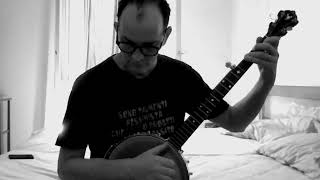
Originally posted by banjopaoloHere I’m fretting the first fret on various strings….
 Lovely tunes
250gibson - Posted - 03/11/2025: 16:12:31
quote:
Originally posted by banjoakquote:
Originally posted by 250gibsonquote:
Originally posted by janolovquote:
Originally posted by 250gibsonquote:
Originally posted by janolovThe b2 note is used in the Prygian mode and the Locrian mode. According to Wikipedia Spanish Gypsy music is based on a dominant Phrygian mode (with 3 steps between the b2 and 3).
I thought this also, but the Phrygian and Locrian modes related to G major are B Phrygian and F# Locrian. Neither of these use a G#/Ab which I think is what the question is?
Phrygian mode starting with G has the notes G Ab Bb C D Eb F G and is based on Eb major scale.
Locrian mode starting with G has the notes G Ab Bb C Db Eb F G and is based on Ab major scale.
Both uses a Ab (=b2).
Sometimes it is confusing how to name modes because they have two different tone centers, first the starting note (in this case G) and then which major scale they are based on (Eb and Ab in this case).
The tone center is the root/tonic of the scale.
The way I interpreted the question was which scale/country/genre uses a major scale that has a minor 2nd (semitone) between the root and 2nd degree. GMaj (as the OP calls out) it would be: G,Ab,B,C,D,E,F# : Which I have never encountered, so I am not sure what the OP is getting at.
I agree it is bit confusing what the OP is asking.
Part of the confusion, is the 2 different ways folks refer. One is through the lens of a major scale; referring to which mode (of 7) of parent diatonic major scale, thus identify as parent major scale letter name as the tonal center. The other is as you mention, just straightforward based on starting with the tonic as defined by the letter name you assign 1(such as G).
The latter, tonic and music doesn't have to be based on diatonic major lens, nor necessarily even have same limited fixed 7 (of 12) note diatonic half/whole step symmetry layout.
Some scales do include augmented whole steps, (3 half steps). Misirlou is an example; tune I play on banjo (in gDGBG) with tonic G; would include notes on first fret; using G,Ab,B,C,D,Eb,F#. As far as which culture, that scale appears in many cultures/countries/genre; although IIRC that tune itself has Lebanese or Turkish roots; but I associate, base my version more on 60s Surf genre culture, but as CH banjo, includes aspects of other cultures.
FWIW, some (esp in jazz/bebop) differentiate an extension b9, as opposed to b2 in a scale, different use (as well might use b13, #11)... just another consideration.
Scales and therefore modes (a mode is just a relative scale) are named after their starting note, ie: tonic or tonal center. They are not named after a parent major scale.
G major (Ionian mode) is not the same scale as G Phrygian or G Locrian. G Phrygian/G Locrian are parallel scales/modes to G major as all three have G as a tonic. G Phrygian is a relative mode to Eb major (Ionian) and five other related modes that all share the same intervalic relationships
Gmajor, G hexatonic, G pentatonic, G Mixolydian, G whole tone, G minor, etc. etc. ,are all scales with a tonic of G and only 2 of them have a parent major scale (Gmixolydian=Cmajor and Gminor=Bbmajor)
KCJones - Posted - 03/13/2025: 10:27:29
D#, G#, C, D#
G# whenever you need an E chord.
C you use all the time I'd say. Pretty common.
D# is in B7. Again, fairly common.
I reject the axiom.
Edited by - KCJones on 03/13/2025 10:27:49
Terms of Use | Privacy Policy | Privacy Consent (EU/GDPR Only)
Copyright 2026 Banjo Hangout. All Rights Reserved.