DVD-quality lessons (including tabs/sheet music) available for immediate viewing on any device.
Take your playing to the next level with the help of a local or online banjo teacher.
Weekly newsletter includes free lessons, favorite member content, banjo news and more.
Premier Sponsors


|
Please note this is an archived topic, so it is locked and unable to be replied to. You may, however, start a new topic and refer to this topic with a link: http://www.banjohangout.org/archive/402100
Noah Cline - Posted - 02/27/2025: 23:58:10
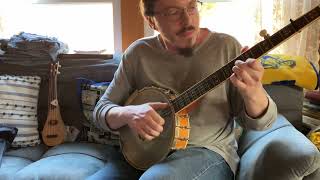
For this TOTW, I’ve chosen “Hell on the Potomac,” gleaning another selection from local Burlington, WV fiddler Israel Welch (1912-2003). It was featured on his “Tearin’ Down the Laurel” album. From the liner notes: “Learned from Mosby Rogers, this is probably of Civil War origin.
This is a quite catchy A-tune, and one that’s a bit hard not to play at a barn-burner pace. It lays out pretty well in gDGBD, capo 2 (aEAC#E), though a bit of a turnaround is needed in the A-part where the fiddle drops down to the low A notes; those with a 5+1/low-bass 6-string banjo could capture that note for note.
It has some presence on YouTube, mostly fiddle renditions, but there are a couple banjo takes besides my own to observe, and hopefully to be added to:
Christopher Dean (banjo): youtu.be/TmxNuCCsjQo?si=Hx--CnQmk6xMtohy
Ben Townsend (fiddle): youtu.be/mqE2xUnvyk0?si=IVZqRgHRU0Cih2Te
Banjo: youtu.be/PGdIkb87D7Q?si=3UJdgiOT4KBsaSSJ
Ben and Eric Zorn (fiddle and guitar): youtu.be/WWJMThd-DUY?si=oDjM_NI2cCahD_G7
Joe and Sam Herrmann with Joe Fallon, at a live concert in Fort Ashby (2023), opening with this tune in a set of tunes from Israel’s repertoire, including “Salt Sack Behind the Door (a previous TOTW), and “The Crooked Stovepipe” (fiddle, hammered dulcimer, and guitar): youtu.be/1kNuf0AeMKI?si=w8rT8maMaWYirQy4
My take (on gourd banjo, tuned eBEG#B): youtu.be/WD2kLtJt_7o?si=TDBscG34d-uDqGmz
Another take, for this TOTW presentation (on standard banjo, tuned gDGBD, capo 2): youtu.be/EjZgI-aTYKI?si=KcNMvyZZ8GD2j1ev
My playing is a bit of a mix (and albeit my own perception/styling coming through) as I listened to both Israel’s and Ben Townsend’s renditions while learning it last year. Ben also learned directly from Israel and has posted several other renditions of tunes from his repertoire as well as from Melvin Wine, Ernie Carpenter, and others.
Looking online, I found a notated source (by John Lamancusa) and audio of Gerry Milnes playing this tune:
oldtimefiddletunes.net/tunes/H...tomac.pdf
oldtimefiddletunes.net/tunes/a...tomac.mp3
Unfortunately, Israel’s album is not available for listening online, at least for this tune, but Gerry’s playing above is very close. Amongst the sources I’ve included, this tune as you can tell has taken on several variations and embellishments of the melody in both parts which I’ve tried to capture in my renditions.
On a side note, another notation (on Tunearch, from Dance to the Fiddle, March to the Fife), shares the same name, but appears to be a different tune in G (an alternate title of “Hell on the Wabash”/Rappahanock,” “Wake Up Susan” — the latter to me sounds much like “Mason’s Apron”):
tunearch.org/wiki/Hell_on_the_Potomac_(1)
Edited by - Noah Cline on 02/28/2025 10:20:16
stanleytone - Posted - 02/28/2025: 03:54:15
Being a Scruggs picker, i notice that clawhammer players strum right about where the neck and pot meet. Bluegrassers will pick closer to the neck when playing way up in the higher register of the fretboard to give it that more hollow sound.
But i seem to see clawhammer players always strumming even over the highest frets. Is that the sweet spot for open backs?
Eulalie - Posted - 02/28/2025: 04:37:55
quote:
Originally posted by stanleytoneBeing a Scruggs picker, i notice that clawhammer players strum right about where the neck and pot meet. Bluegrassers will pick closer to the neck when playing way up in the higher register of the fretboard to give it that more hollow sound.
But i seem to see clawhammer players always strumming even over the highest frets. Is that the sweet spot for open backs?
Yes, that's a sweet spot, taking advantage of the implicit harmonic overtones @ the 17th fret or so. More traditional players play over the head near the neck joint, but there was an urban trend in the 1970s and 80s to play with the right hand over the fingerboard, thwacking the strings every other beat. I reckon that sound must have been inspired by the NYC subway.
RG - Posted - 02/28/2025: 09:36:51
What a GREAT tune Noah, always enjoy your playing, this is one I'm going to have to learn on both banjo & fiddle.
Edited by - RG on 02/28/2025 09:37:08
Noah Cline - Posted - 02/28/2025: 20:25:16
quote:
Originally posted by RGWhat a GREAT tune Noah, always enjoy your playing, this is one I'm going to have to learn on both banjo & fiddle.
Much appreciated!
Noah Cline - Posted - 02/28/2025: 20:32:29
quote:
Originally posted by stanleytoneBeing a Scruggs picker, i notice that clawhammer players strum right about where the neck and pot meet. Bluegrassers will pick closer to the neck when playing way up in the higher register of the fretboard to give it that more hollow sound.
But i seem to see clawhammer players always strumming even over the highest frets. Is that the sweet spot for open backs?
I'll add to what Eulalie said. I tend to always play over the head near the tension hoop/neck joint, finding this the sweet spot for me on this particular banjo. I'm sure other factors come in to play that will affect this "sweet spot" area, such as the position of the bridge on the head, scale length, and what the person playing perceives as the spot for them.
Bill Rogers - Posted - 02/28/2025: 21:37:37
I pretty much echo RG. Great tune; superbly played. With so many more or less obscure fiddle tunes out there, finding a great one takes some effort. You did that, and presented a great rendition. Thanks!
Noah Cline - Posted - 02/28/2025: 23:04:47
quote:
Originally posted by Bill RogersI pretty much echo RG. Great tune; superbly played. With so many more or less obscure fiddle tunes out there, finding a great one takes some effort. You did that, and presented a great rendition. Thanks!
Thanks, Bill! This tune is a standout amongst the other great tunes Israel and brother Tom collected, ranging from local to Canadian.
stanleytone - Posted - 03/01/2025: 03:53:44
I sure appreciate all the good input on my question. Very informative! Didnt mean to draw any attention away from the original post which by the way. Is a great example of that style!
Edited by - stanleytone on 03/01/2025 03:55:46
JanetB - Posted - 03/01/2025: 16:28:07
You always choose a winning tune to share, Noah, and it's a treat to learn another Israel Welch tune. Your slides on the both banjo versions are tempting to try, but I ended up with a fairly melodic version. Those super low notes Israel reached with the fiddle weren't possible on standard-tuned banjo, but I found them an octave higher.
The title and your liner note info regarding the Civil War had me looking up what happened along the Potomac back then. It was a major river needing to be crossed and a border between states, affecting army movement and pacing. You can read about the infamous raid at Harpers Ferry and battles such as Antietam, Aquila Creek and more, all affected by the Potomac.
Noah Cline - Posted - 03/02/2025: 14:20:36
quote:
Originally posted by JanetBYou always choose a winning tune to share, Noah, and it's a treat to learn another Israel Welch tune. Your slides on the both banjo versions are tempting to try, but I ended up with a fairly melodic version. Those super low notes Israel reached with the fiddle weren't possible on standard-tuned banjo, but I found them an octave higher.
The title and your liner note info regarding the Civil War had me looking up what happened along the Potomac back then. It was a major river needing to be crossed and a border between states, affecting army movement and pacing. You can read about the infamous raid at Harpers Ferry and battles such as Antietam, Aquila Creek and more, all affected by the Potomac.
Thanks, Janet. I enjoyed your rendition. I started to add in my initial post some history (but felt it a bit repetitive with what I was going to say was basically the same Joe Herrmann talks about after the play the first set of tunes), but I'll go ahead and list it here:
The South Branch of the Potomac flows near Romney, WV, and while not seeing any battles, it did witness troop movements, the loss of 125 men in the duration of the war, and changed hands at least 56 times. Given the tune's title, it most likely was just that, along with the other areas that the North and South branches of the Potomac flow, and witnessed throughout time. Which branch or part of the Potomac the title refers to, I'm unsure, but it's safe to say the Potomac has seen a lot...
wvencyclopedia.org/entries/108
Additionally, Mosby/Mausby Rogers, who Israel learned the tune from, was born in 1889 (if the same Mausby Rogers I've traced: findagrave.com/memorial/182196...-l-rogers), so he likely would have had to have learned it from someone that lived during the war hence the believed origin. I've not been able to find more information about his musical background, though his son, Mausby William, was big into music as you can read from his obituary: findagrave.com/memorial/695232...am-rogers
I feel I have heard Mausby Sr.'s name mentioned in interviews with Israel, available through Augusta Heritage. I did revisit some of them before presenting this TOTW, and will continue to listen again to the others to check.
Terms of Use | Privacy Policy | Privacy Consent (EU/GDPR Only)
Copyright 2026 Banjo Hangout. All Rights Reserved.