
DVD-quality lessons (including tabs/sheet music) available for immediate viewing on any device.
Take your playing to the next level with the help of a local or online banjo teacher.
Weekly newsletter includes free lessons, favorite member content, banjo news and more.
Premier Sponsors


|
Please note this is an archived topic, so it is locked and unable to be replied to. You may, however, start a new topic and refer to this topic with a link: http://www.banjohangout.org/archive/400910
Mad Hornet - Posted - 12/15/2024: 15:48:08
Seeing some discussion on other threads referencing 120 bpm etc.
I get confused about this because if I set my Strum Machine app to 100 bpm I have to set the Metronome app to 200 bpm to get the same speed. So is strum machine 1/2 actual bpm?
Also with Strum Machine it seems that lead in notes don't synch up I have to play them at double the speed Strum Machine says it's playing. Can someone make sense of that? Is it a 2/4 - 4/4 thing (also confusing!)?
NotABanjoYoda - Posted - 12/15/2024: 17:13:40
A beat in standard 4/4 is a quarter note. So if every note you play is a quarter note and your at 100 bpm (beats per minute) then your playing 100 notes per minute.
If your playing all 16th notes, then your playing 4x100=400 notes per minute at 100 bpm.
Four 16th notes are played in the same amount of time as a quarter note.
Hope that helps.
RB3 - Posted - 12/15/2024: 19:03:25
If you play a Bluegrass, medium tempo song such as Blue Ridge Cabin Home, Your Love Is Like A Flower, etc., typically, you'll be playing at about 125 beats/min if you notate them in 2/4 time. If you notate them in 4/4 time, and play them at the same tempo, you'll be playing 250 beats/min. That's based upon the assumption that you have the same number of measures with either a 2/4 or 4/4 time signature.
I've never used Strum Machine, so I'm not familiar with how it works.
Edited by - RB3 on 12/15/2024 19:18:31
Old Hickory - Posted - 12/15/2024: 19:59:43
quote:
Originally posted by Mad HornetIs it a 2/4 - 4/4 thing (also confusing!)?
Partly, I think.
Foggy Mountain Breakdown helps demonstrate the difference 2/4 and 4/4 make in the number of beats per measure and therefore minute.
I can't write tab in text, but here's one version of the first 8 finger-picking actions:
I - M - T - M - T - I - M - T
If you consider that to be one measure of 2/4 then there are 2 "beats" in those 8 notes, each of which is a sixteenth, then you count it:
1 E & a 2 E & a
If you consider that to be one measure of 4/4 then there are 4 "beats" in those same 8 notes, each of which is an eighth, then you count it:
1 & 2 & 3 & 4 &
Now . . . you can play both of those groups of 8 notes at the exact same speed even though the time signature puts more beats per measure which forces you into more beats per minute. That's because all you're doing is counting the beats differently. By having two or four beats per measure but a quarter note being one beat in each, you're simply subdividing the beat differently.
Prove it to yourself by counting out loud: 1 & 2 & 3 & 4 & 1 E & a 2 E & a over and over. Don't change speed. Just change the syllable that you say. In the 4/4 version you'll be saying "3" at the same time you'd be saying "2" in the 2/4 version. This demonstrates what was said above: 4/4 puts more "beats" in the same amount of time. But it doesn't necessarily put more notes in the same time.
I think this relates to the issue you're having with Strum Machine. I don't think it's beating incorrectly. I assume it only knows beats per minute. Only you know beats per measure and what type of note gets one beat. So you may not be subdividing and counting your measures correctly.
Edited by - Old Hickory on 12/15/2024 20:07:46
Mad Hornet - Posted - 12/15/2024: 20:36:17
quote:
Originally posted by RB3If you play a Bluegrass, medium tempo song such as Blue Ridge Cabin Home, Your Love Is Like A Flower, etc., typically, you'll be playing at about 125 beats/min if you notate them in 2/4 time. If you notate them in 4/4 time, and play them at the same tempo, you'll be playing 250 beats/min. That's based upon the assumption that you have the same number of measures with either a 2/4 or 4/4 time signature.
I've never used Strum Machine, so I'm not familiar with how it works.
So what dictates whether a song is notated 2/4 or 4/4? In terms of how they get played I don't see a difference.
Mad Hornet - Posted - 12/15/2024: 20:42:30
quote:
Originally posted by Old Hickoryquote:
Originally posted by Mad HornetIs it a 2/4 - 4/4 thing (also confusing!)?
Partly, I think.
Foggy Mountain Breakdown helps demonstrate the difference 2/4 and 4/4 make in the number of beats per measure and therefore minute.
I can't write tab in text, but here's one version of the first 8 finger-picking actions:
I - M - T - M - T - I - M - TIf you consider that to be one measure of 2/4 then there are 2 "beats" in those 8 notes, each of which is a sixteenth, then you count it:
1 E & a 2 E & aIf you consider that to be one measure of 4/4 then there are 4 "beats" in those same 8 notes, each of which is an eighth, then you count it:
1 & 2 & 3 & 4 &Now . . . you can play both of those groups of 8 notes at the exact same speed even though the time signature puts more beats per measure which forces you into more beats per minute. That's because all you're doing is counting the beats differently. By having two or four beats per measure but a quarter note being one beat in each, you're simply subdividing the beat differently.
Prove it to yourself by counting out loud: 1 & 2 & 3 & 4 & 1 E & a 2 E & a over and over. Don't change speed. Just change the syllable that you say. In the 4/4 version you'll be saying "3" at the same time you'd be saying "2" in the 2/4 version. This demonstrates what was said above: 4/4 puts more "beats" in the same amount of time. But it doesn't necessarily put more notes in the same time.
I think this relates to the issue you're having with Strum Machine. I don't think it's beating incorrectly. I assume it only knows beats per minute. Only you know beats per measure and what type of note gets one beat. So you may not be subdividing and counting your measures correctly.
I get what you are saying. It just seems there are two ways of reckoning what seems to be the same thing musically. But when ppl say they play FMB at 120 bpm is it really 240? That sounds faster and more impressive for sure. Seems there should be a universal way to measure speed that isn't gimmicky.
RB3 - Posted - 12/15/2024: 20:49:26
Below is a YouTube link to the original version of Foggy Mountain Breakdown by Flatt & Scruggs
The musical phrase that defines FMB consists of 16 measures. If you play the YouTube recording, you'll see that when Scruggs kicks off the song, it takes him 12 seconds to play the first 16 measures. He's playing16 measures per 12 seconds, which is equal to 80 measures per minute. With a time signature of 2/4, there are 2 beats/measure, so in 2/4 time he's playing at a rate of 160 beats/minute. If the time signature is 4/4, there are 4 beats/measure, so in 4/4 time he's playing at a rate of 320 beats/minute.
In 2/4 time, it's:
16 measures/12 seconds X 60 seconds/minute X 2 beats/measure = 160 beats/minute
In 4/4 time, it's:
16 measures/12 seconds X 60 seconds/minute X 4 beats/measure = 320 beats/minute
You can notate the song with either time signature. If you want see what difference it makes, try tapping your foot to the Flatt & Scruggs version of the song at the rate of 160 beats/minute and then try tapping your foot to the song at the rate of 320 beats/minutes. If you can do the latter for the complete song, you'll likely need an appointment with a podiatrist or an orthopedic surgeon.
Edited by - RB3 on 12/15/2024 21:00:40
davidppp - Posted - 12/15/2024: 20:58:26
If 2/4 and 4/4 were basically the same thing in different notation, why would musicians make the distinction?
250gibson - Posted - 12/15/2024: 21:06:21
quote:
Originally posted by RB3Below is a YouTube link to the original version of Foggy Mountain Breakdown by Flatt & Scruggs
The musical phrase that defines FMB consists of 16 measures. If you play the YouTube recording, you'll see that when Scruggs kicks off the song, it takes him 12 seconds to play the first 16 measures. He's playing16 measures per 12 seconds, which is equal to 80 measures per minute. With a time signature of 2/4, there are 2 beats/measure, so in 2/4 time he's playing at a rate of 160 beats/minute. If the time signature is 4/4, there are 4 beats/measure, so in 4/4 time he's playing at a rate of 320 beats/minute.
In 2/4 time, it's:
16 measures/12 seconds X 60 seconds/minute X 2 beats/measure = 160 beats/minute
In 4/4 time, it's:
16 measures/12 seconds X 60 seconds/minute X 4 beats/measure = 320 beats/minute
You can notate the song with either time signature. If you want see what difference it makes, try tapping your foot to the Flatt & Scruggs version of the song at the rate of 160 beats/minute and then try tapping your foot to the song at the rate of 320 beats/minutes. If you can do the latter for the complete song, you'll likely need an appointment with a podiatrist or an orthopedic surgeon.
You are confusing 2/4 with 2/2.
250gibson - Posted - 12/15/2024: 21:09:05
quote:
Originally posted by davidpppIf 2/4 and 4/4 were basically the same thing in different notation, why would musicians make the distinction?
The strong/weak beats fall on different notes.
davidppp - Posted - 12/15/2024: 21:14:06
quote:
Originally posted by 250gibsonquote:
Originally posted by davidpppIf 2/4 and 4/4 were basically the same thing in different notation, why would musicians make the distinction?
The strong/weak beats fall on different notes.
Exactly! They sound different -- and that's crucial to making the melody stand out from the shower of other notes. We do it naturally when we sing, and many teachers will say you should sing the melody -- even wordless da-da-bum-da's -- before and while you play.
Old Hickory - Posted - 12/15/2024: 21:18:40
quote:
Originally posted by Mad Hornet
But when ppl say they play FMB at 120 bpm is it really 240? That sounds faster and more impressive for sure.
I think the people who say they're playing at 240 bpm are wrong because they're couting it in 4/4 and therefore counting twice as many of the NOTES they're playing as BEATS.
That was the whole point of the example I just posted. If you count 8 NOTES as ONE EE AND AH TWO EE AND AH, you have played TWO BEATS in those eight notes.
If you count those eight notes as ONE AND TWO AND THREE AND FOUR AND at the exact same rate/speed/tempo/pace of speaking the syllables, you have played FOUR BEATS in the exact same amount of time. Which means that if you do this for one minute you will have played twice as many beats.
The issue are: A BEAT has no fixed value. And many people don't understand that a lot of the music they play really should be counted as 2. We've mentioned "pulse" any number of times when discussing this on the Hangout. Think of the bass in any up-tempo bluegrass song. The bass pulses are on 1 and 2. The way to count is 1 - 2 - 1 - 2 over and over. Don't try to count the notes in between (the subdivisions). Just play them. The pulses are not 1 - 3 - 1 - 3 (with 2 and 4 uncounted in the spaces).
So if the choice in BPM for an uptempo bluegrass tune is between X bpm and 2X bpm, the "real" number is probably X, the lower.
quote:
Originally posted by Mad Hornet
Seems there should be a universal way to measure speed that isn't gimmicky.
There IS a universal way and it's not gimmicky. It's knowing how to read and count a time signature. Understanding the probable or actual time signature of a piece of music. And understanding the subdivisions of a beat.
I think any problem is the result of players being largely self-taught. So we don't learn these universal rules. Or we learn them wrong. Such as myself.
Truth be told, I never practice with a metronome. The beats drive me crazy. And I write all my tab as if it's in 4/4 because tab in eighth notes feels less cluttered and easier to read to me. It's also easier to count in 4 even though I know it's correct to count in 2. As a result, I don't even think about BPM. I just think about how fast or slow I want to play something and tap my foot. I accept that the BPM in TablEdit is probably twice as high as I'm actually playing for most songs and only right for some of the mid-tempo pieces or vocal numbers that really are in 4.
RB3 - Posted - 12/15/2024: 21:33:00
250gibson,
No, I'm not confusing 2/4 with 2/2. I know what the difference is. You can also notate the song with a time signature of 2/2.
If the time signature is 2/2, you have:
16 measures/12 seconds X 60 seconds/minute X 2 beats/measure = 160 beats/min
For the same tempo, the beats/minute for 2/4 and 2/2 will be the same. It's the numerator of the time signature that determines the beat/minute rate.
Greg Denton - Posted - 12/16/2024: 05:07:24
quote:
Originally posted by Mad HornetSo what dictates whether a song is notated 2/4 or 4/4? In terms of how they get played I don't see a difference.
It's a relative thing.
Get a guitar player to strum while you play an 8-note pattern. In 2/4 time the guitar player would play 2 strums per 8 notes. In 4/4 time the guitar player would play 4 strums per 8 notes. If you're playing at the same speed both times, you'll find the underlying pulse of the music feels very different while you're playing the same thing. Or just try it with your metronome - play 8 notes over 2 clicks, then double the speed of the metronome and play the same 8 notes over 4 clicks. The difference has much more to do with the underlying pulse and feel of the music you're playing over than what you're actually playing. If you play 16th notes over a 2/4 beat, it will sound like you're playing fast over a more relaxed band accompaniment. If you're playing 8th notes over a 4/4 beat, it'll sound like you're playing at a relaxed pace over a faster moving band.
Earl Scruggs notates his instruction book as 16th notes over a 2/4 beat. Most other beginner instruction books show the notation as 8th notes in 4/4 time because it's way easier to read. Notation in 16th notes with 32nd note slides, hammers, and pull-offs is a pretty dense and complex jungle to look at (and to try to count). Notation in 8th notes with 16th note slurs is much quicker to digest and understand at a glance. But 16th notes over a 2/4 beat might be a more accurate representation of the pulse of the music.
Strum Machine doesn't distinguish between 2/4 time, 2/2 time, or 4/4 time - but only offers what it calls "standard time". You enter chords in 2-beat cells. And you control the pulse of the music by setting the tempo along with the number of beats before a chord change. If you're only playing over songs in the database offered by the app, someone else has made that decision for you.
Try entering a new song in "standard time" and put in 2 cells of a G chord then play that with 8 notes over the 4 beats. Then slow the tempo by half and try playing 8 notes over 2 beats. Then you'll get a sense of the difference between 2/4 and 4/4 time.
Mad Hornet - Posted - 12/16/2024: 05:49:46
Thank you for the replies this definitely sheds some light on it. And I agree for purposes of reading music I definitely prefer to see 4/4. I think back to being in the school band 40 some years ago everything we played was 4/4 or 3/4. Never saw 2/4 until the dive into bluegrass.
NotABanjoYoda - Posted - 12/16/2024: 10:26:49
2/4 and 4/4 confusing?
2/4 is 2 beats per measure where each beat is a quarter note
4/4 is 4 beats per measure where each beat is a quarter note
2/4 is used when the emphasis is on every 2 beats. Like a march. Its just a preference to make note emphasis more understood when every other beat has a melody note. (The first beat in each measure is to be emphasized, or first note with rolls)
Edited by - NotABanjoYoda on 12/16/2024 10:30:06
Ira Gitlin - Posted - 12/16/2024: 11:46:52
quote:
Originally posted by Mad HornetThank you for the replies this definitely sheds some light on it. And I agree for purposes of reading music I definitely prefer to see 4/4. I think back to being in the school band 40 some years ago everything we played was 4/4 or 3/4. Never saw 2/4 until the dive into bluegrass.
IIRC, Scott Joplin rags are usually written in 2/4. Using 2/4 for bluegrass and old-time banjo goes back at least as far as the Pete Seeger and Earl Scruggs books. Seeger and Bill Keith (who wrote and transcribed most of the Scruggs book) were both musically literate, and I'm sure chose 2/4 after serious consideration.
Most of the fiddle tunes in 1000 Fiddle Tunes (a reprinting of Ryan's Mammoth Collection from the 1880s) are written out in 2/4, too.
SkippyV - Posted - 12/18/2024: 19:53:35
Can I ask a related question? Or maybe the same question from a different angle. In an effort to work on my right hand speed I am trying something sort of like wind sprints in running. I set my metronome at a beats per minute rate at the edge of what I can comfortably play. Each beat is sounded as 16th notes, i.e. 4 notes per beat. Then I play rolls trying to match the metronome, pushing myself to play at this speed. Typically I can only accomplish this for short bursts. But it seems to help me get used to playing faster and gradually the length of time that I can play rolls at the set rate before falling apart Is increasing.
So my question is this: if I set the metronome at 80 bpm and play each beat as 16th notes, I know I’m playing at 80 bpm and playing 320 notes per minute. But how does this relate to the typical tempo for bluegrass music and is there a “target” rate I should eventually work towards to be comfortable with most songs in jams?
Hope this makes sense. Seems it was harder to write out clearly than it should have been.
chuckv97 - Posted - 12/18/2024: 21:12:05
4 notes per metronome click at 80bpm? Wow, that’s moving! A decent target speed would be around 60 bpm for most jams, I’d think.
Ira Gitlin - Posted - 12/19/2024: 07:01:00
quote:
Originally posted by SkippyVCan I ask a related question? Or maybe the same question from a different angle. In an effort to work on my right hand speed I am trying something sort of like wind sprints in running. I set my metronome at a beats per minute rate at the edge of what I can comfortably play. Each beat is sounded as 16th notes, i.e. 4 notes per beat. Then I play rolls trying to match the metronome, pushing myself to play at this speed. Typically I can only accomplish this for short bursts. But it seems to help me get used to playing faster and gradually the length of time that I can play rolls at the set rate before falling apart Is increasing.
So my question is this: if I set the metronome at 80 bpm and play each beat as 16th notes, I know I’m playing at 80 bpm and playing 320 notes per minute. But how does this relate to the typical tempo for bluegrass music and is there a “target” rate I should eventually work towards to be comfortable with most songs in jams?
Hope this makes sense. Seems it was harder to write out clearly than it should have been.
Having taught a lot of beginners and intermediate students, I'd say your 80 BPM is a good starting point. At amateur jams the tempos usually go from there up to maybe 120 or so, with something around 100 being typical, in my experience.
NotABanjoYoda - Posted - 12/19/2024: 07:55:47
When I worked on speed for guitar or banjo Id set the metronome to where i couldnt play 16th notes but could play 8th notes. Id alternate every other beat with 8th and 16th until I could play the 16th comfortably and then Id play 16ths all the way. Id do this for 6 different rolls. Then Id play a custom 50 measure riff that incorporated all those rolls and switched between G C D F D7 Em Am. Once I could do that at speed Id move up. I saturated at 160 bpm. Good nuff since most bluegrass is 120 bpm. So if you can play 480 notes per minute while switching rolls and chords, theres nothing you cant handle.
Most jams are with amatuers so 80 or 100 is good and most songs do not have 16th notes blasting all the way through. 8th notes ar 100 is fine.
szbassoon - Posted - 01/29/2025: 14:56:26
quote:
Originally posted by NotABanjoYodaA beat in standard 4/4 is a quarter note. So if every note you play is a quarter note and your at 100 bpm (beats per minute) then your playing 100 notes per minute.
If your playing all 16th notes, then your playing 4x100=400 notes per minute at 100 bpm.
Four 16th notes are played in the same amount of time as a quarter note.
Hope that helps.
It would still be 100 BPM. Now if those 16th notes were written as quarter notes and expected to be played at the same speed, then you would be playing at 400 BPM.
Not to be rude (okay, maybe a little) but I have 5th and 6th grade students who understand time signatures better than adult banjo players.
szbassoon - Posted - 01/29/2025: 15:02:58
quote:
Originally posted by 250gibsonquote:
Originally posted by RB3Below is a YouTube link to the original version of Foggy Mountain Breakdown by Flatt & Scruggs
The musical phrase that defines FMB consists of 16 measures. If you play the YouTube recording, you'll see that when Scruggs kicks off the song, it takes him 12 seconds to play the first 16 measures. He's playing16 measures per 12 seconds, which is equal to 80 measures per minute. With a time signature of 2/4, there are 2 beats/measure, so in 2/4 time he's playing at a rate of 160 beats/minute. If the time signature is 4/4, there are 4 beats/measure, so in 4/4 time he's playing at a rate of 320 beats/minute.
In 2/4 time, it's:
16 measures/12 seconds X 60 seconds/minute X 2 beats/measure = 160 beats/minute
In 4/4 time, it's:
16 measures/12 seconds X 60 seconds/minute X 4 beats/measure = 320 beats/minute
You can notate the song with either time signature. If you want see what difference it makes, try tapping your foot to the Flatt & Scruggs version of the song at the rate of 160 beats/minute and then try tapping your foot to the song at the rate of 320 beats/minutes. If you can do the latter for the complete song, you'll likely need an appointment with a podiatrist or an orthopedic surgeon.
You are confusing 2/4 with 2/2.
Yep, we get that a lot here. I've given up on trying to correct it.
A lot of the other confusion is how people notate tablature. Some editors go for predomentaly 16th notes, and others use 8th notes. And people suddenly think they're playing at 300 BPM...
NotABanjoYoda - Posted - 01/29/2025: 16:23:19
quote:
Originally posted by szbassoonquote:
Originally posted by NotABanjoYodaA beat in standard 4/4 is a quarter note. So if every note you play is a quarter note and your at 100 bpm (beats per minute) then your playing 100 notes per minute.
If your playing all 16th notes, then your playing 4x100=400 notes per minute at 100 bpm.
Four 16th notes are played in the same amount of time as a quarter note.
Hope that helps.It would still be 100 BPM. Now if those 16th notes were written as quarter notes and expected to be played at the same speed, then you would be playing at 400 BPM.
Not to be rude (okay, maybe a little) but I have 5th and 6th grade students who understand time signatures better than adult banjo players.
Not to be rude, well, maybe just a little. Your reading comprehension is worse than some 4th graders.
Corwyn - Posted - 01/29/2025: 16:49:54
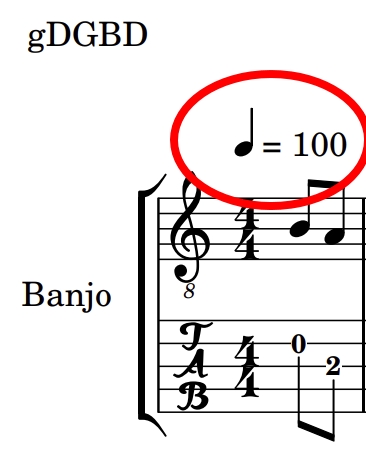
quote:Yep, we get that a lot here. I've given up on trying to correct it.
A lot of the other confusion is how people notate tablature. Some editors go for predomentaly 16th notes, and others use 8th notes. And people suddenly think they're playing at 300 BPM...
How are other people denoting it? Is this unambiguous, or am I missing something?
Thank you kindly.
Ira Gitlin - Posted - 01/30/2025: 06:58:42
quote:
Originally posted by Corwynquote:Yep, we get that a lot here. I've given up on trying to correct it.
A lot of the other confusion is how people notate tablature. Some editors go for predomentaly 16th notes, and others use 8th notes. And people suddenly think they're playing at 300 BPM...
How are other people denoting it? Is this unambiguous, or am I missing something?
Thank you kindly.
Unambiguous, and very possibly (I'd have to see more of the tab to be sure) inaccurate.
Corwyn - Posted - 01/30/2025: 07:08:52
quote:
Originally posted by Ira Gitlinquote:
Originally posted by Corwynquote:Yep, we get that a lot here. I've given up on trying to correct it.
A lot of the other confusion is how people notate tablature. Some editors go for predomentaly 16th notes, and others use 8th notes. And people suddenly think they're playing at 300 BPM...
How are other people denoting it? Is this unambiguous, or am I missing something?
Thank you kindly.
Unambiguous, and very possibly (I'd have to see more of the tab to be sure) inaccurate.
Nah, that's just the lead-in-bar with an invisible rest.
Thank you kindly.
banjoy - Posted - 01/30/2025: 14:27:19
I've tried to help with this topic in the past but pretty much feel it's a lost cause. The same mis-information and confusion seems to propagate no matter what. There are some folks in this thread who understand and are trying to help, and I commend them. It's a tiring battle...
A few years ago someone posted some hand-written tab from Bill Keith who wrote it out when he was that person's teacher. Bill showed groups of four notes per beat and tied them together with one line. Tablature is NOT musical notation, and some folks would see that as 1/8 notes. They are not. Bill was writing out tab. Those are 1/16 notes. That's why 4 notes are tied together per 1/4 note beat.
Bill wrote all the tab out for the Scruggs book and all 1/16 notes at speed. No surprise there. Bill knew music and time theory and loved to teach and share.
Further adding to the confusion are some well-known banjoists who wrote well known and extremely helpful banjo books, but who have continued to comment about Earl playing all those fast 1/8 notes. When you hear that, that person does not understand time. As mentioned above, most 8th graders have a more solid understanding than most banjo players (at least here on BHO LOL!!) ... and hoo boy...
Sure, if you want to believe you're playing 1/8 noes at 320 bpm, whatever floats your boat. But it's incorrect.
Recently Butch Robins posted some excellent videos and made a thread here on BHO about his practice regimen ... go take a look at those videos. He does not explain time signature because he does not have to. His videos were about practicing rolls. But look and listen to him as he plays along with a metronome. And learn, for God's sake. Listen to him when he cranks up the bpms to about 160.
It always amazed me that in banjo world, the banjo can make whole notes, half notes, quarter notes and 1/8 notes, but suddenly it stops there and instead bpm's are warped around that. Time theory is independent of instrument, it does not change. Banjos can make 1/16, 1/32, 1/64 notes too, ya know?
And the confusion of 2/4 vs 2/2, oh good lord.
I made a series of videos years ago which can be found on my YouTube channel ... trying to explain these very basic ideas to other banjo pickers from a banjo picker. I made when this kept coming up over and over and over, and nothing but arguments. It gets old. YouTube is full of excellent videos (mine are not excellent, they're made for banjo pickers after all LOL!!!) that can help with this understanding. They're there, it does not matter if the explanation is on keyboard, guitar, drums or kazoo. The concepts and truths remains the same. They don't change because it's a banjo. The banjo does not exist in its own time universe.
All from me on this topic, I swore off this topic years ago. Go forth, all you banjo grasshoppers. And Learn. It ain't that hard to understand and sooner or later the light bulb has to work. It is not this hard. It is not this hard.
Edited by - banjoy on 01/30/2025 14:35:41
NotABanjoYoda - Posted - 01/30/2025: 15:13:29
In the end it doesnt matter. You tap your foot and play to the rythm. If you can play fmb in the same timespan as Earl note for note, good fer ya.
banjoy - Posted - 01/31/2025: 04:51:24
quote:
Originally posted by NotABanjoYodaIn the end it doesnt matter. You tap your foot and play to the rythm. If you can play fmb in the same timespan as Earl note for note, good fer ya.
Precisely.
janolov - Posted - 01/31/2025: 06:44:17
As long as you play it doesn't matter. The problems starts when you read tab and notation.
Owen - Posted - 02/01/2025: 08:42:26
I dunno, janolov. What I'm finding is that it doesn't matter .... so long as I'm the only one around. 
Terms of Use | Privacy Policy | Privacy Consent (EU/GDPR Only)
Copyright 2026 Banjo Hangout. All Rights Reserved.


