DVD-quality lessons (including tabs/sheet music) available for immediate viewing on any device.
Take your playing to the next level with the help of a local or online banjo teacher.
Weekly newsletter includes free lessons, favorite member content, banjo news and more.
Premier Sponsors


|
Please note this is an archived topic, so it is locked and unable to be replied to. You may, however, start a new topic and refer to this topic with a link: http://www.banjohangout.org/archive/397662
banjered - Posted - 06/03/2024: 07:34:31
I am frustrated with trying to play banjo for newly-written tunes that fiddlers are bringing to jams. Lately there have been dozens of new tunes being brought to the jams. So many of them are written by fiddlers and they really lean into notes on their low G string while of course the lowest note on the banjo is usually a D or an E. Yeah I know the banjo can kick into an upper octave when the fiddlers go low or make harmonic runs or whatever but for me the compromises if they work at all end up jangling the flow of both playing and the sounding of the tune. The old chestnut tunes that everybody knows were written for and by isolated players in the mountains for dances wherein the fiddler and banjo player made a team effort to play together and sound OK. Sure if I was a more talented banjo player or had more time to work out compromises it could work maybe but there are so many new tunes! And some of those new tunes really sound wonderful but they are not always compatible that much with the banjo. Or to say it another way, not every good fiddle tune is a good banjo tune. Am I the only one noticing or frustrated by this? I don't think I would like a 6 string banjo with a low G string. If I am wrong or making excuses for my inabilities I am sure you will let me know. Or, how are you dealing with these newer tunes? banjered
hweinberg - Posted - 06/03/2024: 07:59:58
What tunes are frustrating you? I don't notice too many recently written ones in jams back East, except for the ones Harry Bolick has written for Mississippi fiddle tunes whose names can be found but whose music has been lost. For traditional and very playable tunes from Mississippi, see Harry's two volumes of Mississippi fiddle tunes and songs from the University of Mississippi Press.
ceemonster - Posted - 06/04/2024: 01:34:05
It's become rampant in the Irish and Scottish trad milieu also. There's a new crop of younger players, often "hot" ones, not infrequently products of some college music conservatory "folk" program, who seemingly are bored playing traditional music. They want to "compose.". They want to " create." But they want attention and funds from the traditional folk community. They want traditional music lovers to pay to sit and watch them play their "compositions," and buy recordings of the stuff. Personally, this stuff isn't what I fell for when falling for old time traditional music. I don't buy it or learn to play it. My attitude is, call me in ten, fifteen, twenty years, let's see if any of your "compositions" are memorable enough to become part of a tradition.
Edited by - ceemonster on 06/04/2024 01:35:20
banjered - Posted - 06/04/2024: 12:32:46
Ha! Playing your own "spectacular" compositions at an old time jam isn't a problem I have encountered .....yet. An older friend who plays Irish concertina said of the younger players, "They want to find the most obscure tunes possible and then play it as fast as possible, far too fast for any normal player to pick up on it."
As regards specific NEW old time tunes that aren't all that friendly to the banjo there is "Henry King's Reel" which here in the archives a fiddle/banjo player commented that he enjoyed very much playing on the fiddle but not at all on the banjo. Rayna Gellert has written some very beautiful fiddle tunes but some drop down on that low G sting and make for awkward banjo playing. There are MANY others. banjered
BTuno - Posted - 06/05/2024: 07:20:09
For goodness sake. If you like the tune, figure out a way to play it that suits your style. Its all good music!
banjered - Posted - 06/05/2024: 12:34:56
You can always come up with" a version" of a tune. I am saying that the fiddler playing lots of low G string notes makes the banjo playing either awkward or just doesn't sound all that good. I think though my post isn't striking a "chord" (a pun) with most banjo players. So be it. I don't mind sitting out on tunes that I cannot come up with a compatible banjo part. banjered
JanetB - Posted - 06/08/2024: 17:05:29
Sometimes I like arranging fiddle tunes on the cello banjo (tuned down 4-5 steps below standard). That would help me in your situation, except for hauling and then having to change banjos I’m using in a jam, which could be cumbersome.
When I learned banjo it was with old-time and Celtic fiddle players. They also didn’t understand the challenges faced by banjo players.
R.D. Lunceford - Posted - 06/09/2024: 13:12:24
quote:
Originally posted by JanetB
When I learned banjo it was with old-time and Celtic fiddle players. They also didn’t understand the challenges faced by banjo players.
The most problematic lack of understanding on the part of fiddlers I've encountered is the banjo tunings issue. This is especially common in the old-time styles that don't include much banjo like Texas, and various Midwestern styles for example. Trying to fit into Irish can also be problematic as they play medleys of tunes, one of whose most attractive features are striking key changes. The Appalachian OT practice of staying in a single key for extended periods is not a limitation they'll put up with.
As far as the fiddle G-string, it has always been extensively used as we all know. It just becomes a case of fudging it- you're not going to catch any of those low notes in a melodic sense, so rhythm/counterpoint approaches are options. As mentioned, sometimes switching octaves sometimes works, but not always.
Irish trad wind instruments like the flute, whistle, Uilleann pipes all have "D" as their bottom note, so when the fiddler is calling the tune, they have to deal with those G string notes too.
ceemonster - Posted - 06/09/2024: 16:10:50
Playing concertina myself, realizing how great concertina sounds for oldtime thanks to Bertram Levy's wonderful recordings with Kirk Sutphin has been dangerous to my banjo life, as the key-change/retuning frustrations are gone.
Edited by - ceemonster on 06/09/2024 16:13:03
banjobard - Posted - 06/11/2024: 21:57:00
I'm sure the reverse is true as well. There are some great banjo tunes that just don't make sense to a fiddle player and fiddler's often can't figure out what to do with all our drone notes, and how to separate out the melody notes from them. And some tunes that sound great on banjo sound dumb-as-heck on the fiddle, and vice versa. We just can't play long notes. There's no getting around that. Tunes that rely on long notes to sound good will probably be a flop on the banjo. Some tunes only sound good with staccatto phrases or big jumps in hammer-on/pull-off type playing (eg Banjonique), or bunches of droning, or weird tunings, and they'll be a flop on the fiddle.
And I don't think it's worth blaming people for evolving the tradition and helping to keep it vital. Many traditional players have made their own compositions, and some of those are easy for others to play, others not so easy. Doesn't make them any less valuable, though the hard-to-play ones are less likely to thrive in a jamming tradition than the easy ones.
Ultimately, any banjo player who wants to engage in playing melodies has to contend with the fact that the banjo has a limited range of about an octave and a half in first position. And just between 3 and 4 octaves, depending on the key, if you use the whole neck. A guitar has 3 octaves just in the first position, and fiddle and mandolin do too. Piano players get like 8 octaves. There's going to be some tunes that work easily in that range and some that don't, regardless of how recently the tune was composed and what genre it's in.
Some possible solutions include getting a 6-string banjo, learning to play up the neck, splitting the octave within phrases, doing harmony, counterpoint, rolls, backup, droning, playing percussion on the banjo head, sitting out, or learning another instrument. All of which can be fun explorations, if you like to explore!
If you love the sound of the banjo and want to play all the fiddle tunes in first position, maybe try taking up the tenor banjo, tuned in the Irish tuning (GDAE). So many fiddle tunes just make so much more sense in the 5ths tuning, and it's really intuitive to translate what you hear to what to play. Not a good instrument for clawhammer playing, but you can do fingerstyle single-string on it if the idea of a flatpick feels too foreign to you. But honestly, flatpicking it is more similar to clawhammer playing. And LOTS of the banjo playing on old-time recordings from the 20s & 30s was on tenor banjos, though not in the GDAE tuning. So don't let anyone tell you it's not old-time. Or if banjo tonality isn't as important to you, the mandolin is the same tuning and a much easier scale length for playing fiddle tunes. As someone who has been a melodic 5-string player, both fingerstyle and clawhammer, and who has gone to great lengths to play fiddle melodies note for note, it has been quite liberating to take up the tenor and subsequently the mandolin in the past year to focus on irish tunes with. It's just easier and quicker to learn a lot of those melodies, and more intuitive, and opens up a lot more rhythms and rhythmic emphasis possibilities. And I still love to play 5 string and value it for all the things it does well that the mando or tenor doesn't do, but I'm no longer as frustrated at trying to get it to do the things that are more difficult for it to do well. And I'm also excited to do more playing on a 5+1 tuned guitar or guitar-banjo, partly because it will let me get more of those phrases without jumping the octave, and partly because of the cool sympathetic vibrations of the low string even when it's not being played.
Pomeroy - Posted - 06/12/2024: 00:55:46
Banjo and fiddle played well together can have a symbiotic relationship. But they're still instruments with different characters and ranges.
Playing well together, to me anyway, involves divesting oneself of the creative constraint that my banjo should 'match' the fiddle. Firstly it can't; for example a banjo does not tunefully replicate fast fiddle runs. And secondly the magic of fiddle and banjo together derives from the way the sound of each instrument enhances the other by utilising our distinctiveness. Often the rigid 'formula' of hitting all the same notes - mirroring - kills that potential stone dead. There's no surprises, sparkle or interplay. Instead what we rhythmically and melodically add and omit can have much more pleasing effect on the overall sound. To do that we have to really listen and tune-in to the fiddle player we're with. Hear what he or she is actually doing. That is where in the moment we get the creative ideas to interact musically.
Edited by - Pomeroy on 06/12/2024 00:59:09
Joel Hooks - Posted - 06/12/2024: 05:45:13
quote:
Originally posted by banjobardI'm sure the reverse is true as well. There are some great banjo tunes that just don't make sense to a fiddle player and fiddler's often can't figure out what to do with all our drone notes, and how to separate out the melody notes from them. And some tunes that sound great on banjo sound dumb-as-heck on the fiddle, and vice versa. We just can't play long notes. There's no getting around that. Tunes that rely on long notes to sound good will probably be a flop on the banjo. Some tunes only sound good with staccatto phrases or big jumps in hammer-on/pull-off type playing (eg Banjonique), or bunches of droning, or weird tunings, and they'll be a flop on the fiddle.
And I don't think it's worth blaming people for evolving the tradition and helping to keep it vital. Many traditional players have made their own compositions, and some of those are easy for others to play, others not so easy. Doesn't make them any less valuable, though the hard-to-play ones are less likely to thrive in a jamming tradition than the easy ones.
Ultimately, any banjo player who wants to engage in playing melodies has to contend with the fact that the banjo has a limited range of about an octave and a half in first position. And just between 3 and 4 octaves, depending on the key, if you use the whole neck. A guitar has 3 octaves just in the first position, and fiddle and mandolin do too. Piano players get like 8 octaves. There's going to be some tunes that work easily in that range and some that don't, regardless of how recently the tune was composed and what genre it's in.
Some possible solutions include getting a 6-string banjo, learning to play up the neck, splitting the octave within phrases, doing harmony, counterpoint, rolls, backup, droning, playing percussion on the banjo head, sitting out, or learning another instrument. All of which can be fun explorations, if you like to explore!
If you love the sound of the banjo and want to play all the fiddle tunes in first position, maybe try taking up the tenor banjo, tuned in the Irish tuning (GDAE). So many fiddle tunes just make so much more sense in the 5ths tuning, and it's really intuitive to translate what you hear to what to play. Not a good instrument for clawhammer playing, but you can do fingerstyle single-string on it if the idea of a flatpick feels too foreign to you. But honestly, flatpicking it is more similar to clawhammer playing. And LOTS of the banjo playing on old-time recordings from the 20s & 30s was on tenor banjos, though not in the GDAE tuning. So don't let anyone tell you it's not old-time. Or if banjo tonality isn't as important to you, the mandolin is the same tuning and a much easier scale length for playing fiddle tunes. As someone who has been a melodic 5-string player, both fingerstyle and clawhammer, and who has gone to great lengths to play fiddle melodies note for note, it has been quite liberating to take up the tenor and subsequently the mandolin in the past year to focus on irish tunes with. It's just easier and quicker to learn a lot of those melodies, and more intuitive, and opens up a lot more rhythms and rhythmic emphasis possibilities. And I still love to play 5 string and value it for all the things it does well that the mando or tenor doesn't do, but I'm no longer as frustrated at trying to get it to do the things that are more difficult for it to do well. And I'm also excited to do more playing on a 5+1 tuned guitar or guitar-banjo, partly because it will let me get more of those phrases without jumping the octave, and partly because of the cool sympathetic vibrations of the low string even when it's not being played.
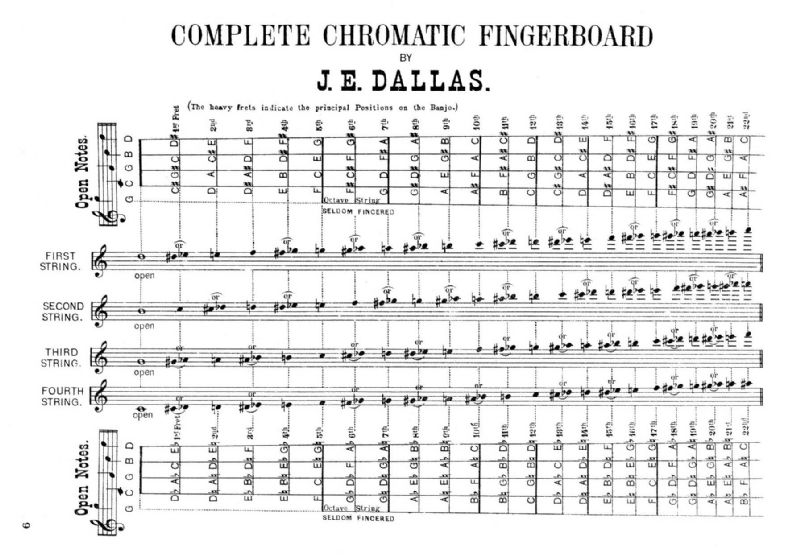
Sorry to divert, but how are you able to get 4 octaves on a regular banjo with 22 frets?
Could you post that full 4 octave scale (preferably in notation)? If not, what is the key, the starting note fret and the 4th octave ending fret?
The regular banjo as known today was established around 1893 with a 3 octave neck (22 frets) pitched (in standard intervals) of C based on the 4th string. I'm not sure how to squeeze more out of it without an extended fingerboard and more frets.
banjobard - Posted - 06/12/2024: 19:14:45
Sorry I didn't mean complete octaves, I said 3-4 Octaves was meaning that you can play 3 octaves of a D note, for instance, 4th string open, 1st string open, 1st string 12th fret. So I was counting the first one in my count. And if the 4th string is pitched to C, then you can get 4 octaves (counting the low C as 1, with the 22nd fret high c as 4). But that doesn't get you the whole scale in those octaves.
Just meaning to compare it to the fiddle, tenor banjo, or mandolin where we can go from a low G up to a G two octaves higher without changing positions, or an A for that matter.
Also I really love what Pomeroy has to say about this subject
jojo25 - Posted - 07/14/2024: 09:58:25
my 2.3 cents worth...I am...generally...amenable to trying "new" old time tunes...as others have noted...if the tune is worth a hoot it will catch on within the overall OT community...too much of most anything...including a near constant stream of new OT tunes...is...generally speaking...taxing
as to the banjo's range...over the last few years I have more and more taken to playing...in open G tuning...out of the 3rd position...the reaches for the fretting hand are easier than in the first position...and not as crowded as in the positions further up the neck...one thing I really like about 3rd position is that it puts me pretty much smack dab in the middle of the banjo's range...quite a bit of room to descend if need be and plenty of room to ascend if need be...and I oft fret the G chord at the 12th fret not as a barre...but with individual fingers...2,3 or even 4 of'em...it is a lot easier to get in and out of that position from the other chord forms in G tuning...the D and F forms
at this point in my banjo journey...I have been playing for over 50 yrs...I tend to most enjoy playing tunes that I do NOT have any set arrangement for...I have noticed...that if a tune gets called that I learned a set arrangement for...say yrs or decades ago...that said set arrangement can get in the way of the flow of the tune for me...I notice this especially after playing many tunes in a row where I have no set arrangement...then the old, set, tune gets called and the fun level for me decreases as I run thru the rigid way I have always played it...learning a new tune on the fly is just about as much fun as a person can have with their clothes on:)
and lastly...the fiddle/banjo combination is what it is all about for me...the Celtic world met West Africa in Appalachia and magic happened...peace...Joe
pmiller510 - Posted - 07/27/2024: 08:39:04
How do I deal with these new tunes? Go to old-time 3-finger picking.
I would add that it does bug me a bit when folks show up with original tunes and it's just assumed that they're good tunes or they're great - simply because they are original. Everybody gushes about them like it's hugely clever. A lot of those songs (IMO) are like the art that shows up at art and craft fairs; well done by sincere people, but not great. Some will make the cut, some won't. I don't particularly care for a lot of them but have become fond of Winder Slide, Nail that Catfish to the Tree, Red Prairie Dawn, and Tippin' Back the Corn; all of which are newer tunes popular at sessions I attend here in the Midwest. So, I am definitely not opposed to newly written tunes.
Lew H - Posted - 07/28/2024: 18:02:52
I find that some fiddle tunes are easier (or sound better) on banjo played in a different key and tuning than the fiddler has picked. Angeline the Baker, for example is very simple in open G tuning rather than the fiddler's D. Flop Eared Mule sounds wonderfully funky in G tuning rather than the fiddler's D, where it sounds wimpy on banjo. The solution is to refuse to play tunes where the fiddler wants them. We should work out the best banjo key and tell the fiddlers that's the key will play the tune in.
WVDreamin - Posted - 08/07/2024: 08:18:24
As a fiddler, I assure you, "Flop Eared Mule" ~should~ be played in G  -D happened because some fiddler thought it was easier to play there with no high B to reach for.
Banjobard is correct in saying some banjo tunes don't work well on fiddle, or are just better as a banjo tune than a fiddle tune. To my ears, these tunes are melodically 'flatter' - shorter intervals with a shorter scale range (generally). Cumberland gap fits that description in my mind.
New tunes, particularly ones that are crooked, rarely grab me. "Winder Slide" is still one I only play when someone else calls it at a jam, it's not on my tune list. I have friends who think some tunes are cool just because they're crooked. There is one called "Grey Owl" that ticks both the crooked box and the "sounds like it would work better on banjo" boxes (to my ears). Most all of my bluegrass buddies love the tune for some reason; I find it unremarkable and entirely forgettable as the melody, such that it is, never sticks in my head
Edited by - WVDreamin on 08/07/2024 08:22:07
Terms of Use | Privacy Policy | Privacy Consent (EU/GDPR Only)
Copyright 2026 Banjo Hangout. All Rights Reserved.