DVD-quality lessons (including tabs/sheet music) available for immediate viewing on any device.
Take your playing to the next level with the help of a local or online banjo teacher.
Weekly newsletter includes free lessons, favorite member content, banjo news and more.
Premier Sponsors


|
Please note this is an archived topic, so it is locked and unable to be replied to. You may, however, start a new topic and refer to this topic with a link: http://www.banjohangout.org/archive/397593
ssssavage - Posted - 05/30/2024: 11:13:54
Relatively new to banjo and am experimenting with nylon strings. Love the tone but the tension seems loose.
Is there a better nylon string at the right gauge that provides this wonderful tone but with more tension?
scott_sovereign - Posted - 05/30/2024: 14:56:20
I like Savarez Super High Tension "Yellow Card" Classical Guitar Strings. I buy them as individual strings from the online sites that sell strings individually. That way, I can just get the 1st through the 4th strings and get an extra 1st string to use as the 5th string. Jason Romero repackages these same strings in a set that you can order from his website as a set if you want to go that way, although I'm **thinking** he may substitute a phosphor bronze string for the 4th string since I think he prefers that combination, but I'm not sure - you would have to check.
Pomeroy - Posted - 05/30/2024: 15:22:28
Ditto Savarez Red/Yellow/White card classical guitar range of varying tensions. Available as single strings so you can create your own custom set at the exact tensions you need. The one-size-fits-all way that nylgut strings are packaged is a basic flaw that can result in tension that is way off as you describe. I have wondered how many folks are playing nylgut that is not quite the right tension and actually never realise. Correct tension is crucial. I prefer to record using gut strings for research purposes, but fit Savarez strings on some shorter 24"-25" scale vintage banjos that I practice on so that my spending on replacement gut strings is not too excessive.
The rectified Savarez strings have a texture similar to the nap on un-oiled gut strings. To me that feel and subtle 'grip' is the big plus; it makes a world of difference when playing finger style. They feel wonderful. They sound excellent. They are durable. They are reasonably priced.
Edited by - Pomeroy on 05/30/2024 15:38:12
ssssavage - Posted - 05/30/2024: 16:11:54
Wow! Thanks for this advice. I’ll report back later and let you know if this solves my mushy strings.
Thx, -steve
scott_sovereign - Posted - 05/30/2024: 16:37:42
I'm surprised more people don't know about the Savarez strings. The other day, I stopped by to visit a local banjo builder here in Nashville. He played my banjo with Savarez strings on it and asked what they were. He liked them and said that he was going to get a set to replace the Nylgut set he had on his fretless. He remarked that he might actually start playing the fretless more often with Savarez strings on it since the main thing he didn't like about playing it was that the Nylgut strings were too floppy.
ssssavage - Posted - 05/30/2024: 17:06:18
Floppy explains it. Not knowing other players using nylon I was trying to convince myself that floppy was ok.
Thanks for the insight.
ssssavage - Posted - 05/30/2024: 17:17:45
Any suggestions where to purchase savarez singles?
Thx, -steve
Bill Rogers - Posted - 05/30/2024: 17:28:59
I’ve been using nylon strings for 20+ years and have always used high-tension guitar strings of one brand or another, building my own sets from singles. I knew from the get-go that was the way to match the tension of the steel strings on my main banjo.
banjered - Posted - 05/30/2024: 17:57:37
I put Aquila Minstrel Nylgut on 25.5 banjo and lowered it to D (dADF#A) and it worked but I found it just would not hold it's pitch very well, I had to retune/tune up about every other tune. When I raised the the pitch to D#, just a half set, that problem went away. I recall using Savarez years ago. The strings lasted a couple years with good tension. banjered
scott_sovereign - Posted - 05/30/2024: 19:28:25
I get my Savarez strings from stringsbymail.com. I think that juststrings.com carries them too, and I'm sure there are others too. The ones you are looking for are the 52XJ individual strings where you replace X by 1, 2, 3, or 4 for the 1st, 2nd, 3rd, or 4th strings. That will get you the "Yellow Card" ones which are the highest tension. When I used to play classical guitar, I actually used to use the "Red Card" ones which are a little lower tension, but for banjo, I've mostly only heard of people using the "Yellow Card" ones other than the other poster who said he has tried the other tensions on banjo. You can actually order a set of the thee treble strings together, 521J, 522J, and 523J if you find that easier, but I think that is literally only pennies different in cost, and you would still need a 524J and an additional 521J for the 5th string.
Pomeroy - Posted - 05/31/2024: 01:29:54
If we're discussing the fine detail I'll mention that there is a variance in the composition of the treble strings within these sets that is easy to miss but highly relevant to note.
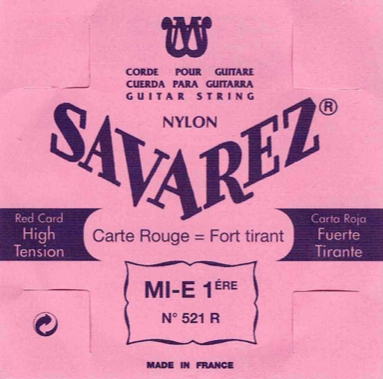
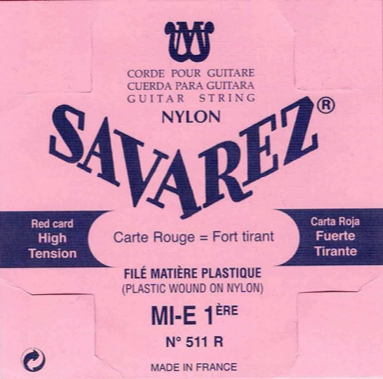
I've attached the cards for two Savarez red card (High tension) first strings. At first glance they appear the same but at the bottom there is a serial # difference: 511 R or 521 R. These strings have slightly different composition. I happen to prefer 511 R as it has closer similarity to gut trebles. Neither good nor bad, just different. And when we are seeking the specific, being aware of difference matters.
Edited by - Pomeroy on 05/31/2024 01:42:02
Pomeroy - Posted - 05/31/2024: 01:49:14
Edit: I prefer 521 R not the plastic wound 511 R. The former has a transparent appearance, the latter plastic wound is an opaque white.
For me the main practical difference is that the plastic wound 511 R causes intrusion of finger 'noise' that I can't eliminate and don't want. Exact same technique using the 521 R and there is no finger noise, only the clear tone of the string.
Edited by - Pomeroy on 05/31/2024 02:01:22
scott_sovereign - Posted - 05/31/2024: 20:39:40
Yes, on the Red Card Savarez that Pomeroy is showing, they do offer both wound and smooth varieties. I mentioned in an earlier reply that when I played classical guitar, I used the Red Cards. I used the wound trebles on the guitar and preferred them on that instrument. With the Yellow Cards, they only offer the smooth variety. You can try whatever you like on banjo and see what you like. However, since you mentioned that you find the Nylgut strings to be floppy, I will tell you that all else being equal, on the same banjo, the Red Card Savarez strings will be "floppier" than the Yellow Card Savarez strings. How the Red Card Savarez strings would be in comparison to the Nylgut strings, I can't say. As I've said, the Yellow Card strings are the highest tension that Savarez offers. If you do a search here on Banjo Hangout for every mention of Savarez strings (other than this post), I think you will find that the only Savarez strings anyone talks about using on the banjo are the Yellow Card ones (the ones that end in J that I referenced). When Pomeroy mentioned earlier on this thread that he uses the Red Cards (the ones that end in R he mentions in his most recent reply), that was the first I had heard of anyone using them on a banjo. Like I said, the tension on the Red Cards is less than the tension on the Yellow Cards. Some may prefer that. Or if one has a banjo they want to tune higher (i.e. tune a standard scale as if it were an A-scale without a capo) by making the strings tighter, then maybe I could see using the Red Cards for that as well. Again, not trying to start an argument here with Pomeroy. Go back and look at the other threads where this is discussed. Or buy both and decide for yourself.
banjooud - Posted - 05/31/2024: 23:42:39
As a comparison, here are the different diameters between a Savarez Super High Tension “Yellow Card” set and a nylgut medium set for the first 3 strings
Nylgut medium set : (Inch) : 22 , 25 , 32 = (mm) 56 , 65 , 82
Savarez yellow card : 29 , 33 , 41 = 73 , 83 , 104
And here is the equivalent of savarez nylon yellow card strings with nylgut strings for the same tension:
Savarez : 29 , 33 , 41 = 73 , 83 , 104
Nylgut : 25 ,29, 37 = 64 , 74 , 94
I've never used savarez yellow card yet. In any case, you can see that they are much thicker than nylgut.
Pomeroy - Posted - 06/01/2024: 01:56:27
quote:
Originally posted by scott_sovereign>Yes, on the Red Card Savarez that Pomeroy is showing, they do offer both wound and smooth varieties. I mentioned in an earlier reply that when I played classical guitar, I used the Red Cards. I used the wound trebles on the guitar and preferred them on that instrument. With the Yellow Cards, they only offer the smooth variety. You can try whatever you like on banjo and see what you like. However, since you mentioned that you find the Nylgut strings to be floppy, I will tell you that all else being equal, on the same banjo, the Red Card Savarez strings will be "floppier" than the Yellow Card Savarez strings.
We're not at cross purposes here, I completely agree with what you are saying about scale and tension. I posted that I use Savarez Red card strings on vintage banjos with shorter scales in the range 24"-25". As the OP mentioned his scale is 25.5" being aware of the lower Red card tension might be useful to have up his sleeve particularly in combination with higher modern G/D/A tuning. For 26 1/4" scale banjos Yellow card very high tension strings would normally be the go-to choice. A scale length of 25.5" and modern tuning potentially puts the OP in an in-between area. Savarez strings are reasonably priced so practical hands-on testing which tension works best for him shouldn't be a too expensive option. Alternatively for absolute certainty one can calculate the tension using the maths.
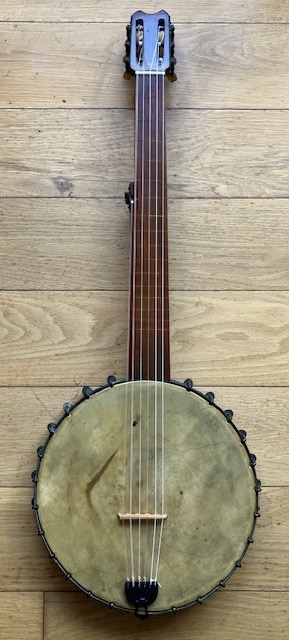
This is an example of a 24.5" scale vintage banjo tuned eABEG#B on which I use Red card strings.
Edited by - Pomeroy on 06/01/2024 02:17:19
scott_sovereign - Posted - 06/01/2024: 03:28:13
Pomeroy, again, not trying to argue, but you've got it exactly backwards. With the shorter length neck (i.e. a shorter string), all else being equal, the pitch of the string will be higher. Therefore, in order to play the same pitch with the same specification string, one would have to loosen the string on the shorter neck. The first string tuned to a D on a standard 26 1/8 banjo neck will be tighter than the exact same specification string tuned to D on a 25 1/2 neck, which will, in turn, be tighter than the same specification string tuned to D on a 24 inch neck. That's the physics of it. If one looks at the specifications of the Savarez strings, the Yellow Card high tension strings (the ones I'm talking about) are all thicker than the corresponding Red Card normal tension strings (the ones you are talking about). Again, talking about physics, one must tighten a thicker string with more tension to get the same pitch as one would a thinner string. So, I'll say it again. The Red Cards will play floppier than the Yellow Cards at the same tunings on the same banjo. And, as I stated, the shorter and shorter you make the neck, the floppier the strings will get with the same tuning. So, while you may prefer the way the Red Cards play on the scale banjos you play, what you say about needing them on the shorter scale but Yellow Cards for longer scales is, like I said, the exact opposite of the actual case, and is why I said in one of my earlier replies that one might want to try the Red Cards if one had a long neck (i.e. Pete Seeger) style banjo, though I don't know of too many people who play those style of banjos who would necessarily be attracted to these type of strings.
scott_sovereign - Posted - 06/01/2024: 03:43:49
I'll just say one last thing. I fully realize that one wouldn't normally want to tune a long neck banjo to standard G based tunings but would instead use a capo to acheive those tunings. But for that matter, to me, I think of a 24-inch banjo as an A-Scale banjo, but I guess that some people might tune them down to G based tunings. I mentioned the different neck lengths to highlight the physics of the lengths of strings.
ssssavage - Posted - 06/01/2024: 05:54:06
This has been a very useful conversation for me. I now have some Savarez yellow card strings on order.
One thing I observed from banjood’s post is that the diameter of the yellow card strings are thicker than the nygut strings currently on my banjo and I’m going to have to file away the nut and perhaps replace my bridge when the new strings arrive.
Even with the nygut strings I was noticing the first string would slip out from the bridge from time to time being thicker than the steel strings that were previously on the instrument.
So are there any recommendations for, what to do about the nut and economical solutions for a new bridge? Thanks in advance for the guidance.
Thx, -steve
Pomeroy - Posted - 06/01/2024: 08:08:25
quote:
Originally posted by ssssavageThis has been a very useful conversation for me. I now have some Savarez yellow card strings on order.
One thing I observed from banjood’s post is that the diameter of the yellow card strings are thicker than the nygut strings currently on my banjo and I’m going to have to file away the nut and perhaps replace my bridge when the new strings arrive.
Even with the nygut strings I was noticing the first string would slip out from the bridge from time to time being thicker than the steel strings that were previously on the instrument.
So are there any recommendations for, what to do about the nut and economical solutions for a new bridge? Thanks in advance for the guidance.
Thx, -steve
Our string preference can vary over time. I'd be inclined to make an exact copy of your original nut and slot it for the gauges of the synthetic strings you're using. Nut blanks are cheap to buy. That way if you want to go back to wire strings you can simply swap the original nut back. Slot files are the accurate tool, but do involve extra cost unless you can borrow them from a friend.
Just for handy reference, this page clarifies the main points about string tension: stringsdirect.co.uk/blogs/blog...nsion-101
Let us know how your yellow card strings work out on your 25.5" scale.
Edited by - Pomeroy on 06/01/2024 08:14:46
Eulalie - Posted - 06/01/2024: 10:05:36
quote:
Originally posted by ssssavageThis has been a very useful conversation for me. I now have some Savarez yellow card strings on order.
One thing I observed from banjood’s post is that the diameter of the yellow card strings are thicker than the nygut strings currently on my banjo and I’m going to have to file away the nut and perhaps replace my bridge when the new strings arrive.
Even with the nygut strings I was noticing the first string would slip out from the bridge from time to time being thicker than the steel strings that were previously on the instrument.
So are there any recommendations for, what to do about the nut and economical solutions for a new bridge? Thanks in advance for the guidance.
Thx, -steve
It's important to understand that Nylgut and Savarez strings are made from entirely different synthetic compounds, and one should probably not expect the string diameters to have direct correlation with the string tension.
banjooud - Posted - 06/01/2024: 11:00:10
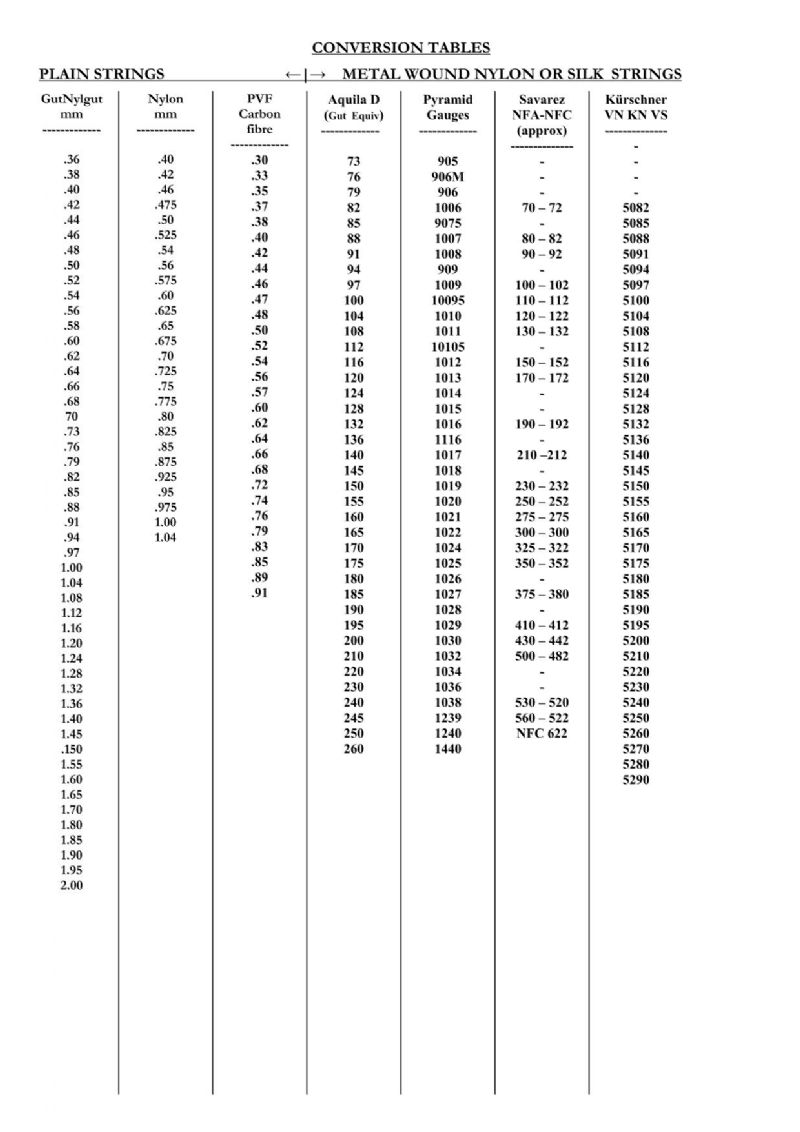
If you are looking for the best sound for your instrument (knowing that our taste evolves) you should proceed as follows:
First, choose the Tension in Kg you want for your instrument. This will determine the thickness of the strings.
This site is very helpful:
gamutstrings.com/calcul...ulator.htm
The diameter indication corresponds to gut. It's the same as nylgut.
And you can choose either nylgut , nylon or fluocarbon (see photo) . It's good to have several suitable bridges and nuts at your disposal (it's easy to make all-maple bridges). At equivalent tension, fluocarbon will always offer the thinnest strings, then nylgut and finally nylon.
scott_sovereign - Posted - 06/01/2024: 12:20:21
ssssavage, as far as widening the slots on the nut and the bridge, many, myself included have found it quite easy to do it ourselves using a welding torch tip cleaner. There are more than a few posts here on Banjo Hangout about how to do this (you can search), but it is is not difficult if you take your time and go slow and are methodical. Like the old adage, you can always take off more material, but you can't put back material you've taken off. If you're not comfortable doing this, you can always pay a luthier/repair shop to do this for you, but then you are looking at a much higher expense and however long it takes them to get around to it (even though the work itself only takes a matter of minutes). On the other hand, if you are uncomfortable doing this yourself, then getting a professional to do it might be a good idea, but like I said, it's not difficult. Of course, you could also buy the specialized nut saws luthiers use, but now we are talking about much more money yet again. Here's a link to the particular one that I got off of Amazon: amazon.com/dp/B01LYSXKHD. There are dozens of our very similar ones on Amazon that I'm sure work just as well. I just happened to pick these because they offered more tip sizes. You should also be able to find these at most hardware stores, Home Depot, Lowes, etc.
Terms of Use | Privacy Policy | Privacy Consent (EU/GDPR Only)
Copyright 2026 Banjo Hangout. All Rights Reserved.