DVD-quality lessons (including tabs/sheet music) available for immediate viewing on any device.
Take your playing to the next level with the help of a local or online banjo teacher.
Weekly newsletter includes free lessons, favorite member content, banjo news and more.
Premier Sponsors


|
Please note this is an archived topic, so it is locked and unable to be replied to. You may, however, start a new topic and refer to this topic with a link: http://www.banjohangout.org/archive/397234
sethb - Posted - 05/08/2024: 15:59:05
Once again I'm coming over from the 4-string section with a music theory question. I'm trying to figure out the chord changes for the 1927 Walter Donaldson tune "Changes." I have the original sheet music, but it only includes the fingering diagrams for a uke tuned to GCEA, there are no chord symbols.
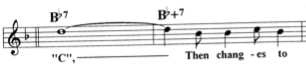
So I'm working with a uke chord fingering chart and have managed to figure out about 95% of the changes, but there are still four chords that are eluding me. I'm attaching a page with clips of the uke diagrams, plus the melody line and piano part for each chord. I'm hoping a uke player out there will recognize the fingering patterns, or that someone with more musical knowledge than me can suss out the chord names from the piano part.
Any help in naming these chords would be much appreciated! SETH
janolov - Posted - 05/09/2024: 06:03:20
If I read right without reading glasses I get this:
The first chord is Ab7 (or G#7) but without a Eb or D# note.
The second chord is F7.
The third chord is an augmented chord: A+ ( or C+, or F+)
The fourth chord is Adim7 (=Cdim7 = Eb dim7 = F#dim7). However the piano notation includes a B note (or is it a Bb?) which does not belong to the diminished chord.
sethb - Posted - 05/09/2024: 07:29:00
Thanks for all the info, I'll plug these chord suggestions into the score and see how they work out. I had suspected that the first chord might be an Ab, but the finger pattern didn't quite fit -- it had a C on the C string instead of the Eb note that Jan spoke about. We'll see how it sounds, and I can always change it to the Ab if needed.
BTW, the tune is in the key of C, so there were no sharps or flats in the key signature. I should have included that info in my first post. Thanks again for the much-needed assistance! SETH
sethb - Posted - 05/11/2024: 08:52:00
So the good news is that Jan's chord suggestions were correct, and I thank him very much for providing that info.
And the better news is that while I was searching the Internet for something else, I stumbled upon a leadsheet for "Changes" ! The original score was published in C, while the leadsheet is in the key of F, perhaps to accommodate a particular singer's vocal range. In checking my original score against the lead sheet, I found that all of the chord changes I had originally guessed based upon the uke fingering diagrams were correct, plus the ones that Jan added.
But I did find that the leadsheet had two variations: 1) in the "B" section, on the words "minor strain" the lead sheet only has a C7 chord for the entire measure. But the original score showed an F chord on "minor" and then the C7 chord on "strain." Ditto in the following line for the measure with "goes again," with the same F - C7 changes. And 2) in the "C" section on the word "as," the lead sheet omitted the Cdim chord -- not a big deal since it's just on one beat and it's what I consider to be a passing chord anyway, and so is capable of being glossed over if necessary.
I do have one more chord in a different tune that I need some expert help on -- what would be the fingering on a plectrum banjo (tuned CGBD) for a Bb7-b5 chord? I'm guessing this is either an augmented or a diminished chord, but that's about as far as I got with my very limited knowledge of music theory.
As a "thank you" for all the past and present help, here's the lead sheet for "Changes" (see attached) that I recently found, and the variations I noted above have been corrected . Since it was first published in 1927, it's now in the public domain and can be shared in this fashion. SETH
mmuussiiccaall - Posted - 05/11/2024: 15:25:15
quote:
Originally posted by sethbI do have one more chord in a different tune that I need some expert help on -- what would be the fingering on a plectrum banjo (tuned CGBD) for a Bb7-b5 chord? I'm guessing this is either an augmented or a diminished chord, but that's about as far as I got with my very limited knowledge of music theory.
2134
sethb - Posted - 05/11/2024: 16:17:22
Thanks Rick, this was the clue I needed. Through a Google search, I also found chords.cc, a website with every plectrum banjo chord known to man and then some! It suggested a variation of your choice -- 2132, as well as two other alternative fingerings at the fifth fret (probably inversions).
Now I have to see what the fingers like best, and what sounds best to me. SETH
mmuussiiccaall - Posted - 05/11/2024: 19:16:12
quote:
Originally posted by sethbThanks Rick, this was the clue I needed. Through a Google search, I also found chords.cc, a website with every plectrum banjo chord known to man and then some! It suggested a variation of your choice -- 2132, as well as two other alternative fingerings at the fifth fret (probably inversions).
Now I have to see what the fingers like best, and what sounds best to me. SETH
woops I was looking at the chord in the lead sheet
sethb - Posted - 05/12/2024: 12:34:58
Rick -- Sorry for any confusion! The Bb+7 was in my first group of "mystery" chords, the Bb7-b5 was a later inquiry.
After looking at and trying various chord possibilities, I'm going to try two different Bb7-b5 fingerings at next week's rehearsal. Since none of the suggested Bb7-b5 fingerings worked well for my 74-year old fingers, I'm going to see if I can cheat a little bit instead. One choice is a straight Bb7 chord at the sixth fret. The unflatted fifth (should be an E note instead of F) is going to be on the second (B) string, and so hopefully won't be heard that much, being on an inside string. Second choice is a Bb6 at the second fret (also known to me as an Abm). Although this chord doesn't have the E flatted fifth note in it at all, my thought is that the advantage here is that the melody note of G will be on the first (D) string and thus the top note of the chord, making it a melody chord.
I'm in uncharted musical theory territory for me here, and I'm paddling as fast as I can! Any thoughts on these two choices, or any other possible ones, woujld be appreciated. Next week, we'll see what works and what doesn't; if the rest of the band doesn't throw up when I play this measure, I'll consider it a win. SETH
Edited by - sethb on 05/12/2024 12:36:03
Terms of Use | Privacy Policy | Privacy Consent (EU/GDPR Only)
Copyright 2026 Banjo Hangout. All Rights Reserved.