DVD-quality lessons (including tabs/sheet music) available for immediate viewing on any device.
Take your playing to the next level with the help of a local or online banjo teacher.
Weekly newsletter includes free lessons, favorite member content, banjo news and more.
Premier Sponsors


|
Please note this is an archived topic, so it is locked and unable to be replied to. You may, however, start a new topic and refer to this topic with a link: http://www.banjohangout.org/archive/396587
Kellie - Posted - 04/01/2024: 11:36:58
Okay so last night I sort of mapped out the fretboard and the best way to climb two octaves the fastest. This is what I have so far for the C major scale, the natural key of the banjo. I plan on expanding it up to three octaves, but for now, two will have to do.
Kellie - Posted - 04/01/2024: 11:38:07
Update tried to post a photo of the sheet music. Did not go as planned. Does anyone know how to on mobile?
Laurence Diehl - Posted - 04/01/2024: 12:22:58
quote:
Originally posted by KellieUpdate tried to post a photo of the sheet music. Did not go as planned. Does anyone know how to on mobile?
You upload it into your photos and attach it here.
or
you can upload to some cloud storage like Box or Dropbox and post a link. But to make the link hot you enter it via the link icon to the right of the smiley on the rich text menu.
Old Hickory - Posted - 04/01/2024: 12:42:31
The upload process here is kind of clunky and counter-intuitive. You'll feel like you're uploading twice. Once to tell the system what you're going to upload then again to actually upload it. Destination is media section of your profile.
Old Hickory - Posted - 04/01/2024: 16:26:48
i look forward to the explanation of the advantages in playing C major scale this way. Have to admit I don't understand going all the way up to F on the 3rd string, especially with that apparent eighth note position shift notes between C and D -- when changing strings there (or sooner) would be easier and more fluid.
This just doesn't seem to be anywhere near as efficient and practical as the prevailing melodic style approach, popularized by Bill Keith in the 1960s, or the single-string approach to scales, for which I don't whom to credit.
I'm always happy to be educated and corrected. Can't remember how many times I've posted "Learn something new every day."
tonygo - Posted - 04/02/2024: 07:07:28
quote:
Originally posted by KellieOkay so last night I sort of mapped out the fretboard and the best way to climb two octaves the fastest. This is what I have so far for the C major scale, the natural key of the banjo. I plan on expanding it up to three octaves, but for now, two will have to do.
Janet Davis, for one, has a whole book on scales, why reinvent the wheel?
Joel Hooks - Posted - 04/02/2024: 07:16:16
quote:
Originally posted by KellieThere we go
You did not include the right hand fingering using 4 fingers and thumb. I understood that was the cornerstone to your classical style.
Joel Hooks - Posted - 04/02/2024: 07:19:15
quote:
Originally posted by tonygoquote:
Originally posted by KellieOkay so last night I sort of mapped out the fretboard and the best way to climb two octaves the fastest. This is what I have so far for the C major scale, the natural key of the banjo. I plan on expanding it up to three octaves, but for now, two will have to do.
Janet Davis, for one, has a whole book on scales, why reinvent the wheel?
Pretty much every banjo instruction book published before general anti-intellectualism rendered banjo instruction to a series of numbers on lines.
peterpeter - Posted - 04/02/2024: 09:31:46
Practicing scales can be fun if you like it. Ok - i do it on a a tenor. Some things are perhaps similar after all. In any case, it helps me to internalize the fingerboard.
I'm only a beginner, but these are my experiences:
- Keep in time, even with the difficult sections. Especially when it goes into a higher register.
- You can have fun by making a scale bit more interesting, rather than simply going up and down.
- Enough practicing of scales is enough practicing of scales :-)
Here are a few examples.
The last one (in F) is from "Classical Studies for Tenor Banjo"
Kellie - Posted - 04/02/2024: 10:04:21
quote:
Originally posted by tonygoquote:
Originally posted by KellieOkay so last night I sort of mapped out the fretboard and the best way to climb two octaves the fastest. This is what I have so far for the C major scale, the natural key of the banjo. I plan on expanding it up to three octaves, but for now, two will have to do.
Janet Davis, for one, has a whole book on scales, why reinvent the wheel?
Studying the fingerboard and building my own understanding is never a bad idea in my eyes.
Kellie - Posted - 04/02/2024: 10:07:25
quote:
Originally posted by Joel Hooksquote:
Originally posted by KellieThere we go
You did not include the right hand fingering using 4 fingers and thumb. I understood that was the cornerstone to your classical style.
I thought it would be, but for now I'm just sticking to the classic style of picking. Thumb and index for the 4th, 3rd and 2nd string. Index and middle for the 1st string. Thumb for the 5th. The ring finger plays a part in the newest piece I'm writing, but not in this instance.
Kellie - Posted - 04/02/2024: 10:09:54
quote:
Originally posted by Old Hickoryi look forward to the explanation of the advantages in playing C major scale this way. Have to admit I don't understand going all the way up to F on the 3rd string, especially with that apparent eighth note position shift notes between C and D -- when changing strings there (or sooner) would be easier and more fluid.
This just doesn't seem to be anywhere near as efficient and practical as the prevailing melodic style approach, popularized by Bill Keith in the 1960s, or the single-string approach to scales, for which I don't whom to credit.
I'm always happy to be educated and corrected. Can't remember how many times I've posted "Learn something new every day."
It's just a study of the fingerboard really. Building my own understanding as I go, But I found doing a scale from the low C to the second highest C allows me quick access to the high C via steps and half steps.
johnedallas - Posted - 04/04/2024: 11:16:00
I'm surprised that no-one mentioned the 5th string - the classic banjo in standard gCGBD tuning is, after all, a 5-string!
For me, a fast scale passage from, say, the C on 2nd string, 1st fret to the C on 1st string, 10th fret, is much easier when I play the G note the 5th string open. This gives me time to shift my left hand from open position (for the notes C, D, E, F) to a position up the neck (for the notes A, B, C.)
In fact, there are plenty of situations where I find the open G on the 5th string ergonomically better that the G on the 1st string at fret 5.
Cheers,
John
Joel Hooks - Posted - 04/04/2024: 11:55:44
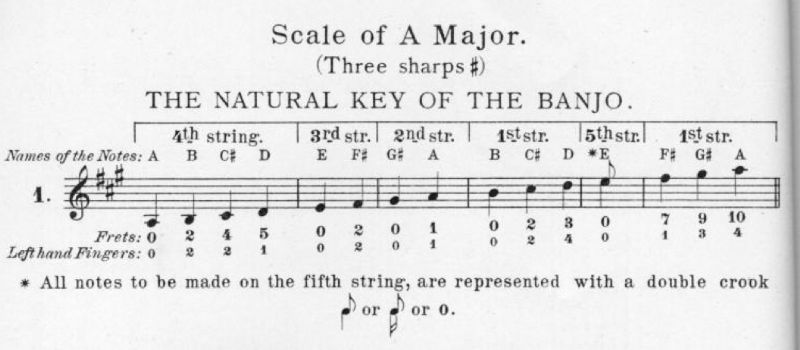
The long established way to play this scale, as found in many instruction books, depicted below on pages 12 and 13:
The system of "alternate right hand fingering" is also spelled out. Pretty much every professional (and good amateur) followed this system of right hand fingering.
Other choice works that are good for the right hand alternate fingering are:
Bradbury's Modern Method as well as the currently in publication Mel Bay Banjo Method.
Fred Bacon's Paramount Method (choose the C notation version). Or any other C notation method.
archive.org/details/@joel_hook...-notation
Kellie - Posted - 04/06/2024: 13:48:37
quote:
Originally posted by johnedallasI'm surprised that no-one mentioned the 5th string - the classic banjo in standard gCGBD tuning is, after all, a 5-string!
For me, a fast scale passage from, say, the C on 2nd string, 1st fret to the C on 1st string, 10th fret, is much easier when I play the G note the 5th string open. This gives me time to shift my left hand from open position (for the notes C, D, E, F) to a position up the neck (for the notes A, B, C.)
In fact, there are plenty of situations where I find the open G on the 5th string ergonomically better that the G on the 1st string at fret 5.
Cheers,
John
Yes the fifth string is placed and tuned perfectly.
Kellie - Posted - 04/06/2024: 13:50:40
quote:
Originally posted by Joel HooksThe long established way to play this scale, as found in many instruction books, depicted below on pages 12 and 13:
The system of "alternate right hand fingering" is also spelled out. Pretty much every professional (and good amateur) followed this system of right hand fingering.
Other choice works that are good for the right hand alternate fingering are:
Bradbury's Modern Method as well as the currently in publication Mel Bay Banjo Method.
Fred Bacon's Paramount Method (choose the C notation version). Or any other C notation method.
archive.org/details/@joel_hook...-notation
Yes but isn't Farland's method surpassed by Emile Grimshaws? I'm not sure which standard to follow.
Joel Hooks - Posted - 04/06/2024: 19:49:14
quote:
Originally posted by Kelliequote:
Originally posted by Joel HooksThe long established way to play this scale, as found in many instruction books, depicted below on pages 12 and 13:
The system of "alternate right hand fingering" is also spelled out. Pretty much every professional (and good amateur) followed this system of right hand fingering.
Other choice works that are good for the right hand alternate fingering are:
Bradbury's Modern Method as well as the currently in publication Mel Bay Banjo Method.
Fred Bacon's Paramount Method (choose the C notation version). Or any other C notation method.
archive.org/details/@joel_hook...-notationYes but isn't Farland's method surpassed by Emile Grimshaws? I'm not sure which standard to follow.
Farland's is identical to Grimshaw.
Kellie - Posted - 04/07/2024: 08:55:58
quote:
Originally posted by Joel Hooksquote:
Originally posted by Kelliequote:
Originally posted by Joel HooksThe long established way to play this scale, as found in many instruction books, depicted below on pages 12 and 13:
The system of "alternate right hand fingering" is also spelled out. Pretty much every professional (and good amateur) followed this system of right hand fingering.
Other choice works that are good for the right hand alternate fingering are:
Bradbury's Modern Method as well as the currently in publication Mel Bay Banjo Method.
Fred Bacon's Paramount Method (choose the C notation version). Or any other C notation method.
archive.org/details/@joel_hook...-notationYes but isn't Farland's method surpassed by Emile Grimshaws? I'm not sure which standard to follow.
Farland's is identical to Grimshaw.
Nevermind it was the Mel bay banjo method I was thinking of.
Joel Hooks - Posted - 04/07/2024: 09:36:21
quote:
Originally posted by Kelliequote:
Originally posted by Joel Hooksquote:
Originally posted by Kelliequote:
Originally posted by Joel HooksThe long established way to play this scale, as found in many instruction books, depicted below on pages 12 and 13:
The system of "alternate right hand fingering" is also spelled out. Pretty much every professional (and good amateur) followed this system of right hand fingering.
Other choice works that are good for the right hand alternate fingering are:
Bradbury's Modern Method as well as the currently in publication Mel Bay Banjo Method.
Fred Bacon's Paramount Method (choose the C notation version). Or any other C notation method.
archive.org/details/@joel_hook...-notationYes but isn't Farland's method surpassed by Emile Grimshaws? I'm not sure which standard to follow.
Farland's is identical to Grimshaw.
Nevermind it was the Mel bay banjo method I was thinking of.
By Frank Bradbury? Also identical.
Kellie - Posted - 04/07/2024: 11:04:34
quote:
Originally posted by Joel Hooksquote:
Originally posted by Kelliequote:
Originally posted by Joel Hooksquote:
Originally posted by Kelliequote:
Originally posted by Joel HooksThe long established way to play this scale, as found in many instruction books, depicted below on pages 12 and 13:
The system of "alternate right hand fingering" is also spelled out. Pretty much every professional (and good amateur) followed this system of right hand fingering.
Other choice works that are good for the right hand alternate fingering are:
Bradbury's Modern Method as well as the currently in publication Mel Bay Banjo Method.
Fred Bacon's Paramount Method (choose the C notation version). Or any other C notation method.
archive.org/details/@joel_hook...-notationYes but isn't Farland's method surpassed by Emile Grimshaws? I'm not sure which standard to follow.
Farland's is identical to Grimshaw.
Nevermind it was the Mel bay banjo method I was thinking of.
By Frank Bradbury? Also identical.
Really? I remember Farland sliding whereas Frank Bradbury taught stretching with the fourth finger to the fifth fret. I'm not sure though I'd have to look.
Terms of Use | Privacy Policy | Privacy Consent (EU/GDPR Only)
Copyright 2026 Banjo Hangout. All Rights Reserved.