
DVD-quality lessons (including tabs/sheet music) available for immediate viewing on any device.
Take your playing to the next level with the help of a local or online banjo teacher.
Weekly newsletter includes free lessons, favorite member content, banjo news and more.
Premier Sponsors


|
Please note this is an archived topic, so it is locked and unable to be replied to. You may, however, start a new topic and refer to this topic with a link: http://www.banjohangout.org/archive/396489
Strelnieks - Posted - 03/25/2024: 12:41:27
The instrument is a Recording King open back, a decent banjo (RK-OT25). I installed a goat skin head. Looks and sounds nice. Then I put on nylgut strings and, while I like the sound pluck for pluck, it ain't in tune. The bridge is placed correctly - I get a clean octave on the 12th fret. But on the first two frets, I get a mess.
1st string is flat 10 cents on 1, flat 20 cents on 2.
2nd string is sharp 35 cents on 1, sharp 20 cents on 2.
3rd string is okay on 1, flat 10 cents on 2.
4th string is flat 15 cents on 1, flat 25 cents on 2.
Ouch. You can really hear it. As soon as I start to finger those low frets, the 'jo sours up. I haven't formally tested higher frets, but it sounds better higher up.
Any ideas? Should I just go back to steel?
BTW - one indication that this machine was not made with nylguts in mind is that the fifth string will not fit in the fifth string nut. I have to put it under the RR spike at 7 and tune it back down to match the first string at the fifth fret. Or start filing away at the fifth string nut, which I am reluctant to do.
(I am getting a similar issue on an old mountain fretless I have with nylguts. The notional distance between the nut and the first position/fret is much shorter than the distance between the first and second position/fret and appears to vary by string. There, I have seriously considered filing down the slots on the nut. The danger would presumably be less on a fretless than on my OT25.)
Any advice appreciated.
Strel
banjonz - Posted - 03/25/2024: 14:20:32
Nylgut strings take quite a while to stretch before they are stable in tuning. Also, the nuts have to be cut to accommodate the thicker strings. You just can't go from steel to nylgut without those modifications to the nuts. The string would sit too high on the nuts and fret incorrectly. As you have stated, you are not willing to recut the nuts. Therefore I think you will continue to experience this issue.
Eulalie - Posted - 03/25/2024: 14:49:39
With nearly 30 years experience with Nylgut strings, I can only say that purity of tone and consistency of diameter is never a certainty with this brand. That said, I continue to use them because I like the sound they produce. The thinner strings tend to wear out quickly, but not as fast as the much more expensive real gut. The thicker strings can be somewhat inflexible, and that might be your problem. The best solution is to try a replacement string and see whether it intonates properly. You can make up your own set by ordering individual strings, which is what I do.
banjered - Posted - 03/25/2024: 15:03:31
Yep to the suggestions above. String thickness/thinness can happen with manufacture, stretching the strings too much at installation, or plain old wear. Once for me on string #1 it was fine for the first five frets, wonky thereafter. If the other strings are OK then it is string #1 to replace but do check the nut and bridge slots. Sometimes a few strokes of a folded sandpaper is all you need. banjered
Maurice McMurry - Posted - 03/25/2024: 16:37:08
Let the strings get broken in then experiment with your bridge compensation.
Wobba - Posted - 03/25/2024: 17:10:13
Nylguts take at least a week to settle in where they're not constantly stretching. Once that has happened, I'd suggest you do a proper set up with the bridge place. Since the base nylgut strings are quite a bit thicker, you need to angle the bridge for them to intone properly. The way I do this is I start with the first string. I position the bridge the same distance from the 12th fret as the 12th fret is from the nut.
Then I put the 1st string in tune. next fret the 1st string at the 12th fret. Is it sharp or flat? If sharp, put the edge of the bridge small bit towards the tailpiece. Test the 1st string again. Is it still in tune? If not, retune it. Then fret at the 12th string. Still sharp? Push that end of the bridge a bit towards the tailpiece, Check tuning again.
Now if at first the 1st string was flat at the 12th fret, you'll be nudge the edge of the bridge towards the neck.
After you have the 1st string in tune open and at the 12th fret, move on to the 4th string. Put it in tune open, then check it at the 12th fret. It is sharp move that end of the bridge towards the tailpiece and if it's sharp, move it towards the neck. Repeat until the 4th string is in tune open and at the 12th fret. Now check the 1st again, both open and at the 12th fret to make sure you didn't accidentally move that end. It's not unusually for the bridge to be at an angle in order to have correct intonation.
Once you have the 1st and 4th strings properly tuned, tune the 2nd, 3rd and 5th strings.
Maurice McMurry - Posted - 03/25/2024: 18:07:21
I have followed a few discussions about making something like the Intonatior that is for fixed bridge guitars that would work for instruments with a floating bridge. I have thought about putting wooden feet on the bottom of the top part of a Gibson tunematic electric guitar bridge to create something like the Intonator that would work on a banjo.
tdennis - Posted - 03/25/2024: 18:44:23
I would suggest the action at the nut is too high. This could be because the thick strings sit too high in the grooves at the nut.
Edited by - tdennis on 03/25/2024 18:47:26
Bart Veerman - Posted - 03/25/2024: 20:35:19
These kinds of comments keep appearing from time to time:
they always make me wonder, why do people keep putting up with problems like that...
This comment made me smile: "create something like the Intonator that would work on a banjo." It's been done, but sorta... it's called a custom compensated bridge. The Intonator gizmo would be too clumsy on a banjo but it could also let you come up with the measurements you need to properly offset the string lenghts with. These measurement can be applied to a banjo bridge's design. Yes, it would mean a custom job and guess what, I used to do just that for over 20 years until I retired. Take a look at bridge numbers 11 & 12 on this page: banjobridge.com/br-08.htm You can read all about intonation on my website as well.
Edited by - Bart Veerman on 03/25/2024 20:38:12
Strelnieks - Posted - 03/26/2024: 00:42:13
Thanks for all the advice and ideas. This place never ceases to amaze me.
I don't think it is "stretch" - the strings have been on a while, weeks, albeit rarely at full G-tuning tension (almost always at F).
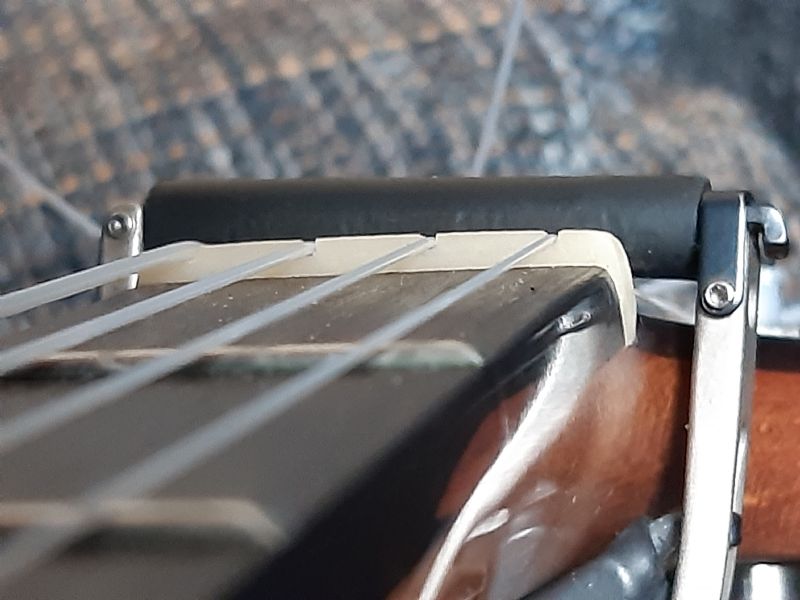
The notion that the strings are too wide for the slots in the nut is plausible. I took the attached photo. It looks to me like they're fully down in the slots, except the fourth string, unsuprisingly.
(My intuition says that a string sitting too high in the nut slot would ring sharp when fretted - it would have to be pushed down more, causing more tenstion. But my fourth string is ringing flat when fretted.)
I am not totally unwilling to do some filing, just hesitant.
Mark ("Strel")
Edited by - Strelnieks on 03/26/2024 00:57:58
Maurice McMurry - Posted - 03/26/2024: 05:03:24
quote:
Originally posted by Bart VeermanThese kinds of comments keep appearing from time to time:
- "Nylgut strings take quite a while to stretch before they are stable in tuning"
- "With nearly 30 years experience with Nylgut strings, I can only say that purity of tone and consistency of diameter is never a certainty with this brand"
- "With nearly 30 years experience with Nylgut strings, I can only say that purity of tone and consistency of diameter is never a certainty with this brand"
- "Nylguts take at least a week to settle in where they're not constantly stretching"
they always make me wonder, why do people keep putting up with problems like that...
This comment made me smile: "create something like the Intonator that would work on a banjo." It's been done, but sorta... it's called a custom compensated bridge. The Intonator gizmo would be too clumsy on a banjo but it could also let you come up with the measurements you need to properly offset the string lenghts with. These measurement can be applied to a banjo bridge's design. Yes, it would mean a custom job and guess what, I used to do just that for over 20 years until I retired. Take a look at bridge numbers 11 & 12 on this page: banjobridge.com/br-08.htm You can read all about intonation on my website as well.
Maurice McMurry - Posted - 03/26/2024: 05:14:34
A have made plenty of custom bridges. A tool that speeds up the process is very helpful.
Joel Hooks - Posted - 03/26/2024: 05:59:48
quote:
Originally posted by Bart VeermanThese kinds of comments keep appearing from time to time:
- "Nylgut strings take quite a while to stretch before they are stable in tuning"
- "With nearly 30 years experience with Nylgut strings, I can only say that purity of tone and consistency of diameter is never a certainty with this brand"
- "With nearly 30 years experience with Nylgut strings, I can only say that purity of tone and consistency of diameter is never a certainty with this brand"
- "Nylguts take at least a week to settle in where they're not constantly stretching"
they always make me wonder, why do people keep putting up with problems like that...
This comment made me smile: "create something like the Intonator that would work on a banjo." It's been done, but sorta... it's called a custom compensated bridge. The Intonator gizmo would be too clumsy on a banjo but it could also let you come up with the measurements you need to properly offset the string lenghts with. These measurement can be applied to a banjo bridge's design. Yes, it would mean a custom job and guess what, I used to do just that for over 20 years until I retired. Take a look at bridge numbers 11 & 12 on this page: banjobridge.com/br-08.htm You can read all about intonation on my website as well.
Aquila polyester "nylgut" strings are extruded. This process very often causes a "false string", which is a string that is uneven in thickness and will not intonate correctly. I personally believe that the intonation problem of a false string is increased by the overtly thick/heavy strings that Aquila adopted for their standard sets.
Then there is the issue of the unwound 4th string (which should have never been offered). For the entire history of the regular 5 string banjo as we know it, the 4th string was wound. Before wire strings, it was silverplated copper wound over silk floss (like a Spanish/Classical guitar). And that was for a good reason.
Aquila was getting complaints about the wire wearing through so they did a switcharoo for the unwound, which sounds dead and flabby and is so thick it rolls under the thumb when played and energy is lost to torque. I'm sure the cost savings of the unwound over the wound was a factor too.
To the OP, take the offending strings off and turn them around and put them back on (put the tailpiece end at the peghead). I believe you have false strings.
By "stretching" I am asking if you followed any of the countless videos on youtube teaching various tricks to stretch out the string? All of those stretching tricks will cause the strings to stretch uneven and make them false.
My personal favorite strings are Labella. Previously, they offered their No 17 (which is actually .019 now-- the trend is to go thicker) in rectified nylon from Dupont. It is my understanding that new sets are no longer rectified. I do not know this to be a fact other than from a phone discussion with my sales person.
The Labella sets I offer are rectified and trued. Also, the Dupont nylon is processed different than the extrusion which gives a truer result. Nylon is also cut resistant and will not develop flat spots at the frets as fast as polyester (nylgut).
Maurice McMurry - Posted - 03/26/2024: 06:11:31
The bridges I make for Nylgut are very different than the bridges I make for steel. Nylgut was created to reproduce the sound of natural gut strings made from sheep intestines. They are a little finicky but far more stable and consistent than gut. I love the sound.
Edited by - Maurice McMurry on 03/26/2024 06:15:14
RV6 - Posted - 03/26/2024: 06:54:35
I made maple nuts for a couple of banjos for use with Aquila's (including a RK OT25). I popped the factory nut out and replaced it with a maple one. I didn't glue the nut in so it was easy to switch back and forth between nuts/strings. String tension keeps the nut in place. I also trashed the thick Aquila fourth string and just used a GHS phosphor wound fourth which worked well.
I've made all of the bridges for my banjos which was fun. I started doing this to see what worked best for me so I could order a professionally made bridge and never got around to it.
Wobba - Posted - 03/26/2024: 08:09:50
I agree with Joel Hooks about the LaBella Classics. But after using them for a long time, I was kind of annoyed with the wound 4th squeaking when I did slides on it. So these days I use a set of Baritone Ukulele strings, fluorocarbon. And I use an old 1st or 2nd string for the 5th string. The Oasis set is a double set for baritone uke, so they're plenty long enough for a banjo.
Oasis Baritone Ukulele Strings, Double Set
Eulalie - Posted - 03/26/2024: 08:45:51
I'll contribute one more observation to add to the levity. The Nylgut strings packaged for banjo constitute one type of string that Aquila produces. They also manufacture a different type of plastic for lute strings, which is more supple and possibly even more accurately extruded. This is what Mimmo began with in an attempt to replicate the sound of gut without the expense and unreliable lifespan. The ukulele and banjo strings came on the scene much later, and they appear to be extruded from a slightly different compound. If you want to create your own set, you can order individual strings from Curtis at Aquila USA.
Bill H - Posted - 03/27/2024: 03:31:31
Two things. If there is a truss rod in the neck, check the bow of the neck--too much can mess with the intonation near the nut. And take note of how hard you press the strings into the fret board. A fret wire with a higher crown may not intonate right if pressed hard into the fret board. See if a lighter touch helps. I have a newer banjo with high crown frets and it took some getting used to. It would sound out of tune near the nut until I acclimated and learned to use a lighter touch.
Sabira - Posted - 03/27/2024: 04:17:57
quote:
Originally posted by StrelnieksBTW - one indication that this machine was not made with nylguts in mind is that the fifth string will not fit in the fifth string nut. I have to put it under the RR spike at 7 and tune it back down to match the first string at the fifth fret. Or start filing away at the fifth string nut, which I am reluctant to do.
Any advice appreciated.
Strel
Joel Hooks helped me out with this problem recently. The string sets I ordered from him at thejoelhooks.com/ include 5th strings that do fit in the 5th string nut on my 1882 banjo.
I am also learning a lot from this thread, and am subscribed to it for more.
This is a wonderful forum. Great folks here. Thanks to all.
Strelnieks - Posted - 05/24/2024: 12:34:07
My apologies for letting this thread die without thanking all the kind people who gave their thoughts and advice.
I ended up filing down the nut on my fretless mountain banjo. That helped a bit. Otherwise I'm just going to adjust my fingering and maybe go back to steel strings. On my open-back fretted banjo I went back to steel strings and I am content with the result. As I said earlier in the thread, I don't think it was designed with nyguts in mind.
When I took the nylguts off, I saved them and marked which end is which so that if I put them back on, I can reverse them as someone on this forum suggested.
Terms of Use | Privacy Policy | Privacy Consent (EU/GDPR Only)
Copyright 2026 Banjo Hangout. All Rights Reserved.


