DVD-quality lessons (including tabs/sheet music) available for immediate viewing on any device.
Take your playing to the next level with the help of a local or online banjo teacher.
Weekly newsletter includes free lessons, favorite member content, banjo news and more.
Premier Sponsors


|
Please note this is an archived topic, so it is locked and unable to be replied to. You may, however, start a new topic and refer to this topic with a link: http://www.banjohangout.org/archive/391767
janolov - Posted - 07/21/2023: 05:41:42
I have chosen Baptist Shout for this week’s TOTW. It is an old-time banjo instrumental recorded by Frank Jenkins in 1927:
Baptist Shout (it has also been labeled as “Babtist’s Shout”) is a banjo instrumental recorded by Frank Jenkins in 1927 (96 years ago!). It was recorded when Jenkins played with Da Costra Woltz’s Southern Broadcasters, but this recording was without accompaniment from the band.
I have found no other early recordings of Baptist Shout, neither before nor after Jenkins’ recording, so it may have been an original composition by Jenkins. It seems to have been a forgotten tune until it was re-released at the end of the 1900's. First time I heard of a tune was in a Homespun video "Old-Time Banjo Styles" from 1994 by Mike Seeger where Kirk Sutphin and Greg Hooven demonstrated old-time three-finger picking, and I have found no recordings between 1927 and 1994.
Baptist Shout has some resemblance with Pete Steele’s Coal Creak March (same tuning and similar melodies and chord progressions). It also has resemblance with Spanish Fandango, Marching Jaybird and similar tunes that usually are played in G tuning (Spanish Fandango also in open C tuning). All these tunes have the following characteristics:
Baptist Shout is played in open D tuning f#DF#AD, also called Reuben tuning or Graveyard tuning. Jenkins played an old-time three-finger style.
The tune is rather easy and uncomplicated and should easily be transferred to clawhammer or two-finger and to other tunings, for example double C/D tuning, see the tab list below.
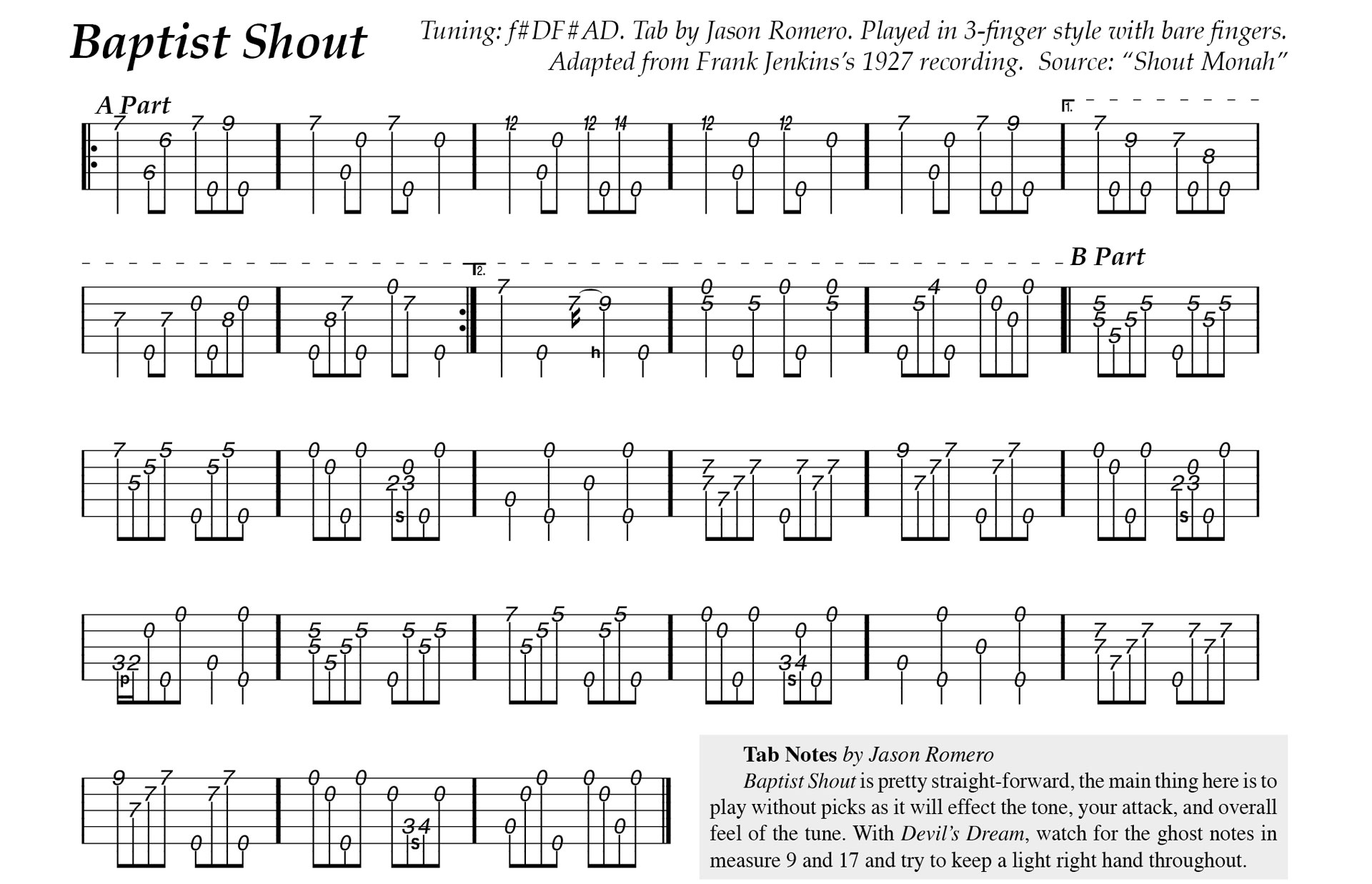
It is basically a two-part tune, but the first part is played with some easy variations (see the tab below). A is the first part, and A' and A'' are variations of A. B is the second part. In the A parts the melody notes are played up the neck on the first string and usually with the other strings open, while the B part is more chord based (with bar chords) and played with arpeggio rolls (the chord sequence is G G D D A A D D). Jenkins played the parts in the following order: A A B A' B A B A'' B A.
J. FRANCIS "FRANK" JENKINS (1888 - 1945) from Dobson, Surrey County, North Carolina was most famous as a member of DaCosta Woltz's Southern Broadcasters, at whose recording session this solo piece was rendered. His father, J. Francis Sr., known as "Old Frank" (ca.1849-1935), played banjo in the down-picking style. Although primarily a sawmill man and tobacco farmer, Jenkins always followed music semi-professionally, performing with medicine-type shows, on the radio and recordings.
Jenkins played banjo in the band Da Costa Woltz's Southern Broadcasters in the 1920s. He later formed his own band, the Pilot Mountaineers, in which he played fiddle, his son Oscar played banjo, and Ernest V. “Pop” Stoneman played guitar.
Frank Jenkins was presented at an earlier TOTW by greenbrooms in 2015 with the fiddle tune Wandering Boy . I also mentioned Frank Jenkins on another TOTW 2019 Home Sweet Home: .
DaCosta Woltz’s Southern Broadcasters

DaCosta Woltz was an American old time banjo player from Galax, Virginia. His band, DaCosta Woltz's Southern Broadcasters played string band and square dance music and recorded in 1927. They disbanded in 1929. The members were
Ben Jarrell and Frank Jenkins would both have their music inherited by their children: Tommy Jarrell and Oscar Jenkins.
The Southern Broadcasters’ recorded legacy was the 18 songs and tunes recorded in three days in Richmond May 5-7, 1927. Some songs and tunes were moderately successful but most of the discs were scarce: for many years the only copies of “Roving Cowboy” and “Jack of Diamonds” in collectors’ hands were barely listenable.
DaCosta Woltz eventually vanished into obscurity after being elected mayor of Galax and swindling the town.
Frank Jenkins played a three-finger style, much built up by forward rolls (T-I-M), backward rolls (M-I-T) and “old-time” rolls (T-I-T-I-M-I-T-I). The enclosed tab shows his playing more in detail.
It has been discussed if Jenkins played two-finger, since his son Oscar played some kind of two-finger (but without fifth string), but I am convinced that he played three-finger on this recording. Jenkins’ father seemed to play down-picking, so each of the Jenkins seemed to have their own playing style.
Links
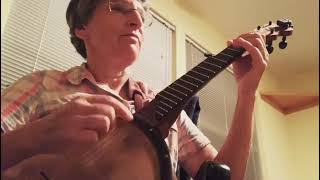
My favourite versions of Baptist Shout are:
There are also some other versions on YouTube that are worth listening to:
I have tabbed out a version based on Frank Jenkins’ recording. It is far from a note-by-note transcription but is my attempt to catch the “flow of music”. When listening to other versions (see above) I have found that there are many ways to interpret the tune: banjohangout.org/tab/browse.as...p;v=26390
I am also working on a clawhammer version. Here is a preliminary tab showing some ideas how the tune can be played in clawhammer f#DF#AD-tuning and still sounding similar to Frank Jenkins’ three-finger version: banjohangout.org/tab/browse.as...p;v=26391
JanetB has also a clawhammer version in double C tuning: mybanjoworld.com/_files/ugd/52...48293.pdf
I once saw a good tab by John Salmon (“sugarinthegourd”), but I cannot find it just now. I remember it as a very accurate tab.
hweinberg - Posted - 07/21/2023: 07:33:39
Great TOTW contribution and a fine translation of the 3-finger version into clawhammer.
Jack Baker - Posted - 07/21/2023: 08:23:29
Jan,
The research and the tabs you present are fantastic. I'm gonna try this one myself...Jack
Edited by - Jack Baker on 07/21/2023 08:25:10
Jack Baker - Posted - 07/21/2023: 09:38:12
Ha! No I just want to fool with the version Jan from Sweden posted...Jack
JanetB - Posted - 07/21/2023: 12:14:35
Wonderfully thorough presentation, Jan! I'm glad I worked on it a while back, so can focus on the information and the many beautiful examples you provided this week. My double C clawhammer version came by listening to Frank Jenkins with a slow-downer which also lets me hear it in any key. I went for ease of fingering in that tuning, though it's still a challenging piece. The video's down-the-neck A part isn't tabbed yet. Somebody once sent me another file of a rather syncopated Baptist Shout, which resulted in my open G tuning tab below, not yet recorded, but of interest because of its tuning with the highest fret being the 9th fret .
Edited by - JanetB on 07/21/2023 12:16:52
chip arnold - Posted - 08/01/2023: 13:39:57
Thanks so much for posting my version, Jan. I got it from Kirk Sutphin, who plays it beautifully.
Terms of Use | Privacy Policy | Privacy Consent (EU/GDPR Only)
Copyright 2026 Banjo Hangout. All Rights Reserved.