
DVD-quality lessons (including tabs/sheet music) available for immediate viewing on any device.
Take your playing to the next level with the help of a local or online banjo teacher.
Weekly newsletter includes free lessons, favorite member content, banjo news and more.
Premier Sponsors


|
Please note this is an archived topic, so it is locked and unable to be replied to. You may, however, start a new topic and refer to this topic with a link: http://www.banjohangout.org/archive/390741
martyjoe - Posted - 05/30/2023: 02:55:33
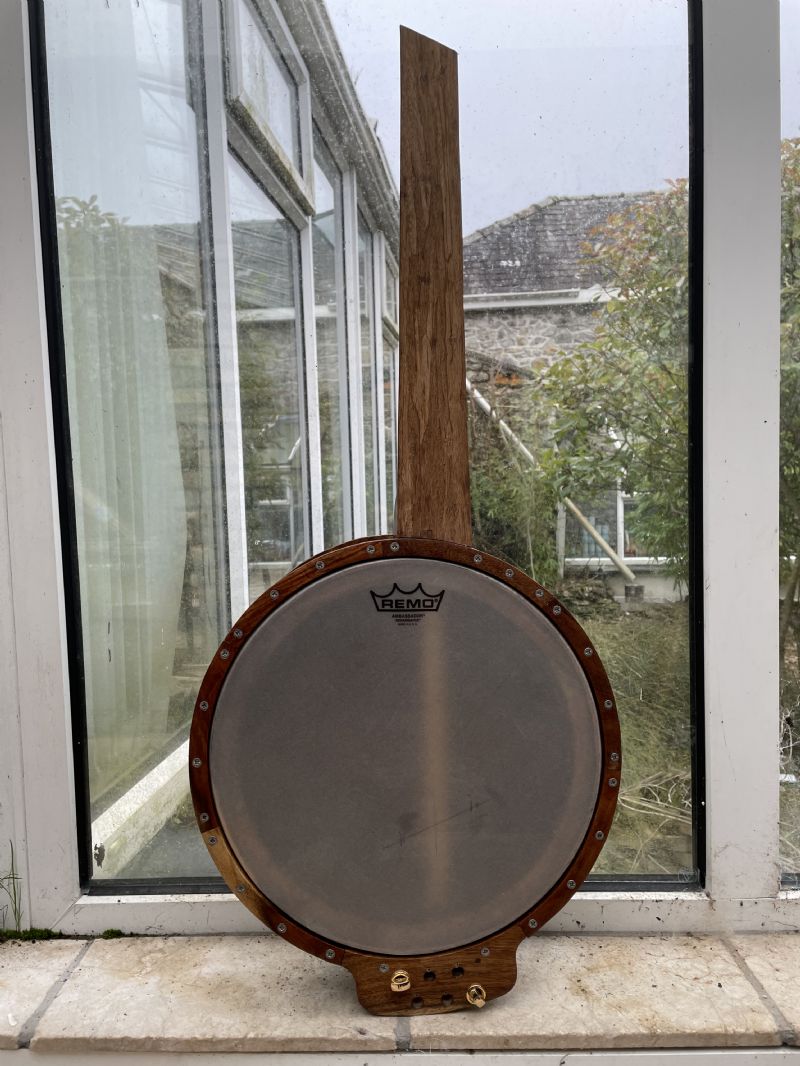
I’m in the middle of building a couple of 6 string banjos for the use in acoustic trad sessions. They will have a low E string of around 27” in length. I’m undecided as to what tuning to put on them, I’m leaning towards standard tuning. You see I can’t play them so they’ll be instruments to pass around at a session. & I won’t be bringing both as I usually bring two tenors & an 18” fiddle anyway.
KennyB - Posted - 05/30/2023: 04:22:01
I've played guitar, 5 string banjo, tenor banjo, and mandolins in Irish trad sessions.
My experience is that I want my lowest note to be G or D, not E. A guitar in standard tuning leaves me wishing for a low D, or forces me to play the next octave up, and ignore the lowest two strings.
Alternate guitar tuning (drop D or DADGAD) doesn't work for me because of the D-A interval on the lowest two strings.
Fifths tuning on a guitar length scale is too much of a stretch. I can handle about a 23 inch scale (19 fret tenor) and I have fairly large hands.
If you're looking to pass an instrument around, I'd suggest a tuning that other players are familiar with.
Personally, I'd like to try a 5 string instrument, tuned GDAEB, like a standard octave-tuned tenor, with an additional high B string. Because of the breaking tension of the high B string, that would limit the scale length to about 20 or 21 inches. Most playing would be on the middle 3 strings, with the low G and high B extending the range in both directions.
martyjoe - Posted - 05/30/2023: 15:25:22
quote:
Originally posted by KennyBI've played guitar, 5 string banjo, tenor banjo, and mandolins in Irish trad sessions.
My experience is that I want my lowest note to be G or D, not E. A guitar in standard tuning leaves me wishing for a low D, or forces me to play the next octave up, and ignore the lowest two strings.
Alternate guitar tuning (drop D or DADGAD) doesn't work for me because of the D-A interval on the lowest two strings.
Fifths tuning on a guitar length scale is too much of a stretch. I can handle about a 23 inch scale (19 fret tenor) and I have fairly large hands.
If you're looking to pass an instrument around, I'd suggest a tuning that other players are familiar with.
Personally, I'd like to try a 5 string instrument, tuned GDAEB, like a standard octave-tuned tenor, with an additional high B string. Because of the breaking tension of the high B string, that would limit the scale length to about 20 or 21 inches. Most playing would be on the middle 3 strings, with the low G and high B extending the range in both directions.
Thanks Kenny for your ideas, plenty of food for thought there. I fully understand jumping up an octave from time to time when I'm playing flute. I'm of the opinion that, to get a quality sound/tone from a low E the string needs to be 27" long & any thing longer is becoming too much of a stretch for most players. These banjos are getting 13" pots the one in the photo has a 12mil (thickness) renaissance drum head as opposed to a regular 8mil banjo head. The other will get a 14mil 2ply clear head which should mellow the bottom end a little more and make a low D achievable. Does the lower D tuning work ok for baking songs?
KennyB - Posted - 05/30/2023: 16:26:54
Drop D or DADGAD tuning on guitars works quite well for backing tunes, for some of the people I play with, just not for me. I've attended 3 or 4 workshops on it and can't seem to get used to that low D-A interval. John Doyle is recognised as the authority on it, he has some published instruction material.
I had a guitar modified by narrowing the neck to 4 strings, originally tuned to DAEB just above a cello, but that was too hard on my left hand, so it's now DGBE, an octave below the highest strings of a guitar. That works but trying to play chords at the low end seems to sound a bit muddy. It's also not loud enough for a noisy session. I expect your 13 inch pot and 27 inch scale will fix that.
I didn't wreck a perfectly good guitar, it was broken to start with.
Helix - Posted - 06/01/2023: 06:20:59
DADGAD
D modal or Double D
The same 14 basic banjo chords a still apply, just simpler and more melody notes.
Laurence Juber of Wings conducted a seminar and then performed in concert with DADGAD
Capoing is allowed.
Open G 4th choice. What was the 3rd, players choice.
Edited by - Helix on 06/01/2023 06:25:57
Leslie R - Posted - 06/01/2023: 06:49:03
G in place of F# ?
Never occurred to me.
I’m sure others have done this plenty.
I need to get out more!
In G tuning, that would be C instead B.
I can’t imagine how it works out, but I will try it.
Terms of Use | Privacy Policy | Privacy Consent (EU/GDPR Only)
Copyright 2026 Banjo Hangout. All Rights Reserved.


