DVD-quality lessons (including tabs/sheet music) available for immediate viewing on any device.
Take your playing to the next level with the help of a local or online banjo teacher.
Weekly newsletter includes free lessons, favorite member content, banjo news and more.
Premier Sponsors


|
Please note this is an archived topic, so it is locked and unable to be replied to. You may, however, start a new topic and refer to this topic with a link: http://www.banjohangout.org/archive/388693
finger-picker - Posted - 02/10/2023: 16:10:33
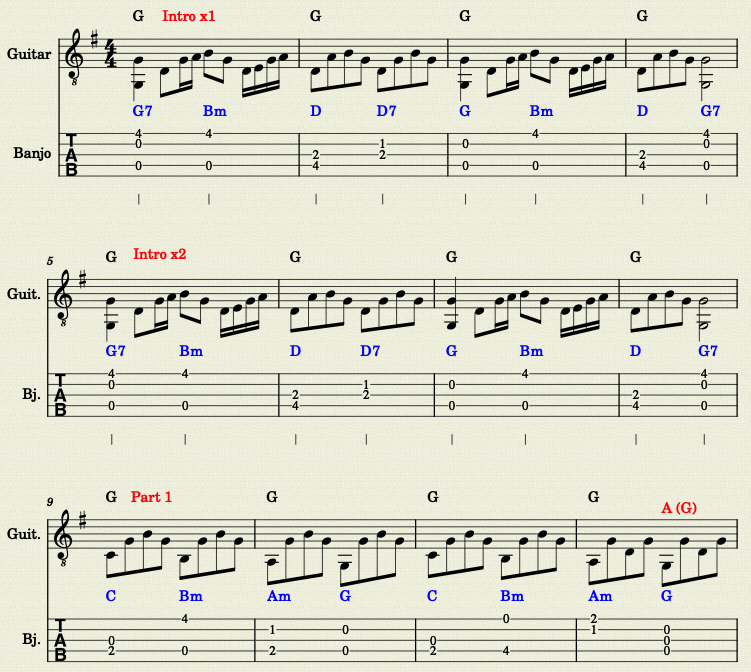
Question: My friend wrote a song on the guitar and although it sounds good, it’s virtually void of any chord progressions. Asking him to change his arrangement aside, what are my options to pick or strum chord segments that won’t sound robotic in nature?
Additional context: I’m just learning to write harmony parts. His first 8 bars are comprised entirely of G Maj chord (GBD) notes with a few passing tones here and there. Every beat 1 of each of the 8 bars are: GDGDGDGD. So to harmonize each beat 1 G I could pinch a B and D and every beat 1 D I could pinch an F# and A. But then it sounds humdrum if I do just that.
Thanks and hope that wasn’t confusing.
thisoldman - Posted - 02/10/2023: 18:53:26
I took the liberty of scoping out your homepage and watching some of your videos. You have some skills, so you should be able to handle this.
A couple of questions: (1) is your friend accompanying the song by strumming chords? Playing a melody line here and there? Some sort of repetitive picking pattern? Something else?
(2) What do you hope to accomplish with your playing? Do you want to do something simple, like the pinching you are doing, with a bit more variety, or are you looking to do something more complex, adding some "color" to your backup? Do you want to play a solo/break during the song?
With your clawhammer video, you are showing the bum-ditty, drop thumbing and double thumbing. It would appear that you could add some rhythmic and melodic variation in your backup playing with this.
You play "fingerstyle" as well. Lots of options there. Different vamping patterns to add rhythmic variation and using tonal variation moving between positions up and down the neck. Look at Travis style picking (Eddie Collins' video on youtube) for another idea. Some up the neck 3 finger backup...you've got partial or full D and G chords at the 10th through 12th chords for example. Others will probably have more (and better) ideas.
It might help others if you did an audio recording of the song with just your friend playing. Knowing the tempo of the tune is important. I am sure that one of the suggestions will be to make sure your friend's playing is in the forefront, and what you add to the mix is subtle and complements your friend's playing.
Edited by - thisoldman on 02/10/2023 18:57:23
Old Hickory - Posted - 02/10/2023: 19:04:04
Roll through it. Play licks. Play scale-based patterns. Play arpeggios that run up and down the neck. Do sixth patterns up and down the neck. Play G pentatonic patterns -- you can't hit a bad note.
If by "harmony" you mean playing something that supports and complements the melody, then the types of things I mentioned work. Some of them will be a type of counterpoint.
You can do just basic backup such as chord vamping. Alternate chord positions.
If by harmony, you mean notes simultaneous with the melody, then what you described is a start. You can try playing thirds above each melody note. I assume there's more to the melody than G and D that the measures start with.
This is all basic harmony concepts. Please realize we know next to nothing about the song. Especially the melody. And not knowing the melody we cant really know what works as harmony.
Wobba - Posted - 02/11/2023: 01:27:31
Since you mentioned pinches I assume you're playing fingerstyle. With a lot of G I'd try just noodling on the G pentatonic scale and see what sounds good. Or you could try throwing in E minor chord instead of G and A minor instead of D. Heck, even tossing in a B minor at the right spot can add some real spice to what you're playing. Inserting ii, iii and iv into a I IV V chord progression is the easiest way to make it more interesting. I'm not saying to put all three in. Start with E minor, see how that goes, then try and A minor. Maybe it works, maybe it doesn't. Next try a B minor. Same.
Also, you don't have to play the full chord, you should just use the root, so: E, A and B. Use them to add some interest to what your playing. So, instead of picking G, pluck it and hammer down on the 2nd fret to see how that sounds. Same thing with D, pluck the 1st or 4th string and hammer down on the 2nd for an E. On a G try instead plucking the 3rd string at the 2nd fret and sliding to the 4th fret for a B. Instead of just plucking the 1st string for a D, try plucking the 2nd string at the 2nd fret and sliding to the 3rd fret for a D. You could also try the reverse of the hammer ons with pull offs. Adding these types of slurs to your boring notes will add interest to what you're playing. It does require some time to see what works were. Don't over use these, Treat them like olives: a couple here and there for flavor.
Alex Z - Posted - 02/11/2023: 06:32:17
"what are my options to pick or strum chord segments that won’t sound robotic in nature?"
As a general principle, thirds and sixths up and down the neck, in between the vocal phrases, going from one G chord position to another. All the scale tones can be used, yet the underlying chord structure is always G.
A lot of how to accompany, complement, counterpoint, or harmonize (all different concepts) depends on the style of the melody. Posting the melody would help the advice you get, immensely.
finger-picker - Posted - 02/11/2023: 07:05:20
Please see attached PDF. My friend is using fingerstyle on the guitar (i.e. not strumming chords) and yes I am asking about Bluegrass/Scruggs/fingerstyle backup for my arrangement of a harmony line to go alongside his playing the melody and singing the lyrics. I first thought that I was limited to pinching or vamping chords but as I've read your replies I see that I have a ton more options for the backup. I don't plan on playing any lead breaks at this time although once I have some initial groundwork laid with my backup, perhaps that would be a viable option to explore in the future.
This is my first piece I have ever tried to play alongside someone else's instrument (jamming) so I am a little intimated by the whole process.
Edited by - finger-picker on 02/11/2023 07:07:04
Alex Z - Posted - 02/11/2023: 11:58:24
Thanks for posting. No vocal, no pauses between phrases. So can skip the 3rds and 6ths between phrases. 
For the chordal analysis, might tend to the overall sound of the 4-note blocks, as the chord is not necessarily going to be whatever the first note is.
Once you have the chord sounds that you want, one thing I've done is do a progression of those chords gradually up the neck or down the neck. Just for example, G at the 5th fret, Bm at the 9th fret, D and D7 at the 7th fret, back to G at the 5th fret. Gives the accompaniment some direction, compared to all the chords within the first 4 frets.
Experimentation will be fun. Enjoy.
Old Hickory - Posted - 02/12/2023: 08:04:20
There is much to be said for listening to recordings that include three-finger banjo as backup or accompaniment.
Terms of Use | Privacy Policy | Privacy Consent (EU/GDPR Only)
Copyright 2026 Banjo Hangout. All Rights Reserved.