DVD-quality lessons (including tabs/sheet music) available for immediate viewing on any device.
Take your playing to the next level with the help of a local or online banjo teacher.
Weekly newsletter includes free lessons, favorite member content, banjo news and more.
Premier Sponsors


|
Please note this is an archived topic, so it is locked and unable to be replied to. You may, however, start a new topic and refer to this topic with a link: http://www.banjohangout.org/archive/387836
finger-picker - Posted - 12/31/2022: 12:09:55
Is there a way to determine the chord progression of each measure if studying just the melody notes and you know what key a song is in or is it more complicated than that?
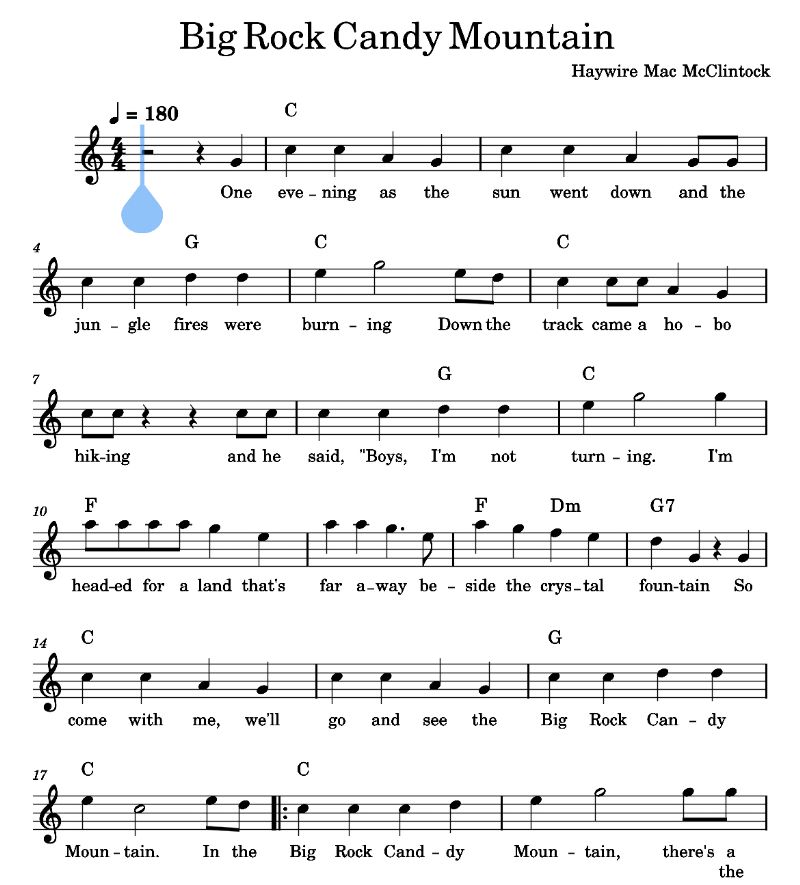
I posted an example of BRCM melody in C and chords were already listed. Wouldn't have been able to determine when it jumps to G early in the song for instance or when it goes to Dm from F.
Starting to experiment writing my own Scruggs and clawhammer songs and am at a loss when bar chords are not listed.
Edited by - finger-picker on 12/31/2022 12:15:05
Old Hickory - Posted - 12/31/2022: 13:58:31
quote:
Originally posted by finger-pickerIs there a way to determine the chord progression of each measure if studying just the melody notes and you know what key a song is in or is it more complicated than that?
It's not necessarily more complicated. But to the best of my understanding, the only way to determine the chords working with only a melody line is by ear: playing the melody and trying likely chords based on the key and current note. Once you find the first chord, which is often, but not always, the root or "I" (one) chord, you keep playing that chord until it's obviously wrong. Then you use your knowledge of music theory which tells you the most likely chords to be used in a key and try the chords that harmonize with the note on the chord change until you find the one that sounds best. Then you continue this process.
Use all the songbooks and chord+lyric sheets at your disposal to become familiar with the various chord progressions in the type of music you're playing and especially to see where chord changes occur. I think that will always be at the start of a measure in 2/4 and sometimes in the middle of a measure (the count of "3" in 4/4 . There may be the occasional oddball chord change. But rules of thumb will cover the vast majority of bluegrass, folk, traditional country, blues, and rock.
One of the best demonstrations of this I've seen is in this 2-part video by a music teacher named Karen Ramirez, who I assume offered these sessions in music stores to help sell organs. While her demonstration is on a keyboard, the concepts apply to any song you might want to play by ear. She uses Silent Night.
Also, she doesn't even use the sheet music for the melody, except for the first note, so you have more material to work with. After part 1 ends (and I start in the middle), part 2 should be next up.
Texasbanjo - Posted - 12/31/2022: 14:19:43
If you're trying to do it by ear, it's usually by trial and error until you get familiar with chord progressions.
If you go to jams, watch the rhythm guitar picker and when he changes chords, you do, too. Don't play guitar? Ask a guitar picker to show you some basic chords: G, C, D, A, E.
Not any jams in your area? If you know the key of a song, start off (as said above) with the key or root chord (in the key of G, the root would be G), play that G until it doesn't sound right. Then try either a 4 or a 5 chord (C or D). Usually one of them will sound right. A song usually ends with a root chord and the chord right before that is often a 5 chord. When the chorus chord progression is different than the verse, try starting off with a 4 chord (C) and then a 1 chord.
Remember: most bluegrass songs are simple 3 chord songs, maybe 4 chords. Usually 1, 4, 5 chords with maybe a 6m or 2m and occasionally you'll have a 7dim. When hunting chords think: 1, 4, 5, 2 , 6, 7 with an occasional 3, with the 2, 3, 6 and 7 being your last pick of chords.
The more songs you learn, the easier it is to hear the changes and you'll begin to feel a change coming up. Many times if you listen, you'll hear a run up or down to the next chord either by one doing the break or by someone doing backup.
You'll also find that many songs have the exact same chord sequence, just a different melody.
mmuussiiccaall - Posted - 12/31/2022: 15:19:04
Here's the theory:
Write out the steps of the scale of the melody notes and match up the numbers to those in the chords allowing for the occasional passing notes. BTW there are missing chord changes in this arrangement, can you spot them?
Edited by - mmuussiiccaall on 12/31/2022 15:20:40
finger-picker - Posted - 12/31/2022: 16:50:51
quote:
Originally posted by Old HickoryOne of the best demonstrations of this I've seen is in this 2-part video by a music teacher named Karen Ramirez, who I assume offered these sessions in music stores to help sell organs. While her demonstration is on a keyboard, the concepts apply to any song you might want to play by ear. She uses Silent Night.
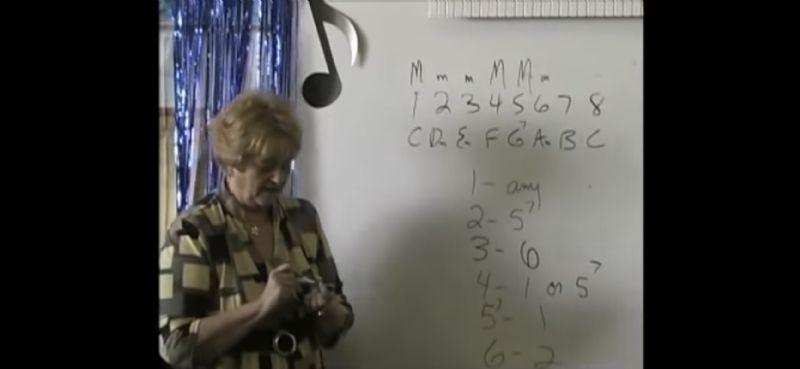
You know I actually watched one of her videos earlier on determining chords, took a screen shot of a handy tool she wrote out when determining where chords will typically jump to when they jump (see attached).
finger-picker - Posted - 12/31/2022: 16:59:30
quote:
Originally posted by mmuussiiccaallHere's the theory:
Write out the steps of the scale of the melody notes and match up the numbers to those in the chords allowing for the occasional passing notes. BTW there are missing chord changes in this arrangement, can you spot them?
Thank you Musical, that's really helpful. Looks like maybe:
Would taking into account any other chords be helpful, such as VIm ?
Edited by - finger-picker on 12/31/2022 17:02:37
wrench13 - Posted - 12/31/2022: 20:08:31
I write a good number of fiddle tunes for my pirate band. After I get the melody hammered out, it a matter of listening to what chords might fit and sound like I want the song to sound like. One section might fit with a C or Am or F or G or some passing chord, just have to listen to what they sound like against the melody and the feel I want.
banjoak - Posted - 01/02/2023: 17:43:45
quote:
Originally posted by finger-pickerIs there a way to determine the chord progression of each measure if studying just the melody notes and you know what key a song is in or is it more complicated than that?
I posted an example of BRCM melody in C and chords were already listed. Wouldn't have been able to determine when it jumps to G early in the song for instance or when it goes to Dm from F.
Starting to experiment writing my own Scruggs and clawhammer songs and am at a loss when bar chords are not listed.
Essentially - listen, see how it sounds.
I don't think you can find any magic algorithm, formula, calculus to determine a singular "right" chords. You will find many examples that would seem to violate those "rules".
That said, you can look at what's happening in the tune and maybe narrow down, or get various ideas of what "might" harmonically fit, or options which push the character of the tune another direction/feel; create different types and degrees tension/resolve, and/or flow. It's important to zoom out, listen to the big picture of the overall composition, phrasing, balance; and overall structural theme. There is a bit of subjectivity.
Again, a lot comes down listening to lot's of examples, observing and acquiring experience of how different chords effect.
As far as that chord arrangement, it works just fine; and isn't necessarily "missing" any changes. Not to say other possibilities exist, I can think of quit a few... but for CH probably wouldn't go that route.
Edited by - banjoak on 01/02/2023 17:47:43
Jerry Hatrick - Posted - 01/03/2023: 01:30:54
Until you develop a good ear for working out tunes and chord progressions by ear, I always found it easier to work it out on pen and paper. Once you have the melody line and the key within which it flows, then you can search out which chords best correspond with the melody, if you work out the basic notes of the main chords in that key - C (c,e,g), G (g,b,d), F (f,a,c), Am (a,c,e), Dm (d,f,a), etc. Clearly, you don’t really want to change chord for every change in the melody note, but rather just the main ones, such as those at the beginning of each measure (bar), or half way through it. In the above example, the main notes of the first couple of measures sit happily within a C chord, but by the time the melody starts to pivot around the a note, then a chord change is needed (such as F, though sometimes it might be more interesting to use Am or Dm). When the melody reverts to notes like c, e and g, you can safely return to C, though c does still work against the F chord.
Familiarity with standard chord progressions certainly makes this approach a lot easier, eg many folk, country and bluegrass songs follow a basic underlying pattern, starting and finishing on the home chord and dangling halfway through on the seventh chord:
C/C/F/C
C/C/C/G
C/C/F/F
C/G/C/C
Am I the only one that prefers this much less hit or miss approach? It might sound a bit longwinded but until recently, published sheet music and songbooks didn’t contain any chord symbols and you had to work them out themselves. Actually, fiddle tune books still don’t give you chordal accompaniments in the main, but again many fiddle tunes work against the above skeletal progression.
Terms of Use | Privacy Policy | Privacy Consent (EU/GDPR Only)
Copyright 2026 Banjo Hangout. All Rights Reserved.