DVD-quality lessons (including tabs/sheet music) available for immediate viewing on any device.
Take your playing to the next level with the help of a local or online banjo teacher.
Weekly newsletter includes free lessons, favorite member content, banjo news and more.
Premier Sponsors


|
Please note this is an archived topic, so it is locked and unable to be replied to. You may, however, start a new topic and refer to this topic with a link: http://www.banjohangout.org/archive/385706
Stephen Rapp - Posted - 09/15/2022: 20:01:41
This week’s TOTW is one of two versions of a tune called Calico. This version is a Kentucky tune from the playing of Jim Bowles. On fiddle it’s traditionally played in cross tunings such as GDGD or AEAE. The other version, which I’m leaving for future TOTW submissions, is by Marcus Martin and is played in Calico tuning on fiddle–AEAC#. According to Jeff Titon in his book Old-Time Kentucky Fiddle Tunes (via Jim Nelson), Bowles learned the tune from Thomas Page. It notes there are similarities between Bowles Calico and Marcus Martin’s Citigo. I don’t know if that implies much, but certainly worth mentioning.
From Tunearch.org:
CALICO. AKA and see "Want to go to Meeting and Got No Shoes." American, Reel (cut time). USA; Mississippi, south-central Kentucky. A Mixolydian ('A' part) & A Major ('B' part). AEae or GDgd tuning (fiddle). ABB. There is an Appalachian fiddle tuning called 'Calico' tuning, or AEac#, but source Bowles' tune plays much easier in when the instrument is tuned in AEae or GDgd. A different "Calico (2)", often called "Marcus Martin's Calico" and a different tune, is played in AEac#, or 'Calico' tuning.
Calico is an all-cotton fabric woven in plain, or tabby, weave and printed with simple designs in one or more colors. Calico originated in Calicut, India, by the 11th century, if not earlier, and in the 17th and 18th centuries calicoes were an important commodity traded between India and Europe.
A tune by this name was learned by south-central Kentucky fiddler Jim Bowles (1903-1993) from local musicians, although his cross-tuned version was supposedly not widely known outside his area. Jim Nelson maintains that Bowles learned the tune from Thomas Page (Titon, 2001). Titon says the melody is similar to Marcus Martin's "Citaco." The tune was recorded by Herbert Halpert for the Library of Congress from the playing of Lauderville County, Mississippi, fiddler Stephen B. Tucker in 1939. A rhyme sung to the tune goes:
Don't care where in the world I go,
Can't get around for the calico.
Like most cross tuning fiddle tunes, this can be played in lower keys from F to A. Bowles is likely tuned closer to F than G. I think most people play this in G which is handy for banjo players. It should be noted that Bowles plays an A part and a B part, but occasionally throws in a part that is basically a variation of the A part. If you look up videos of people playing the tune, some consider that variation as a separate part and mix the parts up to reflect that. Like any fiddle tune, everyone can make their own choices in playing it. I think it’s more common the just play the A/B version two or three times and then play the variation in place of an A part.
The tune starts with a couple of quick lead-in notes, That first measure can be played a few different ways. In my own tablature I put another take on that first measure in the second half.
I originally learned my version from Erynn Marshall’s CD which is titled Calico. Her and Carl sing the verse noted above from a Mississippi version. A nice personal touch, I think. Here’s a link to hear that version: Erynn Marshall's version
Give a listen here to Bowles version on Slippery-Hill: Slippery-Hill
*As a side note: Consider donating a few bucks to support Larry Warren’s Slippery-Hill website. It’s become the most popular source for fiddle tunes on the web and due to high traffic, their web host fees have gone up.
Don Borchelt - Posted - 09/17/2022: 07:22:45
quote:
Originally posted by Stephen RappThis week’s TOTW is one of two versions of a tune called Calico. This version is a Kentucky tune from the playing of Jim Bowles. On fiddle it’s traditionally played in cross tunings such as GDGD or AEAE. The other version, which I’m leaving for future TOTW submissions, is by Marcus Martin and is played in Calico tuning on fiddle–AEAC#...
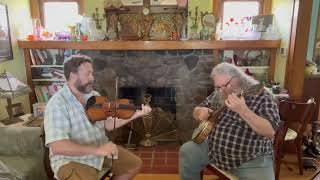
This is a really fine tune, Stephen, and you and Paul do it great justice. I have heard it but had never tried to play it before, so I spent all day yesterday fussing with it, instead of doing my yard work. I've attached an MP3 of what I have come up with, in three finger style picking in standard G tuning. If anyone is interested, I have posted the tab here.
Here is a link to Marcus Martin's Citigo on Slippery Hill, in case anyone is curious about the similarity to Bowles' Calico. It sounds pretty close to me, but Martin doesn't hit that low E (in key of G).
I already play Martin's Calico, so I'm ready for you when you get to it!
Edited by - Don Borchelt on 09/17/2022 07:26:09
JanetB - Posted - 09/17/2022: 10:21:11
A tasteful, rustic duet by you and Paul. I say rustic, because it's exactly what I'd want to hear if I was rocking on the porch, a favorite way to enjoy this music. And Don, your playing has a magical banjo fullness all on its own.
As for my arrangement here, I found the syncopation in Jim Bowle's version challenging enough to cause me to break clawhammer "rules," using the thumb on downbeats. Additionally, the way I hear the Slippery Hill recording there are A and B parts, but then he has an alternate A part, too. After playing it, he goes back to the B part, thus my assumption that the third part is a variation on the first part.
Since the source recording was closer to F, I also worked it out in an F tuning -- fDGCD, but after looking at your tab, Stephen, went with the open G tuning and found it easier. (And I really like how you play straight clawhammer accompaniment that gets the melody with rhythm and blends with the fiddle.) I'm not sure about using the key of A, but Slippery Hill states: "The Milliner-Koken book lists all cross tunes in the key of A (AEAE) despite what cross tuned pitch the fiddler may have been using."
This is the third Jim Bowles tune I've learned, including Apple Blossom and Christmas Eve. I haven't looked up yet the alternate title for Calico -- Want to Go to Meeting and Got No Shoes. Let's hope that the other Calico is selected as a TOTW soon, too.
RG - Posted - 09/17/2022: 13:04:38
Great choice Stephen! Can never go wrong with some Jim Bowles. This is by far my favorite tune to play on the fiddle, always in cross G, have never played it on banjo oddly enough though-haha!
Stephen Rapp - Posted - 09/18/2022: 11:53:00
Wow, Janet! I'm amazed at the complexity of your arrangements. You learned well from Adam it seems.
Stephen Rapp - Posted - 09/18/2022: 11:53:35
quote:
Originally posted by RGGreat choice Stephen! Can never go wrong with some Jim Bowles. This is by far my favorite tune to play on the fiddle, always in cross G, have never played it on banjo oddly enough though-haha!
Thanks RG!
Don Borchelt - Posted - 09/21/2022: 18:20:49
quote:
Originally posted by JanetB
...Additionally, the way I hear the Slippery Hill recording there are A and B parts, but then he has an alternate A part, too. After playing it, he goes back to the B part, thus my assumption that the third part is a variation on the first part...
A wonderful job of picking, Janet, I love the bluesy feel you have instilled in it, it really kicks. I had the same feeling about the variation- that it was an alternate A part, and that's how I worked it in, too.
Terms of Use | Privacy Policy | Privacy Consent (EU/GDPR Only)
Copyright 2026 Banjo Hangout. All Rights Reserved.