
DVD-quality lessons (including tabs/sheet music) available for immediate viewing on any device.
Take your playing to the next level with the help of a local or online banjo teacher.
Weekly newsletter includes free lessons, favorite member content, banjo news and more.
Premier Sponsors


|
Please note this is an archived topic, so it is locked and unable to be replied to. You may, however, start a new topic and refer to this topic with a link: http://www.banjohangout.org/archive/384628
kbiinde2 - Posted - 07/24/2022: 08:29:24
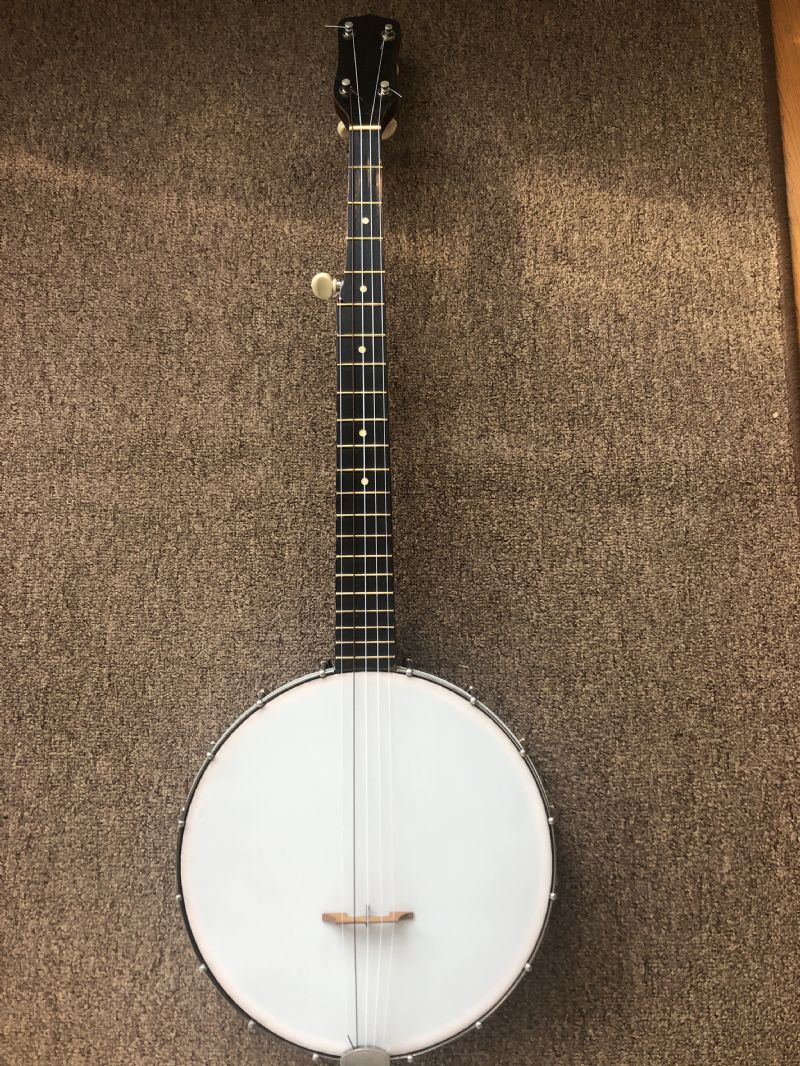
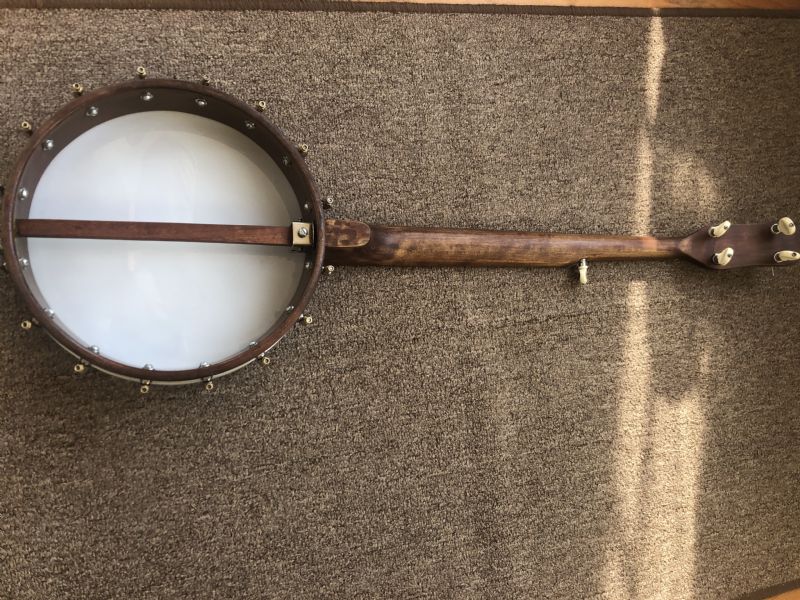
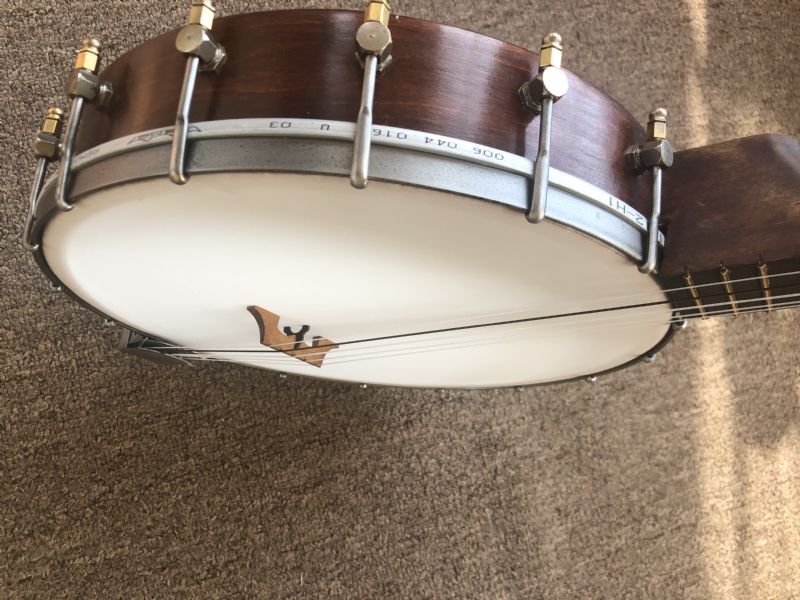
Just refurbished an Open Back project with new head, tuners, a good cleaning on the hardware, and a replaced dowel stick. With no truss rod, and just not wanting the stress of higher tensioning string tuning, what tunings do most use in this case.?
raybob - Posted - 07/24/2022: 08:44:15
I just did some work on an old Lyon and Healey with no truss rod. I have a set of Chris Sands nylons on it, and I'm using standard tunings. I think things are fine so far. (The strings were my last set. I know they're not available anymore, but I'm expecting them to last quite a while, except for the wound one.)
rmcdow - Posted - 07/24/2022: 09:21:24
I've had a few of these openbacks, and have not had any difficulty with the neck getting stressed. Here is a good way to find out how much additional stress is going to be applied when you tune to different tunings, with the same set of strings. On the site, I believe it comes up with guitar tuning, but below you can choose 5 string banjo tuning, with nylon strings. Then choose the editor, and you can change your scale length, string size, note that you are tuning to on each string, then calculate the tension on the strings.
chordgen.rattree.co.uk/tensiontool.php#
hbick2 - Posted - 07/24/2022: 09:24:40
You shouldn't have to worry about string tensioning, particularly if you are using nylon strings. I can't tell without more pictures, but your banjo may be able to accommodate steel strings, too. I have dozens of old banjos and none of them have truss rods. They are all fine. It shouldn't matter.
Whatever strings you use, tune your banjo up to standard pitch: Open G, Open C,
Double C, etc. If you want to play in A or D, use a capo. You can't let the banjo determine your tunings. It should handle them all.
kbiinde2 - Posted - 07/24/2022: 09:49:08
Other than a couple of ukulele builds, this is my first experience with nylon strings and my first open back with dowel stick.. so treading on the cautious side..
I have a set of "regular" strings handy, so I can switch if these don't work out.!
rmcdow - Posted - 07/24/2022: 12:30:04
I checked in my notes for string tensions on a 26.5" scale banjo, using different sets of strings. I tested a few of the tensions, using a force indicator I mounted on the tailpiece, that are indicated on the website I listed above, and the tension was pretty close to the theoretical listed there. The results were interesting, given all the back and forth about old banjos and gut strings being strung with steel strings. I have acquired at least 10 banjos over 100 years old that were strung with steel strings when I got them, measured and saved all the steel strings for my records, and also had gut strings made from a variety of manufacturers that I have also tried on various banjos. Here is the interesting information I have recorded. Scale length is 26.5" on all these calculations and banjos used for actual testing.
Period gut gauges are. 017", .019", .023", .024w, .017", as reported by John Cohen. This set of gut strings calculates to approximately 35 pounds of tension using the tension tool website listed. I have been unable to locate well made .017" gut strings, but the .018" varnished gut string I got from Olav, which are very well made strings, broke under tension on the first string. A set of strings from Olav with a tension of 16 kg (35.2 pounds) were gauges .018", .020", .030", .034" or .032"w, .018". These were nice strings, heavier than the period gut strings indicated by John, but of the approximate same tension. I didn't find that a lighter set of gut strings worked; they kept breaking. John has indicated that the gut from that period was able to hold a greater tension, as the quality was different/better. I have worked with Optima in Germany, and have confirmed that higher quality gut that will hold a greater tension is very difficult, if not impossible to locate. Olav recommended .0205", .0236", .0287", .040", .0205", which I also tried. The 4th unwound string was a bit heavy at first, but I got used to it. The calculated tension of this set is about 45 pounds.
Classic banjo Aquila medium 1B strings are .0225", .027", .0315", .-250"w, .0245". These calculate out to about 49 pounds of tension.
Classic banjo Aquila light 2B strings are .0205", .024", .027", .0305"w (with nylgut center), .02". This set calculates out to about 45 pounds of tension.
There are other sets of nylon strings and gut strings that I have tested, but these give a pretty good idea of baseline tensions for the gut, nylgut, and nylon strings.
Steel strings, in this case Optima light: .009", .011", .013", .020"w, .009". These calculate out to about 56 pounds of tension.
Based on this, and my more extensive testing of individual strings on a banjo set up with the force indicator on the tailpiece, I have not worried a lot about putting a light set of steel strings on an older banjo without a truss rod, as long as the neck appears to me to have the strength to hold the strings, is still straight after having steel strings on it when I got it (I measure them, and most of the time they are a bit heavier than the light set indicated above. I agree completely that one needs to make sure there are steel tuners on the banjo rather than ebony pegs, that the nut is going to take the steel string, and that the bridge is also going to take them. I prefer the gut strings over the steel strings on this kind of old banjo, and have a wide range of them from several manufacturers. Unfortunately at this time Clifford-Essex's store seems to be offline, as their gut strings were one of the most affordable sets, maybe a bit on the heavy size, but they mounted up and worked well. Their set didn't have a wound 4th, so based on the National (Bell brand) silver wound over gut strings that I have (gut is completely hard, so they are not usable, I have tried), I used a .024" wound over nylon to calculate the tension. It comes out to 56 pounds.
I hope that my long post is of some use to anyone who is interested in gut vs steel vs nylon and nylgut. The information and research has been useful to me.
kbiinde2 - Posted - 07/24/2022: 15:49:43
Rives, I feel I should be sitting in a lecture hall looking at the overhead projector screen, taking copious notes to study when I return to my dorm room.! You present an interesting read and study on the topic. Thank you, and also to a great and informative forum.
rmcdow - Posted - 07/24/2022: 16:12:08
quote:
Originally posted by kbiinde2Rives, I feel I should be sitting in a lecture hall looking at the overhead projector screen, taking copious notes to study when I return to my dorm room.! You present an interesting read and study on the topic. Thank you, and also to a great and informative forum.
You are very kind:<).
One thing I forgot to mention is the reason I like to use the tension calculator mentioned above and here:
chordgen.rattree.co.uk/tensiontool.php#
I have noticed that sometimes the tension on sets of strings I acquire vary considerably from string to string, and this makes it a bit difficult at times when playing. It seems to be better to have all of the strings to be at a tension that is similar, and checking the theoretical tension on the calculator can explain at least some of this. Another factor is the size of the string. A thick string can feel like a solid pole even when strung at a low tension, and I find that strings above about .032" start to get into that territory, again depending on the tension at which they are strung. The 4th string is the hardest one to get right, as is also evidenced by the long history of different people working with that string. As I said above, the .040" 4th gut string that I tried, after I got used to it at the tension it was strung, didn't feel that way, but if I strung it with a different set of strings, it did, so it seems that the variation in tension from string to string is important.
I try and get all the tension pretty close to the same, within about a pound, when stringing up a banjo, and again, the 4th string is the one I have to work with to get that balance. I'd be interested to know what people who are accomplished banjo players think about this. I am a complete banjo playing novice, and enjoy building things, including banjos, more than playing them.
Bill H - Posted - 07/25/2022: 03:31:41
If that is a late 19th or early 20th century banjo with a spun over pot, it is the perfect banjo for nylon strings. I have a couple of these, and they shine with nygut strings. you may need to experiment with different strings and bridges, but my old 1895 Bay State banjo has plenty of volume and a beautiful tone.
Terms of Use | Privacy Policy | Privacy Consent (EU/GDPR Only)
Copyright 2026 Banjo Hangout. All Rights Reserved.


