DVD-quality lessons (including tabs/sheet music) available for immediate viewing on any device.
Take your playing to the next level with the help of a local or online banjo teacher.
Weekly newsletter includes free lessons, favorite member content, banjo news and more.
Premier Sponsors


|
Please note this is an archived topic, so it is locked and unable to be replied to. You may, however, start a new topic and refer to this topic with a link: http://www.banjohangout.org/archive/383563
banjola1 - Posted - 05/31/2022: 21:04:18
I know someone has probably brought this topic up before, but here goes anyway -
Here are the notes of a G major scale :
G - A - B - C - D - E - F# - G
G scale notes are all over the neck and it's difficult at first to imagine and organize them. The following method can be used to discover G major scale notes laterally along each of the first three open strings on your banjo. Find all these notes and you'll have the key of G,
The first step is to play the familiar G chord on the first three open strings of your banjo.
Starting with the first string, play a note on each fret going up the neck while comparing how it sounds to the open G chord.
If you listen carefully, here's what you'll discover as you ascend the neck:
1.) Notes that sound just like a notes of the open G major chord.
2.) Notes that sound close to the open G chord but but don't really sound that bad.
3.) Notes that sound really bad and out of place when compared to the open G chord.
You want to keep the first two kinds of notes and reject the ones that sound really bad. Chances are that the notes that sound bad are outside of the G major scale. Now perform the same process of comparison going up fret-by-fret on the second and third strings. (Hint: Overall, there are only 4 really bad sounding notes)
That's it!
No tablature, no naming notes, no problem!
It's easier to visualize and comprehend the notes on a single string than playing them across the neck in a closed position. Repeat the process as many times as it takes to form your own survey of which notes seem to merge with a G chord and which notes sound bad. Trust your ears. Learning to play along a string is important. If you keep identifying the good sounding notes, they will become second nature and a natural pattern will begin to emerge.
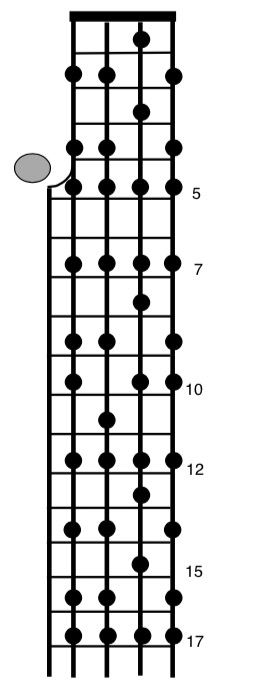
Attached is a key that has all the good notes of G major identified. It represents the key of G. Compare this information with your own discoveries. Weed out those really bad notes by ear and discover the key of G major.
Edited by - banjola1 on 05/31/2022 21:06:51
Greg Denton - Posted - 06/01/2022: 03:57:26
I encourage people to play through a major scale in two ways.
Once you've identified the notes: G - A - B C - D - E - F# G
Descend from 'C': C B - A - G, then B-A-G, then A-G.
Then Ascend from 'D': D - E - F# G, then D - F# G, then F# G.
This helps your ear to become familiar with the sound character of each note in relation to the "root" G note. It's a good way to train your ear to recognize what note of a scale you're hearing.
The other thing I encourage people to do is not to play through the scale notes in straight ascending or descending order.
Try playing A to G, C to B, E to D, and F# to G
What you will hear is musical tension that resolves to a feeling of rest. Landing on a G note has a sense of finish to it.
The "tension" notes (A, C, E, F#) create an expectation that something is about to happen next. The "resolution" notes (G, B, D) have a sense of "arrival" or "rest". The G note has a sense of "home" or "destination".
Then try playing through all the tension notes (in any order and with any rhythm) A, C, E, F# and then landing on one of the resolution notes G, B, D.
You'll find that you're not just practising the scale and getting familiar with it on your fretboard, but "using" the scale to play musical ideas, and building an understanding of how melody works.
banjola1 - Posted - 06/01/2022: 06:27:19
quote:
Originally posted by Greg Denton
What you will hear is musical tension that resolves to a feeling of rest. Landing on a G note has a sense of finish to it.
The "tension" notes (A, C, E, F#) create an expectation that something is about to happen next. The "resolution" notes (G, B, D) have a sense of "arrival" or "rest". The G note has a sense of "home" or "destination".
Then try playing through all the tension notes (in any order and with any rhythm) A, C, E, F# and then landing on one of the resolution notes G, B, D.
You'll find that you're not just practising the scale and getting familiar with it on your fretboard, but "using" the scale to play musical ideas, and building an understanding of how melody works.
Greg,
Absolutely! Tension and release and the understanding of resolves in a musical progression.
A,C,E (an A minor chord) is subdominant in the key of G. Adding F# to those notes creates the F#/C tritone which creates the dominant chord (D7) and the urge that invites the resolve to G, the tonic. That "sense of finish" or tonic chord is like a big sack of potatoes. It's at rest. And it's a beautiful thing -
When I used to do workshops, I'd save the last 10 minutes of the meeting for a survey. (I like surveys) I'd ask a group of players just how many actually knew and could name the notes on their banjo. Generally, out of about 30 to 40 people, *maybe* one or two out of the whole group would raise their hands. I could never quite understand why this of lack of knowledge persisted in the banjo playing community. Kids in middle-school band who play clarinet know the notes on their instrument. Naming and understanding the relationship between the notes on an instrument should be one of the very first things a sincere banjo student should learn.
But who ever heard of a "sincere" or "serious" banjo student? I certainly wasn't when I began. For me, there was only sound and sheet music was like seeing the Rosetta stone and knowing somehow that there's a great meaning to it all.
The banjo is just another musical noise maker. It has notes that can be named just like any other musical invention. And the relationship between those notes is called basic musicianship. And that's actually a good thing for banjo playing.
Thank you, Greg. You've made my day.
Pat-
Edited by - banjola1 on 06/01/2022 06:38:17
Comtngal - Posted - 06/06/2022: 05:29:54
I’m so glad I found this thread.
I’ve been playing almost 3 years (mostly Clawhammer, some Scruggs style too) and have really begun to focus on learning chords and notes within them. I’ve struggled to find a progressive way to do this.
Working now on first position full chords and naming the notes under my fingers, but it feels slow and clunky.
I use a metronome slow and am working on clean chord changes.
I will be studying these posts and see how I can make some more progress! Thanks!
Edited by - Comtngal on 06/06/2022 05:30:37
Fathand - Posted - 06/15/2022: 18:02:24
quote:
Originally posted by Greg Denton
This helps your ear to become familiar with the sound character of each note in relation to the "root" G note. It's a good way to train your ear to recognize what note of a scale you're hearing
You'll find that you're not just practising the scale and getting familiar with it on your fretboard, but "using" the scale to play musical ideas, and building an understanding of how melody works.
We rarely hear talk of how we should be thinking as a player of music. You have just brought up 2 concepts, foreign to me after playing for 45 years.
I have never thought of notes having a "sound character" this is a new concept to me. How does one begin to think like this?
Is having "musical ideas" something we should cultivate? My musical ideas have usually been limited to trying to repeat something I have heard or to calculate where I might put my fingers that will sound acceptable. This is something I started wondering about recently.
banjola1 - Posted - 06/15/2022: 20:17:11
After I started this thread, I realized that posting a graphic of a banjo neck with just a bunch of dots was rather incomplete.
So I've reposted that same graphic, broke it down visually into simplified understandable steps, and came up with a newer idea for an easier understanding.
You can find it here:
patcloud.com/harmonized-g-major-scale/
I would have reposted here, but it was easier for me to create the new graphics on my own computer and post them to my website.
As always, my site is absolutely free.
All the best -
Pat-
patcloud.com
Greg Denton - Posted - 06/16/2022: 08:13:31
quote:
We rarely hear talk of how we should be thinking as a player of music. You have just brought up 2 concepts, foreign to me after playing for 45 years.I have never thought of notes having a "sound character" this is a new concept to me. How does one begin to think like this?
Is having "musical ideas" something we should cultivate? My musical ideas have usually been limited to trying to repeat something I have heard or to calculate where I might put my fingers that will sound acceptable. This is something I started wondering about recently.
The "root" note of a scale sounds like home - that is its "sound character". Each of the notes in the scale has a "sound character" in relation to the root note. Playing through the scale exercise I outlined in my original post here will help your ear to hear it as an implied cadence toward the root note (either descending toward the "root" or ascending toward the "octave". You can start to recognize that a note is 4 notes away from the "root" or "home" note, for example. This can be useful ear-training for learning new melodies by ear, improvising, or composing.
I should think "having" musical ideas would be desirable for a musician, and "recognizing" the structure of musical ideas would be very useful in understanding music that you're trying to learn by ear. Melody works by creating expectation and then either "satisfying" that expectation or "defying" that expectation. Understanding the "tension" and "resolution" in the major scale is a good place to start understanding how this contributes to the "creation" and "recognition" of what I'm calling "musical ideas". (what I really mean is simply using a scale to play music rather than just playing a scale - it's more fun and I think it's the goal)
Terms of Use | Privacy Policy | Privacy Consent (EU/GDPR Only)
Copyright 2026 Banjo Hangout. All Rights Reserved.