DVD-quality lessons (including tabs/sheet music) available for immediate viewing on any device.
Take your playing to the next level with the help of a local or online banjo teacher.
Weekly newsletter includes free lessons, favorite member content, banjo news and more.
Premier Sponsors


|
Please note this is an archived topic, so it is locked and unable to be replied to. You may, however, start a new topic and refer to this topic with a link: http://www.banjohangout.org/archive/381766
lature - Posted - 03/06/2022: 10:03:54
Most musicians refer to chords as numbers. For example, the chords G, C, and D (or 1, 4, and 5) are the most common chords in the key of G. For major keys this works consistently and it works great.
For minor keys, it's a big mess.
The problem started with the original Nashville Number System. Someone had a brain fart and decided to base chord numbers for minor keys off the relative major scale. So, in the key of E minor, the chord numbers would come from the G scale. In this system an Em chord in the key of Em would be a 6 (vi).
Well, this was a complete fail. Most everyone agrees that an Em chord in the key of Em should be a 1 chord, not a 6.
As a result, three camps formed. One group uses the relative major Nashville system. One group believes that chord numbers for minor keys should use a minor scale. Another group thinks the chord numbers should always use a major scale.
What's the right choice?
There isn't one.
It's the wild west out there. If you run across a tune in a minor key and it uses a number system for chords (like every book/online music teacher) you have to first figure out what number system they're using.
In the new math, 6 2 3 may mean 1 4 5 or it may mean 6 2 3 or it may mean something else.
Texasbanjo - Posted - 03/06/2022: 11:08:16
You could use a 1m 2, 3m and so on for minor keys. You'd still be using the NNS but it would be understood the "m" meant minor.
In other words, don't over think it, just use the KISS principle.
spoonfed - Posted - 03/06/2022: 11:38:50
Or just call it what it is, Am or Em, stop using numbering altogether then everybody knows what you mean. We in the UK have no such numbering system and all works well.
mmuussiiccaall - Posted - 03/06/2022: 13:44:42
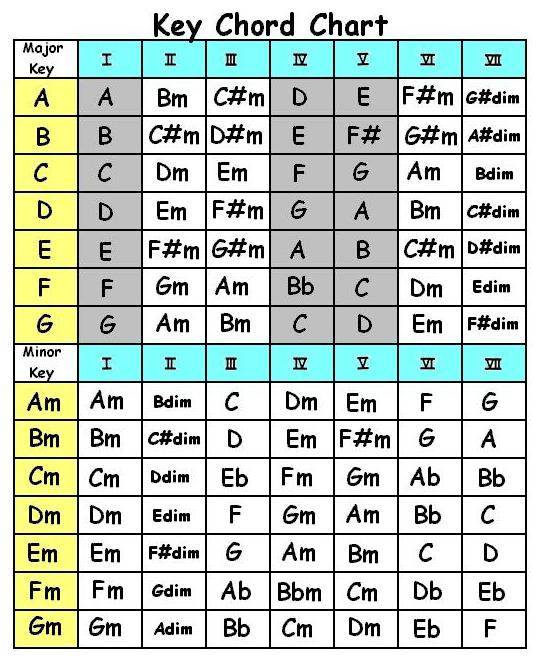
I always think in the top half of the chart (parent key), the answers on the bottom can be found in the top.
Edited by - mmuussiiccaall on 03/06/2022 13:45:45
banjopaolo - Posted - 03/06/2022: 14:39:41
I don't know the Nashville number system but I think it is quite crazy to use the major scale numbers in a minor tune....
A minor key is a different thing: if you are playing in E minor I'd call Em as I, Am as IV, the problem is the B chord that with the natural minor scale would be minor but in most tunes is a dominant chord so I'd call it V7.
Different is with modal minor tunes, very common in banjo palying, you can have in a E minor tune the A major chord (if it is a dorian mode) or you may not find a dominant seventh chord on the fifth grade (B7), and as a 'dominant function' you may find a VII D major chord (that is very similar to a Bminor)
Maybe I'm adding more confusion? I'm sorry... ;-)
lature - Posted - 03/06/2022: 14:41:13
Everyone at every jam session should have that chord chart glued to their forehead.
mmuussiiccaall - Posted - 03/06/2022: 16:23:24
In my mind for the music I play:
80% focuses on the I (Ionian)
10% focuses on the iim (Dorian)
10% focuses on the vim (Aeolian)
banjoak - Posted - 03/06/2022: 19:57:12
This reminds me of other related issues folks have, where multiple ways exist... Key signatures for modal tunes. Fixed vs moveable Do. Chord letter name as sounded, or chord shape/capo. As well as the 2/2, 2/4, 4/4 arguments.
From pragmatic, when it comes to actually playing music, none of these seem like problematic big deal... and can quickly easily parse it out.
Mostly the big mess seems folks wanting more to argue about being right about semantics.
banjoak - Posted - 03/06/2022: 20:13:58
quote:
Originally posted by spoonfedOr just call it what it is, Am or Em, stop using numbering altogether then everybody knows what you mean. We in the UK have no such numbering system and all works well.
Using numbers is useful in many ways... as it is about relationship of chords to key; and easily transposable. Popular use is to make single chord chart, no matter what key singer sings in. (this was part of origin of NNS, for studio/session players) Comes in hand with capo players as well. In live playing, verbal form it is often easier to hear "four" "five" "six" compared all the similar eeee sound names.
A numbering system exists, (even in UK) both verbal and written... you just might not be familiar with it. Older written form uses Roman numerals... upper case refers to major chord, lower case refers to minor chord. For example I, ii, iii, IV, V, vi, also easy to modify and add III7... this is still used.
Written Nashville uses Arabic number 1, 2, 3, 4, 5, 6, 7.
Edited by - banjoak on 03/06/2022 20:27:50
janolov - Posted - 03/06/2022: 22:57:17
Nashville Number System was developed by professional musicians, so they easily could find the chords when playing in different keys. In the original NNS the numbering refers to the key, both in minor or major, as well as different modes. Then it has become a mess when amateur banjo and guitar players try to make their own interpretation of the system.
spoonfed - Posted - 03/07/2022: 07:14:32
quote:
Originally posted by banjoakquote:
Originally posted by spoonfedOr just call it what it is, Am or Em, stop using numbering altogether then everybody knows what you mean. We in the UK have no such numbering system and all works well.
Using numbers is useful in many ways... as it is about relationship of chords to key; and easily transposable. Popular use is to make single chord chart, no matter what key singer sings in. (this was part of origin of NNS, for studio/session players) Comes in hand with capo players as well. In live playing, verbal form it is often easier to hear "four" "five" "six" compared all the similar eeee sound names.
A numbering system exists, (even in UK) both verbal and written... you just might not be familiar with it. Older written form uses Roman numerals... upper case refers to major chord, lower case refers to minor chord. For example I, ii, iii, IV, V, vi, also easy to modify and add III7... this is still used.
Written Nashville uses Arabic number 1, 2, 3, 4, 5, 6, 7.
If any such system exists in the UK and, I am not doubting it I have never met anybody who uses it.
janolov - Posted - 03/07/2022: 08:57:09
quote:
Originally posted by spoonfedquote:
Originally posted by banjoakquote:
Originally posted by spoonfedOr just call it what it is, Am or Em, stop using numbering altogether then everybody knows what you mean. We in the UK have no such numbering system and all works well.
Using numbers is useful in many ways... as it is about relationship of chords to key; and easily transposable. Popular use is to make single chord chart, no matter what key singer sings in. (this was part of origin of NNS, for studio/session players) Comes in hand with capo players as well. In live playing, verbal form it is often easier to hear "four" "five" "six" compared all the similar eeee sound names.
A numbering system exists, (even in UK) both verbal and written... you just might not be familiar with it. Older written form uses Roman numerals... upper case refers to major chord, lower case refers to minor chord. For example I, ii, iii, IV, V, vi, also easy to modify and add III7... this is still used.
Written Nashville uses Arabic number 1, 2, 3, 4, 5, 6, 7.
If any such system exists in the UK and, I am not doubting it I have never met anybody who uses it.
The system was developed mainly by professional country music players in Nashville, mostly studio musicians that have to often play in different keys, and the same song in different keys. Your comment says something about the the UK music standard  . I think at ordinary Bluegrass jams or Old-Time jams the Nashville Number System is not necessary. I Bluegrass you play everything in G, in Old-Time you play it in A or D. And you don't need to be able to play the same song in different keys.
AGACNP - Posted - 03/07/2022: 10:19:36
"I Bluegrass you play everything in G, in Old-Time you play it in A or D. And you don't need to be able to play the same song in different keys."
Not trying to be argumentative, but perhaps this is an over-generalization? Or perhaps you may mean (re bluegrass music) out of G position?
spoonfed - Posted - 03/07/2022: 10:49:15
quote:
Originally posted by janolovquote:
Originally posted by spoonfedquote:
Originally posted by banjoakquote:
Originally posted by spoonfedOr just call it what it is, Am or Em, stop using numbering altogether then everybody knows what you mean. We in the UK have no such numbering system and all works well.
Using numbers is useful in many ways... as it is about relationship of chords to key; and easily transposable. Popular use is to make single chord chart, no matter what key singer sings in. (this was part of origin of NNS, for studio/session players) Comes in hand with capo players as well. In live playing, verbal form it is often easier to hear "four" "five" "six" compared all the similar eeee sound names.
A numbering system exists, (even in UK) both verbal and written... you just might not be familiar with it. Older written form uses Roman numerals... upper case refers to major chord, lower case refers to minor chord. For example I, ii, iii, IV, V, vi, also easy to modify and add III7... this is still used.
Written Nashville uses Arabic number 1, 2, 3, 4, 5, 6, 7.
If any such system exists in the UK and, I am not doubting it I have never met anybody who uses it.
The system was developed mainly by professional country music players in Nashville, mostly studio musicians that have to often play in different keys, and the same song in different keys. Your comment says something about the the UK music standard
You could well be right, who knows ? just think how impressive UK music standard could be if the Beatles, Queen, Elton John, Rod Stewart etc Knew about that system : - ) they may even have sold as many albums as Ralph Stanley .
250gibson - Posted - 03/07/2022: 11:16:47
The system was developed by session musicians, so they don’t have to re-chart everything. In early Nashville and Motown, producers would find songs written by their songwriting team and bring in various singers to perform it. So the same musicians may have to play the song in 4 different keys for 4 different singers, possibly even back to back. Depending on the quality of the performance and various other factors as to who “needs” the song (singer popularity, who’s going on tour, etc. etc,) the label would decide which one gets released.
banjoak - Posted - 03/07/2022: 14:32:41
quote:
Originally posted by mmuussiiccaallhere's a devilish mess for example
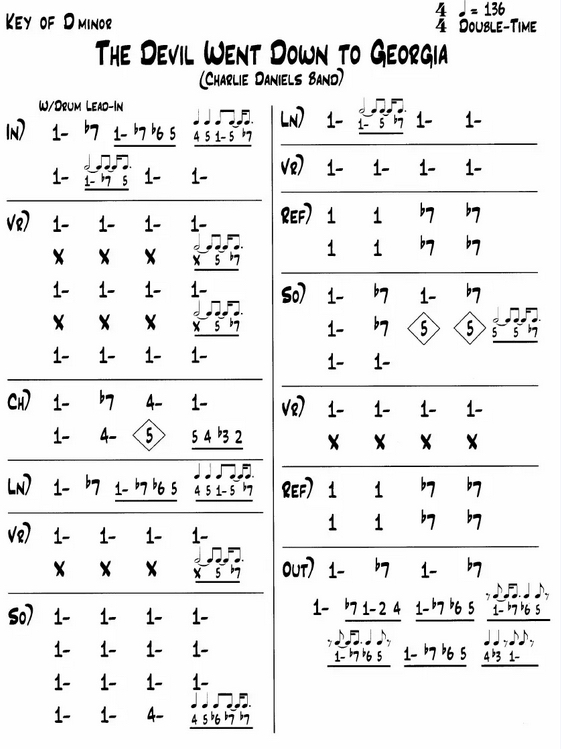
It's not really... fairly tidy way to communicate a chart arrangement... (though could have been condensed a little more). But like any written system, need to understand what the symbols mean, from person writing it.
This does show a fairly common way that minor chords are written; using a minus sign. So if in D minor, main chord progression is Dm and C. But can be used for any other key.
Probably less of of mess than compared to trying to use standard notation score.
Edited by - banjoak on 03/07/2022 14:40:39
250gibson - Posted - 03/07/2022: 15:42:50
quote:
Originally posted by mmuussiiccaallhere's a devilish mess for example
Why write key if D minor and then use numbers. The numbers are meant to be key ambiguous. If the chart was written to be played in D minor, then just use the letter name chords.
lature - Posted - 03/07/2022: 16:20:45
I see a lot of b7 and b6 in that chord chart -- so I'm guessing it is from the MAJOR scale (for minor keys) camp. If it was from the MINOR scale you could replace b7 with 7 and b6 with 6. Of all the variations I've seen out there I like the MAJOR camp the best even though you have all the flats. You don't have to guess -- it's always the major scale for major and minor keys.
250gibson - Posted - 03/07/2022: 17:42:43
quote:
Originally posted by latureI see a lot of b7 and b6 in that chord chart -- so I'm guessing it is from the MAJOR scale (for minor keys) camp. If it was from the MINOR scale you could replace b7 with 7 and b6 with 6. Of all the variations I've seen out there I like the MAJOR camp the best even though you have all the flats. You don't have to guess -- it's always the major scale for major and minor keys.
That is the only method. I have never seen a chart where for example in the key of D minor, a 6 meant Bb and a 7 meant C. How would you notate a Dorian tune #6??
Major = 1,2,3,4,5,6,7 Minor = 1,2,b3,4,5,b6,b7.
lature - Posted - 03/08/2022: 03:49:51
quote:
Originally posted by 250gibsonquote:
Originally posted by latureI see a lot of b7 and b6 in that chord chart -- so I'm guessing it is from the MAJOR scale (for minor keys) camp. If it was from the MINOR scale you could replace b7 with 7 and b6 with 6. Of all the variations I've seen out there I like the MAJOR camp the best even though you have all the flats. You don't have to guess -- it's always the major scale for major and minor keys.
That is the only method. I have never seen a chart where for example in the key of D minor, a 6 meant Bb and a 7 meant C. How would you notate a Dorian tune #6??
Major = 1,2,3,4,5,6,7 Minor = 1,2,b3,4,5,b6,b7.
People use the minor scale to make charts all the time. For an example, look at the first chord chart mmuussiiccaall posted in this thread (4 posts down).
I don't know, but I think you do use #6 for dorian tunes and #7 for harmonic tunes. Or maybe they use the dorian or harmonic scales instead of the natural. That's another reason I prefer using the major scale.
However it doesn't matter what I like. Different musicians/teachers like different things and there is no official standard. There are even people who will argue that using the original Nashville relative major is the best.
Edited by - lature on 03/08/2022 04:00:57
RB3 - Posted - 03/08/2022: 05:59:50
Is the Nashville numbering system embraced or frowned upon by the music teachers involved in traditional music education programs?
jojo25 - Posted - 06/15/2022: 10:43:39
quote:
Originally posted by AGACNP"I Bluegrass you play everything in G, in Old-Time you play it in A or D. And you don't need to be able to play the same song in different keys."Not trying to be argumentative, but perhaps this is an over-generalization? Or perhaps you may mean (re bluegrass music) out of G position?
most definitively an over generalization...esp in my experience playing OT...lots of sessions...or at least significant parts of some sessions...are spent in C...and F and B flat even...and yeah...probably mean in G tuning capoed up for other keys in regard to BG...playing the same tune in different keys...and maybe even in a different tuning...is a great way to improve your chops...I play a lot of A tunes...and A minor or A modal tunes...out of double D tuning
Terms of Use | Privacy Policy | Privacy Consent (EU/GDPR Only)
Copyright 2026 Banjo Hangout. All Rights Reserved.