
DVD-quality lessons (including tabs/sheet music) available for immediate viewing on any device.
Take your playing to the next level with the help of a local or online banjo teacher.
Weekly newsletter includes free lessons, favorite member content, banjo news and more.
Premier Sponsors


|
Please note this is an archived topic, so it is locked and unable to be replied to. You may, however, start a new topic and refer to this topic with a link: http://www.banjohangout.org/archive/380798
m06 - Posted - 01/25/2022: 04:34:29
I'm looking to compare notes with other folks who own banjos of this period who may have replaced an old skin head.
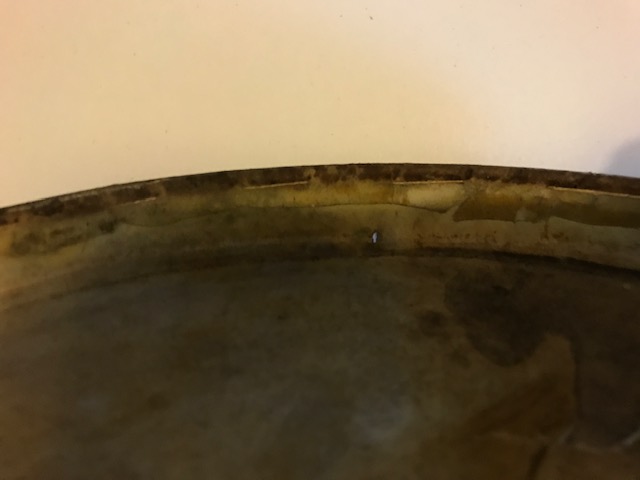
I have a 7-string Tunbridge ware banjo with an oak rim, and walnut neck. Unfortunately damage to the head means that I have to replace the original(?) 12" vellum. On removing the head from my banjo I was surprised to see that the skin had been stitched in place around the circumference of the flesh hoop. I've replaced skin heads many times, including on late-19th century banjos, but not on a banjo this early. This is the first time I've seen this stitching. Has anyone else come across this technique before?
From the patina and pencil marks to the rear, the vellum is old, more than likely the original head. Whoever did the stitching clearly had to remove the stretched and dried vellum to make this stitched attachment. I'm curious if this was the practice in the maker's workshop or whether it's the handiwork of someone in the mid-Victorian period who, like me, needed to replace the skin.
Edited by - m06 on 01/25/2022 04:45:24
nickll - Posted - 01/25/2022: 05:00:01
Could be an old vellum that has been re-used- I have re-mounted a couple after cleaning by stitching a draw string round the perimeter.
Alvin Conder - Posted - 01/25/2022: 05:16:12
I have never seen that before. NickLl is most likely correct.
woodchips - Posted - 01/25/2022: 05:50:31
I have two old skin heads that came off old banjos. One was a 1926 Tb1 and the other one was a 1904 Rettberg&Lange. Both of them have stitches around the fleshing hoop.
IMBanjoJim - Posted - 01/25/2022: 07:28:49
I have several older banjos with the skin head stitched to the flesh hoop. It must have been an accepted way of attaching heads at the time.
m06 - Posted - 01/25/2022: 07:33:47
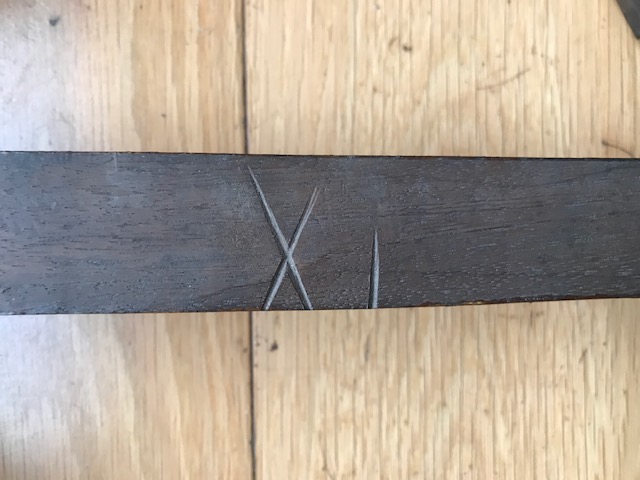
With the vellum removed the underside of the perch pole (made from Beech) was visible. This mark had been cut into it; 9 or 11 in Roman numerals.
Has anyone else found a similar mark on a Tunbridge ware banjo?
Edited by - m06 on 01/25/2022 07:36:47
beegee - Posted - 01/25/2022: 07:38:49
It was probably a pre-Rulebook banjo.
I have seen this on a couple of 19th Century banjos.
jbalch - Posted - 01/25/2022: 08:29:58
I've seen one-or-two very old heads that were stitched to flesh hoops. The examples I've seen were mounted on round wire hoops. I assume it was done to prevent the hide from slipping around the round wire.
I've also seen them where the steel wire flesh hoop was wrapped with cloth ... or a spiral wrapping of twine (underneath the hide).
The spiral wrapping is something that I use on some new heads today. I like the look of it and think it may add some stability to the finished head.
Hunter Robertson - Posted - 01/25/2022: 12:09:10
I have what I think is an English banjo based on the 1867 Dobson patent with a stitched vellum.
IMBanjoJim - Posted - 01/25/2022: 13:08:18
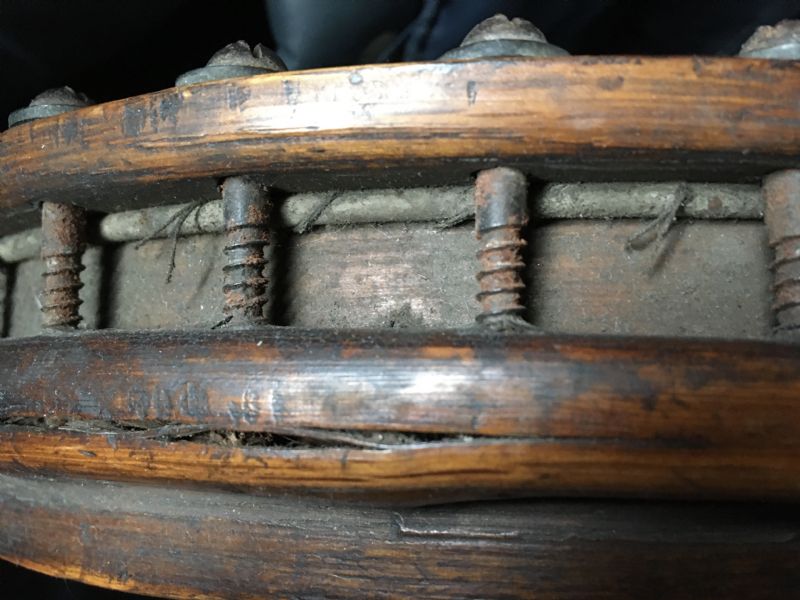
Here is my English top tension banjo, with the threaded skin head:
m06 - Posted - 01/26/2022: 00:56:40
quote:
Originally posted by IMBanjoJimHere is my English top tension banjo, with the threaded skin head:
I've had close look at the stitching on the old head I took off. It wouldn't be too difficult to replicate on the replacement head.
Does this stitching have any securing function apart from neatness on these earlier banjos? It appears that the stitching was simply a finishing job after the stretched and dried skin was removed and trimmed (very close) off the banjo. The flesh hoop and tension ring are a snug fit and even with the fewer hooks there's no obvious reason to think there would be any slippage.
My usual fitting method is to trim the excess with a scalpel with the stretched skin in place on the banjo. With a longer blade no excess is visible when completed.
Have you successfully replaced an old stitched head without replicating the stitching?
Edited by - m06 on 01/26/2022 01:11:26
IMBanjoJim - Posted - 01/26/2022: 07:32:21
Luckily, I have not had to replace, or, god forbid, re-stitch, any stitched banjo heads. With my seeing skills,it would be pretty ugly!
Edited by - IMBanjoJim on 01/26/2022 07:33:17
m06 - Posted - 01/28/2022: 02:26:46
There's a practical angle to this stitched skin head that is now puzzling me.
The usual modern method when stretching a dampened skin head is to pull the excess evenly up through the tension hoop and this naturally forms an edge toward the outside of the flesh hoop. But this old stitched head has the finished edge toward the inside.
To me that suggests that the head could not have been stretched on the banjo, removed when dried, the excess cut off and then stitched and refitted. The only way I can explain the edge being toward the inside is if the skin was soaked, trimmed, folded over and stitched to the flesh hoop when damp immediately before fitting to the banjo. This would remove any need to trim the skin after drying and tightening it up to tension on the banjo
Is that feasible? I'm tempted to experiment to see if a skin head can be easily and successfully fitted by that method. Maybe some folks here use that method routinely?
Edited by - m06 on 01/28/2022 02:39:46
m06 - Posted - 01/28/2022: 03:24:52
I wonder if one possible reason why stitching before fitting the head may have been the preferred method is to minimise the risk of water damage to fine decorative craftsmanship? Some Tunbridge ware banjos (mine included) have the characteristic fine wood mosaic set around the rim in addition to the designs on the neck. The maker would not want to risk that detail work lifting by excess moisture getting under those tiny wood mosaic pieces and affecting the water-based glue during the skin fitting part of manufacture.
Edited by - m06 on 01/28/2022 03:27:38
m06 - Posted - 01/28/2022: 03:54:20
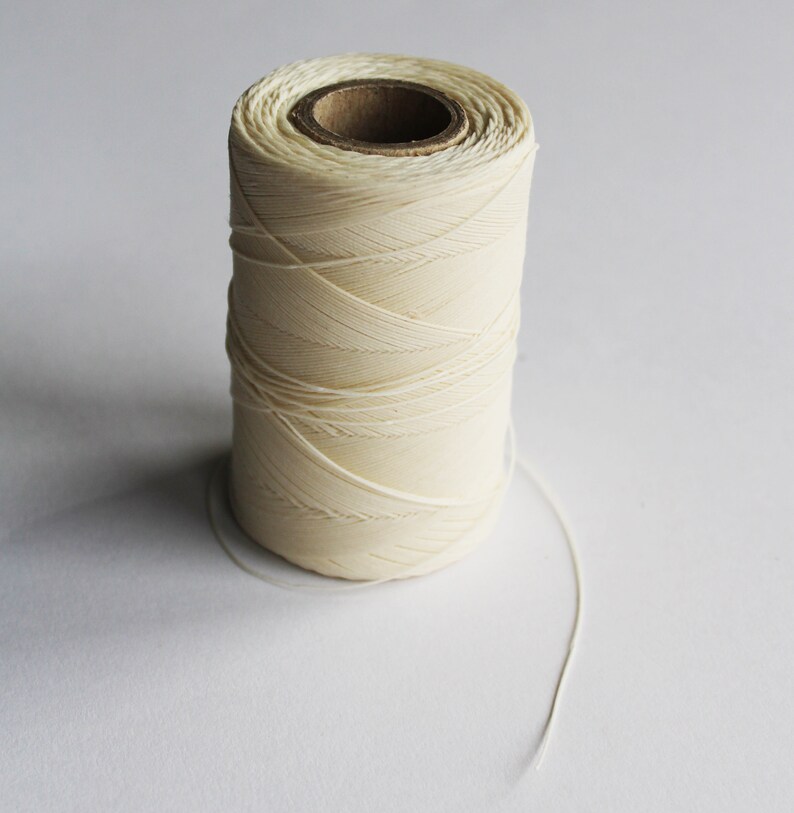
The original thread used to stitch the skin head to the flesh hoop was thicker than modern sewing thread. The match is with this undyed cotton thread sold as bookbinding thread also suitable for professional quality leather work.
I don't see how there can be enough flex for a skin stitched to the flesh hoop to stretch enough to allow the fitting of the tension hoop? There's only one way to find out...
I've just bought some of this book binder's thread. Now I'm off to raid my wife's needlework box. The experiment is on!
Edited by - m06 on 01/28/2022 04:10:55
AndrewD - Posted - 01/28/2022: 05:24:44
How were drum heads mounted in this period ? I would have thought there was little if any difference in methodology. And there may be more and better information among military drum enthusiasts.
Terms of Use | Privacy Policy | Privacy Consent (EU/GDPR Only)
Copyright 2026 Banjo Hangout. All Rights Reserved.


