
DVD-quality lessons (including tabs/sheet music) available for immediate viewing on any device.
Take your playing to the next level with the help of a local or online banjo teacher.
Weekly newsletter includes free lessons, favorite member content, banjo news and more.
Premier Sponsors


|
Please note this is an archived topic, so it is locked and unable to be replied to. You may, however, start a new topic and refer to this topic with a link: http://www.banjohangout.org/archive/379737
m06 - Posted - 12/12/2021: 13:04:13
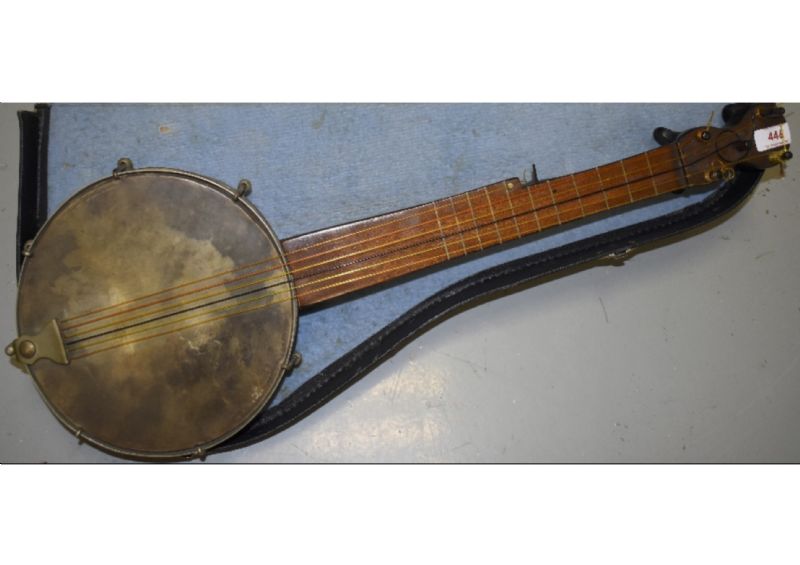
Fairly typical example of an English flush fret 6-string c.1870's or could be later. More detailed photos to follow when it arrives from Cumbria.
Edited by - m06 on 12/12/2021 13:07:35
spoonfed - Posted - 12/13/2021: 07:25:53
Well it certainly looks old and interesting, not my bag but I have seen plenty of pics of Minstrel and Pierrot troupes playing similar instruments in Victorian Britain, is it tuned like a guitar ?
m06 - Posted - 12/13/2021: 09:38:38
The early English 6-strings weren’t tuned and played like modern guit-jos.
m06 - Posted - 12/14/2021: 04:39:50
Does anyone have a 19th century banjo catalogue showing a brass tailpiece of the type fitted on this banjo? Or a photo of a banjo with an identical tailpiece? It looks like it could be a workshop manufactured part rather than a one-off homemade design.
It's more common that these c.1870's English flush fret banjos originally had a wooden tailpiece. The brass tailpiece might be original or it might be a later addition.
Edited by - m06 on 12/14/2021 04:51:03
m06 - Posted - 12/27/2021: 13:16:00
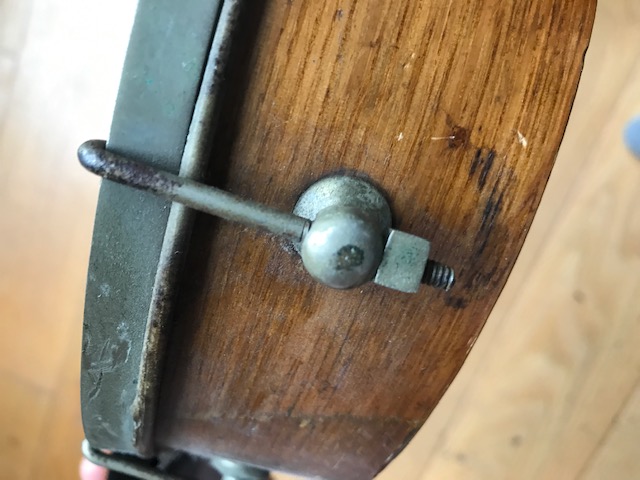
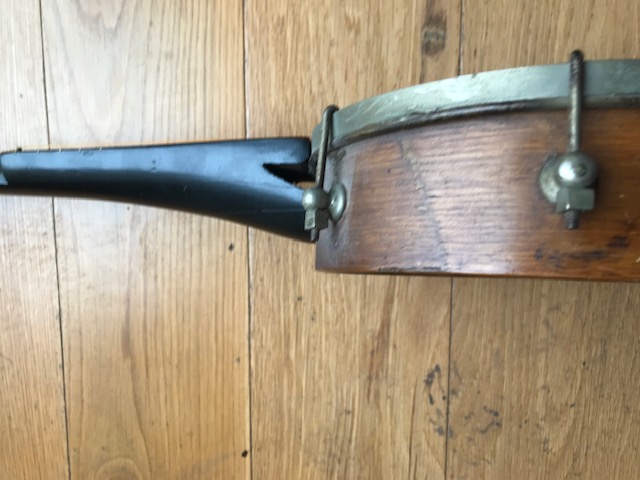
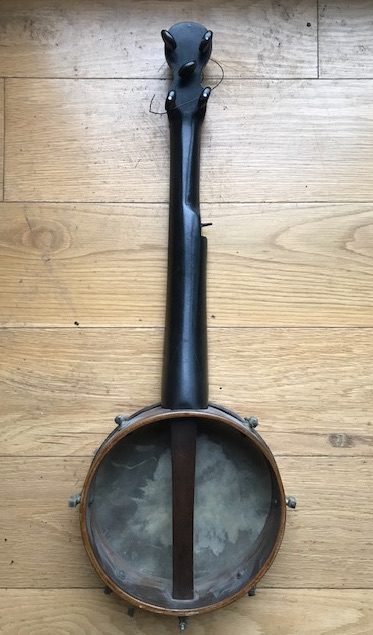
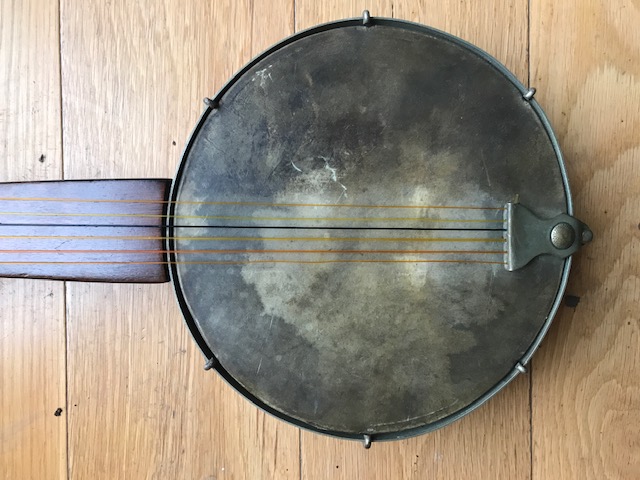
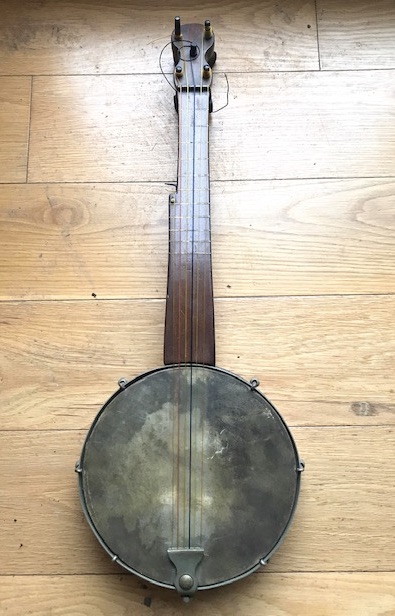
Just took delivery from Cumbria of a nice little early English 6-string piccolo banjo. It shouldn't take much to have it playable, just a 6th string peg and make a suitable bridge. Here are some detail photos.
Edited by - m06 on 12/27/2021 13:17:30
flatfootjohnny - Posted - 12/28/2021: 09:35:56
Ooh nice little banjo. i love the patina on the head.
m06 - Posted - 12/28/2021: 10:19:14
quote:
Originally posted by flatfootjohnnyOoh nice little banjo. i love the patina on the head.
I'm guessing it's the original head? There are no no splits and it's in perfectly usable condition. I can't wait to make a bridge and fit a 6th string peg and hear what this little banjo sounds like. Tuning is gGDGBD but an octave higher than for a that tuning on 5-string.
Stephen John Prior - Posted - 12/28/2021: 10:24:50
Nice Mike. What is the head diameter and scale length please.
m06 - Posted - 12/28/2021: 10:54:39
quote:
Originally posted by Stephen John PriorNice Mike. What is the head diameter and scale length please.
Stephen, scale length is 17" (based on nut to the front edge of the clean area on the skin where the bridge stood). Head diameter 8.5".
Edited by - m06 on 12/28/2021 10:55:09
m06 - Posted - 12/28/2021: 12:01:20
I’d be interested to know more about piccolo banjos in the 19th century. From what little I know I thought they were popular later c.1880 - 1900, and spun over, ebony fingerboard, fretted and inlaid similar to those made by S.S. Stewart typifying the finery of the late century banjo boom.
This one has all the hallmarks of the much simpler and more rustic full-size early English banjos c.1870’s that I’m more familiar with. It has the cherry/ash/mahogany type flush fret neck, thin ash or oak pot, brass rim and crude square hook nuts.
It doesn't seem a style fit with the piccolo banjos usual home in the later top hat and tails banjo orchestra. Nor is it an obvious fit with what we know about the early English banjo context.
Edited by - m06 on 12/28/2021 12:09:12
m06 - Posted - 12/28/2021: 14:10:56
quote:
Originally posted by AndrewDMade for a child ? We'll probably never know.
It would be a fit for a child. But the later piccolo banjos in the 1890's banjo orchestras were played by adults.
Of the three other early c.1870 flush fret piccolo banjos I've seen (in photos) two were Tunbridge ware instruments.
Maybe you're right and we'll never know, or maybe a contemporary studio photograph exists out there somewhere and will add to our knowledge?
Stephen John Prior - Posted - 12/29/2021: 00:34:05
I'm not sure about it being a piccolo banjo Mike. I don't think the tailpiece is original. Andrew could be on the money or maybe just a novelty instrument.
Edited by - Stephen John Prior on 12/29/2021 00:34:33
m06 - Posted - 12/29/2021: 03:55:51
quote:
Originally posted by Stephen John PriorI'm not sure about it being a piccolo banjo Mike. I don't think the tailpiece is original. Andrew could be on the money or maybe just a novelty instrument.
That's interesting.
In your experience what in particular points to the tailpiece being a later addition?
Over the last few years I've done fairly extensive research using Victorian British newspaper archives. One area of interest was commercial and private banjo advertisements pre-1880. Not one of the many ads I copied unfiltered for content included mention of a child's banjo. Of course that proves nothing other than a negative (which can sometimes be useful when researching).
The three other similar style, size and period banjos I've seen indicate that mine is not a complete one-off. Other than that...
...I'm stumped too.
Edited by - m06 on 12/29/2021 03:59:45
m06 - Posted - 12/29/2021: 04:08:16
On a side note, owners of early Tunbridge ware banjos may be interested to know that evidence exists to back up what seemed likely i.e. that Tunbridge ware banjos were sold new by dealers located well outside their Sussex area of manufacture. A Liverpool music shop in one example.
So theory of Victorian rail excursions specifically to Tunbridge Wells and banjos bought as local 'souvenirs’ of that trip is quaint but inaccurate.
Antique dealers with more knowledge of the far wider range of Tunbridge ware items may be able to fill in whether this style was in fact manufactured elsewhere too.
Edited by - m06 on 12/29/2021 04:14:34
AndrewD - Posted - 12/29/2021: 05:49:25
My guess (as somebody who was involved in the antiques trade way back when there was a big collectors market for Tunbridge ware is that it was more or less industrialised by the late 19th C and that Tunbridge ware panels could be bought commercially for inclusion in other items. I've seen lots of cigar boxes, desk boxes etc. which are similar to other commercially made items, probably made in the furniture quarter of London, but with the addition of inlaid Tunbridge panels. A good example is the banjo posted by Flatfoot Johnny a couple of days ago. Most of the decoration is marquetry Only the floral panel on the neck is Tunbridge ware.
A more useful area of research could be cabinet makers sundries catalogues of the period, catalogues of knobs, hinges, handles, veneers etc., to see if they included Tunbridge panels.
Things are complicated by the trend to call any 19thC inlay or marquetry 'Tunbridge Ware', when the term really only applies to the creation of wooden micro-mosaics made by slicing bundles of glued together coloured wooden sticks. For example, the banjo used as an illustration on the Wikipedia page for Tunbridge ware which shows a plain fretless banjo with a mop inlaid neck !
m06 - Posted - 12/29/2021: 07:33:38
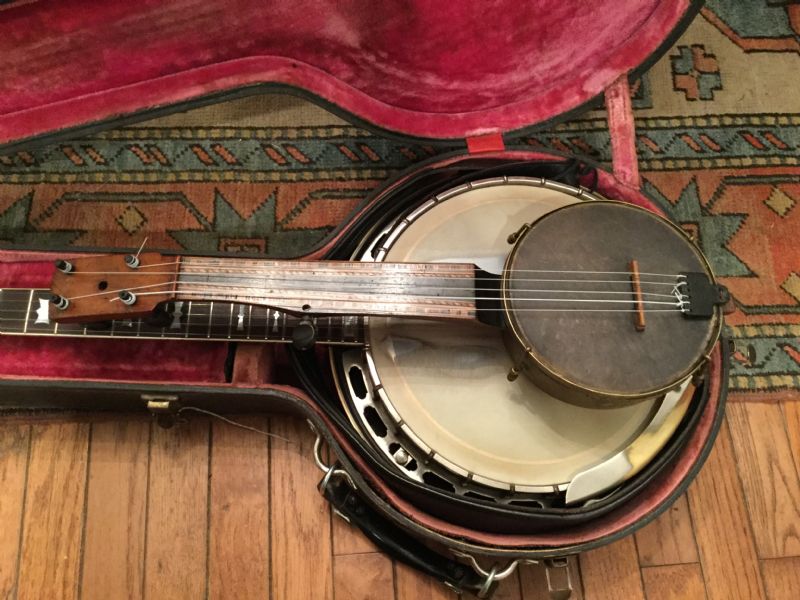
Here is a photo of another English small/'piccolo' banjo. Possibly someone here owns it? Tunbridge ware 7-string c.1870 (+/-) set up as a 6-string. Interesting spun over rim, cutaway fretless neck and hook nuts that look to be later replacements.
Edited by - m06 on 12/29/2021 07:34:29
flatfootjohnny - Posted - 12/29/2021: 07:45:33
quote:
Originally posted by AndrewDMy guess (as somebody who was involved in the antiques trade way back when there was a big collectors market for Tunbridge ware is that it was more or less industrialised by the late 19th C and that Tunbridge ware panels could be bought commercially for inclusion in other items. I've seen lots of cigar boxes, desk boxes etc. which are similar to other commercially made items, probably made in the furniture quarter of London, but with the addition of inlaid Tunbridge panels. A good example is the banjo posted by Flatfoot Johnny a couple of days ago. Most of the decoration is marquetry Only the floral panel on the neck is Tunbridge ware.
A more useful area of research could be cabinet makers sundries catalogues of the period, catalogues of knobs, hinges, handles, veneers etc., to see if they included Tunbridge panels.
Things are complicated by the trend to call any 19thC inlay or marquetry 'Tunbridge Ware', when the term really only applies to the creation of wooden micro-mosaics made by slicing bundles of glued together coloured wooden sticks. For example, the banjo used as an illustration on the Wikipedia page for Tunbridge ware which shows a plain fretless banjo with a mop inlaid neck !
I contacted these guys for more info but got no response... it was at the beginning of the Covid era.
m06 - Posted - 01/04/2022: 07:39:31
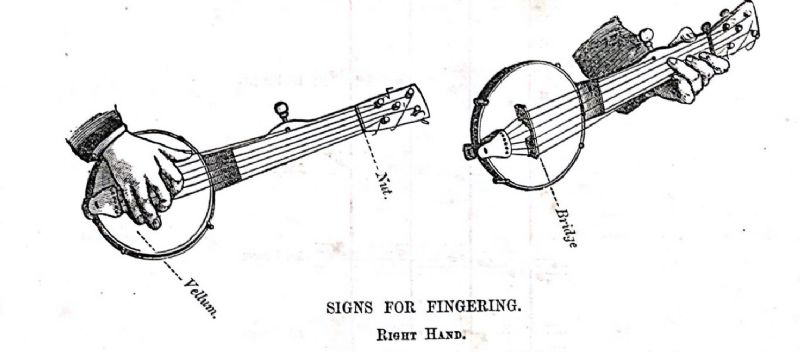
From Walter Howard's Banjo Tutor 1880 (London) these illustrations showing how to hold a banjo. Little wooden early banjo and adult hands seems to answer our conundrum.
Terms of Use | Privacy Policy | Privacy Consent (EU/GDPR Only)
Copyright 2026 Banjo Hangout. All Rights Reserved.


