DVD-quality lessons (including tabs/sheet music) available for immediate viewing on any device.
Take your playing to the next level with the help of a local or online banjo teacher.
Weekly newsletter includes free lessons, favorite member content, banjo news and more.
Premier Sponsors


|
Please note this is an archived topic, so it is locked and unable to be replied to. You may, however, start a new topic and refer to this topic with a link: http://www.banjohangout.org/archive/378885
gentrixuk - Posted - 11/05/2021: 03:34:42
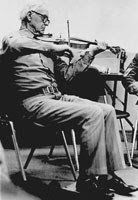
My Tune Of The Week is “La Belle Catherine”; a Quebecois fiddle tune taken from the playing of Louis “Pitou” Boudreault of Chicoutimi, Quebec.
"Louis Boudreault: Old Time Fiddler of Chicoutimi, Quebec" (currently Voyager CD 322), as translated by Michelle DeLaurenti.
"Summary of the life of a fiddler. Born in Chicoutimi on July 8th, 1905 of a modest family; having the ability to get along with everyone. His father Idas Boudreault played the violin with a special style. His son Louis, when 11 years old, one day alone in the house, fascinated by the fact that his father had repaired a violin smaller than he had seen before, took the small violin and started to find the notes of a tune he knew how to sing, finding in a few minutes that perhaps he could do like his father. This was the start of his fiddling career which after all was not very active. "As was the custom, a fiddler was hired for weddings which could last as long as three days. Louis soon found out that this was very unhealthy and that he should not continue to breathe the dust produced by the dancers' feet, which was very bad for his lungs. At 15, he began to work with his father building houses. By nature both agile and clever, he quickly became a very good carpenter which enabled him to earn his livelihood. In the winter he became a lumberjack, staying at a logging camp 4 to 5 months at a time, and always ready to entertain his friends with his violin, especially Saturdays and Sundays. "Around the '30's, there was a radical change in the manner of entertainment. The Charleston, the boogie-woogie, rock & roll and other dances became the obsession of the young and the folklore gradually disappeared. For this reason he put his violin aside, only occasionally visiting other fiddlers to learn reels in different keys. What fascinated him was to play what they called flat tone (B flat) or F. Even in his area, he was the only one to have kept the style and the reels played by his father and his grand-uncle Thomas Vaillancourt of Lac St.-Jean. He started playing violin again to enter a fiddler's competition, and won the first prize in 1970."
La Belle Catherine | Slippery-Hill
Talk About La Belle Catherine | Slippery-Hill
There is a video here teaching the tune for fiddle: youtu.be/h-mB--J0hZY
There is a page about this tune on the North Atlantic Tune List: Belle Catherine – North Atlantic Tune List (natunelist.net)
The North Atlantic Tune list page and the talk on Slippery Hill both mention the probable source of the tune’s name:
Jean Rhéaume sends this interesting explanation for the name Catherine in the title: “it is a Vielle fille, a girl who never found a husband. It is from the Holiday, La fête de la Ste-Catherine, specially dedicated to those women who never married and when we prepare the Ste-Catherine taffy.”
La Fête De La Ste-Catherine (St. Catherine’s Day) is celebrated on the 25thNovember. St. Catherine is traditionally the patron saint of women who have never married, but also various types of textile workers, and there are different traditions associated with the day around the world. In England it was known as “Catterntide”, celebrated by lacemakers with special cakes flavoured with cinnamon, fruit and caraway seeds, known as “Cattern Cakes”.
The tune is quite irregular. It has three parts, usually played by repeating the A part three times, B part twice, repeat the A part three times again, then the C part twice (AAABBAAACC). On the recording, the number of repetitions of the A part seem to vary sometimes (not sure if this is deliberate or not), and it ends with the B part. The B part is always crooked, with an extra 2 beats added to the first bar.
The recordings feature Louis’ podorythmie, which really pushes the tune along. Can anyone do this kind of foot tapping while playing banjo?
I played around with different ways of arranging this. I’ve taken the B part down to the lower strings to play as more of a back-up part, rather than following the tune upwards. I find this sounds good if you hold down the G chord shape while you play the crooked second bar, and then the A chord shape as you play the last part of the final bar. Tab and recording are attached.
GMB - Posted - 11/05/2021: 05:17:43
Great post, what a lively tune! And you're right about the foot tapping; reminds me of flatfooting. I'll have to learn this one. Thanks!
ndlxs - Posted - 11/05/2021: 06:10:28
I adore this tune and the foot tapping. Andre Brunet is quite the live wire, too...looks for his other videos.
I would love to be able to do that kind of foot tapping, but I think I'm too big (6-4...) too clumsy and too old to do that. But banjo playing I can do.
hweinberg - Posted - 11/05/2021: 09:40:29
Great tune. Thanks, Mark. Quebecois music has many fans here.
JanetB - Posted - 11/06/2021: 11:01:37
I listened first to your mp3, Mark, and was entranced with your gentle touch of a lovely piece. Then when I listened to the Louis Boudrault recording I was overwhelmed with the intricacy and speed of his playing, and wondered if I could arrange it for clawhammer. Slowing it down, here is what I come up with in double C. It's interesting to see on tab once figured out. The C part has some similarities to the B (yet is different from the B part) and perhaps that's why the B and C parts were separated from each other. The crooked part doesn't come at the end of the B part, but towards its end. I wonder if the dancers do a special step right there.
Perhaps someone familiar with Quebecois music would explain it here. We don't get too many Canadian tunes, but they're all so good. Is that the same as "French Canadian" music? Does it mean that it came up from the southern part of the US? Is Cajun music similar?
rickhayes - Posted - 11/06/2021: 11:58:31
What a great tune and TOTW pick. I loved hearing M. Brunet fiddle it and seeing his joyous expressions as he did so. Enjoyed hearing Mark's and Janet's different interpretations, both well done.
gentrixuk - Posted - 11/06/2021: 17:06:03
I'm glad you're enjoying the tune everyone. It's a wonderful tune to play. Love your version Janet. Taking the C part up an octave works really well. I'd love to find out more about Quebecois fiddling. I watched a video that said it's common for these tunes to have a third part that is simpler and more rhythmic, like the C part of this tune.
WVDreamin - Posted - 11/06/2021: 17:35:28
As the fiddling style up there is a solo affair, the fiddlers each add their own twist to the tunes, adding beats in different places and at times repeating a phrase more or less than "usual." The dancers just do their thing regardless.
Terms of Use | Privacy Policy | Privacy Consent (EU/GDPR Only)
Copyright 2026 Banjo Hangout. All Rights Reserved.