DVD-quality lessons (including tabs/sheet music) available for immediate viewing on any device.
Take your playing to the next level with the help of a local or online banjo teacher.
Weekly newsletter includes free lessons, favorite member content, banjo news and more.
Premier Sponsors


|
Please note this is an archived topic, so it is locked and unable to be replied to. You may, however, start a new topic and refer to this topic with a link: http://www.banjohangout.org/archive/377207
sbarham - Posted - 08/19/2021: 14:18:19
Greetings all!
This is my first post -- and I'm a rather new member -- so do forgive me if I've posted in the wrong place, or in the wrong manner.
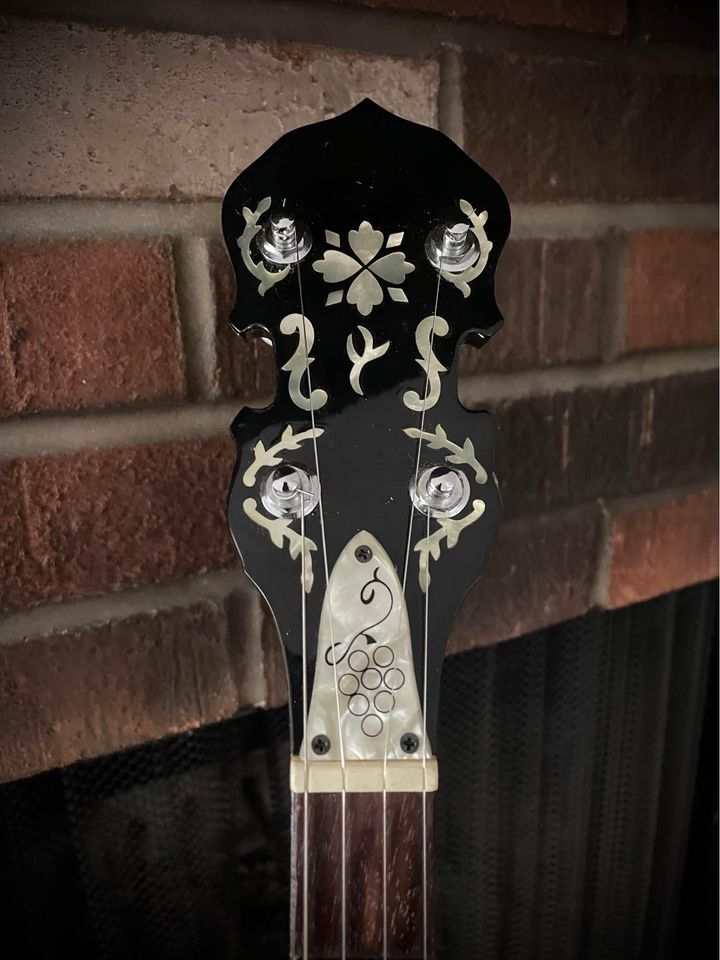
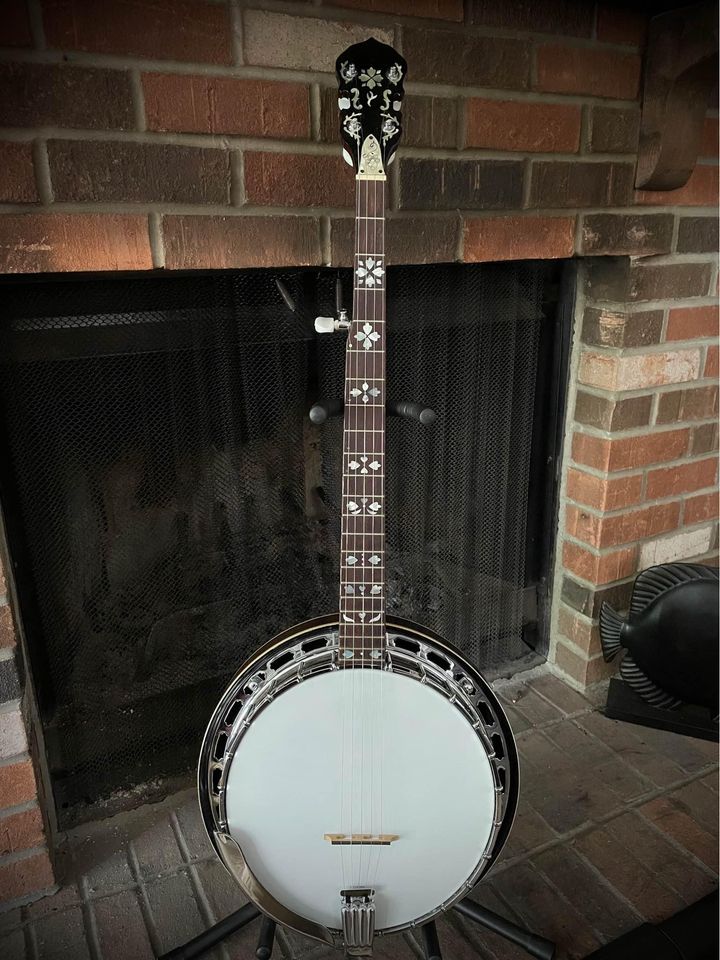
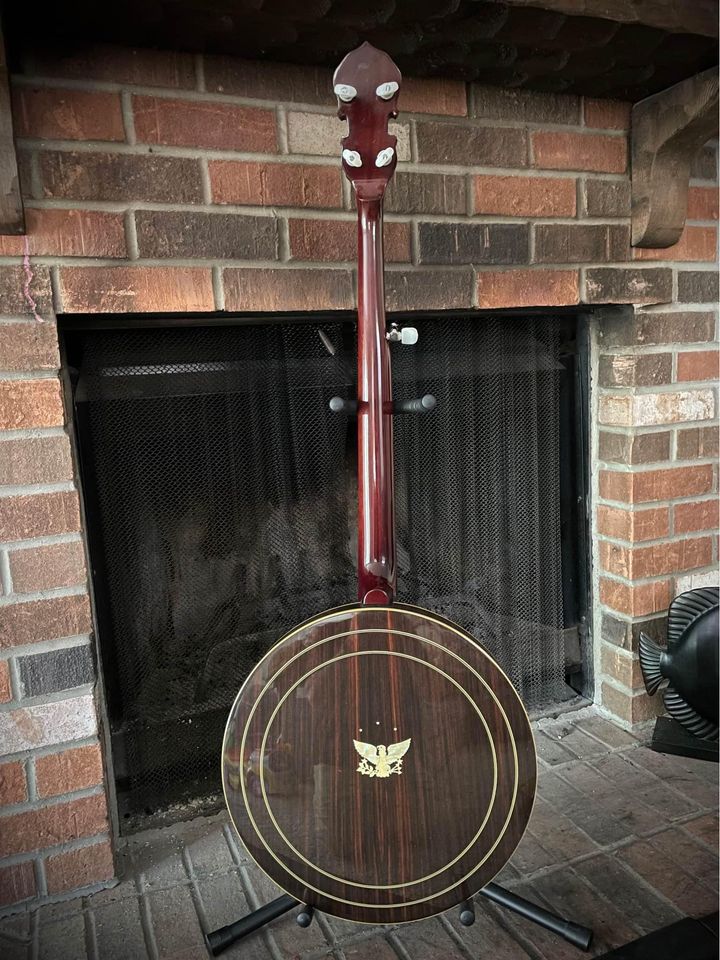
I was just perusing Facebook marketplace when I discovered an intriguing banjo -- being sold for only a few hundred dollars, presumably because the seller is unable to positively identify the banjo. I've included two pictures from the original listing -- one from the front, one from the back, showing a resonator with a mother-of-pearl (?) inlay of what appears to be the US national emblem (the bald eagle holding an olive branch in one claw, and thirteen arrows in the other). I've also included a picture of the headstock.
About the banjo, the seller says: "Vintage 5-string bluegrass banjo. New Remo topcoat head. New D’Addario medium nickel wound strings. Chromed brass flathead tone ring under the hood - really gives it some power. No names or markings on it. Railroad spikes at frets 7, 9, & 10."
Has anyone seen a banjo like this? Does anyone have any inkling what it is? It seems unlikely that it's only worth the few hundred dollars the seller is asking, but I'm a new banjo player, so perhaps I'm naive. : )
deestexas - Posted - 08/19/2021: 14:49:38
It is Asian made and only worth a few hundred dollars( $200 - 250, maybe 300), but it might be a suitable first instrument. The Asian factory often put various names on their instruments and sometimes, none at all.
This link might be useful: hawthorne.fastie.com/asianbanjos/
Edited by - deestexas on 08/19/2021 14:52:44
sbarham - Posted - 08/19/2021: 15:14:37
@emiel -- Thank you so much for posting the pictures properly!
@deestexas -- Interesting. Just so I can learn, what is your conclusion based on? What's the tell-tale sign -- just the lack of insignia or other identifying information? Or is it something about the appearance of the banjo?
sbarham - Posted - 08/19/2021: 15:15:38
quote:
Originally posted by deestexasIt is Asian made and only worth a few hundred dollars( $200 - 250, maybe 300), but it might be a suitable first instrument. The Asian factory often put various names on their instruments and sometimes, none at all.
This link might be useful: hawthorne.fastie.com/asianbanjos/
And yes, the link is very useful -- thanks!
Bill Rogers - Posted - 08/19/2021: 17:05:22
If it has a Mastertone style tone ring, and it probably does, I’d put it more in the $500-700 range,
Old Hickory - Posted - 08/19/2021: 17:06:00
quote:
Originally posted by sbarham... what is your conclusion based on? What's the tell-tale sign -- just the lack of insignia or other identifying information? Or is it something about the appearance of the banjo?
Three-hole truss rod cover.
Design on truss rod cover.
Extreme gloss that looks like a thick polyester or polyurethane rather than lacquer.
Eagle on resonator.
Not sure about the absence of name on peghead. That would typically indicate a parts banjo, perhaps a Golden Gate neck. But that would have been unfinished and wouldn't have included the type of truss rod cover seen here.
Anyway, nothing about this points to any known US maker.
If parted out, it could probably draw more than a few hundred dollars. But the rim and tone ring (unseen here) are mysteries. I'm assuming the seller knows or suspects them not to be high quality. Possibly pot metal. Maybe actual brass, but not a bell metal alloy and not sand cast. Or who knows. Maybe the seller is not the person who put this together and the rim and tone ring are actually some high quality replacement parts.
All this being said: If it's easy to play and sounds good, to your ear, it's most likely better than anything else available at that price. Going solely by the photos, there's NOTHING new for $400 or less I'd recommend over this banjo.
Depending on your current ability and future goals, this could be all the banjo you'll ever need.
Good luck.
Old Hickory - Posted - 08/19/2021: 17:12:25
quote:
Originally posted by sbarhamGreetings all!
Hey! Just noticed you're in Bowie. I'm in Takoma Park. At the beach right now. But if there's any way I can help, let me know.
Sseriously: If the seller is asking only "a few hundred dollars" -- as in under $400? -- I don't see how you can go wrong with this.
As a beginner, you might want to change the strings to a lighter set than what the seller is calling medium. And the head tightness will need to be checked. In general, these Asian banjos, or Asian parts, can be set up to be great beginner instruments or first steps up from lesser/simpler instruments.
RioStat - Posted - 08/19/2021: 17:13:23
Here's a couple of 'tell-tale" signs.....the eagle decal on the resonator.....the Japanese instrument factories back in the '70's thought that the decal gave their banjos an "Americana" vibe.....Americans (most) think that the eagle decal is cheesy-looking.
The 3 screws on the truss rod cover almost always point to an Asian-made instrument.
The tailpiece, armrest, and the tube-and-plate flange all are hallmarks of Asian built 1970-80's banjos.
However, these things can be set-up to sound and play pretty good, and a lot of "bluegrassers" got started on similar instruments "back in the day".
Dan Gellert - Posted - 08/19/2021: 18:00:31
My guess as to that one's vintage is early 2000's, made in China. If I'm right, that's fine, IMO. They were putting out some very inexpensive "masterclones" then which were amazingly good for the price-- not quite comparable to the real thing (which were maybe 5x the price new at the time), but perfectly respectable intermediate-grade banjos.
Whether it's one of those or an older one from Japan or Korea, $400 seems like a good price to me-- I doubt you could find a comparable new banjo for less than twice that.
sbarham - Posted - 08/19/2021: 18:20:43
Wow -- you all have been extremely helpful. I would call myself a beginner; I am a classical pianist by training (BM in piano performance!), and I've been a musician my whole life, but it's only been in the last six months that I've really delved into the banjo. I've quickly become obsessed.
But I am not banjoless -- I own a Lyon and Healy 1913 Improved Washburn (Bohnenberger tone ring), which is in the shop at the moment for an action adjustment; and I own a Deering Sierra from that odd transitional period around 2008 (when they added wood inlays around the mother-of-pearl dots). They're both excellent banjos.
I suppose I was just ... well, *intrigued* -- I'd never seen anything like this before! And I thought, for the asking price of $350 (or whatever I could negotiate him down to), this might make a good, cheap travel banjo (that I don't mind having inadvertently broken, etc.). Or -- perhaps, as a dream -- that the seller didn't quite know what he was doing, and the banjo was really worth more.
Based on the tips you all have so generously proffered, I've managed to find my way to the Lida banjo catalogues from the 70's. The banjo itself is certainly reminiscent of Lida model 235, or 237, or 239. Ah, perhaps it's a fruitless search. But super intriguing, nonetheless. I feel that that odd white truss rod cover, with the grape cluster insignia, must surely be a clue. I haven't been able to find a similar picture on the internet yet. The other oddity is the lack of first fret inlay -- most Asian masterclones from the 70's have inlays at the first fret.
sbarham - Posted - 08/19/2021: 18:21:58
quote:
Originally posted by Old Hickoryquote:
Originally posted by sbarhamGreetings all!
Hey! Just noticed you're in Bowie. I'm in Takoma Park. At the beach right now. But if there's any way I can help, let me know.
Sseriously: If the seller is asking only "a few hundred dollars" -- as in under $400? -- I don't see how you can go wrong with this.
As a beginner, you might want to change the strings to a lighter set than what the seller is calling medium. And the head tightness will need to be checked. In general, these Asian banjos, or Asian parts, can be set up to be great beginner instruments or first steps up from lesser/simpler instruments.
This is great advice -- and yes, I'm in Bowie! Great to meet a fellow Maryland banjoer. And finally, yes, the asking price is $350.
sbarham - Posted - 08/19/2021: 18:33:44
One thing I'll say is that this has occasioned a fascinating journey into early Gibson styles. You all probably know this, but the inlay pattern on the neck and headstock is the Gibson Hearts and Flowers pattern. The early RBs with the H&F pattern had no inlay at the first or fifteenth fret, just like this banjo. I guess the rosewood fingerboard + H&F + no 1st/15th inlay suggests the maker was trying to imitate the early Granadas.
AndrewD - Posted - 08/19/2021: 18:42:49
quote:
sbarham
It might help your researhch to know that it may look like Lida but it is in fact Iida with a double ii. Common mistake, so Lida will find Google hits.
sbarham - Posted - 08/19/2021: 18:45:03
quote:
Originally posted by AndrewDquote:
sbarham
It might help your researhch to know that it may look like Lida but it is in fact Iida with a double ii. Common mistake, so Lida will find Google hits.
Ha! Oh dear -- thanks much. That's a big help.
Old Hickory - Posted - 08/19/2021: 18:50:14
quote:
Originally posted by sbarhamI guess the rosewood fingerboard + H&F + no 1st/15th inlay suggests the maker was trying to imitate the early Granadas.
Of course they were. This was -- and is still -- very common.
Many, many, if not actually most, mass produced banjos with inlays beyond simple dots have some form of Gibson copy inlay. This doesn't even count all the five-string conversion necks made for actual Gibson pots.
The banjo you're looking at not only opies a Gibson inlay, it has a two-piece flange used during some of the pre-war years and then again in the 1970s. The flange holes are Gibson pattern. That's the case in nearly all flanges in use today. But that resonator is no Gibson copy. The biggest question is whether this banjo came from an Asian factory this way or if it's a parts project assembled by someone here in the US.
Again, good luck with this.
stanger - Posted - 08/19/2021: 19:57:37
I agree completely with Old Hickory's list.
The overall look of the banjo tells me this banjo is Japanese-made, most likely by the same factory that made Iida brand banjos.
The lack of a brand name isn't common, but it's not real rare, either. There were only a couple of rather small banjo factories in northern Japan that made good Gibson copies.
The Japanese export companies like Ibanez, Iida, Alvarez, and others all purchased their instruments from these shops under contract to the exporter's specifications.
Iida banjos quite often came with mixed woods such as this banjo, which has a mahogany neck with a thin center strip of a darker hardwood and a resonator with a rosewood veneer. The eagle on the resonator isn't inlaid pearl; it's very thinly shaved pearl that was led in place with the sealer coat and then covered with the catalyzed polyester spray finish.
The polyester is sprayed in 3 thick coats, and then is buffed after drying. It's a rock-hard finish, but is so thick it gives them the typically plasticky appearance, especially around the heel of the neck.
At a 'few hundred' dollars- anything under $500 tops- I think the banjo is a very good deal. It looks like it's been very lightly played, and the parts all appear to be upper-grade Japanese stuff. It would certainly make a good travel banjo, as it's better than any comparable new travel banjo I know of at the price.
If you want the real expert's opinion as to the make, I would contact Scott Zimmerman, a member here. Scott lives in Japan, and knows the banjo guys there personally. He once worked for Fender when Fender was building their banjos in Anaheim. Scott and I have been internet buddies for a long time.
I was also very glad to see the recommendation of Paul Hawthorne's list in this thread. Paul is the real authority on the Japanese-made banjos from 1960s to the 1990s, but he died in the 2000s before the Chinese were a real presence in banjo manufacturing.
I knew Paul very well too. His loss at a young age was a great loss to the banjo community, as Paul was as great a philosopher on all things banjo and was an extremely proficient player.
He was a reclusive guy by nature, but as close to genius as anyone I'm ever likely to meet.
regards,
stanger
Old Hickory - Posted - 08/19/2021: 20:16:06
quote:
Originally posted by sbarhamI own a Lyon and Healy 1913 Improved Washburn (Bohnenberger tone ring), which is in the shop at the moment for an action adjustment; and I own a Deering Sierra from that odd transitional period around 2008 (when they added wood inlays around the mother-of-pearl dots). They're both excellent banjos.
I know nothing about Lyon and Healy, but that 08 or so Sierra is a serious professional grade bluegrass instrument. The floral inlay around the dots was a nice upgrade until the Victorian era inlays that came along in 2010/11.
The great thing is you have the 06 tone ring which featured a new alloy, looser fit and more rounded head bearing surface -- all changes resulting from Jens Kruger's role as a design consultant at Deering.
mikehalloran - Posted - 08/19/2021: 22:15:56
quote:
Originally posted by Old HickoryNot sure about the absence of name on peghead. That would typically indicate a parts banjo, perhaps a Golden Gate neck. But that would have been unfinished and wouldn't have included the type of truss rod cover seen here.…
Typical of a "stencil banjo". The manufacturer would stencil whatever name you wanted—or even inlay if for the right price. There would be a setup fee and the actual parts and labor — the more you bought, the easier to amortize the cost. Music stores buying small quantities would buy them plain and apply water-slide decals or have stickers printed.
This goes way back. Long before the Japanese, Swedes and Finns were doing it in the '60s, companies like Lange, Gibson, Vega, Gretsch and especially Regal, Harmony and Kay had this as a business model.
Fender had bought the Regal name in the 1960s and were re-branding Harmony instruments as Regal and even Fender. I can't believe that someone is selling this Harmony Resd-O-Tone for over $350 on Reverb:

or this one for $499. Yikes!

Edited by - mikehalloran on 08/19/2021 22:26:42
mikehalloran - Posted - 08/19/2021: 22:24:39
That's Iida, not Lida — yea, we know.
The tuners on this combined with the resonator look more like Korea and Sam Ick (Samick) to me. Mid 1980s to early 2000s when Samick imploded and production moved to China. Could be Japanese… Scott Zimmerman aka @DesertRose is the one to ask.
Old Hickory - Posted - 08/20/2021: 05:57:39
quote:
Originally posted by mikehalloran
Typical of a "stencil banjo". The manufacturer would stencil whatever name you wanted—or even inlay if for the right price. There would be a setup fee and the actual parts and labor — the more you bought, the easier to amortize the cost. Music stores buying small quantities would buy them plain and apply water-slide decals or have stickers printed.
Thanks for the education. Sounds a bit like the paper-thin pearl on-lays that Kasuga buried in finish to decorate the banjos exported as Aria, Alvarez, Dorado, Ventura and I forget what else.
Do you think the one here might have come to the US with no name or perhaps a previous owner removed the name?
sbarham - Posted - 08/20/2021: 10:32:57
quote:
Originally posted by Old Hickoryquote:
Originally posted by sbarhamI own a Lyon and Healy 1913 Improved Washburn (Bohnenberger tone ring), which is in the shop at the moment for an action adjustment; and I own a Deering Sierra from that odd transitional period around 2008 (when they added wood inlays around the mother-of-pearl dots). They're both excellent banjos.
I know nothing about Lyon and Healy, but that 08 or so Sierra is a serious professional grade bluegrass instrument. The floral inlay around the dots was a nice upgrade until the Victorian era inlays that came along in 2010/11.
The great thing is you have the 06 tone ring which featured a new alloy, looser fit and more rounded head bearing surface -- all changes resulting from Jens Kruger's role as a design consultant at Deering.
The Sierra is truly a stunning isntrument. I was lucky enough to stumble upon the forum during my initial search six months ago, where I learned about the importance of the transition to the new tone ring in '06. I recently got the instrument back from Appalachian Bluegrass (I was fiddling with the set up -- it came to me with insanely low action, so that you couldn't play with fingerpicks without strings buzzing against frets), and ever since I haven't been able to put it down. I work from home (at the Johns Hopkins APL), and occasionally wake up from a reverie to find I've somehow sonambulated over to the banjo and started playing it.
On another note, I'm sincerely thankful for your help and attention in teaching me more about the history of these instruments.
sbarham - Posted - 08/20/2021: 10:35:15
This thread has certainly been a rich education for me. I can't thank you all enough for the advice and instruction you've given. As I said earlier, this is my first post to the forum, and it's already so apparent what a wonderful and generous community this is. I'm blessed to have found you all.
My sincerest thanks for all the information you've provided, and the kind way in which you've all done it.
mikehalloran - Posted - 08/20/2021: 10:44:13
quote:
Originally posted by Old Hickoryquote:
Originally posted by mikehalloranTypical of a "stencil banjo". The manufacturer would stencil whatever name you wanted—or even inlay if for the right price. There would be a setup fee and the actual parts and labor — the more you bought, the easier to amortize the cost. Music stores buying small quantities would buy them plain and apply water-slide decals or have stickers printed.Thanks for the education. Sounds a bit like the paper-thin pearl on-lays that Kasuga buried in finish to decorate the banjos exported as Aria, Alvarez, Dorado, Ventura and I forget what else.
Do you think the one here might have come to the US with no name or perhaps a previous owner removed the name?
Exactly. Mom and pop music stores buying only a few at the NAMM show could order them without a name to get a better price by going around Coast Wholesale, St Louis or whoever their jobber was at the time.
banjoy - Posted - 08/20/2021: 10:50:18
What everyone else said ^^^ ...
$350 is a great price, even better if you can get it for less. You can pick it for a few years and have no problem getting your money back when you sell it.
Needless to say, this is assuming it includes a hardshell case. If it has no case, the deal isn't so great anymore
This can definitely be a descent player instrument it appears to have what it takes to be set-up right.
One more thing -- these Asian masterclones can weigh a TON. I've seen 'em upwards of 14lbs +/- which can be a real back-breaker...
Edited by - banjoy on 08/20/2021 10:53:18
Im banjobruce - Posted - 08/27/2021: 07:40:53
Ok, this banjo closely resembles the upper end '70 s Iida I purchased (without the cheesy eagle applique ) . It's a tube-and-plate Mastertone clone that weighs in at around 11 pounds and has great sound. Funny, I also paid $350, and it came with a padded leather strap and a quality case which alone valued at $350. This is a bluegrass banjo which can hold it's own. Buy it.
Helix - Posted - 08/29/2021: 05:53:09
Aida was the first patent dodger, Iida's scroll was disguised so they could quarrel over a tiny niche market.
Buy it, learn to tweak it here with us. It's something you can dial in.
and by, the way, excuse our manners, welcome to the hangout, fun, huh?
Ira Gitlin - Posted - 08/29/2021: 07:43:17
Did you get the banjo? If so, show it to someone knowledgeable to see if it's in good playing condition (Ken in Takoma Park, maybe me in Alexandria). If it needs some work, I'd recommend a trip up to Pennsylvania to have Mike Munford work it over. I've sent many of my students to him, and their banjos always come back feeling and sounding better than anyone would have a right to expect.
Tom Meisenheimer - Posted - 09/01/2021: 07:37:54
My two cents: I have two vintage banjos and they play beautifully. I also have two home-made banjos and THEY play beautifully as well. Setting a banjo up correctly is the key. I'm not convinced that a banjo plays beautifully just because it is vintage or that one should seek out a vintage banjo with the thought that since it is old it will play beautifully. That can be so. And not.
I know that wasn't the gist of this thread, but I felt a comment such as the one above might be worth reading.
And, truly off-topic: Thank you (and others posting here) for using your real name(s) and including a photo. I have become convinced that the only way social media could ever be a reliable source of information would be for us to identify ourselves. I know most of us do here on BHO. But I'm of the further opinion that a post by someone calling themselves Diddy Boo and displaying a flaming hotdog* might not contain the veracity we really should be seeking.
* As far as I know, that is not a real handle or avatar - just an example.
Tom
Terms of Use | Privacy Policy | Privacy Consent (EU/GDPR Only)
Copyright 2026 Banjo Hangout. All Rights Reserved.