DVD-quality lessons (including tabs/sheet music) available for immediate viewing on any device.
Take your playing to the next level with the help of a local or online banjo teacher.
Weekly newsletter includes free lessons, favorite member content, banjo news and more.
Premier Sponsors


|
Please note this is an archived topic, so it is locked and unable to be replied to. You may, however, start a new topic and refer to this topic with a link: http://www.banjohangout.org/archive/374037
janolov - Posted - 04/02/2021: 06:08:42
I have had some problems with week’s TOTW. When I signed up for this week, I had several ideas of tunes that are not banjo tunes or fiddle tunes. But it took more time than I thought to work out quite new clawhammer versions of non-banjo (and non-fiddle) tunes, so I think that my ideas will be presented later. So my emergency choice late last night was instead to pick out a typical OT banjo tune by a typical OT banjo player - Hollyding by Wade Ward.
I think Wade Ward needs no further presentation here. He lived between 1892 and 1971. He was an American old-time music banjo player and fiddler from Independence, Virginia. He was especially renowned for his clawhammer banjo playing, but he was also a well reputed Old-Time three-finger picker playing some kind of Charlie Poole style. He was a frequent winner at the Galax, Virginia Old Time Fiddler's Convention. He used to play a resonator banjo: Gibson RB-11 banjo (at least during the folk revival era in the 1960’s), which now is housed in the Smithsonian Institution.
I first heard Hollyding on the County Clawhammer Volume 3 record. Here is a YouTube version from the record: youtube.com/watch?v=dm8CQytIkmk
Wade Ward played Hollyding in double D tuning (double C capo 2).
Hollyding is a rather simple tune (but hard to play in the Wade Ward way!). According to the Traditional Tune Archive it is related to Tommy Jarrell’s Old-Time Step Back Cindy (or Old-Time Backstep Cindy?) . Tommy Jarrell has pointed out that this family of melodies is known as "Holly Ding" above the "Mountain" (the Blue Ridge chain separating NC and VA) and "Back Step Cindy" below the "Mountain".
According to Traditional Tune Archive the title "Holly Ding" comes from a verse set to the melody which goes: "Hollyding! Step back and swing". Thomas Talley (1870-?), in his book Negro Folk Rhymes (originally published 1922, republished in 1991 edited by Charles Wolfe), recalls that it was known in the middle Tennessee African-American community he grew up in since slavery times. His "Holly Dink" (sic) was performed in a call and response format:
“Oh now swing yo' partner, Holly Dink,
I sure love Doney. Holly Dink.”
Here are some versions based on Wade Ward’s version to listen to:
Dan Levenson (demonstrating the hand motion and sound of the “ding” in Holly Ding): youtube.com/watch?v=piVolYzitGo
Noah Cline: youtube.com/watch?v=SR2KBGF2OcA
Paul Draper: youtube.com/watch?v=299fOW_jwVo
Fiddler Kerry Belcher, banjo player Al Hart, and guitarist Emily Fine at the Galax Fiddlers Convention, 1988. youtube.com/watch?v=uSwVXLlH3iI
Bob Carlin: youtube.com/watch?v=ZZq1CYrDchM
Bob Carlin, Mac Benford, and Greg Cahill: youtube.com/watch?v=sgSKrm5JswA
Chuck Levy (on a Gold Tone 6 String Banjo ): youtube.com/watch?v=I-WVG-Vr0Iw
Chris Via: youtube.com/watch?v=SkZwhVCxGMk
Pat Conte (on a Gibson R-11 banjo): youtube.com/watch?v=XlZvxSTeGZ0
Chad Banjo (in A tuning): youtube.com/watch?v=P5z6ls15SfM
Lillyanne McCool (on a fretless gourd banjo): youtube.com/watch?v=oQBwUQ1bsDk
I have enclosed a tab below, and it is also in the tab archive.
Holly Ding!
Edited by - janolov on 04/02/2021 07:36:35
Hay-on-Wye - Posted - 04/02/2021: 12:38:27
Great old tune .
Know what you mean about trying non banjo tunes for TOTW. I’ve got one coming up in the near future and though I’ve got the tune down in a fashion, trying to sing along to it is a harder task than I imagined it would be.
Look forward to your later submission
janolov - Posted - 04/02/2021: 23:31:34
quote:
Originally posted by Hay-on-WyeGreat old tune .
Know what you mean about trying non banjo tunes for TOTW. I’ve got one coming up in the near future and though I’ve got the tune down in a fashion, trying to sing along to it is a harder task than I imagined it would be.
Look forward to your later submission
The non banjo tunes I have been working with was the original jazz version of Farewell Blues from 1922 (and I try to avoid any resemblance to the Bluegrass version), and Buckdancer's Choice bt Sam McGee. I have also been working with Rock'n'Roll Music by Chuck Berry, and Chopin's Nocturne Op. 9 No.2. I have found that it is not too much work to make a first draft, but after that it is a very hard work too also let it sound good on the banjo.
Hay-on-Wye - Posted - 04/02/2021: 23:52:01
The nocturne by Chopin is beautiful
youtu.be/9E6b3swbnWg
It would go well on banjo, it has a haunting empty sound to it that the banjos lack of sustain would mimic well.
Hay-on-Wye - Posted - 04/02/2021: 23:57:41
Buck dancers choice sounds pretty neat on banjo
youtu.be/-gJVCejJeqo
Hay-on-Wye - Posted - 04/03/2021: 00:06:10
Trouble with converting non banjo tunes to banjo is some of clawhammer rules need to be broken in that it’s drilled into you that M finger hits on the beat and the thumb off the beat. Sometimes I can’t get this on non standard banjo tunes so you have to alter your stroke to get the notes you need which takes a while to do having been bounded by rules for so long. But I suppose that’s the way things evolve, sometimes rules need to be broken
Mtngoat - Posted - 04/03/2021: 09:13:34
A fine OT tune which seems to be out of fashion at the moment. I haven't heard it called at a jam in a long while. It used to be in the repertoire of everyone who learned to play listening to the Ward recordings.
Ms. McCool's gourd banjo version linked above is a great example for those aspiring to learn the tune.
JanetB - Posted - 04/05/2021: 20:26:09
I always liked the title and now I know the story, thanks to you, Jan. Wade Ward has been on our radar recently. As I listen to his source recording, I'm having to choose just how many measures to put in the A part, as it varies. Each recording I listen to has their own variations as well, but the B part remains distinctly delightful and similar in all versions.
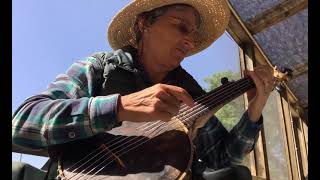
To learn it, I thought of the first part as divided in three. The first phrase ends on the fourth measure. Then comes a short phrase of two more measures with a unique second measure. The third phrase has four measures which incorporate parts of the first and second phrases. Sounds confusing! I just learned it and so decided to read my tab for recording today. It's fun to play, especially the B part with its unusual clawhammer thumb fingering on the fourth beat of the measure (as shown by Dan Levenson in the above link).
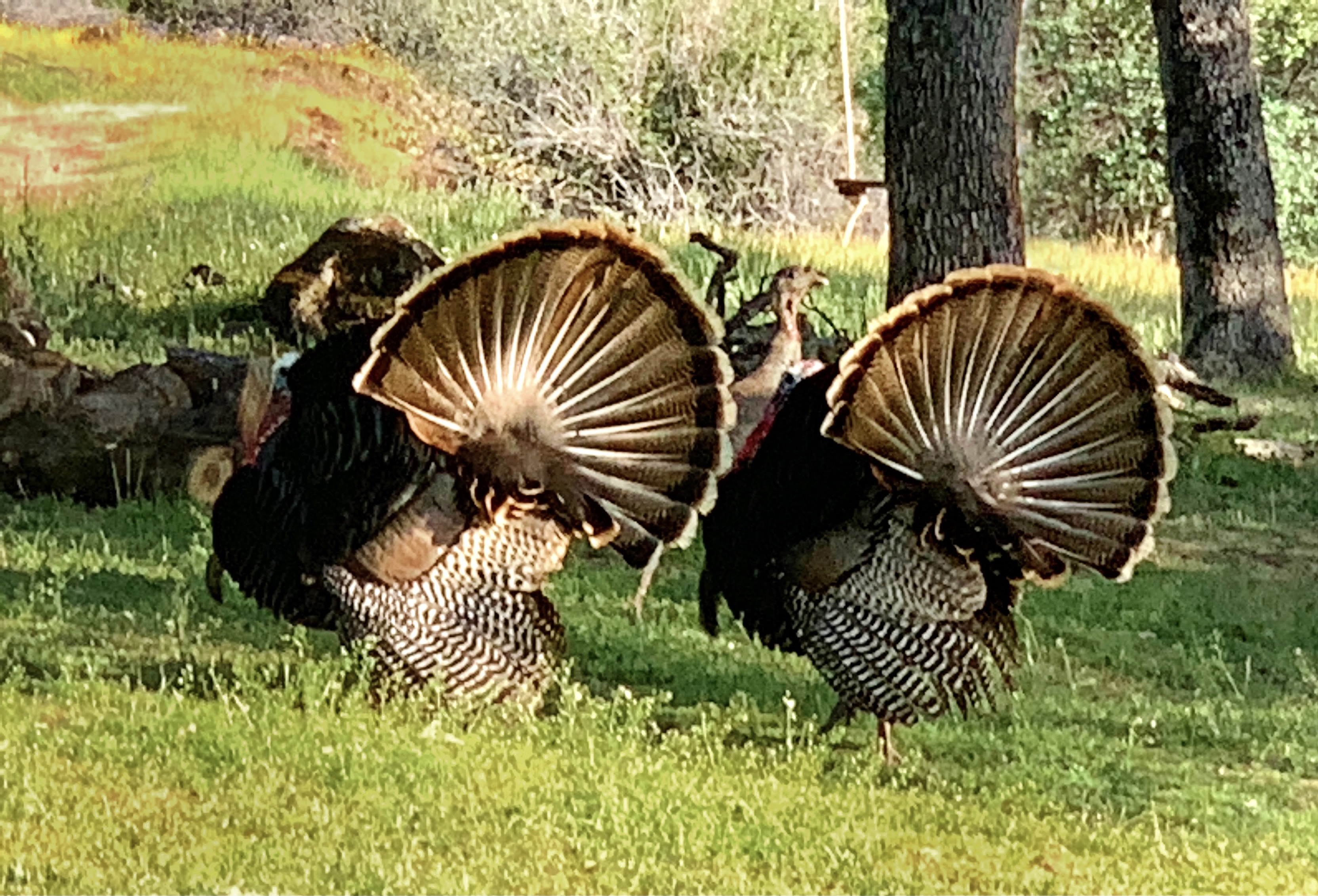
The turkeys didn't let me have peaceful recording time. You can hear one of them gobbling twice, especially at the end.
Terms of Use | Privacy Policy | Privacy Consent (EU/GDPR Only)
Copyright 2026 Banjo Hangout. All Rights Reserved.