DVD-quality lessons (including tabs/sheet music) available for immediate viewing on any device.
Take your playing to the next level with the help of a local or online banjo teacher.
Weekly newsletter includes free lessons, favorite member content, banjo news and more.
Premier Sponsors


|
Please note this is an archived topic, so it is locked and unable to be replied to. You may, however, start a new topic and refer to this topic with a link: http://www.banjohangout.org/archive/373867
carolynf - Posted - 03/25/2021: 22:48:38
I chose “Three Forks of Hell” for my Tune of the Week submission, a tune that grabbed my attention the very first time I heard it on Jim Taylor’s Civil War Collection CD, Volume 1. It was part of a medley along with Arkansas Traveler and Pop Goes the Weasel. Sheila Kay Adams was the banjo player on that CD, and being a new banjo player not yet able to figure things out for myself, I desperately wanted the tablature. This was back in the days of BanjoL (the Banjo List), and someone supplied it to me. I printed it off and did learn to play it, but I cannot remember who to attribute the tab to. And as far as I knew, Sheila had written the tune; that was what I’d been told.
Twenty-one years later now, I knew there might be more to the story, so I started some research. I found that “Three Forks of Hell” is associated with the American Civil War battle of Cheat Mountain. (There is another tune named “Three Forks of Cheat,” which is unrelated musically)
From the liner notes of Taylor’s Civil War Collection:
This banjo piece comes from Gerry Milnes who learned it from Arthur D. Johnson, a banjo player from Mill Creek, West Virginia. This tune is associated with the battle of Cheat Mountain in what is now West Virginia. The battle, which took place September 11-15, 1861, pitted the Confederate forces under Robert E. Lee against Union held positions on Cheat Mountain and the surrounding area. After five days of fighting in rugged mountain terrain and heavy rains, Lee was forced to pull back from his previously held positions and abandon the northern part of western Virginia to the Federals. Lee’s reputation was tarnished by this setback and would not be restored until the Seven Days campaign near Richmond in June of the following year. Indicative of the bitterness of the struggle in western Virginia during the war, Arthur Johnson declared that there was a time when if you went to the area around Cheat Mountain and played this tune, you’d be killed.
Besides Sheila Adams’ piece, I discovered no commercial recordings of the tune. I did, however, find that a field recording, of which seemed to be the sole tune source, had been published by Marimac Recordings in 1991 under the title, Banjo Anthology, Volume 1. Unfortunately, I discovered that Marimac was a dead-end, as it has since gone out of business and the recordings are mostly unavailable. The cassette recordings that exist reside in a couple of university libraries back east.
I turned to YouTube, and I found a performance by Emily Pinkerton, who referenced the source recording by Arthur D Johnson. I contacted her, hoping to find that recording, and she confirmed that it did not seem to be available to buy online anymore. She did lend me the source mp3, and encouraged me to check with Gerry Milnes, who had done the original field recording.
Gerry Milnes was very helpful, and kindly gave me permission to share the field recording of Arthur. Here is the YouTube video I made of it. At the time of the recording, sometime between 1976 and 1990, Gerry also met Arthur’s brother, Cletus, and his sister, Jessie, who also played. They were all in their 80’s when he met them. Gerry suggested I check with the Augusta Heritage Society, who has the Banjo Anthology recordings. I am currently working with them to try to get a copy.
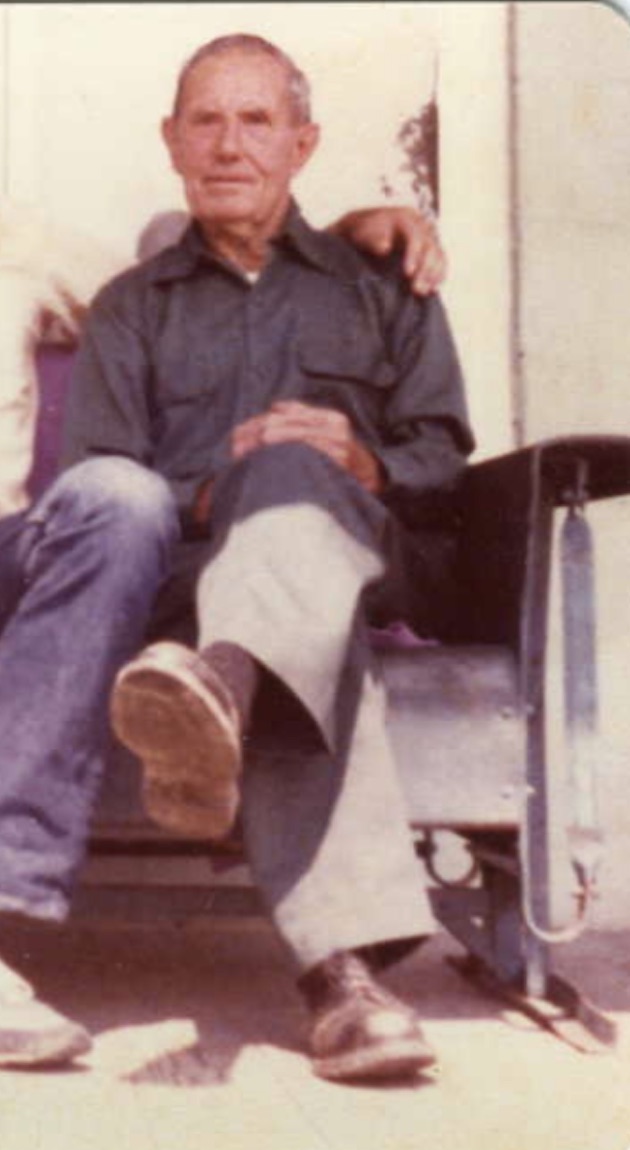
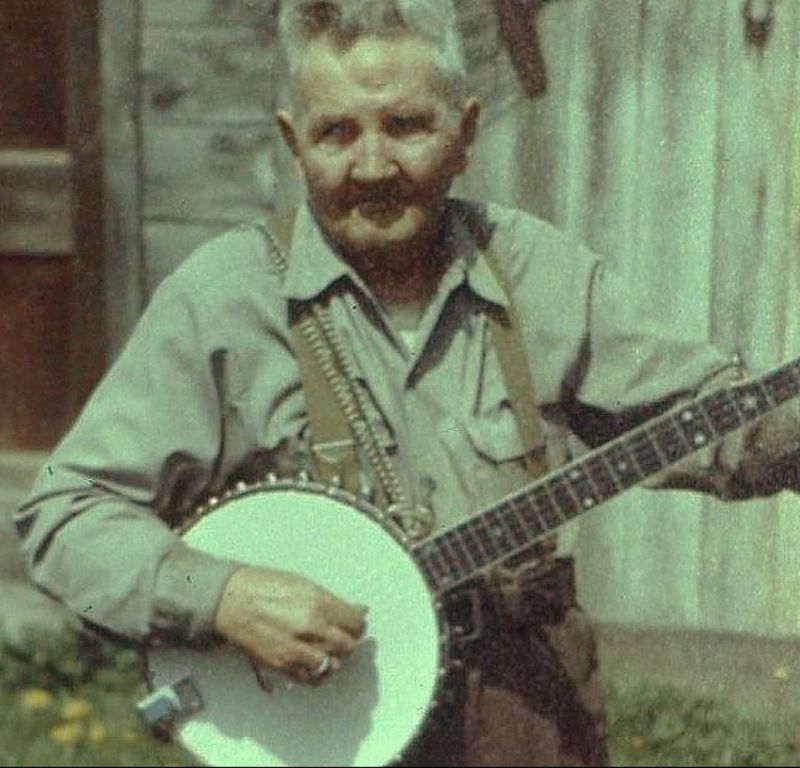
Arthur was born June 16, 1907 in Gilmer County, WV, and passed away Nov 22, 1995. His nickname was “Ott,” and his wife was Vada, or “Vadie.” My sister found a photograph of Arthur and Vadie on Ancestry. Seeing the person behind the music makes the tune live and breathe, for me. It isn’t just a pretty set of notes, it’s a real person playing something he learned from an elder, playing it in his life experience, with his friends, his family. His fingers on the strings are confident and familiar, and it is my joy that it still lives for me to own it also.
The tuning for Three Forks of Hell is double c, but with the 5th string tuned down lower, to an “e” rather than a “g.”
The tab I got back in the day, I am sharing it, although it is not an exact duplicate of Arthur’s playing. I did not re-tab the tune myself, but Janet B created a tab from Arthur’s mp3 I sent her. Janet also said that she could see similarities between Three Forks of Hell and Callaway, another West Virginia tune from the Hammonds Family. I agree, though they are different tunes.
The tune “Half-Shaved” from Wade Ward was also shown to me as having similarities, both with the tuning and the styling of the A part. Wade was from Virginia, so perhaps a tune from that area, not identified, inspired musicians’ creativity.
Arthur’s brother Cletus was reportedly an amazing banjo player, and his field recording also appears on the Banjo Anthology.
I videoed myself playing the tune on my James Hartell Boucher Minstrel banjo, in tribute to the Civil War origins of the tune, and am also sharing the mp3 of me playing here.
Bill Rogers - Posted - 03/25/2021: 23:22:23
Good research, Carolyn. Interesting to me that the tune has such a major sound, rather than the modal or minor we often associate with WVA tunes. Liked your playing. You’ve come far from when we first met.
carolynf - Posted - 03/26/2021: 00:01:19
Thanks, Bill. I am grateful for all the banjo players whose paths I’ve crossed and helped me in my journey.
ndlxs - Posted - 03/26/2021: 05:00:37
Jim Taylor was also a fine hammered dulcimer player; I treasure his LP "Come Before Winter". The title track has become a standard of hammered dulcimer repetoire. He had a tragic and untimely death in 2009; Sheila Kay Adams was his wife.
ndlxs - Posted - 03/26/2021: 05:08:26
Carolyn,
Such a fine job you have done on this tune! Great video, and great choice of banjo to play it on, too. This is a great example of the type of tune that the banjo excels at; mostly catchy rhythms with enough melody to glue it together.
I guess if it would have been dangerous to play this tune by this name that others would change the name so they didn't get in trouble.
carolynf - Posted - 03/26/2021: 06:18:38
Right! You change it a little and say, no no! This is called, uh, Callaway!
ndlxs - Posted - 03/26/2021: 06:26:22
It would have been nice to have some spoons or tambourine accompaniment...anyone else at home willing to do this? :-)
carolynf - Posted - 03/26/2021: 06:35:30
I’m on my own, musically speaking, right now. But I give everyone permission to put my mp3 on speakers and try out various extraneous musical devices. (Except saxophones and piano accordions)
ndlxs - Posted - 03/26/2021: 06:42:20
I think saxophones are instruments that play better in flat keys. They'd need a saxophone capo to work with banjo. I'd better check on saxophonehangout.com...
Hay-on-Wye - Posted - 03/26/2021: 09:57:57
Lovely tune once again Carolyn and your playing of it on that bassy Boucher banjo was exquisite. Really enjoyed your performance.
Sheila K Adams banjo style is lovely. I fell in love with her style years ago when I came across a cassette called A spring in the Burton Cove. I particularly liked her rendition of Ducks on a Millpond. Never heard anyone play it like her. She uses the cluck in her tunes, just in the right places.
youtu.be/Wl0SdqyByFc
cmic - Posted - 03/26/2021: 11:15:28
What a pleasure it is to learn this story, the research and of course this very nice tune. Nice rendition.
(and some measures of the first part reminds me of "Indian ate a woodchuck" as played by Nancy Sluys...)
JanetB - Posted - 03/26/2021: 17:28:11
Thanks, Carolyn, for bringing us full circle back to this tune and for your compelling research. I still have the tab you gave me way back when. I already liked the tune, but knew nothing about it till now. I was beginning my re-exploration of clawhammer at the time and tabs were one way we both were seeking out tunes.
You made a good choice to play for us on minstrel banjo and I like your tempo and slides. After reading the historic description Three Forks of Hell, I decided to try a more frantic tempo, as if in a battle. My tab follows measure-per-measure timing of Arthur Johnson's recording, but I may have changed a couple of notes.
The lowered 5th string adds to the melodic flow. Anita Kermode says this about the tuning on Donald Zepp's site: eCGCD
Double-C, lowered 5th string: Wade Ward's "High Atmosphere" tuning
Wade Ward, Half Shaved ("High Atmosphere"). Pete Steele, The Train A-Pulling.("Pete Steele: Banjo Tunes & Songs"). Art Rosenbaum, Heavy Loaded Freight Train (Tab in "Old-Time Mountain Banjo"). Bob Fulcher, Lost Indian ("Old Five-String"). Clyde Davenport, Sugar in My Coffee-O ("Puncheon Camps"). Joel Mabus, Briarpicker Brown/ Spider Bit The Baby; Soldier's Joy ("Joel Mabus, Clawhammer"). Molly Tenenbaum, Jack O' Diamonds ("And the Hillsides Are All Covered with Cakes"). Hank Bradley, Ducks on the Millpond (Tab courtesy of Ray Stewart. I've no recorded example). Dwight Diller, Callaway ("Harvest: West Va. Mountain Music").
Hay-on-Wye - Posted - 03/26/2021: 21:18:35
You know Janet, you say the faster, more dramatic tempo you used, is to simulate a battle? I agree, but I see on Carolyn’s you tube channel you asked could if the title could be anything to do with the meeting if water tributaries. I think that fits as well as there’s a delicacy in parts of your playing and then the big bass notes intermixing like the waters meeting initially and then a thunderous roar as they combine.
JanetB - Posted - 03/26/2021: 21:36:35
quote:
Originally posted by Hay-on-WyeYou know Janet, you say the faster, more dramatic tempo you used, is to simulate a battle? I agree, but I see on Carolyn’s you tube channel you asked could if the title could be anything to do with the meeting if water tributaries. I think that fits as well as there’s a delicacy in parts of your playing and then the big bass notes intermixing like the waters meeting initially and then a thunderous roar as they combine.
Titles are powerful suggesters. Today I learned about the historic background of the tune, so I tried a different approach. Arthur Johnson's sounded more like a battle and the very title uses the "h" word.
Here was my first effort at the tune -- it has a different, more gentle feel, which is my norm: Three Forks of Hell. Music is so subjective, isn't it.
Hay-on-Wye - Posted - 03/26/2021: 22:23:45
It is Janet, your first version had a Tony Ellis feel to it
JeroenJ - Posted - 03/31/2021: 03:19:43
I uploaded my take.
banjohangout.org/myhangout/med...archived=
I have two more days until next TOTW, but an OK take one is always more interesting than a faultless take twenty three.
I used Carolyn's tab of forgotten origin and tried to stay close to that and Sheila Kay Adams' version. I plan to keep playing it until it feels so natural that I can start to work on something resembling Sheila Kay Adams' great peppy clucks.
Do cluckers practice on their clucks as if it were notes, or do they work on developing a right hand routine where they just happen?
Edited by - JeroenJ on 03/31/2021 03:21:46
carolynf - Posted - 03/31/2021: 07:26:48
JeroenJ your upload was great! That was the magic that drew me to the tune when I first heard Sheila Adams play it. The little background percussion is nice.
I like some cluck, and sometimes I play around with my technique to get some. But I’d have to play more mindfully in practice to have it at hand easily.
Terms of Use | Privacy Policy | Privacy Consent (EU/GDPR Only)
Copyright 2026 Banjo Hangout. All Rights Reserved.