
DVD-quality lessons (including tabs/sheet music) available for immediate viewing on any device.
Take your playing to the next level with the help of a local or online banjo teacher.
Weekly newsletter includes free lessons, favorite member content, banjo news and more.
Premier Sponsors


|
Please note this is an archived topic, so it is locked and unable to be replied to. You may, however, start a new topic and refer to this topic with a link: http://www.banjohangout.org/archive/371515
finger-picker - Posted - 01/03/2021: 16:08:40
I have a few questions in this so I'll just number them out:
1) How is it explained, musically, in that the 2nd inversion/barre Em chord at the 9th fret, B-G-E, is "able to" have such a ubiquitous second string/11 fret choke tacked onto it when the note, A#, isn't even part of the Em Scale (E F# G A B C D)?
2) Is it just a pleasant sounding passing tone or what? To me, it would make more sense musically (mind you I have very limited musical education under my belt) to have the A (second string/10th fret) choked and it would be a lot easier on everyone's pinkies to boot!
3) For that matter, are there certain frets that chokes sound the best with? I've come across probably the 10th fret choke the most when not dealing with Earl's Em, and some third string 2nd and 3rd frets for some bluesy songs like 9 Lb Hammer and Clinch Mountain Backstep.
Thanks
Edited by - finger-picker on 01/03/2021 16:09:28
Old Hickory - Posted - 01/03/2021: 16:41:36
quote:
Originally posted by dan_the_man1) How is it explained, musically, in that the 2nd inversion/barre Em chord at the 9th fret, B-G-E, is "able to" have such a ubiquitous second string/11 fret choke tacked onto it when the note, A#, isn't even part of the Em Scale (E F# G A B C D)?
Because you're choking (bending) into a B note which is a part of the scale?
More to the point, scales and chords are not straightjackets into which melody notes are confined. Yes, most melodies encountered in bluegrass (and probably other genres as well) will stay within their scales. They they often go outside the underlying chord. There's no rule saying don't do it.
The reason we can do the choke you ask about is the same reason that when playing against a G major chord, we can slide from 2-3 (A to B-flat) on 3rd string on our way to the open 2nd string (B), when B-flat is not in the G Major scale and neither of those notes is in a G Major chord. The reason is the rule of theory that trumps all other rules: If it sounds good, it is good.
A better explanation is above my grade.
quote:
Originally posted by dan_the_man2) Is it just a pleasant sounding passing tone or what? To me, it would make more sense musically (mind you I have very limited musical education under my belt) to have the A (second string/10th fret) choked and it would be a lot easier on everyone's pinkies to boot!
Oops. Looks like you answered it yourself!
Not necessarily more "pleasant," but supportive of the musical effect the player is trying to achieve. Bluesy, for example. Or mournful. Different people have different ideas for the subjective attributes they hear in the ways notes are slurred.
quote:
Originally posted by dan_the_man3) For that matter, are there certain frets that chokes sound the best with? I've come across probably the 10th fret choke the most when not dealing with Earl's Em, and some third string 2nd and 3rd frets for some bluesy songs like 9 Lb Hammer and Clinch Mountain Backstep.
Ned Luberecki does a demonstration in which he shows how the 2nd string 10th fret choke/bend in a roll with open 5th and 1st is the all-purpose use-it-anywhere-anytime-as-much-as-you-like lick.
Seems to me some chokes just wouldn't sound good. So they don't get the benefit of the rule above all rules. Trust your ears.
mmuussiiccaall - Posted - 01/03/2021: 18:01:54
Wow your actually asking the right question, most posters want to just learn a song and not the nuts and bolts that make every song tick. Simply put there are three blue notes in the scale b3 b5 b7 and that Bb is the b3 of a G chord and the b5 of Em chord.
finger-picker - Posted - 01/03/2021: 18:28:43
quote:
Originally posted by mmuussiiccaallWow your actually asking the right question, most posters want to just learn a song and not the nuts and bolts that make every song tick. Simply put there are three blue notes in the scale b3 b5 b7 and that Bb is the b3 of a G chord and the b5 of Em chord.
OK so the note has more of a bluesy sound to it than the A at 10th fret and it follows the b3 b5 b7 blues convention. I guess the same can be said when the third string 3rd fret is choked in songs like Clinch Mountain Backstep, b3 again.
1) You mentioned it as Bb vs. A#. Since G and Em both have F# as their one accidental, would it be more correct to call the note A# or does it matter?
2) I noticed when choking the note, or any note, that it doesn't quite achieve the next semitone up, so that would be a quarter tone correct? Are those treated like accidentals too with their own symbols?
BigFiveChord - Posted - 01/03/2021: 19:12:36
(1) You could call it A# as it is a lead tone up to B. You could call it Bb as it's the minor third being "choked" up. Either works. (I like Bb.)
(2) This is widely-discussed, even beyond the bluegrass banjo world. There is this convention typical to "the blues" of bending these "blue" notes somewhere between, say, the 4/#4/5th or b3/3rd. Some musical traditions have proper notation for semitones (e.g. Indian classical music). In guitar and banjo tablature, it's typically written a a degree of bending/choking, i.e. an upward-bending arrow with "1/4" or "1/2" to indicate the amount of bend/choke relative to a semitone.
Edited by - BigFiveChord on 01/03/2021 19:13:28
Old Hickory - Posted - 01/03/2021: 19:31:03
quote:
Originally posted by dan_the_man1) You mentioned it as Bb vs. A#. Since G and Em both have F# as their one accidental, would it be more correct to call the note A# or does it matter?
Yes, it matters.
First, F# in the keys of G Major and E minor is not an accidental. Accidentals are by definition notes outside the scale. F# is very much in the scale. F natural in the key of G or E minor would be an accidental. And the key signature is one sharp so that the scale adheres to the convention of using every letter name exactly once.
More to the point, the note is called B-flat instead of A# because B-flat indicates what's happening: the third of the scale is being flatted.
quote:
Originally posted by dan_the_man
2) I noticed when choking the note, or any note, that it doesn't quite achieve the next semitone up, so that would be a quarter tone correct? Are those treated like accidentals too with their own symbols?
I don't think standard notation can indicate less than a half step. I could be wrong and I'm happy to be corrected. I've seen plenty of guitar tablature with 1/4, 1/2 or the next fret number written adjacent to the bend symbol (a curved arrow) indicating the amount of note change in the bend.
The amount to bend - or choke - a note on banjo only matters if you're trying to re-create a particular performer's version. Otherwise, trust your ear and bend as much or as little as you want.
Edited to add: I was offline writing for a long time while BigFiveChord made good points in fewer words.
Edited by - Old Hickory on 01/03/2021 19:34:38
Old Hickory - Posted - 01/03/2021: 22:04:52
quote:
Originally posted by dan_the_man. . . 2nd inversion/barre Em chord at the 9th fret, B-G-E
Something just now struck me about this comment.
The full 4-string E-minor chord at 9th fret 9-9-8-9, B-E-G-B (strings 4-3-2-1) is of course a 2nd inversion (with the 5th on the bottom).
But if you don't use the 4th string and fret only the 9-8-9, E-G-B on 3-2-1 -- which is way more common for the up-the-neck E minor in Foggy Mountain and other tunes -- then I suggest you're not playing a 2nd version but a higher octave root position E minor. There's a root position triad at the top of the 2nd inversion shape. The bottom note in the three-string stack is an E. It's an octave higher than the 4th string 2nd fret E, but it's still E, so it's still the root.
I don't think it's right to refer to the shape as an inversion if the lowest note you're using is the root.
I'm also not sure about calling the 4-string version of that shape a barre. The shape needs all four fingers. I'd think it has it's own name. But I don't know what to call it.
While I think some of this is good stuff to know and agree on for understanding's sake (whether it's my position or another one that's agreed on doesn't matter) I think some of this is more useful in talking about music than in playing it.
finger-picker - Posted - 01/04/2021: 05:14:11
quote:
Originally posted by Old HickoryI'd think it has it's own name. But I don't know what to call it.
Let me know if you find the name :)
finger-picker - Posted - 01/04/2021: 05:17:09
Thank you fellas, calling it a Bb makes a lot of sense since it's the 3rd degree being flatted to achieve the desired sound whereas the case of the A# would make sense since its the leading tone up to the B. As for the choke notation, I've seen that in some of my instructor's tabs, I just didn't put two and two together. Thanks for the clarification.
USAF PJ - Posted - 01/04/2021: 07:51:09
quote:
Originally posted by Old HickoryWhile I think some of this is good stuff to know and agree on for understanding's sake (whether it's my position or another one that's agreed on doesn't matter) I think some of this is more useful in talking about music than in playing it.
Hi Ken,
Can you develop this a little for me? I have wondered if my playing would be enhanced by a fuller understanding of music theory. Also I have found myself confused about the Cumberland gap formation and how it functions as "G" and an "Em". How important do you think this knowledge is for many of us who do not have strong backgrounds in music theory?
mmuussiiccaall - Posted - 01/04/2021: 08:09:05
The vast majority of players in the genres covered by the hangouts play by ear. They learn the "sweet spots" on the neck by "hunt and peck" and possibly TAB. Let's say if I ask a question "Except for the second string, why do you learn to stay away from the first fret on the banjo?"
250gibson - Posted - 01/04/2021: 08:48:55
quote:
Originally posted by dan_the_manThank you fellas, calling it a Bb makes a lot of sense since it's the 3rd degree being flatted to achieve the desired sound whereas the case of the A# would make sense since its the leading tone up to the B. As for the choke notation, I've seen that in some of my instructor's tabs, I just didn't put two and two together. Thanks for the clarification.
I would call it an A# because in standard notation it would be written with an appoggitura (little note) on the A space/line with a sharp accidental, tied to the main note B next to it. Calling it a Bb would have the appoggitura on the same space/line as the B and would need 2 accidentals, a flat on the appoggitura and then a natural on the main B note, which would be tight to read, and also doesn’t easily convey the rise up in pitch as the appoggitura written on the space/line below.
Old Hickory - Posted - 01/04/2021: 10:23:15
quote:
Originally posted by USAF PJquote:
Originally posted by Old HickoryWhile I think some of this is good stuff to know and agree on for understanding's sake (whether it's my position or another one that's agreed on doesn't matter) I think some of this is more useful in talking about music than in playing it.Can you develop this a little for me? I have wondered if my playing would be enhanced by a fuller understanding of music theory. Also I have found myself confused about the Cumberland gap formation and how it functions as "G" and an "Em". How important do you think this knowledge is for many of us who do not have strong backgrounds in music theory?
My own understanding of music theory is probably fuller than yours but less full than others. For example, 250gibson just wrote about something in music notation I've never heard of -- never had any reason to know about it. But reading it now, I understand his reasoning for calling the note we've been discussing one thing and not another.
That doesn't address what you're asking. It's just my way of saying that we get by with whatever level of theory is right for our current needs and desired progress. I'll answer to the best of my ability and understanding, which I think reflects the level of theory that's been useful for helping me work out tunes by ear, get through jams and keep up with my former bandmates who knew more than I did. At 69 years old, I'm still learning more theory in dribs and drabs as I encounter it in online lessons and messages here.
More to the point: I don't know how much theory you know. There's a chance you know more than you're aware you know. I think the theory that's most useful for someone who wants to be able to jam and improvise on banjo includes:
I'm sure there's more. I didn't list pentatonic (five note) scales. Not sure where to put that. Capo is something that every banjoist needs to know. Understanding the time values of note symbols -- especially because modern tablature borrows note forms from standard notation.
You don't need to know all of this at once. And I'm not sure of the order for learning it. Some of this will help you jam and improvise. And as you jam and improvise, you'll probably discover where a little more theory will help you: How do people immediately know the chords to songs they've never played before? How do people decide when to use a capo and what fret to put it on? And how can three different banjo players be playing a song in the same key and tuning with three different capo locations (including no capo)?
If you find yourself wondering any of those things or if you sense that a reason you're not able to do something has more to do with your knowledge and understanding than with your physical ability to sound notes, then you probably need the next amount of theory.
This has gotten really long, which is typical for me, and I haven't got to your specific question about the Cumberland Gap position (also called the Sally Goodin' position) and why it functions as a both a G and Em. At the risk of simplifying to the point of error, here goes.
In the 9-8-9 shape on strings 3-2-1, the notes are E-G-B. That's an E minor "triad" (three note chord). E minor is the iv (sixth degree) chord in the key of G Major. If you roll on only strings 5-2-1, you'll be playing G-G-B, two notes that are common to the chords G Major and E minor. I don't have my banjo in hand and I'm not looking at tab, but in my head I'm imagining that when playing Cumberland Gap up the neck we maybe avoid the 3rd string 9th fret E note until we want to make a clear E minor sound. It's quite possible we could play that E note during a G chord because as I said in a previous message a melody will often have notes that are not part of the underlying chord. Non-chord notes played in passing from one note to another create a sense of movement. Non-chord notes add color to rolls.
IF we want to play that E note during the G chord in Cumberland Gap or Sally Goodin' we should do what Earl Scruggs taught and lift our fretting finger after playing that note to immediately stop it from ringing. The way Tony Trischka told it at banjo camp was someone asked Earl about that fingering and why not play it like Foggy Mountain Breakdown, to which he said "Because it's Sally Goodin', not Foggy Mountain Breakdown."
And this -- finally -- gets to the real answer to your question, which is: The Cumberland Gap shape does not function as both G and E minor chords. It provides access to melody or passing notes that work over both G and E minor chords. There's a subtle difference.
Hope I've helped. I'm happy to be corrected in any of the above.
finger-picker - Posted - 01/04/2021: 11:39:19
quote:
Originally posted by Old HickoryMy own understanding of music theory is probably fuller than yours but less full than others. For example, 250gibson just wrote about something in music notation I've never heard of -- never had any reason to know about it. But reading it now, I understand his reasoning for calling the note we've been discussing one thing and not another.
More to the point: I don't know how much theory you know. There's a chance you know more than you're aware you know. I think the theory that's most useful for someone who wants to be able to jam and improvise on banjo includes:
- Names of notes everywhere on the fingerboard. The ability to immediately name any string/fret location is best, of course. This is a case of do as I say, not as I do, because I am very slow to name the notes up the neck. I need to get better at this.
- Notes in the scales of the keys you play in most. G, C and D, for example. Eventually you should learn the formula of whole and half steps that defines every Major key. This will allow you to name the notes in any key, including the ones you never play in.
- The primary chords in every key you play in most. I'm referring to the chords identified by their "degree" or number in the scale. The three main chords you encounter in bluegrass are one, four and five, usually written as Roman numerals I, IV, V. In the key of G, those are G, C, D. In C, they're C, F, G. There's a reason for this, answered by more theory.
- The "diatonic" progression of chords in the "harmonized" scale, which explains where I, IV and V come from and shows which other chords you are likely to encounter in a particular key. Those chords, in order are: I Major, ii minor, iii minor, IV Major, V Major, vi minor, vii diminished.
- How chords are built on starting (root) notes which explains the relationship of chords to scales in the previous bullet.
- Intervals. The distances between notes. The intervals of thirds (both major and minor) and sixths are especially useful and good sounding in creating certain kinds of licks and runs in improvising. Maybe intervals belongs higher up. Recognizing the sounds of intervals is useful in working out melodies. I should know my intervals better than I do.
I'm sure there's more. I didn't list pentatonic (five note) scales. Not sure where to put that. Capo is something that every banjoist needs to know. Understanding the time values of note symbols -- especially because modern tablature borrows note forms from standard notation.
Well sounds like I'm on the right track at least as I am familiar with most/all of what you mentioned (but not what 250gibson said, lol - which was very informative though).
To provide context to the previous inquirer of my own desire to learn more music theory, I've been playing for a couple years now and am coming to an existential crisis with my banjo playing up until now. I've been obediently taking lessons this whole time and now starting to realize that I may not need to continue taking lessons as much going forward. As such, I've also realized how little I know about the banjo other than reading tab and the rudiments of playing by ear. I don't have a musical background or education and I don't really know the WHY behind a lot of things I do on the banjo, and that is driving my desire to learn more. I'm starting to learn what I want to learn vs. what someone else thinks I should learn, albeit with very good intentions.
I am not sure if certain styles of music benefit more of music theory than others but I will say that I probably enjoy playing classical/baroque music on the banjo the most as well, followed by melodic, old-time, Celtic, etc.
USAF PJ - Posted - 01/04/2021: 15:02:17
quote:
Originally posted by Old Hickoryquote:
Hope I've helped. I'm happy to be corrected in any of the above.
Thanks Ken, you have helped. Curious if you or Rick V have any material that you would recommend. I am still thinking through Diatonic/Root notes. Actually while I was out on a run a few hours ago I found myself thinking through different keys w/ and w/out a capo and trying to work out the chords in my mind.
Ira Gitlin - Posted - 01/05/2021: 07:20:52
"And this -- finally -- gets to the real answer to your question, which is: The Cumberland Gap shape does not function as both G and E minor chords. It provides access to melody or passing notes that work over both G and E minor chords. There's a subtle difference."
Ken puts this very well. In the up-the-neck breaks to "Foggy Mountain Breakdown" it does indeed function as an E-minor some of the time. But in "Cumberland Gap" it's just a bunch of notes that work with a G chord.
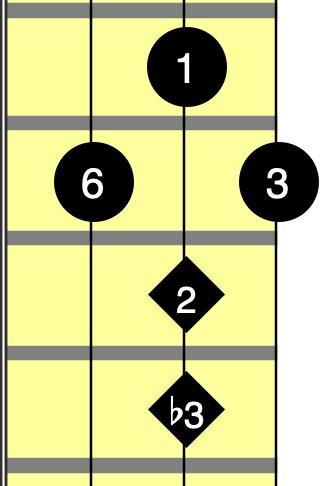
In fact, as Earl Scruggs advised Bill Keith at their first (?) meeting, in "Sally Goodin", "Cumberland Gap", the up-the-neck tag lick, and other settings where the prevailing chord is G, fret that E note only at the very moment you pick it. Don't hold it down all the time. (Bill Emerson calls this technique "touch and kill".) That way, the E pops in only when it's needed. If you leave it fretted, it keeps ringing, which muddies the harmonic waters.
mmuussiiccaall - Posted - 01/05/2021: 07:40:39
Here's a visual for what Ira is talking about, diamonds equal pinky positions
Old Hickory - Posted - 01/05/2021: 09:34:53
quote:
Originally posted by USAF PJ
Curious if you or Rick V have any material that you would recommend. I am still thinking through Diatonic/Root notes.
I'm not directly familiar with published books or DVDs that teach diatonic chord/scale theory in terms of practical application on 5-string banjo. By practical, I mean teaching the triads that make up harmonized scales and their various inversions for starting scales at different locations and how you turn that knowledge into licks and phrases.
Tony Trischka and Noam Pikelny both teach this in their online banjo schools at Artistworks. Right now, Artistworks is offering 12-month subscriptions (usually $279) for the price of 6 months: $179. That's not quite as good as the annual 50% discount in December ($139.50) but is still a good deal. Code: 2021
I've taken a quick look at material available for purchase to see what could be good.
The Mastering Banjo book from Ned Luberecki's Complete 5-String Banjo Method might include the type of practical application of theory I'm describring. The sample pages viewable on Amazon don't show exactly what I described above, but the contents shows what appears to be an in-depth section on chords/triads and putting them to use. $20, direct from Ned or from Amazon. I might buy this just to have it in my library.
A Banjo Newsletter review of Best of Jack Hatfield makes that book sound promising. As a "best of" it's a compilation of material from his previous books, but the review says the section on chords includes a lot of new material.
Maybe Alan Munde's Modern 5-String Banjo Method. I don't know.
Most of my books are songbooks. They tend to be either banjo artists' own tab books for specific albums or special collections created by them for publication, such as Tony Trischka's Master Collection of Fiddle Tunes or Alan Munde's Great American Banjo Songbook.
Sorry I can't recommend much material from personal experience. Maybe someone else can chime in to recommend instruction on practical application of diatonic chord theory (if that's in fact what you're asking about).
Good luck.
paco0909 - Posted - 01/05/2021: 11:09:28
Rick McKeon. Basic Music Theory for Banjo Players MelBay. Elderly Instruments is a good source.
Old Hickory - Posted - 01/05/2021: 13:17:07
quote:
Originally posted by Ira GitlinIn fact, as Earl Scruggs advised Bill Keith at their first (?) meeting, in "Sally Goodin", "Cumberland Gap", the up-the-neck tag lick, and other settings where the prevailing chord is G, fret that E note only at the very moment you pick it. Don't hold it down all the time. (Bill Emerson calls this technique "touch and kill".) That way, the E pops in only when it's needed. If you leave it fretted, it keeps ringing, which muddies the harmonic waters.
Just looked this up to be sure my memory was clear: Going on eight years ago, a Hangout member quoted Tony Trischka as saying of that position (probably at a banjo camp): "if you leave your middle finger down, you're going to hell!"
I don't think the consequences are quite that severe, but it does emphasize the importance of killing that note.
Terms of Use | Privacy Policy | Privacy Consent (EU/GDPR Only)
Copyright 2026 Banjo Hangout. All Rights Reserved.


