DVD-quality lessons (including tabs/sheet music) available for immediate viewing on any device.
Take your playing to the next level with the help of a local or online banjo teacher.
Weekly newsletter includes free lessons, favorite member content, banjo news and more.
Premier Sponsors


|
Please note this is an archived topic, so it is locked and unable to be replied to. You may, however, start a new topic and refer to this topic with a link: http://www.banjohangout.org/archive/351297/2
Page: 1 2
IMBanjoJim - Posted - 03/02/2019: 19:12:41
quote:
Originally posted by Alvin ConderJim- That screw is machine manufactured. Standard American. 1880 to present. Very common in commercial furniture from the 1880s on.
Love what you discovered about the neck. Just adds to the mystery. Never seen a mountain banjo with that cloth spacer. Also interesting is the inner oak hoop. Most of the banjos of this type that I have seen had either a can or a piece of stovepipe for the what could be called a tone ring.
I’m sure once this is together and playable it’s going. To have a nice tone to it.
You dug up a few nice scores in the recent months. Nice thing about them all is that you shared them here and they brought forth a lot of discussion and knowledge to be shared.
Thank you.
Hey, Alvin--thanks for the nice comments. Ya--I've been finding a few things lately, but what is interesting to me is that they are not always exactly what I thought when I got them. Some of the English banjos end up being American, and vice-versa, for instance.
I'm having fun, learning how much I DON'T know, but I am going to have to slow down and let the credit card cool off.
IMBanjoJim - Posted - 03/07/2019: 18:19:17
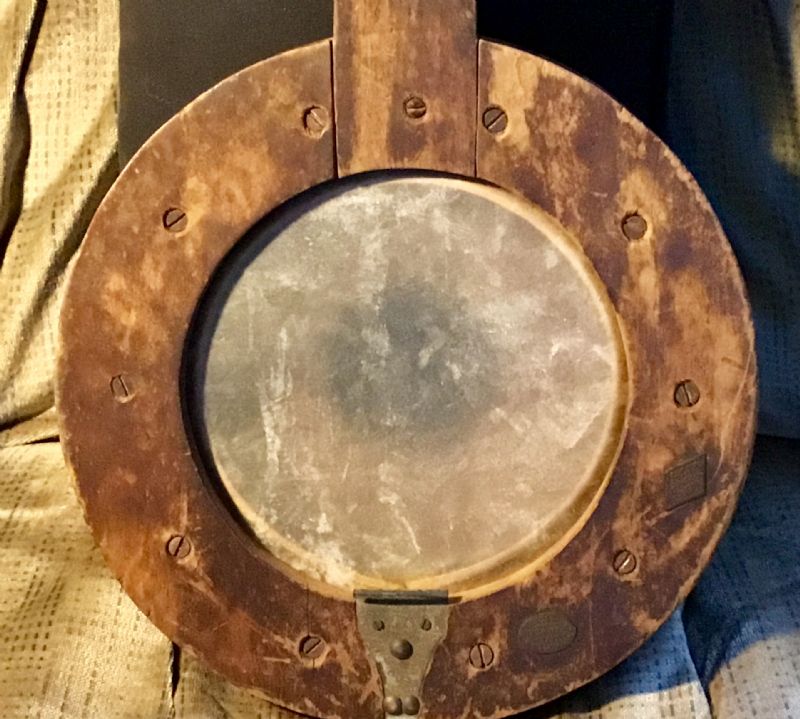
Well, it took 2 try's, but the mt banjo has a new head.
The 1st try, I tacked the head to the middle wooden piece, reassembled, and nothing fit.
Luckily I had taken photos when I first got the banjo, so saw that on this particular mt banjo (every damn one I own is different), the head gets tacked to the underside of the top wooden ring. Once I did that, it all worked out.
Head dried nice an taut, by the way.
IMBanjoJim - Posted - 03/14/2019: 15:10:47
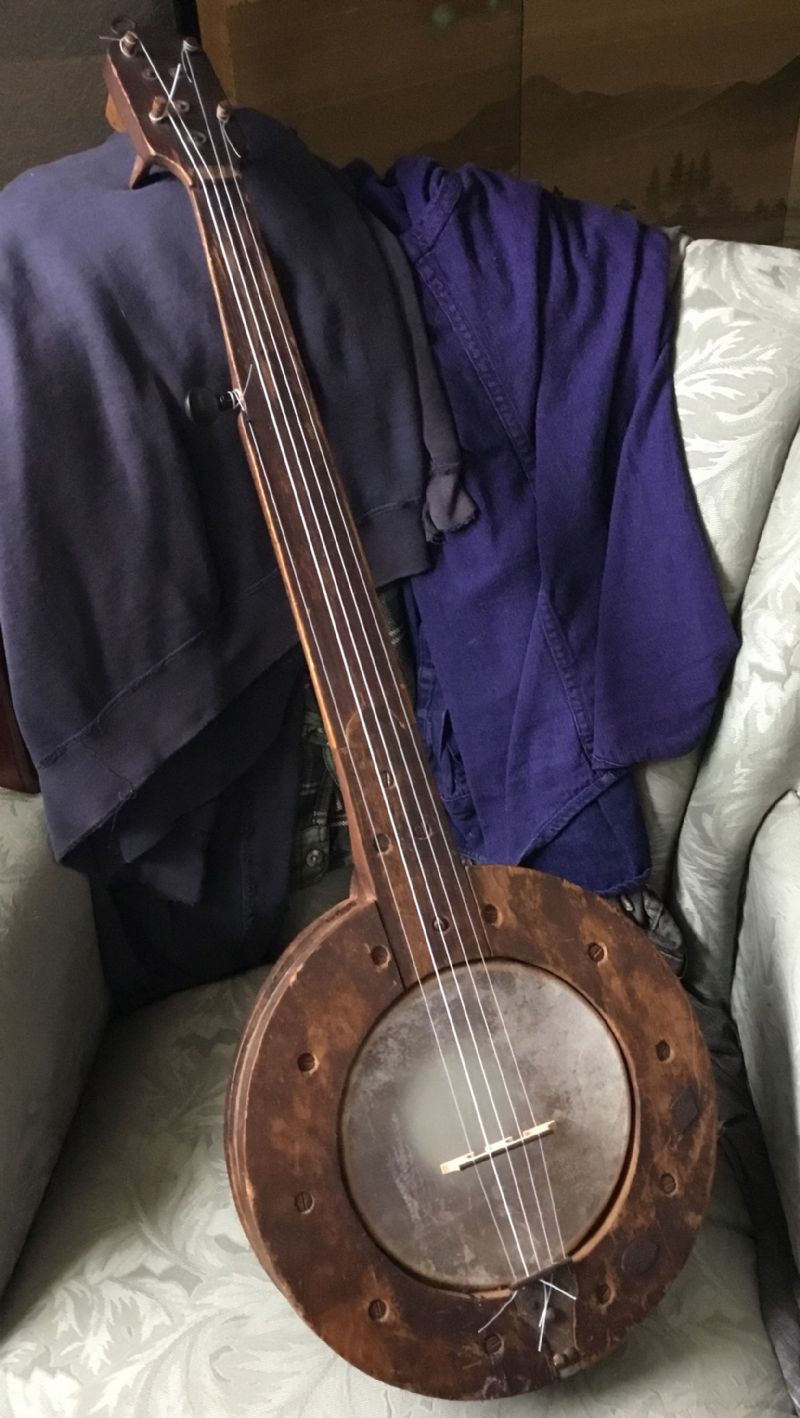
And all strung up...finally!
I need a plain wooden bridge, but for now, put a modern one in there so I can play.
Edited by - IMBanjoJim on 03/14/2019 15:11:43
IMBanjoJim - Posted - 03/14/2019: 16:19:47
Re-assembling the banjo turned out to be a real challenge. The middle wooden ring of this 3-ring pot had split in several places over the years. That ring is surrounded by a piece of sheet metal, so the cracks never mattered. However, unscrewing and re-screwing the banjo caused more cracks in that middle ring, and the parts no longer fit together as tightly as they should.
Luckily, one of my long-suffering luthier friends has tools and clamps I didn't even know existed. Still, this was a difficult project. After filling in the cracks and screw holes with sawdust and wood glue, and letting that dry overnight, we re-drilled the holes, then clamped the bottom wood ring to the middle ring. Then we screwed those together while still clamped, so the screws would sit tight.
Then we re-soaked the new skin so that it was pliable again. The inner, steamed and bent oak 'tone ring' did not sit high enough to effectively make the skin taut, so we glued some wood strips to the inside back of the instrument. The tone ring now rode higher, and the wet skin head stretched nice and tight.
We then clamped the top wooden ring over the rest of the assembly. Once it was tight against the middle ring, we screwed that and the neck on.
All this time we were half expecting the entire thing to explode, and the screws to go bouncing around the room like so much shrapnel!
At that point I brought it home, fashioned a new nut, strung up the banjo, and…it works!
And it's got a great sound!
Joel Hooks - Posted - 03/15/2019: 06:51:53
It is interesting (but not surprising) that the neck is a reused neck from a dowel stick style banjo.
Yet another indication that it was cobbled together some time in the 20th century.
I wonder if they made the rim look old to match the neck? They are a good match.
IMBanjoJim - Posted - 03/15/2019: 09:35:07
The idea that there is a whole cottage industry devoted to churning out fake old banjos just stretches my Incredulity Index to the limit.
IF someone was going to ‘fake’ a mt banjo, they would fake a signed Frank Proffitt banjo, since those fetch the big bucks.
There are too few people who would want this particular mt banjo to make it worth faking. By and large, the reaction I’ve gotten from people when I’ve shown them photos of this one is, ‘Why?’
I happen to think it’s pretty cool, but that doesn’t seem to be the usual reaction.
I agree that these banjos are almost impossible to date accurately, but, having taken this apart (several times), and put it back together (again, several times) I can assure
you this is an old instrument.
Joel Hooks - Posted - 03/15/2019: 11:42:54
quote:
Originally posted by IMBanjoJimThe idea that there is a whole cottage industry devoted to churning out fake old banjos just stretches my Incredulity Index to the limit.
IF someone was going to ‘fake’ a mt banjo, they would fake a signed Frank Proffitt banjo, since those fetch the big bucks.
There are too few people who would want this particular mt banjo to make it worth faking. By and large, the reaction I’ve gotten from people when I’ve shown them photos of this one is, ‘Why?’
I happen to think it’s pretty cool, but that doesn’t seem to be the usual reaction.
I agree that these banjos are almost impossible to date accurately, but, having taken this apart (several times), and put it back together (again, several times) I can assure
you this is an old instrument.
Hi Jim, I have reread my post and I was not able to find where I used the word "fake."
According you your findings posted earlier when you had the banjo dissembled, the neck shows all the evidence that it was from a factory banjo using a dowel rod (and has the appearance of those often attributed to the Buckbee factory).
Using that information, one can deduce that the neck predates the body/rim. By how many years? No way to tell.
Was this banjo assembled because the original rim was destroyed or in some other way found unsuitable (unlikely as rims tend to outlive necks but still possible)?
Or was this banjo assembled/built from an old banjo after the maker read or learned about the "mountain style" banjo that came to popularity in the folk revival?
Often people will take "old" objects and modify them to take on a more contemporary nostalgic "old timey" look or function. This is not malicious. It is possible that during the "folk revival" that a resourceful person wanted a "mountain banjo." What better way to make an "old timey" banjo than to use a old neck-- just like they would have done in the olden times.
That is just as likely a scenario as some old man in isolation building it due to poverty during the depression.
Again we are arguing a negative. Unless someone comes forward and says "I built it" we will never know the story.
My question, since you have examined it closely, did whoever built it age the new rim to match the old neck? Or, did they refinish the neck and rim at the same time it was built? Is this something you can tell from having it in hand?
Unrelated (mostly), when I was a child my father built a coffee table and used a book he had that taught him how to make it look old and worn. The book was filled with techniques on how to make a table surface look old. That would have been in the early 1980s and the information was likely not hard for him to get.
IMBanjoJim - Posted - 03/15/2019: 14:23:39
Hey, Joel. First of wll, please realize I am not being argumentive for the sake of being argumentive. We just seem to be reaching different conclusions.
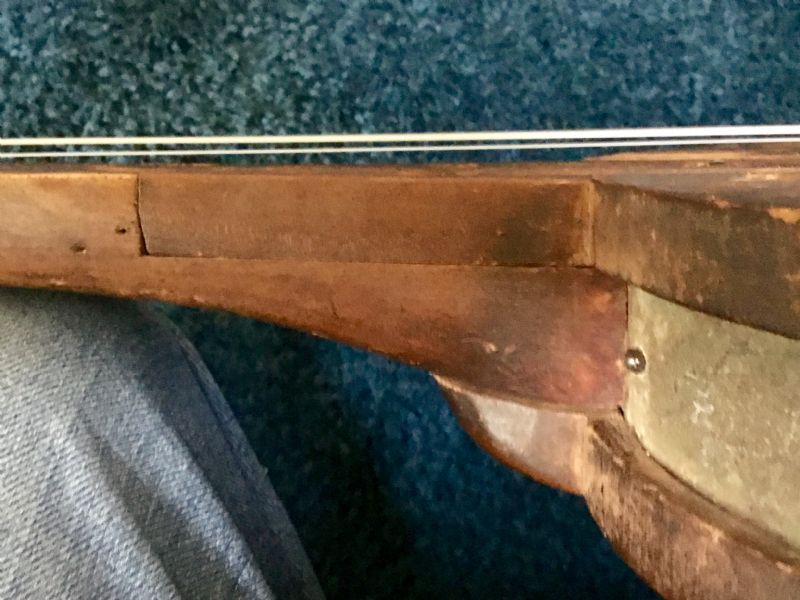
As to your question, the pot is darker than the neck, whether by design or not.
I now have 6 mt banjos in my collection. Two are obviously old (regardless of how we define that), while the others are obviously post Foxfire 3.
What I find interesting is that each one took the basic idea of a mt banjo, and built it differently. On some (including one of the older ones) the three ‘layers’ of the wooden pot are glued, on some, they are screwed together. On some the head is attached to the sides of the inner wooden tension ring. On this last one, the skin was attached to the under side of the top wooden ring. On one of the banjos, the pot is all one piece of turned wood, and the wooden tension rimg with the head is shoved up from underneath!
So it seems like, both with the old and with the new ones, there was wide variations in construction methods, despite the overall concept being the same.
Attached is a photo of the side view, where the old neck meets the new pot.
Edited by - IMBanjoJim on 03/15/2019 14:27:20
jun3machina - Posted - 03/25/2019: 14:31:59
Neat find! I'm personally fond of these type of 'folk art' ones...
Page: 1 2
Terms of Use | Privacy Policy | Privacy Consent (EU/GDPR Only)
Copyright 2026 Banjo Hangout. All Rights Reserved.