DVD-quality lessons (including tabs/sheet music) available for immediate viewing on any device.
Take your playing to the next level with the help of a local or online banjo teacher.
Weekly newsletter includes free lessons, favorite member content, banjo news and more.
Premier Sponsors


|
Please note this is an archived topic, so it is locked and unable to be replied to. You may, however, start a new topic and refer to this topic with a link: http://www.banjohangout.org/archive/350996
carolynf - Posted - 02/08/2019: 09:37:03
(Poor) Little Nell, in open D, f#DF#AD
I first heard this tune from a Piney Creek Weasels CD, Squirrel Heads and Gravy. (1996, Hay Holler Records)
Little Nell, by Piney Creek Weasels on youtube
The A part is reminiscent of Angeline the Baker, and perhaps that was part of its origin. But I have not been able to easily find out very much information on this lovely little tune. When I googled it, I only found some other, more modern “Little Nell” tune. I did find it listed in Zepp’s banjo tuning list:
Which was handy, since I have misplaced the original Squirrel Heads cd and case I own. The tuning is in “Open D/Graveyard/Reuben” tuning, f#DF#AD. Rick Abrams is the clawhammer banjo player leading the tune, with some pretty back-up on mandolin and guitar. And there I was stuck, until I asked the current Piney Creek Weasels’ banjo player, Andy Alexis, if he knew where the band had come up with the tune. He believed that Rick Abrams had learned it directly from the source, Marvin Gaster, and found a link on Amazon for Marvin’s recording.
When I looked at the list, I knew why Marvin’s name had not come up in my searches. He calls it “Poor Little Nell.” His style is old time 2-finger playing.
I wanted the cd recording, “Uncle Henry’s Favorites” (which caused me momentary confusion because I have a cd from another band whose name is “Uncle Henry’s Favorites!") right away, so I downloaded the digital version. Janet B. was following me on my research, and ordered the physical disc, which was loaded with fascinating historical information on Marvin. I should have been patient! But I am grateful she shared the liner notes with me.
The information is also part of Bob Carlin’s Book, “Stringbands in the North Carolina Piedmont.”
Bob Carlin's North Carolina Stringbands, from Google books
I’ve written out a bit of that info here:
Marvin Gaster born in 1934, came from Lee County, North Carolina, from a long line of musicians. When his family left for wartime employment in Georgia, Marvin was put in the care of his father’s Aunt Alice and Uncle Henry Perry, who were childless. The three became so attached, Marvin stayed with the couple and was raised by them. He was inducted into a culture of “workings” and music. One day, although unaware of his musical heritage, a teenaged Marvin Gaster saw a banjo in the window of the local music store and felt an overwhelming desire to buy it. When he got it home, he found out his Uncle Henry had been a musician, but quit sometime in the 20’s because “he got afraid he would end up an old drunk.” The other reason was because he got sick of people coming up and asking him to play such and such a tune, but then just walk off while he was playing. He felt insulted by that. Along with his Uncle Henry, Marvin also had mentors from among other local musicians.
The notes under the majority of the tunes in this cd are extensive at times, detailing where they came from. However, Poor Little Nell only reads, “Key of D. Banjo tuned f#DF#AD. From Henry Perry.”
So we can say that either Marvin’s Uncle Henry developed the tune himself, or he learned it from some other musician from the distant past.
I don’t have a link for Marvin playing Poor Little Nell, but here he is trying out a new Enoch banjo.
Marvin trying Enoch banjo video
And here is a historical piece done on him by the Community Folklife Documentation Institute. Listen until the end so you can hear him tell his banjo joke.
Short video about Marvin Gaster
Rick Abrams was a well-known clawhammer banjo player who founded a local old time band he “whimsically named the Piney Creek Weasels.” Sadly, Rick passed away in 1997.
Here is some more information on Rick.
I’ve made a recording myself. It’s fun because it feels so easy to create variations within it. I’ve tried it in aDADE tuning, and it works fine there too.
Edited by - carolynf on 02/08/2019 10:01:18
banjered - Posted - 02/08/2019: 13:10:47
One of the dirty (joke!) little secrets in OT is that Angelina Baker is easier to play out of G tuning rather than D tuning in which it is usually played. You stay in first position in G tuning. The A part sounds pretty similar to ABake except going up on one note and the B part has a nice Em if it is in G tuning. Perhaps we can figure all this out before the OT police show up.... banjered
carolynf - Posted - 02/08/2019: 14:39:05
I think the original Angelina Baker was played in G, which was "low bass" on the minstrel banjos. (standard tuning) That sort of translates well into the double D tuning popular now. (open tuning was D) So perhaps that is what happened to the tune over time. Another thing I have noticed is that all the antebellum minstrel songs seem to be pitched for a man's voice, which would make sense, as they were the ones doing that kind of music. But now, Angeline the Baker has been conveniently pitched for the modern me.
hope I got that right. Its been awhile since i played minstrel.
Edited by - carolynf on 02/08/2019 14:41:20
JanetB - Posted - 02/08/2019: 18:40:17
Thanks for the heads-up on this tune, Carolyn, and your delightful clawhammer take on Marvin's 2-finger style. I'm looking forward to learning more about him, and perhaps also the Lotta Crabtree connection.
Lotta (1847 - 1923) is a favorite banjo player of mine, known as the "Shirley Temple" of the 1800's and the Fairy Star of the gold fields near where I live. She was a famous dancer, singer, and actress, performing from coast to coast with her own company and even her own train car. Born on Broadway and landing in San Francisco to get her first taste of performing, she traveled to the mining camps on muleback as an 8-year old. When she returned to the east coast her first big hit in NYC as a 20 year-old was Little Nell and the Marchioness, a play based on "The Old Curiosity Shop" by Charles Dickens. Lotta's favorite character as she aged remained Little Nell, the orphan servant girl, especially while pretending to be the marchioness (a rich lady). Here is Lotta as a 17 year-old and a 20 year-old, portraying Little Nell.
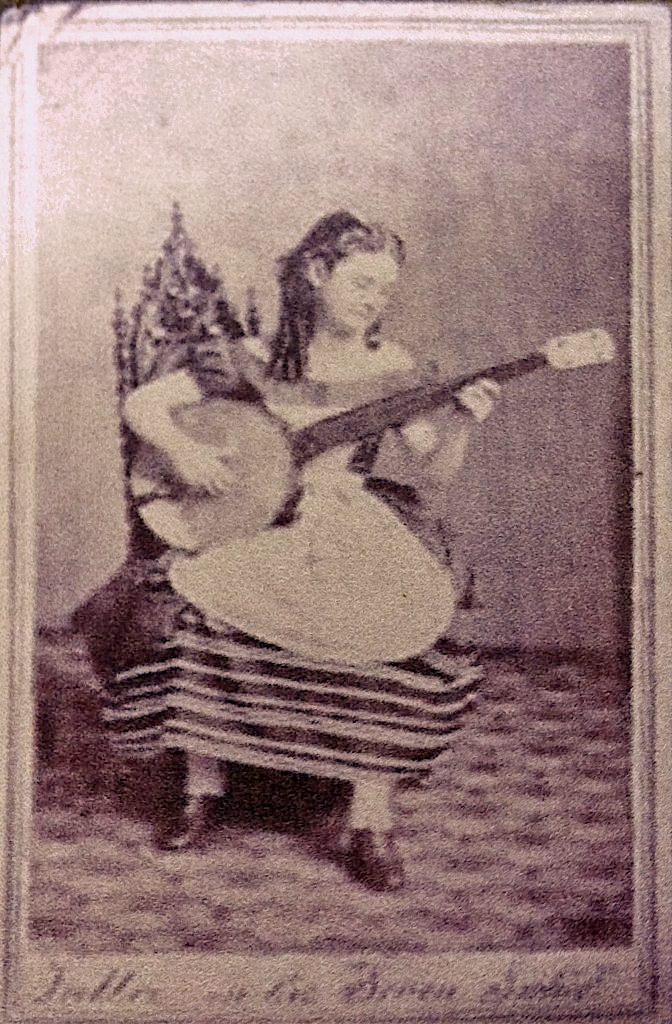
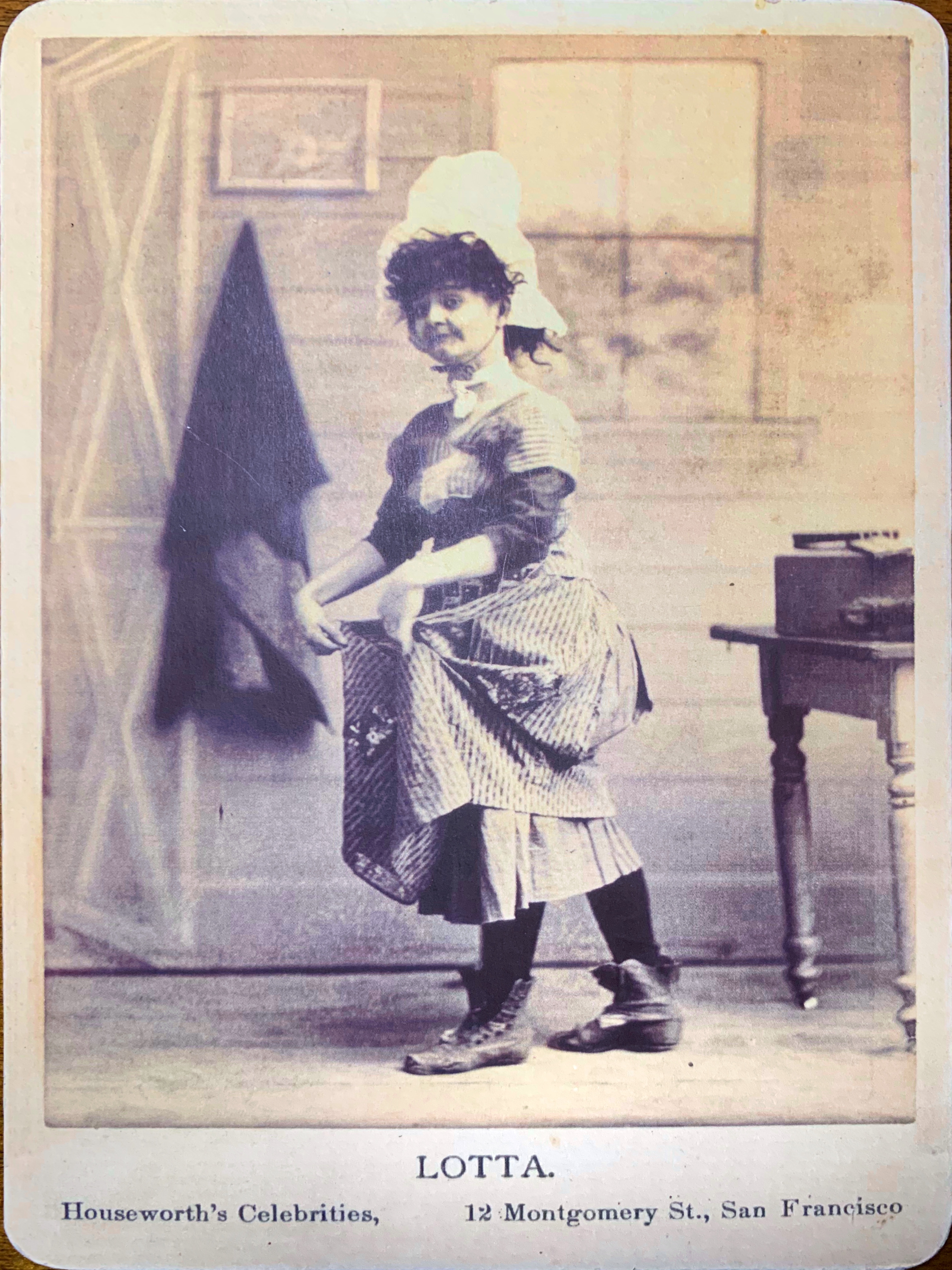
Whether or not our tune is named for her part in the musical play Little Nell and the Marchioness I may never know, but she was famous in her day and that was her favorite part, so who knows if they didn't write a tune in her honor. (If you've been to San Francisco a famous landmark is Lotta's Fountain, which she gave to the town for watering people and animals. It became a meeting place during the 1906 earthquake and remains one.)
Marvin Gaster received the North Carolina Heritage Award. His 2-finger picking is highly respected and I'm finding his playing is pretty and pleasant. In Poor Little Nell he plays real fast, so I copied him. Using a slow-downer and a different tuning than he used, as I discovered later, I tabbed his picking, but ended up being able to claw instead -- easier for me.
Reading about Rick Abrams is equally fascinating and the Piney Creek Weasels make great old-time music. Hopefully we'll hear from Andy Alexis here.
Edited by - JanetB on 02/08/2019 18:43:28
ndlxs - Posted - 02/08/2019: 19:48:21
Good job, Carolyn! I've always liked this piece. I do remember Eric Anderson telling me that Rick had a lot of trouble understanding Gaster saying the title: "Nell" sounded like "Nay-ul", for example...Rick cast his musical net widely.
carolynf - Posted - 02/08/2019: 19:54:24
Yes! In the cd, Marvin instroduces each song by name. “This is Poor Little Nay-ul.”
It’s interesting how Rick dropped the “poor” from the tune.
I saw the Weasels with Rick in the mid nineties, just before I got the old time banjo bug. I wish I could remember the performance better, but I do remember it.
JanetB - Posted - 02/10/2019: 11:43:26
On the trail for information about Marvin Gaster and Poor Little Nell, I heard from BHO member gailg64 who knows him personally. Here was her response to my query: "Yes, he’s a friend and still a presence at NC & VA fiddlers conventions. Marvin doesn’t really have computer expertise, but that’s not surprising because he’s in his 80s. You have to get in touch with him by letter, telephone, or drive down to Sanford to see him. I’ll see if I can find out more about Poor Little Nell.
"Marvin learned to play as a teenager from family and friends, but Uncle Henry is the person he most often mentions. The melodic style of melodic 2 finger he plays was actually pretty common in the central Piedmont and when we first moved here in the mid-80s my husband and I would often hear several 2 finger players at gatherings—Marvin from Sanford, A.C. Overton from Farrington, or Bob Roberson from Chicken Bridge. There were also Black banjo players around the Sand Hills and Piedmont, both men and women, who played 2 finger style.
"A friend advised Marvin to take off his picks when he started entering fiddlers convention banjo contests. He plays a 1948 Gibson RB-3 and judges who didn’t know what they were seeing or hearing, tended to disqualify him for playing bluegrass :-( The first LP/CD he was on was overseen by Bob Carlin, who got Marvin to pose on the cover with one of his (Bob’s) open back banjos."
I also asked Bob Carlin, but he has no further information about the elusive tune. One more query has been sent out to Wayne Martin, who recorded Marvin. Adam Hurt agrees that Marvin's 2-finger arrangements are "indeed remarkably clawhammer-like" and can be literally converted to clawhammer.
JanetB - Posted - 02/14/2019: 19:09:24
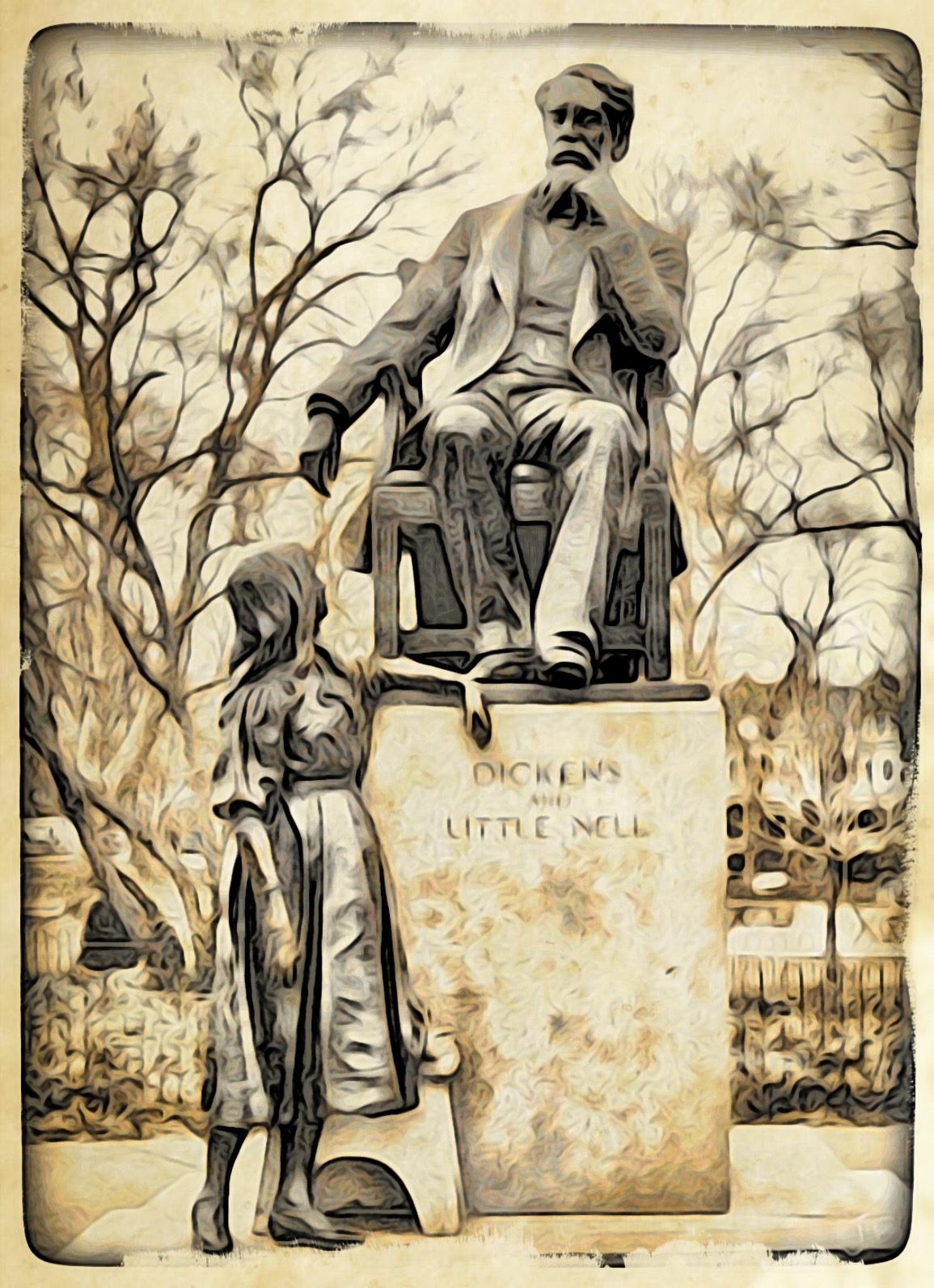
One more interesting image before the next TOTW rolls round. This is of Charles Dickens and his beloved fictional character Little Nell. Read here about the history of the statue. It was commissioned in 1890 and won awards and gold medals in the United States. After it was shipped to London to display and sell, Dickens expressed his desire against keeping it there and the statue was shipped back to the United States, where it eventually ended up at Clark Park in Philadelphia. In his introduction to The Old Curiosity Shop, Dickens stated that he knew the novel had won him "many friends", and was appreciate of "the many hearts it turned to me when they were full of private sorrow." I'm reading it now and see why it has been a beloved book.
And so, this good old banjo tune has a long and interesting history....
Terms of Use | Privacy Policy | Privacy Consent (EU/GDPR Only)
Copyright 2026 Banjo Hangout. All Rights Reserved.