
DVD-quality lessons (including tabs/sheet music) available for immediate viewing on any device.
Take your playing to the next level with the help of a local or online banjo teacher.
Weekly newsletter includes free lessons, favorite member content, banjo news and more.
Premier Sponsors


|
Please note this is an archived topic, so it is locked and unable to be replied to. You may, however, start a new topic and refer to this topic with a link: http://www.banjohangout.org/archive/347173
Sean ONeel - Posted - 10/08/2018: 12:11:23
I bought this banjo late last year and have only had it out of the case a few times. Between the death of both parents resulting in a lot of travel, plus the fact that I really love my 1960 Vega long neck, it has just not been a priority. It is too nice to not play, so I am contemplating selling it.
In the meantime, I know that Muse was the retail store version of the Ode banjos.
I presume that the instrument is pre-Baldwin. It has an archtop, aluminum pot, a three-piece neck, dowel stick, and a raw brass Ode tailpiece.
The only identifiers I can see are the "Muse" inscription on the peghead and stamped into the dowel with the Boulder COLO name and a stamped 4 digit serial number, 1587. I may look again, but there seem to be none of the stamps inside the pot bearing a model number or grade.
The banjo has Pat Pending Grover Roto tuners that appear to be original. The 5th tuner is a guitar tuner that at first looked funny, but it works fine.
One of the most fascinating things is the banjo is fitted with a Weather King head that dates back to the late 1950's, having the plain, black ink stamp that the company used prior to the "crown" logo.
The case was probably original...an archtop "Lifton" style with lots of case candy and cool, old stickers.
I know that there are quite a few folks here that know a great deal about these, and I thank you in advance!
Edited by - Sean ONeel on 10/08/2018 12:12:57


jun3machina - Posted - 10/08/2018: 12:19:10
I would date this early 1960's, pre baldwin. I believe the muse brand was only available through one method, one was to get these was through a dealer and I think the other way was to order direct. I need a bit of refreshing. But the pot looks to be a 52 holes, series 30 or series 33 sandcast, which according to ODE experts was the best sounding one they made and probably the rarest next to their wood rims. I had a regular ode longneck from 62'-63' and it was almost identical to this.
There are a lot of experts as well as some great ODE threads if you do a search here.
Sean ONeel - Posted - 10/08/2018: 12:24:18
quote:
Originally posted by jun3machinaI would date this early 1960's, pre baldwin. I believe the muse brand was only available through one method, one was to get these was through a dealer and I think the other way was to order direct. I need a bit of refreshing. But the pot looks to be a 52 holes, series 30 or series 33 sandcast, which according to ODE experts was the best sounding one they made and probably the rarest next to their wood rims. I had a regular ode longneck from 62'-63' and it was almost identical to this.
There are a lot of experts as well as some great ODE threads if you do a search here.
Thanks, June! I had a '64 Ode Long neck with the Series 33 pot that looked like this one. I have already searched threads, and while finding a lot of info, I have yet to see a serial number concordance anywhere.
And, yes, I know that the Muse brand was a response by Ode to requests they had to sell these in stores,, while Ode was strictly direct-order.
Edited by - Sean ONeel on 10/08/2018 12:26:05
VPS - Posted - 10/08/2018: 12:56:51
Have you tried contacting Chuck Ogsbury at Ome? He's a nice fella, and he's the horse's mouth on Ode.
stanger - Posted - 10/08/2018: 16:12:22
Hi Sean...
Your Muse is was made 1963. Everything looks stock except for the 5th string tuner and the Shubb capo. I suspect that tuning peg was an amateur replacement; the original peg would have been a Grover Sta-Tite 5th.
The raw brass tailpiece is original, and not all that unusual.
If Chuck had an order to fill, he would sometimes send a banjo out with some unplated parts instead for waiting for the next delivery from the plating shop. If the owner wanted a plated replacement, Chuck would send one along later. As often as not, the replacement ended up in the pick box in the case unused. He made all the parts except for the tuning pegs in-house.
This is the banjo that made Ode's reputation, and it's early for Muse. The Pete Seeger book "How to Play the 5-String Banjo" had come out in it's revised version the year before, in 1962, and Pete mentioned the Ode company making good longnecks in it.
By 1963, Chuck had more orders than he could fill, and there were music stores who wanted to carry them.
Chuck really isn't the authority on Odes many folks think he is. The Odes were only made for about 6 years before he sold the company, and all the records went to Baldwin after the sale. And now, all the memories he has of that time are over 50 years old. He remembers most of the big stuff, but the Ode collectors know much more about the details than Chuck or Tanya.
It's a nice old banjo! The very first Ode I ever saw was a Muse- a regular length 5-string just like this one. It was brand new in 1963, and after I played it, I had to have one for my own. I bought my first Ode the following summer.
regards,
stanger
Sean ONeel - Posted - 10/08/2018: 20:20:22
quote:
Originally posted by stangerHi Sean...
Your Muse is was made 1963. Everything looks stock except for the 5th string tuner and the Shubb capo. I suspect that tuning peg was an amateur replacement; the original peg would have been a Grover Sta-Tite 5th.
The raw brass tailpiece is original, and not all that unusual.
If Chuck had an order to fill, he would sometimes send a banjo out with some unplated parts instead for waiting for the next delivery from the plating shop. If the owner wanted a plated replacement, Chuck would send one along later. As often as not, the replacement ended up in the pick box in the case unused. He made all the parts except for the tuning pegs in-house.
This is the banjo that made Ode's reputation, and it's early for Muse. The Pete Seeger book "How to Play the 5-String Banjo" had come out in it's revised version the year before, in 1962, and Pete mentioned the Ode company making good longnecks in it.
By 1963, Chuck had more orders than he could fill, and there were music stores who wanted to carry them.
Chuck really isn't the authority on Odes many folks think he is. The Odes were only made for about 6 years before he sold the company, and all the records went to Baldwin after the sale. And now, all the memories he has of that time are over 50 years old. He remembers most of the big stuff, but the Ode collectors know much more about the details than Chuck or Tanya.
It's a nice old banjo! The very first Ode I ever saw was a Muse- a regular length 5-string just like this one. It was brand new in 1963, and after I played it, I had to have one for my own. I bought my first Ode the following summer.
regards,
stanger
Mike, you were actually one of the next folks I was going to talk to. Much obliged!
So '63 was the first year for the Muse?
FYI, there was a Pittman capo on the 5th...it was in a very bad way. and since I had the Shubb I that I'd try it out...and it practically "dropped in" to those holes. There were spikes in the banjo at one point, those holes are still there, so if I decide to re-install, then I've got a head start.
Thanks again!
Edited by - Sean ONeel on 10/08/2018 20:25:52
stanger - Posted - 10/08/2018: 21:01:02
quote:
Originally posted by Sean ONeelquote:
Originally posted by stangerHi Sean...
Your Muse is was made 1963. Everything looks stock except for the 5th string tuner and the Shubb capo. I suspect that tuning peg was an amateur replacement; the original peg would have been a Grover Sta-Tite 5th.
The raw brass tailpiece is original, and not all that unusual.
If Chuck had an order to fill, he would sometimes send a banjo out with some unplated parts instead for waiting for the next delivery from the plating shop. If the owner wanted a plated replacement, Chuck would send one along later. As often as not, the replacement ended up in the pick box in the case unused. He made all the parts except for the tuning pegs in-house.
This is the banjo that made Ode's reputation, and it's early for Muse. The Pete Seeger book "How to Play the 5-String Banjo" had come out in it's revised version the year before, in 1962, and Pete mentioned the Ode company making good longnecks in it.
By 1963, Chuck had more orders than he could fill, and there were music stores who wanted to carry them.
Chuck really isn't the authority on Odes many folks think he is. The Odes were only made for about 6 years before he sold the company, and all the records went to Baldwin after the sale. And now, all the memories he has of that time are over 50 years old. He remembers most of the big stuff, but the Ode collectors know much more about the details than Chuck or Tanya.
It's a nice old banjo! The very first Ode I ever saw was a Muse- a regular length 5-string just like this one. It was brand new in 1963, and after I played it, I had to have one for my own. I bought my first Ode the following summer.
regards,
stangerMike, you were actually one of the next folks I was going to talk to. Much obliged!
So '63 was the first year for the Muse?
Hi, Sean...
I don't know what the first year for the Muse was.
Given the history, though, they were probably introduced in either 1962 or 1963.
Chuck made his first banjo in the fall of 1959 in the mechanical engineering shop at the U of Colorado, but his first was intended to be just for himself. Originally, he had no intention of going into the biz.
But when some other students saw it and asked if he would make them a banjo, he bought enough stock to make about 100 banjos in 1960. That first batch were all built in the student workshop. Chuck knew metalworking better than woodworking, so to learn how to make necks, he sought out a local cabinet maker in town who schooled him on woodworking.
Eventually the project sort of took over the workshop and other students began to complain, so Chuck found an old barn outside of town he rented and moved it all there, where the first 100 were eventually completed. They all sold as soon as they were done, so he decided to just keep going and build some more in 1961.
At first, Chuck never thought of making banjos his career, but the orders kept on coming, so he just stayed at it. When the work because too much for him to do alone, he got a couple of friends to help him, and the whole thing just grew like Topsy.
I don't know exactly how Pete Seeger learned about his banjos; it may have been from an old guy who lived in Boulder who was once a classical banjoist on the vaudeville circuit. I've forgotten his name, but his picture was featured in one of the first catalogs or ads. Chuck advertised in Sing Out magazine, featuring only his longneck banjos. There was a picture of the old fellow playing one with a testimonial added in the ad copy.
Pete might have known the old gentleman, or he may have just noticed Ode was making longnecks and contacted Chuck. At the time, the longneck was pretty much only Pete's tool, but Pete was getting a lot of info requests about them after the Kingston Trio began using Vegas.
Those Vegas were all custom-made at that time, as Vega hadn't gone into a model production of them. A few New York players ordered Vegas- Peggy Seeger, Eric Darling, and a couple of others. At the time, the banjos were called Excel Customs, and they varied from banjo to banjo. When Dave Guard ordered 2 at a visit to the factory, Vega finally took notice of what they had and contacted Seeger about making a model with his name on it.
Pete included the Ode brand, along with Vega in his instruction book, along with contact info. The book came out around the same time as Vega introduced the Pete Seeger model and it became a part of their production line.
Since his book was the only really good 5-string instruction manual to be found at the time, when it came out, it sold like crazy. I learned of the Ode Co. from it; I bought a copy at a local music store in Dec. 1962 at the same time I bought my first banjo, a Kay. I got my first Ode catalog about 4 months later in 1963.
So given all these circumstances, along with some stuff I've learned, I think the first Muse banjos must have been offered to dealers in late 1962. It would have taken Chuck about a year to get a crew together, get geared up into production, and all the rest of the things needed. Interested dealers probably contacted him before he had it all up and running after seeing the ad in the book and in Sing Out.
The first Muse I saw belonged to a fellow who lived in Boulder; a music store there was the first Muse dealer, he said, and he had put in an order for an Ode, but after he saw his Muse, he decided not to wait for the Ode and bought the Muse instead. I ran into him at the first folk festival in Sun Valley, Idaho. He was very knowledgeable about the company and gave me the phone number of the music store he bought the banjo from, but I lost it the next day.
The New Lost City Ramblers played that festival, as did Hedy West, who played a very early Seeger model Vega. I talked to Mike Seeger and Hedy, and both of them had played an Ode and were impressed by them, especially their price for their quality level. That cinched the deal for me, and by the following summer, I ordered mine. I worked all summer, saved up my wages, and had the money ready by the time it was built.
At that time, there was a 6-month waiting list, but Chuck tended to give himself more time on an order than it actually took to fill it. My banjo was ready in about 4 months, but Chuck used it as a test bed for a new prototype tone ring he was trying out, and called me to ask if he could keep it for 30 days before shipping it out. I chose a curly maple neck for mine, which was an option at that time; the standard wood he was using was walnut. He had a stock model with a walnut neck he said he would ship right out, but I decided I wanted the maple, so I agreed to wait. The banjo came with that tone ring in it- it's the first cast bronze flathead tone ring he ever made.
It arrived by train at 11:45 at night. The depot master called me and said it was there, but I had to give him cash to pick it up. A family friend owned a small convenience store. I called him and asked it he would cash a $200 check for me, and he kept the store open until I came.
I picked up the box at midnight, and took it home. When I slid the banjo out, it literally changed my life. It was much more beautiful than I anticipated, and it made me a dedicated player. It was my only banjo for the next 14 years. I still have it. It's serial number is 1776.
regards,
stanger
Edited by - stanger on 10/08/2018 21:22:09
Sean ONeel - Posted - 10/08/2018: 21:05:26
quote:
Originally posted by stangerHi Sean...
Your Muse is was made 1963. Everything looks stock except for the 5th string tuner and the Shubb capo. I suspect that tuning peg was an amateur replacement; the original peg would have been a Grover Sta-Tite 5th.
The raw brass tailpiece is original, and not all that unusual.
If Chuck had an order to fill, he would sometimes send a banjo out with some unplated parts instead for waiting for the next delivery from the plating shop. If the owner wanted a plated replacement, Chuck would send one along later. As often as not, the replacement ended up in the pick box in the case unused. He made all the parts except for the tuning pegs in-house.
This is the banjo that made Ode's reputation, and it's early for Muse. The Pete Seeger book "How to Play the 5-String Banjo" had come out in it's revised version the year before, in 1962, and Pete mentioned the Ode company making good longnecks in it.
By 1963, Chuck had more orders than he could fill, and there were music stores who wanted to carry them.
Chuck really isn't the authority on Odes many folks think he is. The Odes were only made for about 6 years before he sold the company, and all the records went to Baldwin after the sale. And now, all the memories he has of that time are over 50 years old. He remembers most of the big stuff, but the Ode collectors know much more about the details than Chuck or Tanya.
It's a nice old banjo! The very first Ode I ever saw was a Muse- a regular length 5-string just like this one. It was brand new in 1963, and after I played it, I had to have one for my own. I bought my first Ode the following summer.
regards,
stanger
The funny thing that just hit me was that in the 1960's, every department store that had instruments ALWAYS had two things: Fake Hofner violin basses, and an off-brand long neck banjo. JC Penney, Sears and Monkey Wards had their own brands.
Back to this Muse, what do you make of the head? I am thinking that this is the first one and pre-dated the "big crown" version. Does that sound right?
stanger - Posted - 10/08/2018: 21:06:15
quote:
Originally posted by stangerHi Sean...
Your Muse is was made 1963. Everything looks stock except for the 5th string tuner and the Shubb capo. I suspect that tuning peg was an amateur replacement; the original peg would have been a Grover Sta-Tite 5th.
The raw brass tailpiece is original, and not all that unusual.
If Chuck had an order to fill, he would sometimes send a banjo out with some unplated parts instead for waiting for the next delivery from the plating shop. If the owner wanted a plated replacement, Chuck would send one along later. As often as not, the replacement ended up in the pick box in the case unused. He made all the parts except for the tuning pegs in-house.
This is the banjo that made Ode's reputation, and it's early for Muse. The Pete Seeger book "How to Play the 5-String Banjo" had come out in it's revised version the year before, in 1962, and Pete mentioned the Ode company making good longnecks in it.
By 1963, Chuck had more orders than he could fill, and there were music stores who wanted to carry them.
Chuck really isn't the authority on Odes many folks think he is. The Odes were only made for about 6 years before he sold the company, and all the records went to Baldwin after the sale. And now, all the memories he has of that time are over 50 years old. He remembers most of the big stuff, but the Ode collectors know much more about the details than Chuck or Tanya.
It's a nice old banjo! The very first Ode I ever saw was a Muse- a regular length 5-string just like this one. It was brand new in 1963, and after I played it, I had to have one for my own. I bought my first Ode the following summer.One interesting thing about yours is the peghead shape. This was the shape I saw in the 1963 catalog I ordered my banjo from, but by the time mine was made, Chuck had changed the shape to make it more like a Vega.
regards,
stanger
stanger - Posted - 10/08/2018: 21:34:10
quote:
Originally posted by Sean ONeelquote:
Originally posted by stangerHi Sean...
Your Muse is was made 1963. Everything looks stock except for the 5th string tuner and the Shubb capo. I suspect that tuning peg was an amateur replacement; the original peg would have been a Grover Sta-Tite 5th.
The raw brass tailpiece is original, and not all that unusual.
If Chuck had an order to fill, he would sometimes send a banjo out with some unplated parts instead for waiting for the next delivery from the plating shop. If the owner wanted a plated replacement, Chuck would send one along later. As often as not, the replacement ended up in the pick box in the case unused. He made all the parts except for the tuning pegs in-house.
This is the banjo that made Ode's reputation, and it's early for Muse. The Pete Seeger book "How to Play the 5-String Banjo" had come out in it's revised version the year before, in 1962, and Pete mentioned the Ode company making good longnecks in it.
By 1963, Chuck had more orders than he could fill, and there were music stores who wanted to carry them.
Chuck really isn't the authority on Odes many folks think he is. The Odes were only made for about 6 years before he sold the company, and all the records went to Baldwin after the sale. And now, all the memories he has of that time are over 50 years old. He remembers most of the big stuff, but the Ode collectors know much more about the details than Chuck or Tanya.
It's a nice old banjo! The very first Ode I ever saw was a Muse- a regular length 5-string just like this one. It was brand new in 1963, and after I played it, I had to have one for my own. I bought my first Ode the following summer.
regards,
stangerThe funny thing that just hit me was that in the 1960's, every department store that had instruments ALWAYS had two things: Fake Hofner violin basses, and an off-brand long neck banjo. JC Penney, Sears and Monkey Wards had their own brands.
Back to this Muse, what do you make of the head? I am thinking that this is the first one and pre-dated the "big crown" version. Does that sound right?
That head is a very early Weather King!
Years ago, here on the hangout, I once asked Sonny Osbourne when it was that he first used a Weather King head. Sonny was one of the first guys to use them, and he said 1961. He said the company sent him a couple to try out. Remo had been making plastic drum heads for a couple of years, but hadn't thought of making banjo heads until some player requested one.
The drum heads all had a larger, heavier tension hoop than the banjo heads, so it must have taken Remo some time to come up with something that would fit a banjo. If Sonny got a couple in 1961, I'm guessing his looked like your head. Chuck probably got some around the same time, possibly from the Remo company, as he always used them from the first. The Weather King was a selling point that was featured in the early Ode fliers, ads, and catalogs.
But by 1962, the Weather Kings I saw all had the big crown logo. Some of the earliest heads on Odes have an Ode logo, so Chuck must have ordered at least a few batches with that custom imprint early on. The typeface on your head is identical to the early Ode heads I've seen.
regards,
stanger
Sean ONeel - Posted - 10/08/2018: 21:39:09
quote:
Originally posted by stangerquote:
Originally posted by Sean ONeelquote:
Originally posted by stangerHi Sean...
Your Muse is was made 1963. Everything looks stock except for the 5th string tuner and the Shubb capo. I suspect that tuning peg was an amateur replacement; the original peg would have been a Grover Sta-Tite 5th.
The raw brass tailpiece is original, and not all that unusual.
If Chuck had an order to fill, he would sometimes send a banjo out with some unplated parts instead for waiting for the next delivery from the plating shop. If the owner wanted a plated replacement, Chuck would send one along later. As often as not, the replacement ended up in the pick box in the case unused. He made all the parts except for the tuning pegs in-house.
This is the banjo that made Ode's reputation, and it's early for Muse. The Pete Seeger book "How to Play the 5-String Banjo" had come out in it's revised version the year before, in 1962, and Pete mentioned the Ode company making good longnecks in it.
By 1963, Chuck had more orders than he could fill, and there were music stores who wanted to carry them.
Chuck really isn't the authority on Odes many folks think he is. The Odes were only made for about 6 years before he sold the company, and all the records went to Baldwin after the sale. And now, all the memories he has of that time are over 50 years old. He remembers most of the big stuff, but the Ode collectors know much more about the details than Chuck or Tanya.
It's a nice old banjo! The very first Ode I ever saw was a Muse- a regular length 5-string just like this one. It was brand new in 1963, and after I played it, I had to have one for my own. I bought my first Ode the following summer.
regards,
stangerMike, you were actually one of the next folks I was going to talk to. Much obliged!
So '63 was the first year for the Muse?
Hi, Sean...
I don't know what the first year for the Muse was.
Given the history, though, they were probably introduced in either 1962 or 1963.
Chuck made his first banjo in the fall of 1959 in the mechanical engineering shop at the U of Colorado, but his first was intended to be just for himself. Originally, he had no intention of going into the biz.
But when some other students saw it and asked if he would make them a banjo, he bought enough stock to make about 100 banjos in 1960. That first batch were all built in the student workshop. Chuck knew metalworking better than woodworking, so to learn how to make necks, he sought out a local cabinet maker in town who schooled him on woodworking.
Eventually the project sort of took over the workshop and other students began to complain, so Chuck found an old barn outside of town he rented and moved it all there, where the first 100 were eventually completed. They all sold as soon as they were done, so he decided to just keep going and build some more in 1961.
At first, Chuck never thought of making banjos his career, but the orders kept on coming, so he just stayed at it. When the work because too much for him to do alone, he got a couple of friends to help him, and the whole thing just grew like Topsy.
I don't know exactly how Pete Seeger learned about his banjos; it may have been from an old guy who lived in Boulder who was once a classical banjoist on the vaudeville circuit. I've forgotten his name, but his picture was featured in one of the first catalogs or ads. Chuck advertised in Sing Out magazine, featuring only his longneck banjos. There was a picture of the old fellow playing one with a testimonial added in the ad copy.
Pete might have known the old gentleman, or he may have just noticed Ode was making longnecks and contacted Chuck. At the time, the longneck was pretty much only Pete's tool, but Pete was getting a lot of info requests about them after the Kingston Trio began using Vegas.
Those Vegas were all custom-made at that time, as Vega hadn't gone into a model production of them. A few New York players ordered Vegas- Peggy Seeger, Eric Darling, and a couple of others. At the time, the banjos were called Excel Customs, and they varied from banjo to banjo. When Dave Guard ordered 2 at a visit to the factory, Vega finally took notice of what they had and contacted Seeger about making a model with his name on it.
Pete included the Ode brand, along with Vega in his instruction book, along with contact info. The book came out around the same time as Vega introduced the Pete Seeger model and it became a part of their production line.
Since his book was the only really good 5-string instruction manual to be found at the time, when it came out, it sold like crazy. I learned of the Ode Co. from it; I bought a copy at a local music store in Dec. 1962 at the same time I bought my first banjo, a Kay. I got my first Ode catalog about 4 months later in 1963.
So given all these circumstances, along with some stuff I've learned, I think the first Muse banjos must have been offered to dealers in late 1962. It would have taken Chuck about a year to get a crew together, get geared up into production, and all the rest of the things needed. Interested dealers probably contacted him before he had it all up and running after seeing the ad in the book and in Sing Out.
The first Muse I saw belonged to a fellow who lived in Boulder; a music store there was the first Muse dealer, he said, and he had put in an order for an Ode, but after he saw his Muse, he decided not to wait for the Ode and bought the Muse instead. I ran into him at the first folk festival in Sun Valley, Idaho. He was very knowledgeable about the company and gave me the phone number of the music store he bought the banjo from, but I lost it the next day.
The New Lost City Ramblers played that festival, as did Hedy West, who played a very early Seeger model Vega. I talked to Mike Seeger and Hedy, and both of them had played an Ode and were impressed by them, especially their price for their quality level. That cinched the deal for me, and by the following summer, I ordered mine. I worked all summer, saved up my wages, and had the money ready by the time it was built.
At that time, there was a 6-month waiting list, but Chuck tended to give himself more time on an order than it actually took to fill it. My banjo was ready in about 4 months, but Chuck used it as a test bed for a new prototype tone ring he was trying out, and called me to ask if he could keep it for 30 days before shipping it out. I chose a curly maple neck for mine, which was an option at that time; the standard wood he was using was walnut. He had a stock model with a walnut neck he said he would ship right out, but I decided I wanted the maple, so I agreed to wait. The banjo came with that tone ring in it- it's the first cast bronze flathead tone ring he ever made.
It arrived by train at 11:45 at night. The depot master called me and said it was there, but I had to give him cash to pick it up. A family friend owned a small convenience store. I called him and asked it he would cash a $200 check for me, and he kept the store open until I came.
I picked up the box at midnight, and took it home. When I slid the banjo out, it literally changed my life. It was much more beautiful than I anticipated, and it made me a dedicated player. It was my only banjo for the next 14 years. I still have it. It's serial number is 1776.
regards,
stanger
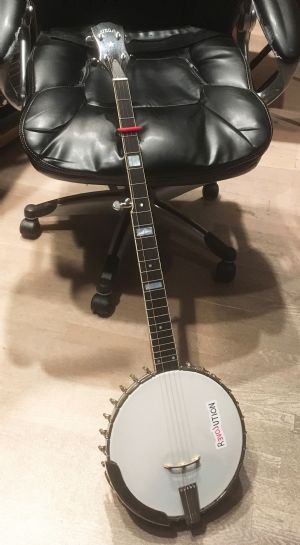
This is my 1960 for which I had Mark Hickler make a neck and fit it.
I did this as what I mostly think of as a Bob Gibson tribute. I had one before, and like an idiot, I got rid of it. It is OK though...this is the absolute best-playing banjo I have ever owned. Since I took this picture I have gone to one of John Balch's from that tannery that did the Vega heads in that period. I have it just "tight enough" and I've got a piece of Balch's sheepskin swatches stuck in the back.
That tailpiece is a nearly pristine Kerschner from the early 20th Century. The Rotos were a very early NOS Roto set WITH the 5th...that I did not use. I top it with heavy stings (Ome) and one a Davis bridge that is really stout.
But this is the first one that I've had that sounds like it was born for Folk Scare stuff!
mikehalloran - Posted - 10/08/2018: 21:51:10
Gotta have a Muse in the stable!

Edited by - mikehalloran on 10/08/2018 22:00:25
Sean ONeel - Posted - 10/08/2018: 22:03:42
quote:
Originally posted by stangerquote:
Originally posted by Sean ONeelquote:
Originally posted by stangerHi Sean...
Your Muse is was made 1963. Everything looks stock except for the 5th string tuner and the Shubb capo. I suspect that tuning peg was an amateur replacement; the original peg would have been a Grover Sta-Tite 5th.
The raw brass tailpiece is original, and not all that unusual.
If Chuck had an order to fill, he would sometimes send a banjo out with some unplated parts instead for waiting for the next delivery from the plating shop. If the owner wanted a plated replacement, Chuck would send one along later. As often as not, the replacement ended up in the pick box in the case unused. He made all the parts except for the tuning pegs in-house.
This is the banjo that made Ode's reputation, and it's early for Muse. The Pete Seeger book "How to Play the 5-String Banjo" had come out in it's revised version the year before, in 1962, and Pete mentioned the Ode company making good longnecks in it.
By 1963, Chuck had more orders than he could fill, and there were music stores who wanted to carry them.
Chuck really isn't the authority on Odes many folks think he is. The Odes were only made for about 6 years before he sold the company, and all the records went to Baldwin after the sale. And now, all the memories he has of that time are over 50 years old. He remembers most of the big stuff, but the Ode collectors know much more about the details than Chuck or Tanya.
It's a nice old banjo! The very first Ode I ever saw was a Muse- a regular length 5-string just like this one. It was brand new in 1963, and after I played it, I had to have one for my own. I bought my first Ode the following summer.
regards,
stangerThe funny thing that just hit me was that in the 1960's, every department store that had instruments ALWAYS had two things: Fake Hofner violin basses, and an off-brand long neck banjo. JC Penney, Sears and Monkey Wards had their own brands.
Back to this Muse, what do you make of the head? I am thinking that this is the first one and pre-dated the "big crown" version. Does that sound right?
That head is a very early Weather King!
Years ago, here on the hangout, I once asked Sonny Osbourne when it was that he first used a Weather King head. Sonny was one of the first guys to use them, and he said 1961. He said the company sent him a couple to try out. Remo had been making plastic drum heads for a couple of years, but hadn't thought of making banjo heads until some player requested one.
The drum heads all had a larger, heavier tension hoop than the banjo heads, so it must have taken Remo some time to come up with something that would fit a banjo. If Sonny got a couple in 1961, I'm guessing his looked like your head. Chuck probably got some around the same time, possibly from the Remo company, as he always used them from the first. The Weather King was a selling point that was featured in the early Ode fliers, ads, and catalogs.
But by 1962, the Weather Kings I saw all had the big crown logo. Some of the earliest heads on Odes have an Ode logo, so Chuck must have ordered at least a few batches with that custom imprint early on. The typeface on your head is identical to the early Ode heads I've seen.
regards,
stanger
There is a backstage photo of Dave Guard's two Vega's. One of them has the Big Crown head...and that would have been no later than mid-1961?
jun3machina - Posted - 10/08/2018: 22:14:06
my ODE long neck (which is currently on consignment with Bernunzio), had the original ODE stamped head. It had been removed and replaced with a newer one, but was included when sold to me.
just for comparison, as it was about the same era as this muse..my number was 760, and i was told it was from 1962-63, although they have it listed as a 64'
bernunzio.com/product/ode-24847/
Edited by - jun3machina on 10/08/2018 22:17:54
stanger - Posted - 10/08/2018: 22:33:48
quote:
Originally posted by Sean ONeelquote:
Originally posted by stangerquote:
Originally posted by Sean ONeelquote:
Originally posted by stangerHi Sean...
Your Muse is was made 1963. Everything looks stock except for the 5th string tuner and the Shubb capo. I suspect that tuning peg was an amateur replacement; the original peg would have been a Grover Sta-Tite 5th.
The raw brass tailpiece is original, and not all that unusual.
If Chuck had an order to fill, he would sometimes send a banjo out with some unplated parts instead for waiting for the next delivery from the plating shop. If the owner wanted a plated replacement, Chuck would send one along later. As often as not, the replacement ended up in the pick box in the case unused. He made all the parts except for the tuning pegs in-house.
This is the banjo that made Ode's reputation, and it's early for Muse. The Pete Seeger book "How to Play the 5-String Banjo" had come out in it's revised version the year before, in 1962, and Pete mentioned the Ode company making good longnecks in it.
By 1963, Chuck had more orders than he could fill, and there were music stores who wanted to carry them.
Chuck really isn't the authority on Odes many folks think he is. The Odes were only made for about 6 years before he sold the company, and all the records went to Baldwin after the sale. And now, all the memories he has of that time are over 50 years old. He remembers most of the big stuff, but the Ode collectors know much more about the details than Chuck or Tanya.
It's a nice old banjo! The very first Ode I ever saw was a Muse- a regular length 5-string just like this one. It was brand new in 1963, and after I played it, I had to have one for my own. I bought my first Ode the following summer.
regards,
stangerThe funny thing that just hit me was that in the 1960's, every department store that had instruments ALWAYS had two things: Fake Hofner violin basses, and an off-brand long neck banjo. JC Penney, Sears and Monkey Wards had their own brands.
Back to this Muse, what do you make of the head? I am thinking that this is the first one and pre-dated the "big crown" version. Does that sound right?
That head is a very early Weather King!
Years ago, here on the hangout, I once asked Sonny Osbourne when it was that he first used a Weather King head. Sonny was one of the first guys to use them, and he said 1961. He said the company sent him a couple to try out. Remo had been making plastic drum heads for a couple of years, but hadn't thought of making banjo heads until some player requested one.
The drum heads all had a larger, heavier tension hoop than the banjo heads, so it must have taken Remo some time to come up with something that would fit a banjo. If Sonny got a couple in 1961, I'm guessing his looked like your head. Chuck probably got some around the same time, possibly from the Remo company, as he always used them from the first. The Weather King was a selling point that was featured in the early Ode fliers, ads, and catalogs.
But by 1962, the Weather Kings I saw all had the big crown logo. Some of the earliest heads on Odes have an Ode logo, so Chuck must have ordered at least a few batches with that custom imprint early on. The typeface on your head is identical to the early Ode heads I've seen.
regards,
stanger
There is a backstage photo of Dave Guard's two Vega's. One of them has the Big Crown head...and that would have been no later than mid-1961?
That sounds right to me, Sean. Possibly early 1961. Guard played his old Stewart on the first two Trio recordings, but the recording sessions were earlier than their release by quite a while, and the Trio toured very heavily in between the releases. DAve might have been using his Vegas for a while before they ever made a record cover photo.
I love that Vega of yours! It's like Peggy Seeger's banjo. I've always thought they were very elegant looking instruments.
Once thing about the early Odes is their minimalist/industrial appearance. They look like musical tools, all function and no frills.
That's one of the interesting things to me about the Ode company. By 1965, that entire simplicity thing was tossed out the window with the first wood-rimmed Odes. The D model was as fancy and highly ornamented as the old vintage banjos of the past, and easily as fancy as their competitor's banjos. I've often wondered how that big mental change happened in Chuck's thinking.
Kix Stewart was a big influence on Chuck. Kix loved the old fancy Epiphone Recording banjos, and the Odes closely resemble them in many aspects. Kix was also the guy who showed Chuck what wood rims were all about. The archtops offered as an option on the wood-rimmed series were very close to the old Epi archtop tone ring design.
When it came to fancy, the D was just the beginning. The Omes that followed became even fancier by far. And then, over the past few years, the Ome banjos have taken a 180 degree away from that and have become very simple looking again.
Part of it is meeting the market of course, but it's also a reflection of Ogsbury's restless mind. He has always tinkered with everything he's ever made, and he goes off in a lot of different directions- sometimes structural, sometimes visual. That's probably why he's stayed in the biz for so long. His instruments give him something to mess around with.
regards
stanger
Edited by - stanger on 10/08/2018 22:41:49
stanger - Posted - 10/08/2018: 22:49:27
quote:
Originally posted by jun3machinamy ODE long neck (which is currently on consignment with Bernunzio), had the original ODE stamped head. It had been removed and replaced with a newer one, but was included when sold to me.
just for comparison, as it was about the same era as this muse..my number was 760, and i was told it was from 1962-63, although they have it listed as a 64'bernunzio.com/product/ode-24847/
I think your banjo was made in 1963. If it was made in '64, it would have been made early in that year. 1963 was the year there were many substantial changes in the aluminum rim designs, and in 63, the peghead shape in the catalog that was printed that year looked like this banjo's.
But by May or June of 1964, the peghead shape changed. This makes me think that at least the neck of your banjo was made earlier than 1964.
regards,
stanger
Sean ONeel - Posted - 10/08/2018: 22:58:59
quote:
Originally posted by jun3machinamy ODE long neck (which is currently on consignment with Bernunzio), had the original ODE stamped head. It had been removed and replaced with a newer one, but was included when sold to me.
just for comparison, as it was about the same era as this muse..my number was 760, and i was told it was from 1962-63, although they have it listed as a 64'bernunzio.com/product/ode-24847/
That's a beautiful instrument! Love the head...
mainejohn - Posted - 10/09/2018: 06:18:17
Great thread...I could read Vega/Ode longneck history forever!
Sean ONeel - Posted - 10/09/2018: 07:42:33
quote:
Originally posted by mainejohnGreat thread...I could read Vega/Ode longneck history forever!
Digging the Muse out of the case was a good thing. It isn't going anywhere...except to my grandson when I die, or sooner if he decided to play!
mikehalloran - Posted - 10/09/2018: 09:13:42
Marc Silber once told me that it was he who pushed hard for wood rims and part of the chorus pushing for fancy banjos. When I asked Chuck about that, he confirmed this and told me a couple of stories about Marc’s time at ODE.
mainejohn - Posted - 10/09/2018: 13:56:37
quote:
Originally posted by Sean ONeelquote:
Originally posted by mainejohnGreat thread...I could read Vega/Ode longneck history forever!
Digging the Muse out of the case was a good thing. It isn't going anywhere...except to my grandson when I die, or sooner if he decided to play!
Good decision...too much history in that old girl to send her down the road.
Edited by - mainejohn on 10/09/2018 13:56:58
Sean ONeel - Posted - 10/09/2018: 14:01:21
quote:
Originally posted by mainejohnquote:
Originally posted by Sean ONeelquote:
Originally posted by mainejohnGreat thread...I could read Vega/Ode longneck history forever!
Digging the Muse out of the case was a good thing. It isn't going anywhere...except to my grandson when I die, or sooner if he decided to play!
Good decision...too much history in that old girl to send her down the road.
Amen to that. What I am thinking is that I will keep one in G tuning and the other in C...
Sean ONeel - Posted - 10/09/2018: 22:30:47
quote:
Originally posted by stangerquote:
Originally posted by Sean ONeelquote:
Originally posted by stangerHi Sean...
Your Muse is was made 1963. Everything looks stock except for the 5th string tuner and the Shubb capo. I suspect that tuning peg was an amateur replacement; the original peg would have been a Grover Sta-Tite 5th.
The raw brass tailpiece is original, and not all that unusual.
If Chuck had an order to fill, he would sometimes send a banjo out with some unplated parts instead for waiting for the next delivery from the plating shop. If the owner wanted a plated replacement, Chuck would send one along later. As often as not, the replacement ended up in the pick box in the case unused. He made all the parts except for the tuning pegs in-house.
This is the banjo that made Ode's reputation, and it's early for Muse. The Pete Seeger book "How to Play the 5-String Banjo" had come out in it's revised version the year before, in 1962, and Pete mentioned the Ode company making good longnecks in it.
By 1963, Chuck had more orders than he could fill, and there were music stores who wanted to carry them.
Chuck really isn't the authority on Odes many folks think he is. The Odes were only made for about 6 years before he sold the company, and all the records went to Baldwin after the sale. And now, all the memories he has of that time are over 50 years old. He remembers most of the big stuff, but the Ode collectors know much more about the details than Chuck or Tanya.
It's a nice old banjo! The very first Ode I ever saw was a Muse- a regular length 5-string just like this one. It was brand new in 1963, and after I played it, I had to have one for my own. I bought my first Ode the following summer.
regards,
stangerMike, you were actually one of the next folks I was going to talk to. Much obliged!
So '63 was the first year for the Muse?
Hi, Sean...
I don't know what the first year for the Muse was.
Given the history, though, they were probably introduced in either 1962 or 1963.
Chuck made his first banjo in the fall of 1959 in the mechanical engineering shop at the U of Colorado, but his first was intended to be just for himself. Originally, he had no intention of going into the biz.
But when some other students saw it and asked if he would make them a banjo, he bought enough stock to make about 100 banjos in 1960. That first batch were all built in the student workshop. Chuck knew metalworking better than woodworking, so to learn how to make necks, he sought out a local cabinet maker in town who schooled him on woodworking.
Eventually the project sort of took over the workshop and other students began to complain, so Chuck found an old barn outside of town he rented and moved it all there, where the first 100 were eventually completed. They all sold as soon as they were done, so he decided to just keep going and build some more in 1961.
At first, Chuck never thought of making banjos his career, but the orders kept on coming, so he just stayed at it. When the work because too much for him to do alone, he got a couple of friends to help him, and the whole thing just grew like Topsy.
I don't know exactly how Pete Seeger learned about his banjos; it may have been from an old guy who lived in Boulder who was once a classical banjoist on the vaudeville circuit. I've forgotten his name, but his picture was featured in one of the first catalogs or ads. Chuck advertised in Sing Out magazine, featuring only his longneck banjos. There was a picture of the old fellow playing one with a testimonial added in the ad copy.
Pete might have known the old gentleman, or he may have just noticed Ode was making longnecks and contacted Chuck. At the time, the longneck was pretty much only Pete's tool, but Pete was getting a lot of info requests about them after the Kingston Trio began using Vegas.
Those Vegas were all custom-made at that time, as Vega hadn't gone into a model production of them. A few New York players ordered Vegas- Peggy Seeger, Eric Darling, and a couple of others. At the time, the banjos were called Excel Customs, and they varied from banjo to banjo. When Dave Guard ordered 2 at a visit to the factory, Vega finally took notice of what they had and contacted Seeger about making a model with his name on it.
Pete included the Ode brand, along with Vega in his instruction book, along with contact info. The book came out around the same time as Vega introduced the Pete Seeger model and it became a part of their production line.
Since his book was the only really good 5-string instruction manual to be found at the time, when it came out, it sold like crazy. I learned of the Ode Co. from it; I bought a copy at a local music store in Dec. 1962 at the same time I bought my first banjo, a Kay. I got my first Ode catalog about 4 months later in 1963.
So given all these circumstances, along with some stuff I've learned, I think the first Muse banjos must have been offered to dealers in late 1962. It would have taken Chuck about a year to get a crew together, get geared up into production, and all the rest of the things needed. Interested dealers probably contacted him before he had it all up and running after seeing the ad in the book and in Sing Out.
The first Muse I saw belonged to a fellow who lived in Boulder; a music store there was the first Muse dealer, he said, and he had put in an order for an Ode, but after he saw his Muse, he decided not to wait for the Ode and bought the Muse instead. I ran into him at the first folk festival in Sun Valley, Idaho. He was very knowledgeable about the company and gave me the phone number of the music store he bought the banjo from, but I lost it the next day.
The New Lost City Ramblers played that festival, as did Hedy West, who played a very early Seeger model Vega. I talked to Mike Seeger and Hedy, and both of them had played an Ode and were impressed by them, especially their price for their quality level. That cinched the deal for me, and by the following summer, I ordered mine. I worked all summer, saved up my wages, and had the money ready by the time it was built.
At that time, there was a 6-month waiting list, but Chuck tended to give himself more time on an order than it actually took to fill it. My banjo was ready in about 4 months, but Chuck used it as a test bed for a new prototype tone ring he was trying out, and called me to ask if he could keep it for 30 days before shipping it out. I chose a curly maple neck for mine, which was an option at that time; the standard wood he was using was walnut. He had a stock model with a walnut neck he said he would ship right out, but I decided I wanted the maple, so I agreed to wait. The banjo came with that tone ring in it- it's the first cast bronze flathead tone ring he ever made.
It arrived by train at 11:45 at night. The depot master called me and said it was there, but I had to give him cash to pick it up. A family friend owned a small convenience store. I called him and asked it he would cash a $200 check for me, and he kept the store open until I came.
I picked up the box at midnight, and took it home. When I slid the banjo out, it literally changed my life. It was much more beautiful than I anticipated, and it made me a dedicated player. It was my only banjo for the next 14 years. I still have it. It's serial number is 1776.
regards,
stanger
That is a great story! These kids don't know about sending items by Express Delivery via bus or train. I had strep in Early January 1977 and Mom sent me some Erythromiacin by Greyhound. Not as cool as a life-altering instrument (for me it was my first Les Paul...a '71 Black Beauty Custom that never would set-up correctly. In retrospect, I think those Fretless Wonder frets were the culprit there. These days I would have gotten them replaced with some acoustic medium frets with a conventional shape.
I have another Ode question. Every one I have ever seen is set up for that half-inch bridge. Is there a special mojo there? Now that I have definitely decided to keep it, I am going to have a professional set up. I would like to have it set up for 11/16 or 21/32. Would there be a problem with that?
stanger - Posted - 10/10/2018: 01:25:14
The 1/2 bridge is indeed a problem for those who find it to be too short.
I'm one. Here's what I do to use a 5/8. If you can use one of those bridges with bone inserts, they are often a little shorter than 5/8.
The dowel stick has an adjustment ability, but to accommodate a 5/8, you will need a Dremel or a small round file to lengthen the adjustment slot on the tailpiece end of the stick. The slot isn't quite long enough to allow a really good action without some filing or grinding. There's enough metal to allow quite a bit of lengthening, but I wouldn't go with a higher bridge than a 5/8.
I'm like you- I like an 11/16 the best. I always had trouble with the 1/2" bridge- just too low for me.
One of the odd things about the Ode rim is the rim is milled on the outside at a very shallow angle instead of cutting the inner heel curve at an angle to make a low action. That angle on the rim was designed for use of a 1/2" bridge
regards,
stanger.
Joe Connor - Posted - 10/10/2018: 05:26:49
I saw Roger McGuinn in concert a few months ago, and he was playing an Ode longneck just like the ones pictured in this thread. He played a Vega PS-5 back when he played back-up for the Chad Mitchell Trio and the Limeliters, but he traded it in to buy the Rickenbacker 12-string guitar that became his trademark with the Byrds. At some point, he replaced the PS-5 with the Ode.
Sean ONeel - Posted - 10/10/2018: 07:40:56
quote:
Originally posted by Joe ConnorI saw Roger McGuinn in concert a few months ago, and he was playing an Ode longneck just like the ones pictured in this thread. He played a Vega PS-5 back when he played back-up for the Chad Mitchell Trio and the Limeliters, but he traded it in to buy the Rickenbacker 12-string guitar that became his trademark with the Byrds. At some point, he replaced the PS-5 with the Ode.
Joe, Roger had a bluegrass banjo, but longed for another long neck. He and Bernie Leadon were friends, and he started trying to get that bluegrass banjo from Roger. McGuinn agreed to trade him even. Even though the Gibson was worth more than the Ode, everybody got what they wanted.
This has historical significance, as Bernie played Roger's RB on the Eagles "Take It Easy."
Joe Connor - Posted - 10/10/2018: 08:38:24
Very interesting, Sean. Roger's current show is a retrospective of his career, and the guy was like a musical Forest Gump. He was involved in so much that happened in contemporary music from the late 1950s onward. Just as one example, he tried out to replace Dave Guard when Dave left the Kingston Trio. The Trio played a lot of places that served alcohol and Roger was not 21 yet so he didn't get seriously considered. When he was with the Chad Mitchell Trio, his "enhanced" driver's license solved the age problem. One of Roger's acoustic mentors was BHO member Frank Hamilton (who replaced Erik Darling, who replaced Pete Seeger, in the Weavers). Those old Chad Mitchell Trio albums show that Roger was a very, very good banjo player. Sorry for the thread drift.
Edited by - Joe Connor on 10/10/2018 08:40:32
Sean ONeel - Posted - 10/10/2018: 08:47:23
quote:
Originally posted by Joe ConnorVery interesting, Sean. Roger's current show is a retrospective of his career, and the guy was like a musical Forest Gump. He was involved in so much that happened in contemporary music from the late 1950s onward. Just as one example, he tried out to replace Dave Guard when Dave left the Kingston Trio. The Trio played a lot of places that served alcohol and Roger was not 21 yet so he didn't get seriously considered. When he was with the Chad Mitchell Trio, his "enhanced" driver's license solved the age problem. One of Roger's acoustic mentors was BHO member Frank Hamilton (who replaced Erik Darling, who replaced Pete Seeger, in the Weavers). Those old Chad Mitchell Trio albums show that Roger was a very, very good banjo player. Sorry for the thread drift.
The Trio even considered Chip Douglas of the MFQ. But yeah, Jimmy McGuinn was a 12-string and banjo prodigy.
stanger - Posted - 10/10/2018: 12:15:07
quote:
Originally posted by Joe ConnorVery interesting, Sean. Roger's current show is a retrospective of his career, and the guy was like a musical Forest Gump. He was involved in so much that happened in contemporary music from the late 1950s onward. Just as one example, he tried out to replace Dave Guard when Dave left the Kingston Trio. The Trio played a lot of places that served alcohol and Roger was not 21 yet so he didn't get seriously considered. When he was with the Chad Mitchell Trio, his "enhanced" driver's license solved the age problem. One of Roger's acoustic mentors was BHO member Frank Hamilton (who replaced Erik Darling, who replaced Pete Seeger, in the Weavers). Those old Chad Mitchell Trio albums show that Roger was a very, very good banjo player. Sorry for the thread drift.
The community of professional folk singer was actually quite small in comparison to all the other pop music genres of those times.
They all got to know each other, and they all stole material from each other like crazy. Anyone who could actually play an instrument fairly well was fair game too.
The folk boom was a really interesting phenomenon. It arose mostly in the big cities of the north, and mostly as a musical intellectual movement. Bebop jazz had worn out it's novelty by the late 50s, and was becoming too abstract and complicated for a lot of the younger kids who were part of the avant-garde.
They missed the beginning of be-bop because they were too young when it really flourished, and the music was not participatory; a fan could never hope to get close to the horn virtuosos if he took up a horn to learn to play.
Folk music was more obscure, was simpler so it was more easily understood, as exotic sounding as jazz, and was something a beginner could approach. And buying a guitar was a lot more affordable than buying a horn. Easier to learn, too.
It's no surprise to me that colleges produced so many of the first professionals; if you listen to any of those group's first records, they all sound like what they were- frat boys singing for the fun of it in a chapter house.
Sean ONeel - Posted - 10/10/2018: 21:13:17
quote:
Originally posted by mainejohnGreat thread...I could read Vega/Ode longneck history forever!
When it comes to Vega/Ode long neck history, and speaking of Bob Gibson, look what he is playing in this 1985 video with Anne Hills and Tom Paxton! Looks like an Ode/Baldwin...I may be wrong.
Sean ONeel - Posted - 10/10/2018: 21:35:50
quote:
Originally posted by Joe ConnorI saw Roger McGuinn in concert a few months ago, and he was playing an Ode longneck just like the ones pictured in this thread. He played a Vega PS-5 back when he played back-up for the Chad Mitchell Trio and the Limeliters, but he traded it in to buy the Rickenbacker 12-string guitar that became his trademark with the Byrds. At some point, he replaced the PS-5 with the Ode.
Speaking of Roger, one of my favorites of his work is backing Judy Collins on Bullgine. I read an interview with Judy, and she said that Roger came up to her apartment to rehearse. She said that he was so sweet, gentlemanly and well-mannered. I am thinking he would have been about 21 or 22 at the time, and frankly that he stayed cool in the same room with Judy Blue Eyes...wow. I've always had a thing for Judy, though!
mainejohn - Posted - 10/11/2018: 06:45:12
quote:
Originally posted by Sean ONeelquote:
Originally posted by mainejohnGreat thread...I could read Vega/Ode longneck history forever!
When it comes to Vega/Ode long neck history, and speaking of Bob Gibson, look what he is playing in this 1985 video with Anne Hills and Tom Paxton! Looks like an Ode/Baldwin...I may be wrong.
That "throw together" trio could have done very well as a unit, possibly better than they did as individuals. And Gibson's "folk banjo style" has influenced me far more than Scruggs-style or clawhammer could ever do. Sooo tasteful. I've had the CD of this performance for years, but never saw the video. Thanks for posting! First time I ever saw Gibson play an Ode, and I see he's capoed at the first fret.
Terms of Use | Privacy Policy | Privacy Consent (EU/GDPR Only)
Copyright 2026 Banjo Hangout. All Rights Reserved.


