DVD-quality lessons (including tabs/sheet music) available for immediate viewing on any device.
Take your playing to the next level with the help of a local or online banjo teacher.
Weekly newsletter includes free lessons, favorite member content, banjo news and more.
Premier Sponsors


|
Please note this is an archived topic, so it is locked and unable to be replied to. You may, however, start a new topic and refer to this topic with a link: http://www.banjohangout.org/archive/346508
hurdy_gurdyman - Posted - 09/15/2018: 14:31:00
Hi guys,
I've read where people have stained goatskin heads, including using coffee, but have not been able to find just how to do this. Just how is it done, and what are acceptable stains to use?
Dave
frisco slim - Posted - 09/15/2018: 14:47:15
I have no experience doing this, but I would think Fiebing's leather dyes would be a great place to start. Most of them are alcohol-based, so they can be thinned with rubbing alcohol to any desired concentration, and come in a wide array of yellows, browns, and reds. Available through Tandy Leather and other crafts suppliers.
Dan Drabek - Posted - 09/15/2018: 15:03:15
I'm sure there are plenty of ways to dye heads. Leather dyes might be a bit strong unless diluted. Better to do it in several thin coats, rather than one intense coat. You can build up to the shade you are after.
I've not had the inclination to dye my banjo heads, but if I did, I would probably try strong, black tea--rather than coffee. I'd probably apply it by dabbing it on with a piece of natural sea sponge. No reason why you couldn't dab on several different earth-tones for a richer effect.
DD
Aradobanjo - Posted - 09/15/2018: 15:26:45
Hello,
Dan Knowles used tannin from walnut husks and coffee to stain heads.
rudy - Posted - 09/15/2018: 15:35:43
You can find some excellent methodology on the Romero Setup page under "Heads".
jbalch - Posted - 09/15/2018: 16:10:51
I prefer to stain them - during the mounting process - while the hide is wet. I think that natural stains (coffee, tea, or Dan Knowle's walnut extract) produce the most consistently pleasing results. Those organic materials match virtually any wood color.
Commercial wood stains or dyes can be used, but you have to be careful to match the wood of the banjo or sometimes the color may clash and can be too bold (IMHO). Jason Romero sometimes uses wood stain very effectively. But he matches it to the neck and rim.
There are hundreds of photos of heads I've mounted - posted on instagram at #hidebanjohead (see here: instagram.com/explore/tags/hidebanjohead/)
Edited by - jbalch on 09/15/2018 16:12:46
hurdy_gurdyman - Posted - 09/15/2018: 16:39:06
When using coffee, does one just brew up a pot and apply the liquid with a sponge, or does one use the wet grinds? What about instant coffee? I don't want to spoil many good heads in trial and error. Having more detailed instructions lessens the chance of a screw-up.
Dave
jbalch - Posted - 09/15/2018: 17:03:58
Are you trying to stain a head that is already mounted?
Or are you mounting a new hide from scratch?
hurdy_gurdyman - Posted - 09/15/2018: 17:48:07
I'll be buying a new head, as the one that is on it was mounted with the tension hoop too low.
Dave
jbalch - Posted - 09/15/2018: 19:21:30
Dave:
If a pre-mounted goat hide head is not treated with a waterproofer or waxed, you should be able to apply a stain.
I recomemend doing so with the head installed on a rim (never wet a head while it is off the rim - that can cause it to lose shape and possibly ruin the crown).
ClayTech - Posted - 09/15/2018: 19:33:06
I just mixed up a really strong batch of tea, like a dozen tea bags, and used that when I soaked the head for mounting. Worked great!
hurdy_gurdyman - Posted - 09/15/2018: 21:31:49
Thanks for the help guys. I like the dozen teabags idea.
Just out of curiosity for a future project, has anyone tried to stain a fiberskin head?
Dave
rudy - Posted - 09/16/2018: 05:57:25
quote:
Originally posted by hurdy_gurdymanThanks for the help guys. I like the dozen teabags idea.
Just out of curiosity for a future project, has anyone tried to stain a fiberskin head?
Dave
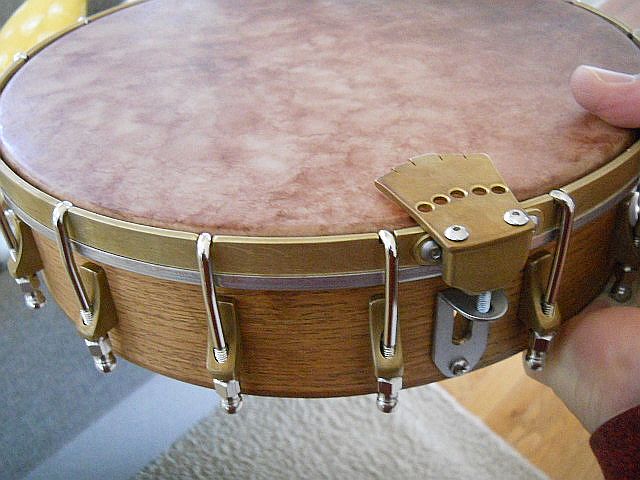
I did a Renaissance head just for fun. Fiberskyn wouldn't be any different.
banjohangout.org/archive/328297
Edited by - rudy on 09/16/2018 06:00:21
Uncle Freddy - Posted - 09/16/2018: 14:53:06
I really like using natural materials for staining; bear in mind, though, that almost all natural dyes, unless they have chemical mordants added, will fade to some degree, often quite dramatically. There are a few botanical dyes that seem to last well, but they require more work, as well as access to the particular plant material. The great thing about coffee or teabags is how easy and accessible they are. The color palate is a bit limited, though. Being an artist (as well as banjoist and banjo-builder), I really like working with color. There are a few natural and easily available dye materials that broaden the color palate: cinnamon is one of the best we've found, for a pretty reddish-brown that is relatively light-fast; you soak the powder in grain alcohol (strong vodka will work) for a few days or a week, until the liquid gets nice and colorful, and apply it to the skin. Turmeric (another spice) will yield a nice yellow, but it's not very lightfast or permanent. Bee propolis (dissolved in alcohol) can make a nice, fairly lightfast brown. Black walnut hulls (mentioned already in this thread) make a great dark brown, but will fade over time. One plant we grow and use is Aloe Arborensis (related to aloe vera), a spiny succulent that grows in a lot of peoples yards in coastal California. The dried juice makes a lovely yellow dye that is pretty lightfast (has apparently been used for violin varnish coloring). Another traditional, and very lightfast dye comes from boiling oak galls in an iron pot (these are round balls found on oak trees that little wasps have laid eggs in; they contain a lot of tannin, which reacts with the iron to make the dye); this was used on medieval manuscripts for ink...lasts a long time! Has a nice sepia gray-brown color. And, if you want bright, really lightfast colors, there is always acrylic artists paints. I mix a little bit of acrylic color with a lot of water, to make a watery dye; this works great for skin, but some might worry about too much acrylic resin in the skin effecting the tone. I haven't noticed that to be a problem; I prefer natural dyes for many other reasons, but if I want a bright, permanent color, I use watered-down acrylic.
My favorite natural dye is made from fermented juice of unripe (astringent) persimmons. Easy to make, but it takes 5 years of aging to get the best results! It makes a dye/stain that gets darker with age and exposure to sun, which is very unusual.
Dying banjo skins can be really fun and results can be beautiful.
jun3machina - Posted - 09/16/2018: 21:38:08
quote:
Originally posted by Uncle FreddyI really like using natural materials for staining; bear in mind, though, that almost all natural dyes, unless they have chemical mordants added, will fade to some degree, often quite dramatically. There are a few botanical dyes that seem to last well, but they require more work, as well as access to the particular plant material. The great thing about coffee or teabags is how easy and accessible they are. The color palate is a bit limited, though. Being an artist (as well as banjoist and banjo-builder), I really like working with color. There are a few natural and easily available dye materials that broaden the color palate: cinnamon is one of the best we've found, for a pretty reddish-brown that is relatively light-fast; you soak the powder in grain alcohol (strong vodka will work) for a few days or a week, until the liquid gets nice and colorful, and apply it to the skin. Turmeric (another spice) will yield a nice yellow, but it's not very lightfast or permanent. Bee propolis (dissolved in alcohol) can make a nice, fairly lightfast brown. Black walnut hulls (mentioned already in this thread) make a great dark brown, but will fade over time. One plant we grow and use is Aloe Arborensis (related to aloe vera), a spiny succulent that grows in a lot of peoples yards in coastal California. The dried juice makes a lovely yellow dye that is pretty lightfast (has apparently been used for violin varnish coloring). Another traditional, and very lightfast dye comes from boiling oak galls in an iron pot (these are round balls found on oak trees that little wasps have laid eggs in; they contain a lot of tannin, which reacts with the iron to make the dye); this was used on medieval manuscripts for ink...lasts a long time! Has a nice sepia gray-brown color. And, if you want bright, really lightfast colors, there is always acrylic artists paints. I mix a little bit of acrylic color with a lot of water, to make a watery dye; this works great for skin, but some might worry about too much acrylic resin in the skin effecting the tone. I haven't noticed that to be a problem; I prefer natural dyes for many other reasons, but if I want a bright, permanent color, I use watered-down acrylic.
My favorite natural dye is made from fermented juice of unripe (astringent) persimmons. Easy to make, but it takes 5 years of aging to get the best results! It makes a dye/stain that gets darker with age and exposure to sun, which is very unusual.
Dying banjo skins can be really fun and results can be beautiful.
From one artist to another, I love your post! I picked up spinning and natural dye methods over the last few years, but never thought to apply them to a banjo head. Now I'm imagining banjo builds with natural dyes...
survivor1911 - Posted - 09/18/2018: 00:04:31
quote:
Originally posted by ClayTechI just mixed up a really strong batch of tea, like a dozen tea bags, and used that when I soaked the head for mounting. Worked great!
Is that what you should do to apply it with like a wood stain to? Just soak the head in it? ive heard of people spreading fine coffee grounds on a head then spraying it with water, or can I brew coffee and do it the way you did with tea? Thanks!
Uncle Freddy - Posted - 09/18/2018: 12:23:56
Natural skins are not of a consistent texture or density throughout. Part of the beauty of dying skin, to me, is the surprise of seeing how the skin absorbs the color; each skin will be completely unique, and not entirely predictable. With a water-based colorant, like coffee, tea, acrylic paint, etc., you basically just add the colorant to the skin-soaking water, before mounting/stretching the skin. You can vary the effect by how long you soak the skin and how much colorant is added to the water. Alternatively, you can mount the skin on the rim (or stretch/tack it in the case of a tack-head), after soaking in water, then apply colorant directly to the skin; this will give perhaps more control over where the color ends up, but will still be effect by what parts of the skin most want to absorb the color. Of course, you can let the skin dry and then decorate it with paints, ink, etc. I've never tried using a pre-mounted skin like some are using these days; I imagine that process would be a bit different, since you're not soaking the skin.
ClayTech - Posted - 09/18/2018: 18:43:54
quote:
Originally posted by survivor1911quote:
Originally posted by ClayTechI just mixed up a really strong batch of tea, like a dozen tea bags, and used that when I soaked the head for mounting. Worked great!
Is that what you should do to apply it with like a wood stain to? Just soak the head in it? ive heard of people spreading fine coffee grounds on a head then spraying it with water, or can I brew coffee and do it the way you did with tea? Thanks!
I would brew the coffee. I think if you just put the grounds on the head, you'll get uneven mottled staining. If you really want to show the 'grain' of the head, then you want the stain to go on evenly. With wood stain, you'll probably want to thin it out, unless you want it dark. My goal with the tea was just to age it a bit so it wasn't white.
Dan Drabek - Posted - 09/18/2018: 19:30:49
Earth tones made from minerals tend to be non fading. Examples would be burnt sienna, burnt umber and yellow ochre. Artist watercolors of good quality in those tones might work. But tea would be pretty easy to test out. If it faded, you could always reapply. I have some antique tea cups with brown tea stains that nothing will take out.
DD
survivor1911 - Posted - 09/18/2018: 20:10:10
quote:
Originally posted by ClayTechquote:
Originally posted by survivor1911quote:
Originally posted by ClayTechI just mixed up a really strong batch of tea, like a dozen tea bags, and used that when I soaked the head for mounting. Worked great!
Is that what you should do to apply it with like a wood stain to? Just soak the head in it? ive heard of people spreading fine coffee grounds on a head then spraying it with water, or can I brew coffee and do it the way you did with tea? Thanks!
I would brew the coffee. I think if you just put the grounds on the head, you'll get uneven mottled staining. If you really want to show the 'grain' of the head, then you want the stain to go on evenly. With wood stain, you'll probably want to thin it out, unless you want it dark. My goal with the tea was just to age it a bit so it wasn't white.
Id like to show the grain of the head, with a bit of a worn look (Im a re-enactor and I did to the best of my ability to make the banjo look a bit worn from being in a soldiers camp for a few years) what would you recommend to use as a dye? Also I could thin wood stain with water correct?
Edited by - survivor1911 on 09/18/2018 20:15:46
jbalch - Posted - 09/19/2018: 05:07:59
If you are seeking a truly natural "aged" look, I recommend caution when choosing a stain. Sone stains produce colors that are attractive and cool - but not natural in appearance. Some stain colors may be too nold and clash with natiral wood tones.
The best (most natural) aged look I have achieved, has beef from using a natural walnut extract that I got form Dan Knowles. The method is to brush the tain on to the unmounted hide and allow it to dry for a brief time. Them soak the hide in clear water for the mounting process. The water washes away some of the stain and produces a "dirty" look that is really natural looking (IMHO). After the head is mounted and dried - coat it with Renaissance wax as a protectant.
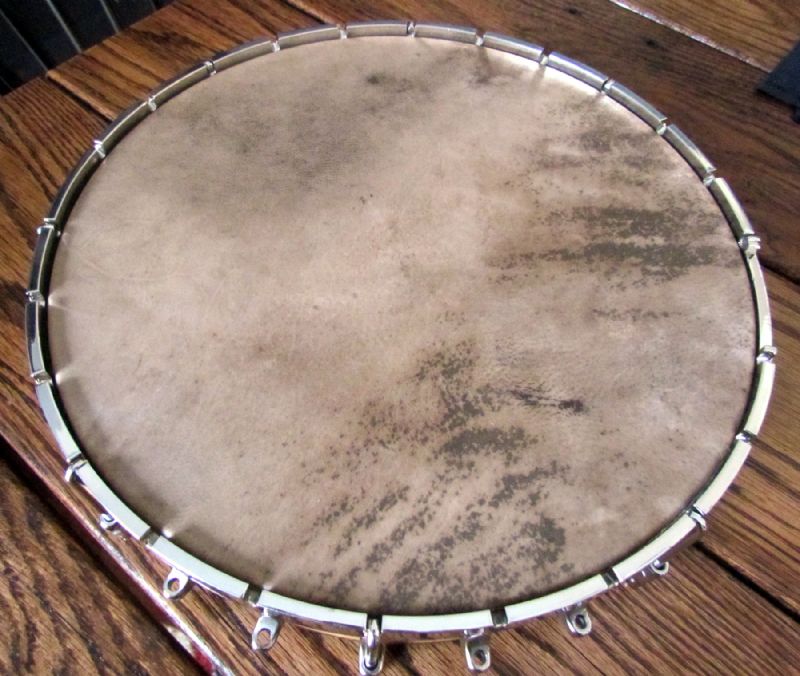
Below are to heads for consideration. One is as a VERY old hide found on an H. C Dobson form the 1880s. That head had awesome natural patina. The second is a goat head I stained as described above.
Edited by - jbalch on 09/19/2018 05:10:11
jbalch - Posted - 09/19/2018: 05:35:45
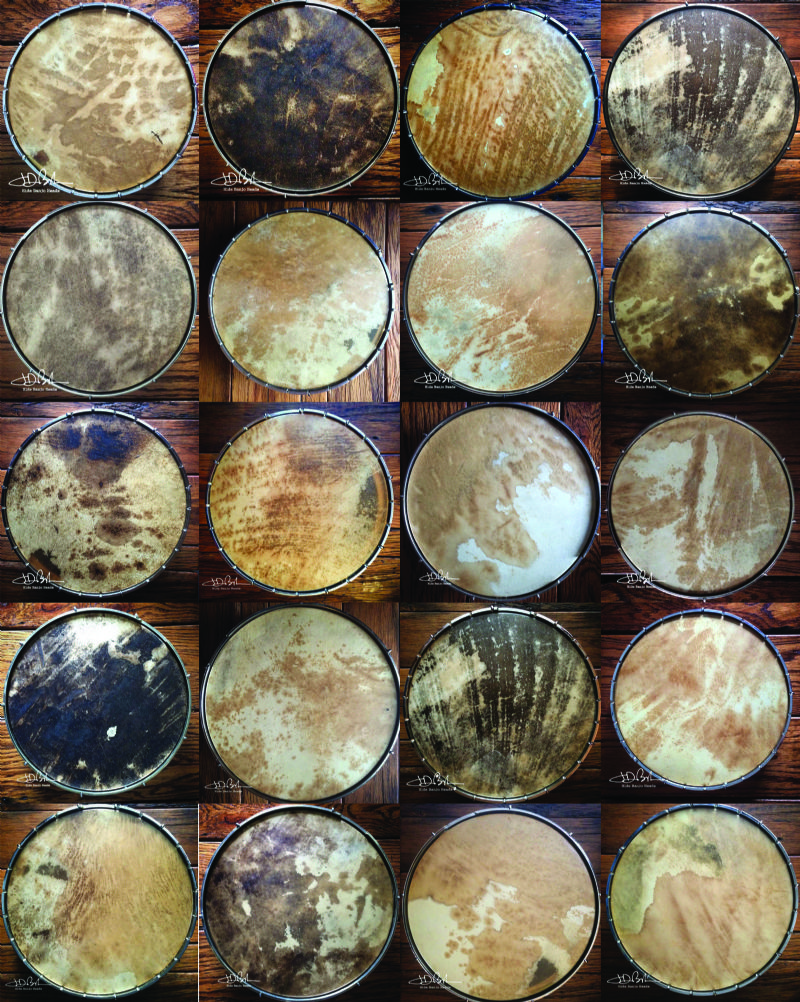
Here are a few more heads from my archives. Stained with: coffee, tea, and the famous Knowles' natural walnut elixir.
More images here: Instagram: #hidebanjohead
Edited by - jbalch on 09/19/2018 05:41:18
jbalch - Posted - 09/19/2018: 08:05:49
quote:
Originally posted by jbalchIf you are seeking a truly natural "aged" look, I recommend caution when choosing a stain. Sone stains produce colors that are attractive and cool - but not natural in appearance. Some stain colors may be too nold and clash with natiral wood tones.
The best (most natural) aged look I have achieved, has beef from using a natural walnut extract that I got form Dan Knowles. The method is to brush the tain on to the unmounted hide and allow it to dry for a brief time. Them soak the hide in clear water for the mounting process. The water washes away some of the stain and produces a "dirty" look that is really natural looking (IMHO). After the head is mounted and dried - coat it with Renaissance wax as a protectant.
Below are to heads for consideration. One is as a VERY old hide found on an H. C Dobson form the 1880s. That head had awesome natural patina. The second is a goat head I stained as described above.
My "hunt-and-peck" typing skills are horrible (doesn't help that the letters are worn off this old keyboard). I corrected several spelling errors below:
If you are seeking a truly natural "aged" look, I recommend caution when choosing a stain. Some stains produce colors that are attractive and cool - but not natural in appearance. Some stain colors may be too bold and clash with natural wood tones.
The best (most natural) aged look I have achieved, has been from using a natural walnut extract that I got from Dan Knowles. The method is to brush the stain on to the unmounted hide and allow it to dry for a brief time. Then soak the hide in clear water for the mounting process. The water washes away some of the stain and produces a "dirty" look that is really natural looking (IMHO). After the head is mounted and dried - coat it with Renaissance wax as a protectant.
Terms of Use | Privacy Policy | Privacy Consent (EU/GDPR Only)
Copyright 2026 Banjo Hangout. All Rights Reserved.