DVD-quality lessons (including tabs/sheet music) available for immediate viewing on any device.
Take your playing to the next level with the help of a local or online banjo teacher.
Weekly newsletter includes free lessons, favorite member content, banjo news and more.
Premier Sponsors


|
Please note this is an archived topic, so it is locked and unable to be replied to. You may, however, start a new topic and refer to this topic with a link: http://www.banjohangout.org/archive/344790
lature - Posted - 07/23/2018: 10:12:25
Does anyone know if swing applies to triplets? Swing increases the time for the first note and reduces the time for the next note.
My guess is an 8th note triplet with swing would play like [ 8th 16th 16th ]. So you would hold the first note of the triplet a little longer and reduce the time for the other 2 notes accordingly. From a google search, some people say you would never do this -- a triplet is a triplet (3 evenly timed notes) regardless of swing. Other people disagree.
Does anyone know if TABLEDIT plays triplets differently if SWING is on or off?
Thanks for your help with this!
mendipman - Posted - 07/23/2018: 10:23:22
What you are describing (a eighth note followed by two sixteenth notes) is dotted rhythm. And yes it's very common, here anyway. Musicians here will often refer to playing a tune dotted or undotted. In English tunes in 6/8 time triplets are never played straight, they have a distinctive rhythmic emphasis that gives the feel.
Edited by - mendipman on 07/23/2018 10:39:02
seanray - Posted - 07/23/2018: 10:32:38
Swing is a feel and triplets are a subdivision.
You can swing anything, including triplets, but as tempos increase swing naturally straightens out.
As for TablEdit with swing (Picking Syncopation) set at 2 it's quite noticeable on straight 8th notes but not so much on 8th note triplets.
Hope that helps.
lature - Posted - 07/23/2018: 10:37:02
I forgot that tabledit has a free version (16 measures) so I gave it a try. It doesn't swing the triplets at all --- 3 evenly spaced notes. Same thing with Musescore. So I guess I answered my own question -- it don't mean a thing because triplets don't swing!
Mooooo - Posted - 07/23/2018: 10:41:18
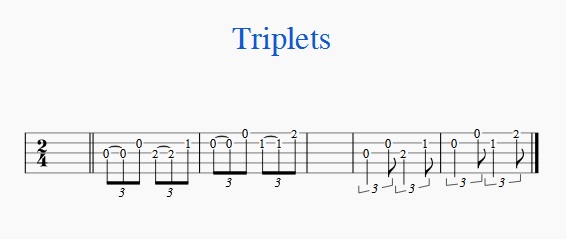
I have read about people saying that to show what swing sounds like you can use a dotted eighth and then a sixteenth note or two tied eight notes followed by the last note of the triplet. But in normal sheet music on real paper, they usually just say "play with swing" or "heavy swing" etc...I imagine the same is true with tab on real paper. I don't know how tabledit does it, but in Musescore the swing doesn't seem to work on triplets. I would love for someone with TablEdit to show us the difference between Swing notes and tied triplets on the same file.
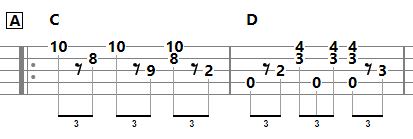
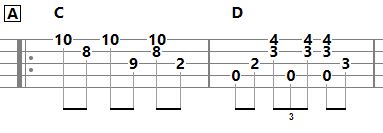
Here is MuseScore the first time through it is tied triplets and the second time it is swing at 60%, and the same file with tied triplets and the swing turned off:
Edited by - Mooooo on 07/23/2018 10:51:09
lature - Posted - 07/23/2018: 11:05:50
I have some tab of J.D.Crowe playing "Mr. Engineer." He uses that standard slow song backup triplet lick over and over. For the life of me I can't get it to sound right and was wondering if he is SWINGING the triplets. I guess it really doesn't matter what Musescore and Tabledit do, it's what J.D. and Earl are doing that matters.
I'm starting to think that using triplets to tab out this backup might be wrong -- should probably have used tied eighths, like you mention, to keep the swing swinging?
Craig_B - Posted - 07/23/2018: 11:30:38
In my opinion, one of the things that makes triplets effective is the even note spacing. It creates contrast between the triplets and the rest of the notes, which makes them interesting. When those evenly-spaced notes occur in a swing setting, the contrast is increased, which for me, makes them even more interesting.
Mooooo - Posted - 07/23/2018: 11:33:38
When JD swings he swings, no one is thinking triplets or 8th notes or whatever when they play. If you do, you're not having fun. I would bet that JD wouldn't have any idea at all what triplets look like on paper.
If you want your tabledit or musescore to sound like swing, do it however it sounds best, but if you want to print out the tab, I would just write "play with swing" and write the tab without triplets. It will be very hard to put those in every measure. Anyway, these electronic tabs are a bit unnecessary if people learn how to read tab correctly. Pdfs should be enough, the midi and tab is more like spoon feeding and leads to dependency.
lature - Posted - 07/23/2018: 12:59:45
There is a discussion going on in the TAB forum right now about a song called 'Nola.' I just looked at the sheet music for piano that janolov posted. It is a combination of triplets followed by swung 8ths followed by more triplets ... It is basically doing what Craig mentions above - combining swing and no swing together in weird and wonderful ways to create a very interesting song. I would have never even noticed this before today -- thanks for the help!
mendipman - Posted - 07/23/2018: 15:16:01
quote:
Originally posted by Craig_BIn my opinion, one of the things that makes triplets effective is the even note spacing. It creates contrast between the triplets and the rest of the notes, which makes them interesting. When those evenly-spaced notes occur in a swing setting, the contrast is increased, which for me, makes them even more interesting.
That may be true of the occasional triplets in simple meter. Very different in compound meter such as 6/8 and 9/8.
Playing these three-note groups evenly in traditional English session and our many 6/8 tunes would stick out like a sore thumb in the wrong way.
JoeDownes - Posted - 07/24/2018: 06:11:13
How are the triplets played in traditional English sessions? Long, short, short? Can you link to an example?
lature - Posted - 07/24/2018: 07:28:54
After experimenting with this a little more I ended up removing all the swing from the tab, simplifying it to use straight 8th notes. This way I could use the music program's swing option to add the swing back in and easily try different amounts of swing without messing with any note timings. The original tab was all triplets so messing with the playback swing setting had no effect. The final tab was much simpler. It appears J.D. and Earl played slow songs with a lot of swing.
Edited by - lature on 07/24/2018 07:29:51
250gibson - Posted - 07/24/2018: 07:54:07
quote:
Originally posted by mendipmanquote:
Originally posted by Craig_BIn my opinion, one of the things that makes triplets effective is the even note spacing. It creates contrast between the triplets and the rest of the notes, which makes them interesting. When those evenly-spaced notes occur in a swing setting, the contrast is increased, which for me, makes them even more interesting.
That may be true of the occasional triplets in simple meter. Very different in compound meter such as 6/8 and 9/8.
Playing these three-note groups evenly in traditional English session and our many 6/8 tunes would stick out like a sore thumb in the wrong way.
I think you are confusing triplets with 3 eighth notes beamed together. In 6/8, 9/8 etc. the 8th notes are beamed in groups of threes and each 8th note is actually one beat, and you are correct that they are usually swung when played. A triplet is a beat divided in thirds. So in 6/8 time, a triplet would be played in the same duration as one of the 8th notes and would be written as 3 16th notes beamed together with a 3 on top. Best example of triplets in Irish traditional is the donegal fiddlers who sort of hiccup their bow on the downbeat as an ornamentation. If this ornamentation was written out it would be close to triplet notation.
chuckv97 - Posted - 07/24/2018: 09:24:27
Swing eighths are actually timed like triplets (evenly spaced) ,but omitting the middle note of the triplet. When triplets are used in swing time, they are played evenly.
Mooooo - Posted - 07/24/2018: 10:26:49
I wouldn't put those rests there between the notes as that would indicate stopping and then waiting for the duration of a note then hitting the next note. I think you can do it two ways with triplets if you don't want that sound. Anyway, just use the swing function, I don't think triplets is a great idea to represent swing. There is an infinite amount of swing one can put in the music, triplets is only one way that equally divides the notes then doubles the first two.
Edited by - Mooooo on 07/24/2018 10:28:47
mendipman - Posted - 07/24/2018: 15:45:30
quote:
Originally posted by JoeDownesHow are the triplets played in traditional English sessions? Long, short, short? Can you link to an example?
Two groups of three in a measure of 6/8 time have the main emphasis on the 1-beat and a secondary emphasis on the 4-beat.
As 250gibson mentioned there are also single beats divided into three. When played both have a triplet feel but I agree that strictly speaking only the single beat divided into three is notated as a triplet with linking and the figure 3 underneath.
I can think of one tune here in particular that I often play and that contains a very distinctive descending pattern of four triplets as a variation in second 8 of the B part. In that tune the triplet sequence has a 'squaring' step down effect and stands out as a texture variation to the dotted feel of the rest of the tune
250gibson - Posted - 07/24/2018: 16:23:38
quote:
Originally posted by mendipmanquote:
Originally posted by JoeDownesHow are the triplets played in traditional English sessions? Long, short, short? Can you link to an example?
Two groups of three in a measure of 6/8 time have the main emphasis on the 1-beat and a secondary emphasis on the 4-beat.
As 250gibson mentioned there are also single beats divided into three. When played both have a triplet feel but I agree that strictly speaking only the single beat divided into three is notated as a triplet with linking and the figure 3 underneath.
I can think of one tune here in particular that I often play and that contains a very distinctive descending pattern of four triplets as a variation in second 8 of the B part. In that tune the triplet sequence has a 'squaring' step down effect and stands out as a texture variation to the dotted feel of the rest of the tune
A triplet is a duration/time value of a note. Not a particular notation configuration or rhythm. 3 8th notes beamed together is not a triplet even though it consists of 3 notes. The 3 is to differentiate it as a division of a note in 3rds not 1/2 and is needed to designate a triplet. In other words. 3 8th notes = 1 1/2 quarter notes. 3 triplet 8th notes = 1 quarter note.
Edited by - 250gibson on 07/24/2018 16:26:39
mendipman - Posted - 07/24/2018: 16:34:59
quote:
Originally posted by 250gibsonquote:
Originally posted by mendipmanquote:
Originally posted by JoeDownesHow are the triplets played in traditional English sessions? Long, short, short? Can you link to an example?
Two groups of three in a measure of 6/8 time have the main emphasis on the 1-beat and a secondary emphasis on the 4-beat.
As 250gibson mentioned there are also single beats divided into three. When played both have a triplet feel but I agree that strictly speaking only the single beat divided into three is notated as a triplet with linking and the figure 3 underneath.
I can think of one tune here in particular that I often play and that contains a very distinctive descending pattern of four triplets as a variation in second 8 of the B part. In that tune the triplet sequence has a 'squaring' step down effect and stands out as a texture variation to the dotted feel of the rest of the tune
A triplet is a duration/time value of a note. Not a particular notation configuration or rhythm. 3 8th notes beamed together is not a triplet even though it consists of 3 notes. The 3 is to differentiate it as a division of a note in 3rds not 1/2 and is needed to designate a triplet. In other words. 3 8th notes = 1 1/2 quarter notes. 3 triplet 8th notes = 1 quarter note.
I did study music and understand the theory so I can save you the time and trouble there.
My reference to and comparison with 6/8 time is about the 'feel' when playing. And in answer to the OP's last post you can play that triplet(s) however you choose unless you're planning on being up at the Albert or Carnegie Hall. Just try it out and see what seems nicest to your ear.
RB3 - Posted - 07/24/2018: 16:39:43
You might want to check out the playing of Jethro Burns. Nobody ever swung better than Jethro. If anyone could swing a triplet at a brisk tempo, it would be Jethro. Below is a link to a recording of Take Me Out To The Ballgame with Steve Goodman that demonstrates Jethro's genius.
Rawhide Creek - Posted - 07/25/2018: 10:31:48
By definition, duplets and triplets are equal divisions of a beat—into 2 equal and 3 equal parts, respectively— ergo, they can neither “swing” nor be “swung”.
lature - Posted - 07/25/2018: 11:39:05
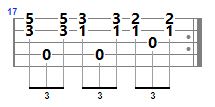
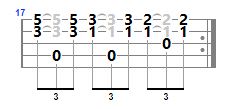
Below is the last measure of Mr. Engineer from the J.D.Crowe's AcuTab book (Vol 1, page 49). This picking pattern is used all over the place. I now understand that triplets are not affected by changing a music program's midi playback swing setting. They will always sound as 3 equal spaced notes even if swing is set to a billion. However, the midi doesn't sound right to me. To get the midi playback to be as close as possible to Crowe's actual backup, I don't think tabbing this as triplets is right. Or, maybe my ears are wrong, which wouldn't surprise me.
So, what do you hear? Triplets or some variation with swing in it.
Here is a link to the youtube: Mr Engineer
lature - Posted - 07/25/2018: 13:02:20
I figured it out. All you have to do is hold the first note of the triplet a little longer and play it a little louder. So you hammer the first note and hold while you play the second note. You end up with the long note/ short note sound which is swing. The middle note is played on a lower string and gets lost in the wash. It looks like this:
Rawhide Creek - Posted - 07/25/2018: 21:40:35
quote:
Originally posted by latureI figured it out. All you have to do is hold the first note of the triplet a little longer and play it a little louder. So you hammer the first note and hold while you play the second note. You end up with the long note/ short note sound which is swing. The middle note is played on a lower string and gets lost in the wash. It looks like this:
. . . and so it is not a triplet.
mendipman - Posted - 07/26/2018: 02:36:17
quote:
Originally posted by Rawhide Creekquote:
Originally posted by latureI figured it out. All you have to do is hold the first note of the triplet a little longer and play it a little louder. So you hammer the first note and hold while you play the second note. You end up with the long note/ short note sound which is swing. The middle note is played on a lower string and gets lost in the wash. It looks like this:
. . . and so it is not a triplet.
As far as applying academic terminology goes, you're right.
But in a folk setting we all know that sticking to the dots isn't what happens when we play. The OP is free to interpret and phrase a tune how he chooses to. And how to play that sequence with a different, less even emphasis within that tune is really what the OP is asking about. And it looks from his last post like he's figured a way that sounds good to his ears.
Rawhide Creek - Posted - 07/26/2018: 05:52:40
quote:
Originally posted by mendipmanquote:
Originally posted by Rawhide Creekquote:
Originally posted by latureI figured it out. All you have to do is hold the first note of the triplet a little longer and play it a little louder. So you hammer the first note and hold while you play the second note. You end up with the long note/ short note sound which is swing. The middle note is played on a lower string and gets lost in the wash. It looks like this:
. . . and so it is not a triplet.
As far as applying academic terminology goes, you're right.
But in a folk setting we all know that sticking to the dots isn't what happens when we play. The OP is free to interpret and phrase a tune how he chooses to. And how to play that sequence with a different, less even emphasis within that tune is really what the OP is asking about. And it looks from his last post like he's figured a way that sounds good to his ears.
. . . and, because there is a difference between “terminology” and “definition”, it’s still not a triplet. 
Edited by - Rawhide Creek on 07/26/2018 05:53:13
lature - Posted - 07/26/2018: 06:45:46
quote:
Originally posted by Rawhide CreekBy definition, duplets and triplets are equal divisions of a beat—into 2 equal and 3 equal parts, respectively— ergo, they can neither “swing” nor be “swung”.
A triplet can swing. Take a look at my last post (3 swinging triplets). Take a look at Moooo's post above to see more examples. When you change the swing setting in any music program, triplets will be ignored. That doesn't mean the triplets didn't swing to start with.
Terms of Use | Privacy Policy | Privacy Consent (EU/GDPR Only)
Copyright 2026 Banjo Hangout. All Rights Reserved.