DVD-quality lessons (including tabs/sheet music) available for immediate viewing on any device.
Take your playing to the next level with the help of a local or online banjo teacher.
Weekly newsletter includes free lessons, favorite member content, banjo news and more.
Premier Sponsors


|
Please note this is an archived topic, so it is locked and unable to be replied to. You may, however, start a new topic and refer to this topic with a link: http://www.banjohangout.org/archive/341953
mmm Bacon - Posted - 04/18/2018: 09:43:08
There has been a lot of discussion on the forum lately regarding the origins of the so called "Mountain Banjo".
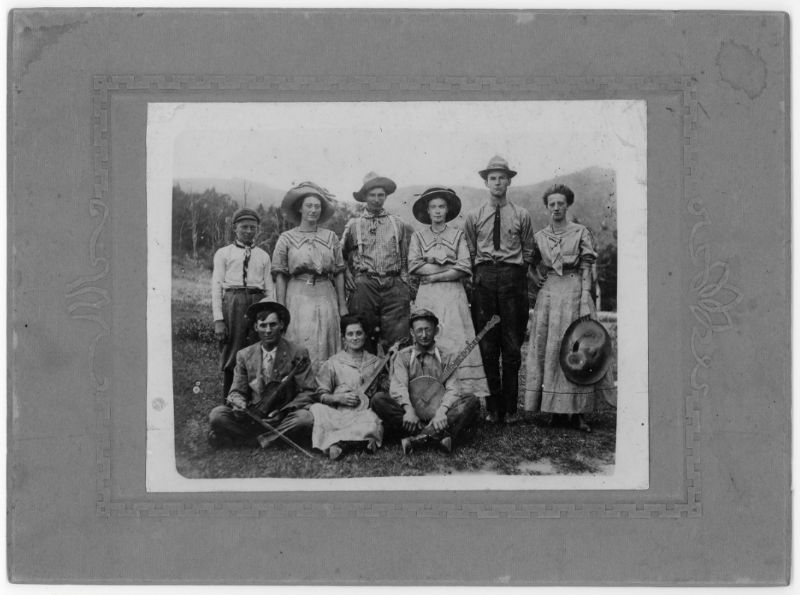
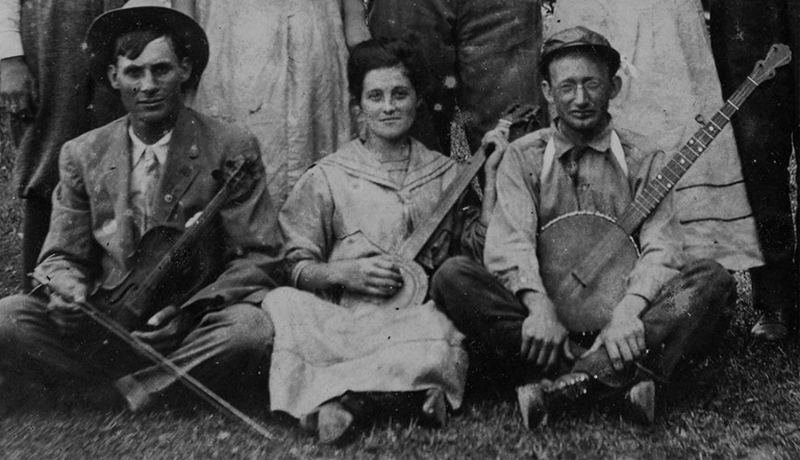
I recently discovered a really interesting early photo of a "mountain banjo" which was included in a large amount of papers from Shull's Mill, Watauga County, NC that was given to The Appalachian State University.
appcollgrant.library.appstate....ll-papers
omeka.library.appstate.edu/ite...how/40604
The museum dates the photo between 1895 - 1905, but I tried to do a little online detective work to try to definitively date the photo. I admit that I am certainly no ancestry expert, but this is what I found...
The lady playing the mountain banjo is Mamie Graybeal Shull who was born in 1889 and died in 1998. She is buried in the Shull Mill Cemetery, Shull's Mill, NC. The gentleman playing the banjo is her husband, Robey (1881-1963) who is also buried in the Shull Mill Cemetery, Shull's Mill, NC. (Note: names in photo are listed RIGHT to LEFT.)
In a 1973 Interview Mamie said that she moved to Shulls Mills in 1906 and was born in '89 - "I was the oldest and I didn't like to go to school, I got married about the time that I got grown. I guess I got about an eighth grade education." In the interview she referred to her husband as Robey. Well that would mean the photo can be no earlier than 1906.
The young boy in the photo is Ernest Lineback who was born about 1899 according to the 1940 census. (Another source said 1898.) Online info said, "After attending Shulls Mill Grammar School, Ernest Lineback received his high school education in Boone, North Carolina, the county seat, at the Appalachian Training School. In 1916 Mr. Lineback went to Cleveland, Ohio, where he was married to the former Miss Emma Mary Heins, of Nashville, Tennessee, on May 23, ..."
So that would mean that Ernest had left Shull's Mill by 1916. He looks no older than 14 in the photo which would put the photo at 1913, but he was most likely off to Boone at that time.
In my opinion this all means the photo was most likely taken between 1910 - 1914.
Maybe someone with more skill than me can trace the other people in the photo. For example, Bessie Isaacs ends up marrying Jim Brown, but I could not find their wedding date.
Edited by - mmm Bacon on 04/18/2018 10:08:47
IMBanjoJim - Posted - 04/18/2018: 10:13:07
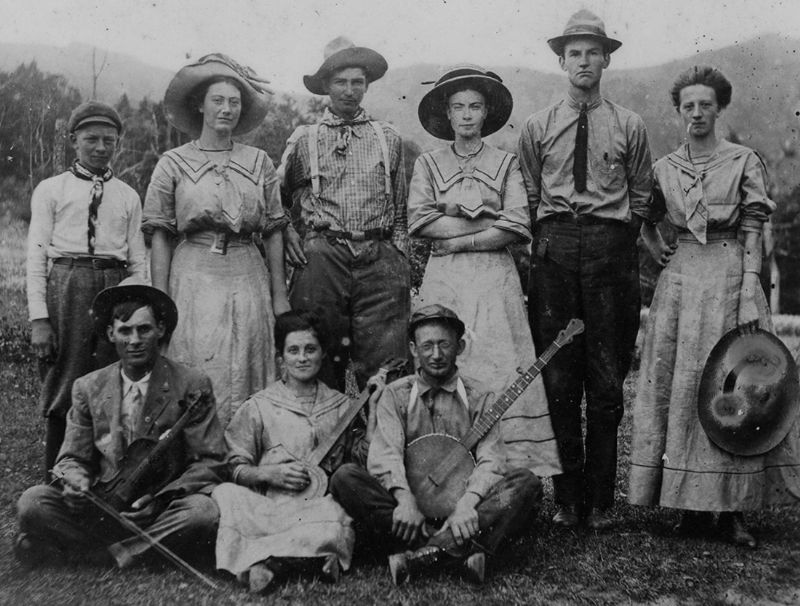
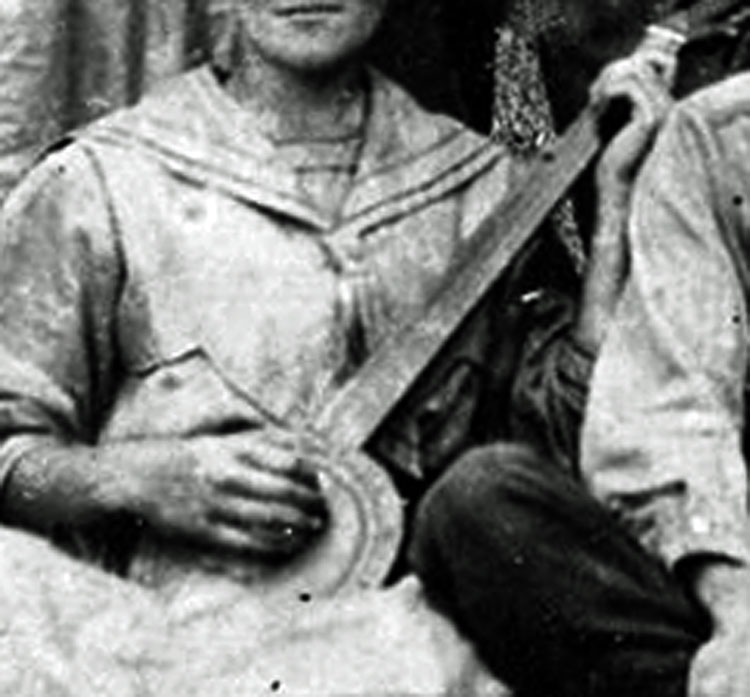
Took the photo, cropped, enlarged, and adjusted brightness and contrast (I love Photoshop!)
maneckep - Posted - 04/18/2018: 12:53:36
Well the banjo must enhance longevity since Mamie lived to be 109.
mmm Bacon - Posted - 04/18/2018: 13:06:45
She must be the longest living banjo player ever. It's not a typo, she really did live that long, and here's the proof:
findagrave.com/memorial/178606311
Edited by - mmm Bacon on 04/18/2018 13:11:00
Joel Hooks - Posted - 04/18/2018: 13:38:50
What a great find and amazing image! You did your homework too!! Thanks for sharing mmm.
Assuming that the standing women have kept up with current fashions in their middy blouses with pointed collars I think your estimated date of about 1914 is good. The puffy waists tend to get straighter by the 20s
Mamie looks to be wearing a Peter Thompson dress which is consistent with the mid teens to early 20s "sporting wear" (they all look to be enjoying a day outside).
The men are wearing pullover shirts and pants with belt loops and belts. The man dressed in "cowboy" garb has a small double action revolver stuck in his belt that looks like the typical inexpensive Iver Johnson safety automatic pistol. There is not enough detail to tell if it is hammer-less.
The other banjo is a typical "jobber" NYC Buckbee and the 17 fret neck is usually (but not always) pre 1890ish. It is showing some use.
Mamie's banjo looks fairly clean and has slots for guitar tuners.
Very cool. So we can roll the timeline back for Mountain banjos to the mid teens. Which would give time for them to become more prevalent by the 20s.
The slotted peg head and guitar tuners is a detail that I have not ever seen on a mountain banjo.
Edited by - Joel Hooks on 04/18/2018 13:40:47
jonredmond - Posted - 04/18/2018: 13:58:06
Could that be a zither or old Dobson type banjo rather than a mountain banjo? It seems to have some kind of brackets around the head similar to how those zither banjos are constructed.
mmm Bacon - Posted - 04/18/2018: 14:40:28
>Could that be a zither or old Dobson type banjo...?
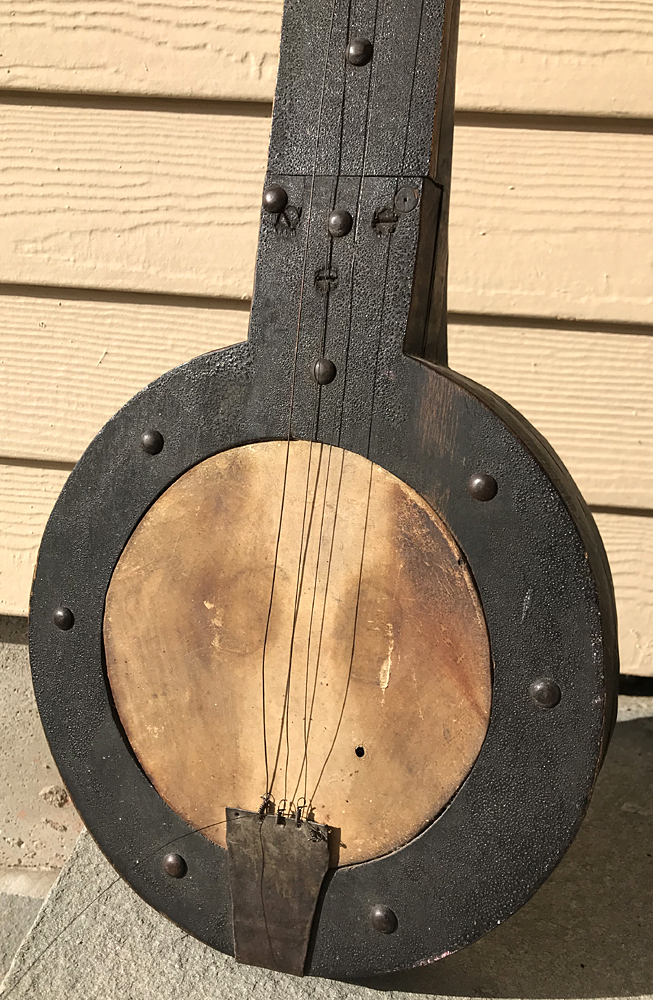
I really don't think so, because zither banjos have waaay more going on around the rim. I think it is the bolts or screws holding the three wooden layers together that we see.
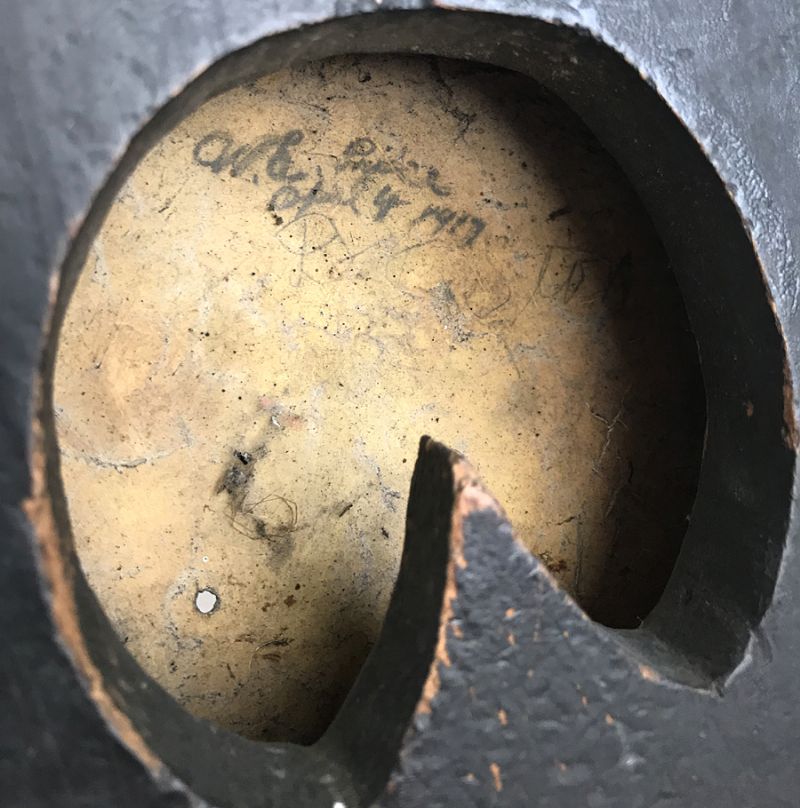
Here is a photo of a banjo that I bought from an estate sale in Elizabethton, TN where the attachment method is also a decorative element. Underneath the dust, dirt, cobwebs, and dead spiders the date of April 4, 1917 can be seen. This date was never mentioned at the time of sale. Elizabethton, TN is only 45 miles from Watauga County, NC.
IMBanjoJim - Posted - 04/18/2018: 16:11:04
Bacon---now that is a sweet looking old banjo! Lucky find!
csacwp - Posted - 04/18/2018: 16:14:24
Looks like a mountain banjo to me- not a zither for sure. Great find! I agree with Joel about the clothing, and while it is possible the clothes were hand-me-down or second hand, I do find it significant that everyone in the photos is wearing clothing styles from the mid-late teens. I’ll roll back my own working date for these banjos to the teens.
Bob Sayers - Posted - 04/18/2018: 17:11:46
Unfortunately, there are now three related threads on this topic. Anyone reading this should probably look for the other two.
That said, here's another image, this one of Leonard Glenn playing a "mountain banjo," probably in the 1930s. It's from the Berea College Collection. (To see the image, you have to go to the Leonard Glenn key at the top of the page):
libraryguides.berea.edu/dulcimers/makers
What's interesting is that the Glenns--Leonard and Clifford, father and son--were from Watauga County, NC. Moreover, it's believed that they built some, if not all, of the banjos sold by Frank Proffitt.
Addendum: The piece says that the Glenns began building dulcimers and banjos in the 1950s, but the photo looks older than that. Leonard was born in 1910.
Edited by - Bob Sayers on 04/18/2018 17:16:14
Bob Sayers - Posted - 04/18/2018: 17:21:39
Here's are two more pieces on Leonard and Clifford Glenn:
blueridgeheritage.com/traditio...ard-glenn
blueridgeheritage.com/traditio...ord-glenn
Edited by - Bob Sayers on 04/18/2018 17:24:01
csacwp - Posted - 04/18/2018: 17:22:54
quote:
Originally posted by Bob Sayers
Addendum: The piece says that the Glenns began building dulcimers and banjos in the 1950s, but the photo looks older than that. Leonard was born in 1910.
That photo is definitely later than the '30s. It looks post-war to me... just look at the type of overalls and the other clothing.
mmm Bacon - Posted - 04/18/2018: 17:35:11
>Unfortunately, there are now three related threads on this topic...
Hi Bob... I was trying to show documented proof of the "earliest" sighting of a Watauga County, NC mountain banjo. There's much info on the Glenns and Frank Proffitt... the question is, where did they get the design from? I'm hoping that more documented pre-1920 info comes to light in this thread. Thanks.
IMBanjoJim - Posted - 04/18/2018: 17:44:10
quote:
Originally posted by IMBanjoJimTook the photo, cropped, enlarged, and adjusted brightness and contrast (I love Photoshop!)
The only thing that bothers me about this image is that slotted peghead. Has anyone out there ever seen a mountain banjo with a slotted head? No reason you couldn't have one, I suppose, but it would be a bit harder to make.
As to whether it might be a zither banjo, were they sold in this country (or just in England)? The 1870s era Dobsons, had a bigger pot, so it isn't a Dobson..
Edited by - IMBanjoJim on 04/18/2018 17:45:06
Bob Sayers - Posted - 04/18/2018: 17:45:09
Quote: "Hi Bob... I was trying to show documented proof of the "earliest" sighting of a Watauga County, NC mountain banjo. There's much info on the Glenns and Frank Proffitt... the question is, where did they get the design from? I'm hoping that more documented pre-1920 info comes to light in this thread. Thanks."
Me, too!
Edited by - Bob Sayers on 04/18/2018 17:46:58
Andy FitzGibbon - Posted - 04/18/2018: 19:35:41
quote:
Originally posted by IMBanjoJim
The only thing that bothers me about this image is that slotted peghead. Has anyone out there ever seen a mountain banjo with a slotted head? No reason you couldn't have one, I suppose, but it would be a bit harder to make.As to whether it might be a zither banjo, were they sold in this country (or just in England)? The 1870s era Dobsons, had a bigger pot, so it isn't a Dobson..
I've seen mountain banjos with slotted pegheads in the past. While the design might require more work in shaping the peghead, it saves the work of having to carve and/or fit friction pegs, and the geared guitar style tuners work much better with steel strings.
Andy
CliftonHicks - Posted - 04/24/2018: 14:00:19
It's also worth noting that the Smithsonian thinks Frank Proffitt's well-known mountain banjo was made before 1900:
"Description: This banjo was made by an unknown maker in the United States around 1875-1899. The instrument’s body is made from oak, and the body’s rim is ornamented with 12 furniture tacks. This banjo was acquired from noted traditional musician Frank Proffitt, who said that he had bought it from a local second hand store with the understanding that it had originally come from the family of a local wagoner. It is a finely crafted example..."
csacwp - Posted - 04/24/2018: 14:50:00
quote:
Originally posted by CliftonHicksIt's also worth noting that the Smithsonian thinks Frank Proffitt's well-known mountain banjo was made before 1900:
"Description: This banjo was made by an unknown maker in the United States around 1875-1899. The instrument’s body is made from oak, and the body’s rim is ornamented with 12 furniture tacks. This banjo was acquired from noted traditional musician Frank Proffitt, who said that he had bought it from a local second hand store with the understanding that it had originally come from the family of a local wagoner. It is a finely crafted example..."
Sure, but it's fairly common knowledge among banjo historians that the Smithsonian knows very little about their own holdings, and what they do "know" is often incorrect.
mutantmoose - Posted - 04/24/2018: 19:14:52
quote:
Originally posted by CliftonHicksIt's also worth noting that the Smithsonian thinks Frank Proffitt's well-known mountain banjo was made before 1900:
"Description: This banjo was made by an unknown maker in the United States around 1875-1899. The instrument’s body is made from oak, and the body’s rim is ornamented with 12 furniture tacks. This banjo was acquired from noted traditional musician Frank Proffitt, who said that he had bought it from a local second hand store with the understanding that it had originally come from the family of a local wagoner. It is a finely crafted example..."
The top and bottom of that banjo are lathe turned. I have a hard time squaring the notion of a home-made banjo being made with a lathe-turned top and bottom. Doesn't mean it's impossible, but I wonder if there WAS a maker who made some of these in a factory setting?
csacwp - Posted - 04/24/2018: 20:15:04
It’s possible that they were made in Appalachian craft schools. That would explain how the pattern spread but remained fairly standard. They also would have had access to the necessary tooling at such schools.
mmm Bacon - Posted - 04/25/2018: 06:07:32
>Originally posted by CliftonHicks
>It's also worth noting that the Smithsonian thinks Frank Proffitt's well-known mountain banjo was made before 1900:
That is a really nicely made banjo, and even though it could be called a mountain banjo, it is not constructed in the classic mountain banjo 3-layer style with an extended tab on the top and bottom plates to support the neck sandwiched in the middle. This system is very simple but extremely strong.
Terms of Use | Privacy Policy | Privacy Consent (EU/GDPR Only)
Copyright 2026 Banjo Hangout. All Rights Reserved.