DVD-quality lessons (including tabs/sheet music) available for immediate viewing on any device.
Take your playing to the next level with the help of a local or online banjo teacher.
Weekly newsletter includes free lessons, favorite member content, banjo news and more.
Premier Sponsors


|
Please note this is an archived topic, so it is locked and unable to be replied to. You may, however, start a new topic and refer to this topic with a link: http://www.banjohangout.org/archive/338284/2
flyingsquirrelinlay - Posted - 01/02/2018: 06:46:14
There's a video on UTube with Eric playing "Duelin' Banjo" with Tom Paxton!
john bange - Posted - 01/02/2018: 09:32:15
quote:
Originally posted by hbick2
There was a folk music band in my high school that played mostly Kingston Trio stuff. They still get together and play the same songs.
I think this is the most significant thing said in this whole thread...well said Harry
arnie fleischer - Posted - 01/02/2018: 10:05:14
I bought my first banjo, and Pete Seeger's instruction book, in late August of 1962 because I was blown away by Pete's intro to "Darlin' Corey" on one of the Weavers' albums. As I worked my way through Pete's book, I realized that what most of the banjo players in the popular groups were playing was a rhythmic strum that Pete called "whamming," fine for accompanying sing-alongs but ultimately pretty boring, I thought, especially when anyone other than Pete used it.
Two events soon changed my banjo direction forever. In the fall I came upon one of the New Lost City Ramblers albums in a discount bin in the Times Square Sam Goody's record store. One listen to "Whoop 'Em Up Cindy" and a perusal of the liner notes to find out where that song and its playing style came from started me on the road to learning old time and ultimately bluegrass music.
And then I was in a college class with John Burke, who years later wrote one of the earliest old time banjo instruction books for Oak Publications. John was a freshman and I was a sophomore, but he was already well-versed in the intricacies of old time banjo playing (and within another year or two he would take up fiddle). John introduced me to the playing of Wade Ward, Buell Kazee, Dock Boggs, and others, including my personal favorite, Hobart Smith. He also showed me how to play melodic clawhammer, something I have long forgotten although I can still drop-thumb frail.
John also introduced me to his classmate, Pete Wernick, who in turn introduced me to bluegrass - even though I wouldn't actually start playing bluegrass for another dozen years or so. During the spring of their senior year of college, and my first year of law school, we played a single gig together as an old time band called The Old Hat Band (I have a reel-to-reel tape of our performance to prove it!) with Pete on guitar, John on fiddle, and me on clawhammer banjo.
Just writing about that time reminds me of how fresh, exciting, and full of discovery old time and bluegrass music were to me. Don't get me wrong, the music still excites me, and I'm probably exploring more new things now, 50+ years down the road, than ever before, but those early years of playing were pretty special.
Joe Connor - Posted - 01/02/2018: 10:59:03
I was blown away by Pete's intro to "Darlin' Corey" on one of the Weavers' albums..
You weren't the only one, Arnie. That was the album of the Weavers' Christmas 1955 reunion concert at Carnegie Hall. You could argue very respectably that that was the album that launched the folk revival.
I realized that what most of the banjo players in the popular groups were playing was a rhythmic strum that Pete called "whamming," fine for accompanying sing-alongs but ultimately pretty boring, I thought, especially when anyone other than Pete used it.
Listen to Dave Guard's stuff with the Kingston Trio. Some pretty good frailing (I don't think he ever dropped his thumb) and some good two- and three-finger picking. But you're right that a lot of those guys didn't do anything more than strum. Eric Weisberg (Tarriers) and Erik Darling (Tarriers and Pete's replacement in the Weavers) were above-the-rim players. Roger McGuinn (back-up for the Chad Mitchell Trio) was very good, too.
In the fall I came upon one of the New Lost City Ramblers albums in a discount bin in the Times Square Sam Goody's record store.
Ah, the memories. Sam Goody's, King Karol's. Times Square had more than its share of great record stores, and the cut-out bins were a treasure trove. Was anything more fun than spending an afternoon going through those discount bins?
Just writing about that time reminds me of how fresh, exciting, and full of discovery old time and bluegrass music were to me.
It was to a lot of us, Arnie. We had never been exposed to this kind of music before. Unless you lived in the rural south (or tuned your radio to WSM late at night), you had never heard it. It was new, fresh, exciting, and real.. The proof is in the pudding: those of us of a certain age are still listening to that music and playing it. Without the folk revival and the directions in which it pointed us, we might all be hanging out in the Accordion Hangout.
.????
Edited by - Joe Connor on 01/02/2018 10:59:54
flyingsquirrelinlay - Posted - 01/02/2018: 11:00:59
Arnie, please, no offense intended, but I think most of our memories of our youth, regardless of what we really did, remain very special. Thanks for the post. Dave
banjo bill-e - Posted - 01/02/2018: 12:05:42
----" It’s called marketing and if it brings exposure and awareness it’s better for all of us, even the purists."
Thank you Harry Bickel! So often musicians sneer at any mention of commerce as if it somehow taints the music for anyone to make a living playing it, or especially if anyone dares to promote it and begins selling it. But the fact remains that marketing is why most of us have heard our favorite artists and songs, and if there had not been a profit motive then much great music would have gone unheard and many great artists would have kept their day jobs and been a big hit on their front porch or local community center but nowhere else. That may well preserve some notion of "purity" but I am most thankful that for all of my favorite music---and I have spent thousands in my lifetime on music---someone somewhere took the financial risk and invested unspent income (aka capital) toward marketing that music, and that has enriched my life many times over.
And if you heard your favorite music on the radio, thank an advertiser, as they are the ones who made that possible!
arnie fleischer - Posted - 01/02/2018: 12:58:39
Joe, we need to add the great Paul Prestopino (Peter, Paul and Mary, and the Chad Mitchell Trio) as perhaps the ultimate example of the exception that proves the rule. I met him a couple of years ago at Mexicali Live in Teaneck, NJ. He was playing banjo in a local band that was opening for Tony Trischka's Christmas show. I saw him by the door as I came in and thought he looked familiar, and then Tony told me who he was.
David, far from taking offense, I think you've confirmed what is likely a universal human phenomenon.
Both of you guys, I hope our paths cross at some point.
hbick2 - Posted - 01/02/2018: 13:37:54
I second that. I got Paul's autograph when I was in high school. He signed his name and drew a little banjo under it. I've still got it around here somewhere.
Shop the Folk - Posted - 01/02/2018: 14:14:56
Mike, I have an Epic long neck (w/resonator). I can send a picture. For what it's worth, I also have Mason Williams' PS-5 and Brooks Hatch's PS-5 (Serendipity Singers). Paul
mikehalloran - Posted - 01/02/2018: 16:34:02
quote:
Originally posted by stangerHas anyone ever actually seen one of those Epic banjos that were in that ad?
I saw the ad several times, but to this day, I have never seen an Epic, nor know of anyone who has. Or has owned one.
regards,
stanger
Did Epic become Christy?
mikehalloran - Posted - 01/02/2018: 16:38:23
quote:
Originally posted by Shop the FolkMike, I have an Epic long neck (w/resonator). I can send a picture. For what it's worth, I also have Mason Williams' PS-5 and Brooks Hatch's PS-5 (Serendipity Singers). Paul
Pictures! Pictures! Pictures! Pleeeeeease!

Helix - Posted - 01/03/2018: 04:12:26
Blumentritt might need a little help with the photos, try to contact him.
flyingsquirrelinlay - Posted - 01/03/2018: 08:51:07
Arnie, in ruminating about your/my youth, my flypaper brain kicked out several lines from songs: Carroll O'Connor in Norman Lear's sitcom "All in the Family" singing "Those were the days'; the singer in Steve Martin's first album, in the tune "Daddy Played the Banjo" the closing line - "memories of what never was become the good ol' days" and finally Paul Simon in "Old Friends" from "Book Ends": preserve your memories, they're all that's left you. Most people, if I can generalize, have no clue about the forces that shaped their lives; lovers of music are way more fortunate, recognizing the tremendous power of the most beautiful of human traits,MUSIC.
Jbo1 - Posted - 01/03/2018: 15:02:58
Paul, it looks like you are having the same horrid weather we are experiencing in Phoenix. It's in the low 70s during the day, and mid 40s at night. Brrrr!
stanger - Posted - 01/03/2018: 15:52:17
Thanks for the photos, Paul. It was good to learn that at least one Epic actually exists.
I suspect the Epic Co. was like a young guy I met in Sand Diego in 1966. He completed 2 banjos, had a little ad in a local music magazine advertising his company, and was all on fire to become a banjo builder, but after 2, they were enough. He quit making banjos and began making surfboards.
Who knows? I lost track of him shortly afterward, but he could have gone on to build many other things before he finally settled down on just one. Or he might have gone into something entirely different.
That's how young people are.
regards,
stanger
petersj12 - Posted - 01/05/2018: 07:12:53
quote:
Originally posted by pastorharryI have linked this to the Long Neck Banjos Group. Check out the Merlin Long Neck on the cover of the Hootenanny Party album. By The Way, is the banjo player in the Cumberland Three a young John Stewart?
Yes, John Stewart was the banjo player in the Cumberland Three. Every record label needed aa Kingston Trio sounding band and the Cumberland three were on Roulette!
Helix - Posted - 01/05/2018: 07:20:07
Movie people show a little kid, the soundtrack is Eric Weissberg on bluegrass. Julliard.
fngrpikr - Posted - 01/06/2018: 21:17:02
I wasn't old enough (born in '57) to be too involved in the great "folk scare" but I was certainly influenced by people who were there and am glad of it. My brother in law who has a few years on me was cleaning house for a move and was getting ready to toss these in the trash so being the hoarder - I mean collector of interesting items I grabbed them and held onto them... Thought some of you may enjoy seeing them.

IMBanjoJim - Posted - 01/06/2018: 21:25:29
I've never owned a long neck banjo, but those of you that did can maybe answer a question I've always wondered about: Pete Seeger NEEDED a longer neck banjo because of his vocal range.
But from photos I've seen, most of the people buying and playing them used capos--thus negating the whole reason to have a long neck. It seems that because Pete had one, all the folkies needed one, whether they needed one or not.
Just my observation, anyway.
pastorharry - Posted - 01/06/2018: 21:56:21
quote:
Originally posted by IMBanjoJimI've never owned a long neck banjo, but those of you that did can maybe answer a question I've always wondered about: Pete Seeger NEEDED a longer neck banjo because of his vocal range.
But from photos I've seen, most of the people buying and playing them used capos--thus negating the whole reason to have a long neck. It seems that because Pete had one, all the folkies needed one, whether they needed one or not.
Just my observation, anyway.
Correct assumption..not unlike Bluegrassers all needing a Gibson Master tone because that's what Earl played.
beezaboy - Posted - 01/07/2018: 05:07:49
Even some Irish music folksters had a long neck banjo (Tommy Makem attached)
About October 1963 Jack Epstein's Music Store in Cleveland had a Plain Dealer photographer drop by the store to snap a photo of the Vega long neck (among other "strange" instruments like the 12 string guitar and a lute) - attached.
And Harmony had a long neck too on a resophonic rim painted silver. (Attached)
Joe Connor - Posted - 01/07/2018: 06:39:09
But from photos I've seen, most of the people buying and playing them used capos--thus negating the whole reason to have a long neck. It seems that because Pete had one, all the folkies needed one, whether they needed one or not.
Just my observation, anyway.
That's accurate, with a couple of caveats:
1. Those Vega longnecks had a pretty distinctive sound. We can argue whether that sound was the result of the Tubaphone tone ring or the longneck (or maybe a combination of the two), but that was the sound the folk players wanted. Those banjos recorded well, and they were loud enough to be heard through the guitars in a concert setting. In other words, the sound may have been as important as the look and the coolness factor.
2. What other new good quality open-back banjos were available before, let's say, 1960? Dave Guard started out with an old S.S. Stewart Universal Favorite (with wire strings) and Pete played an old Vega pot with a homemade neck. Unless a player wanted to hunt for an old banjo, Vega might have been close to the only open-back game in town.
3. Does anyone know if Vega paid any of these guys to endorse their longneck banjos or gave them free ones? I know that Vega gave two PS-5s to Pete. Later in the 1960s, I believe Vega went the endorsement route with Earl Scruggs and Sonny Osborne.
4. Gibson jumped into the open-back longneck market in the early 1960s with the RB-175 and the RB-180. If Gibson had acted a few years earlier, I wonder if all these folk performers would have been playing Gibsons.
5. Things got a bit ironic later in the '60s. As noted earlier, Gibson, with its tradition of resonator banjos popular in bluegrass, tried to lure the folkies with its new open-back models. Later in the '60s, when folk's popularity had faded, Vega returned the favor by trying to lure the bluegrass players with its new resonator models. It must not have worked because Vega sold out to Martin in 1970.
6. I know that John Stewart played at least one Kingston Trio song with no capo on his longneck. It sounded pretty cool without the capo.
Edited by - Joe Connor on 01/07/2018 06:42:04
pragmatic45 - Posted - 01/14/2018: 20:21:33
quote:
Originally posted by mikehalloranquote:
Originally posted by pastorharryI have linked this to the Long Neck Banjos Group. Check out the Merlin Long Neck on the cover of the Hootenanny Party album. By The Way, is the banjo player in the Cumberland Three a young John Stewart?
John Stewart teamed up with Gil Robbins (father of actor Tim Robbins) and John Montgomery were The Cumberland Three,
True. But this photo depicts Mike Settle who took John Montgomery's spot as guitar player. Settle later left to join the New Christy Minstrels and later formed the First Edition with Kenny Rogers.
pastorharry - Posted - 01/16/2018: 10:36:50
banjohangout.org/forum/attachm...ID=212584 banjohangout.org/forum/attachm...ID=212583 I'll give a hoot....my hoot. dowelstick version.
Edited by - pastorharry on 01/16/2018 10:38:13
arnie fleischer - Posted - 01/16/2018: 12:31:33
quote:
Originally posted by IMBanjoJimI've never owned a long neck banjo, but those of you that did can maybe answer a question I've always wondered about: Pete Seeger NEEDED a longer neck banjo because of his vocal range.
But from photos I've seen, most of the people buying and playing them used capos--thus negating the whole reason to have a long neck. It seems that because Pete had one, all the folkies needed one, whether they needed one or not.
Just my observation, anyway.
In 1963 I bought the cheaper Vega long neck banjo, an SS-5 Folklore, because it cost considerably less than the Pete Seeger model. It was either that or a Bacon long neck (which was what John had), which was even cheaper, but I went for the name.
It was standard practice to capo a long neck banjo at the third fret and then tune it to match a standard banjo in drop C tuning. Of course you could also tune it any way you liked with the capo at the third fret, including open G, although that tuning was not used much by folkies. When I played old timey music on my long neck, I used a lot of open tunings such as sawmillI (aka mountain minor) tuning and open C tuning, as well as a number of other, more obscure open tunings, and I still capoed the long neck at three.
In effect, the capo at three was the equivalent of the nut on a standard banjo. The additional range that a long neck gave you was on the low end. If you were in drop C tuning and moved the capo down to the second fret you could play in B; if you moved it to the first fret you could play in Bb; and if you removed the capo you could play in A. Of course, you could also capo at frets above the third fret and get the equivalent of a capo on a standard banjo (for example, a long neck capoed at five was the equivalent of a standard banjo capoed at two).
I remember that I was so excited when I got my long neck banjo that I simply tuned it like a regular banjo without bothering to put a capo at three. I eventually realized that doing it that way wasn't giving me the benefit of a long neck banjo that Pete talked about in his book: being able to play (and sing) in keys like Bb and B while using drop C tuning.
mainejohn - Posted - 01/16/2018: 13:14:11
Bob Gibson was briefly mentioned, and along with Pete, Dave Guard, and all the others already mentioned, was an early influence my learning the 5 string, and preferring a long neck. Same with Billy Faier, in a recent (2011) photo of him I took playing my homemade "Seeger tribute"
mainejohn - Posted - 01/16/2018: 13:56:37
Billy Faier playing his early 60's Vega PS-5, not long before he passed away. His unique capo-less, pick-less style utilized all 25 frets. He's yet another example of a northerner (NYC) who was instrumental in introducing us northern kids to the 5 string banjo, along with all the others previously mentioned. I was 16 in 1959 when I first heard Billy, Bob Gibson, Pete, and Dave Guard, and if it hadn't been for the "folk revival" I might have never been exposed to the 5 string. I recall the debate back then as to whether or not the music that came out of that era was legitimate" and I see it's still going on.

arnie fleischer - Posted - 01/16/2018: 15:44:23
I came upon Billy Faier's wonderful Riverside album "Art of the Five String Banjo" in the early '60s in the Columbia University bookstore of all places. I play his version of "Spanish Fandango" on that album to this day. It was my late father's favorite piece. And his "Last of Callahan" is as mind-boggling as anything by the melodic style bluegrass greats. A truly great player.
Edited by - arnie fleischer on 01/16/2018 15:44:41
Joe Connor - Posted - 01/16/2018: 16:58:10
Arnie, didn't Billy Faier also have a banjo instruction manual? I seem to remember that.
As for Bob Gibson, it still surprises me that he didn't become a real star of the folk revival. He was a terrific musician, good singer and captivating entertainer. I seem to remember him as a regular on a TV show in the late 1970s. He played mostly his 12-string guitar but he had such a nice way about him.
Bill Rogers - Posted - 01/16/2018: 19:23:13
Pete Seeger, of course, was responsible for the advent of the long-necked 5 string. It was hardly a traditional style, but the Seeger followers either didn't know or didn't care. Sister Peggy also had a long-necked Vega. Brother Mike had a Mastertone. Unless you had long arms and big hands, as Pete did, those three extra frets were a bear to play. I never got the bug for a long-neck, for which I'm grateful.
arnie fleischer - Posted - 01/16/2018: 19:31:51
Joe, I don't know if he had a banjo instructional manual, but there was a book of tabs for most of the songs on the album I mentioned. I still have the album and the book.
beezaboy - Posted - 01/17/2018: 03:25:47
Attached is an undated photo from Shustak studio in NYC that is labeled on the back "Jean Ritchie, Oscar (?) and Billy Frier" from my "Hootenanny" photo album.
I wonder about when this photo was taken?
beezaboy - Posted - 01/17/2018: 03:50:23
Gretsch also made long neck 5-string banjos and Montgomery Ward offered a Gretsch made Belmont branded long neck model starting in 1963. Wards Catalog page 1963 attached.
Bill Rogers - Posted - 01/17/2018: 05:41:12
That would be Oscar Brand and Billy Faier. I'd guess the photo is from the mid-50s.
Edited by - Bill Rogers on 01/17/2018 05:47:46
mainejohn - Posted - 01/17/2018: 06:17:26
quote:
Originally posted by Joe Connor"Arnie, didn't Billy Faier also have a banjo instruction manual? I seem to remember that.
As for Bob Gibson, it still surprises me that he didn't become a real star of the folk revival. He was a terrific musician, good singer and captivating entertainer. I seem to remember him as a regular on a TV show in the late 1970s. He played mostly his 12-string guitar but he had such a nice way about him. "
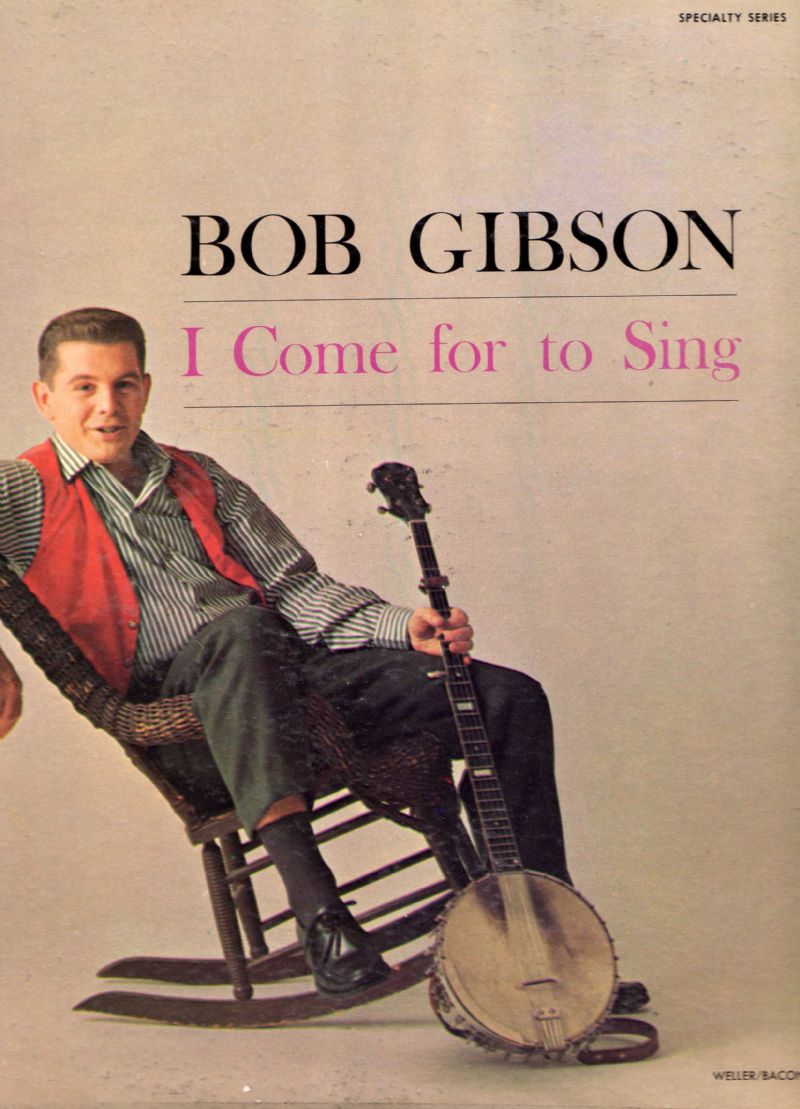
Mainejohn: Bob had a serious substance abuse problem (read his biography "I Come For to Sing", by Carole Bender). Had it not been for that, he quite likely would have risen to the fame his talent warranted. I've heard/read that the classic album "Gibson and Camp at The Gate of Horn" inspired and influenced the likes of Simon and Garfunkel, John Lennon, etc. Of all the albums I've ever owned, I have probably played that one more than any other.
Edited by - mainejohn on 01/17/2018 06:18:52
Joe Connor - Posted - 01/17/2018: 06:41:09
Here's Bob Gibson performing an autobiographical song about his career.
mainejohn - Posted - 01/17/2018: 13:17:41
Then there was Fleming Brown, a Chicago folk singer from "the era" playing what appears to be a 24 fret longneck (one short of the more common 25 fret version), perhaps fashioned after Pete's first longneck, which I recall also had 24 frets. Fleming did the artwork in Pete's red book. I bought this album in 1961 and still have it. It's pretty good. Oh...Fleming and I graduated from the same high school in Glen Ellyn, IL, but he was 17 years older than I (so what, they say!)
Edited by - mainejohn on 01/17/2018 13:21:57

Joe Connor - Posted - 01/17/2018: 19:38:45
John, that Fleming Brown album is on youtube. You're right; he is good. Thanks for the tip.
pastorharry - Posted - 01/19/2018: 10:37:24
quote:
Originally posted by mainejohnThen there was Fleming Brown, a Chicago folk singer from "the era" playing what appears to be a 24 fret longneck (one short of the more common 25 fret version), perhaps fashioned after Pete's first longneck, which I recall also had 24 frets. Fleming did the artwork in Pete's red book. I bought this album in 1961 and still have it. It's pretty good. Oh...Fleming and I graduated from the same high school in Glen Ellyn, IL, but he was 17 years older than I (so what, they say!)
If that cover didn't sell banjo....what could? The poor tortured soul of a man bemoaning his plight, the pretty girl looks on from behind with visions of helping him heal and nights by the fireplace listening to "A froggy went a courting", or some more family oriented folksong , as she knits stockings for their firstborn... LOL !
john bange - Posted - 01/27/2018: 08:11:29
quote: I've heard/read that the classic album "Gibson and Camp at The Gate of Horn" inspired and influenced the likes of Simon and Garfunkel, John Lennon, etc. Of all the albums I've ever owned, I have probably played that one more than any other.me too...wore out a couple of lp's...still listen to the dvd...machines ate my cassette and pulled all the tape out of my 8 track
Edited by - john bange on 01/27/2018 08:26:03
exvagabond - Posted - 01/30/2018: 05:34:33
quote:
Originally posted by pastorharryquote:
I liked the music, but hated the kitsch.However, if it weren't for the kitsch and commercialism, many of us would not have even heard of the 5-string until much later.
exvagabond - Posted - 01/30/2018: 06:07:10
quote:
Originally posted by arnie fleischerJoe, we need to add the great Paul Prestopino (Peter, Paul and Mary, and the Chad Mitchell Trio) as perhaps the ultimate example of the exception that proves the rule.
Amen to that! Very clean, tasteful playing. Whatever happened to Prestopino, anyway? I can't find any thing substantial or audible via Google or YouTube.
arnie fleischer - Posted - 01/30/2018: 08:11:26
A little over two years ago Paul was playing banjo, mandolin and Dobro with a New Jersey band called the Magnolia Street String Band. That's who I saw him with when they opened for Tony Trischka a couple of years ago. Apparently he's still with them. magnoliastreetstringband.com. Really nice guy.
pastorharry - Posted - 01/30/2018: 12:21:40
quote:
Originally posted by exvagabondquote:
Originally posted by pastorharryquote:
I liked the music, but hated the kitsch.However, if it weren't for the kitsch and commercialism, many of us would not have even heard of the 5-string until much later.
That is not my quote, it's someone else's and I answered it in a similar manner !
exvagabond - Posted - 01/31/2018: 11:32:13
Right you are, Pastorharry. I didn't read ahead before I shot off my mouth. I think the topic is still that the commercial folkie scare brought many of us to the 5-string. Around 1960, most people's source of music was commercial AM radio. Typically that was one big radio that the adults controlled, and maybe a little transistor portable for the kids. Not much banjo there and then, not even on smalltown country/western. I suppose a contemporary Billboard Top 40 would confirm that. Then the urban folk revival somehow became trendy, FM got a lot better, and we outlanders got 5-string.
gDGBD - Posted - 01/31/2018: 13:14:59
quote:
Originally posted by mikehalloranquote:
Originally posted by Joe ConnorDavid, the banjo player with the Limeliters is Alex Hassilev.
Playing the first Vega Xcel.
Alex is still alive having retired in 2006.
Obscure trivia: Hassilev had a small role in the film The Russians Are Coming, the Russians Are Coming, playing one of the Russian submarine crewmen. I believe he had a few lines speaking Russian.
tucsonsean - Posted - 02/26/2018: 09:43:00
I didn't realize this thread had four pages until today, so I'm a little late responding. But I will anyway.
First, it's ironic that Pete Seeger created the long neck to accommodate his vocal range in that he usually encouraged folks to sing in a range slightly higher than they considered normal. According to Pete, the extra effort to meet the higher range would force you to push more air and result in a stronger delivery.
Next, if you think rustic traditional is the only legitimate way to go, you should play gourd or cigar-box banjos. In the U.S.of A, commercial often is the tradition. The Carter Family didn't exactly hang out on their back porches making music. Nor did the Louvin Brothers, or many of the other traditional performers mentioned in this thread. Radio was the TV of their day, and they were happy to be heard there (and the sponsors were happy to be associated with them). TV was the medium of the 60's; where else would you expect the burgeoning interest in folk music to appear? I'm a proud, college-educated survivor of the Great Folk Scare. It was the beginning of a lifelong interest track that ultimately led to roots, old-time, and traditional music.
Finally, I came late to the appreciation of longneck banjos. (My first banjo was actually a 60's PS-5; shortly after buying it, I had Homer Ledford replace the neck on it with a standard neck--what did I know?) But I'm no longer just the banjo player in the band. I'm a musician that plays banjo, and the longneck banjo is the most versatile type I've found.. I can play a pretty faithful version of Hartford's "Girl I Left Behind Me" in Emaj., without paying Deering a couple of thousand for that growling sound. I can easily back up any serious vocalist in any key with just a couple of tunings. And I can capo up to the third or fifth fret and jam old-time all night. (BTW, my longneck of choice is a 60's Christy that I recently got from a member here, Paul Blumentritt (ShoptheFolk)).
Terms of Use | Privacy Policy | Privacy Consent (EU/GDPR Only)
Copyright 2026 Banjo Hangout. All Rights Reserved.