
DVD-quality lessons (including tabs/sheet music) available for immediate viewing on any device.
Take your playing to the next level with the help of a local or online banjo teacher.
Weekly newsletter includes free lessons, favorite member content, banjo news and more.
Premier Sponsors


|
Please note this is an archived topic, so it is locked and unable to be replied to. You may, however, start a new topic and refer to this topic with a link: http://www.banjohangout.org/archive/334989
Ken LeVan - Posted - 09/24/2017: 18:16:20
I have been making banjo necks for 55 years, and I’m always trying to find the perfect shape and size.
Truth is, there is no such thing unless everyone had the same size hands and arms.
One thing I have noticed is that as the years have gone by, my necks have gotten a little wider, and my scales have gotten a little shorter.
Lots of people now want shorter scales, and in terms of human engineering, it has to do with reach and finger strength and mobility. So what about the neck?
The banjo neck comes in direct contact with your hands, and is in effect, a handle. This may sound counterintuitive, but in terms of tool handles, you need to have a certain thickness, and handles that are too thin are harder to grasp and you lose power. The less hand mobility we have, the more we need to have everyday tools with thicker and better designed handles. This goes for little kids and grownups alike. It’s easier to grab a hot pot from the stove if the handle is thicker than if it’s thinner .
When I say "thin" it's confusing, because there are 2 dimensions - width and depth - thin to one person means narrow, to another it means "flat" or not deep. OR it can mean both.
When I first started making banjo necks, I was 18 years old, and thought they needed to be really thin. This was probably based on things I had heard “that’s a fast neck” etc. Recently, I got one of those old banjos I had made circa 1964 back (with a twice broken peghead) and it was embarrassing how thin (both domensions) I hade made it, but the person I made it for back then believes it’s the only neck he can play. Too bad for him, because I’m not going to make another one like that.
Anyway, I have a lot of neck profile templates- every time I get an interesting neck in the shop or make a custom banjo for someone who specifies a certain kind of profile, I make templates and save them.
You can make a template of a banjo neck by using a finger gauge and tracing it:
Here’s a template Bill Porter has that Gibson used to make their early profiles:
Here’s a bunch of my neck templates:
Taking familiar ones, here are the neck profiles from old Gibsons, the Vega Pete Seeger, and an ODE longneck.
note: in the case of the two longnecks, the frets are the ones like a regular banjo, as if you had the longneck capoed at the third fret.In other words, the one I call “1” is actually the third fret on the longneck, but the nominal first fret on a regular banjo.etc etc.
You can see a lot of irregularity in the ODE neck - this, I believe, is the result of the “Peruvian mahogany”they were smoking in Boulder in the 60s.
ODE had a reputation for thin necks, but you can see here it’s actually the deepest of the three, and narrow in the middle, past the 5th fret.,so by "thin"they meant narrow The Gibson is the thinnest in both dimensions.
This reiterates the point that there are thin necks and narrow necks. Sometimes they are both, but you can have a very flat neck that’s also wide. It doesn’t necessarily follow that if it’s thin (flat) it has to also be narrow.
I think when we say “thin neck” we may be talking narrow like the ODE, not necessarily thin depth-wise.
Width-wise, I always make necks just a hair under 2”where they join the pot, and use Crowe spacing on the bridge, but some people like them narrower than that.
Dan Drabek, a builder on this forum prefers really thin (depth-wise) necks and has devised a special reinforcement method because the two-way truss rods take up too much vertical space in the neck.
Here are those three original profiles along with some of the ones I use. Some of mine are overtly ergonomic, but I strive to make them comfortable and fit the hand- I make one that’s asymmetrical like some Japanese knife handles.
I once made a neck for a champion powerlifter, which was very large - the largest profile I have ever made, and he just loved it- he was not a guy with small hands, and did not like thin necks.
I also made a banjo for a woman who wanted a comfortable neck and complained that the one she had,which was made by a well-known builder was built for “guys with big paws”. I made a special profile for her, and it’s one of my two favorite “go-tos” to this day.
SO, Here’s my question - what are the best working neck designs others have used?
I have observed a trend towards wider necks - does that go along with short scales?
Do people with limited finger and hand mobility realize that a more ergonomic neck design can help them?
Dimensionally, what’s the modern-day happy medium? If I’m making a custom banjo for someone, I just do what they want, but If I am making something more standardized, I have to hit a happy medium.
Edited by - Ken LeVan on 09/24/2017 18:20:29
rmcdow - Posted - 09/24/2017: 18:53:45
Hi Ken,
I am shaping my first batch of necks right now, so this is a very relevant question to me at this time. I've thought a lot about the ergonomics of this (for the past two years, actually, before starting to shape the various necks I've glued up). What I've come up with may or may not be accurate, but it has been a starting point for me. When I cup my hand around the neck, the shape has to work so that I can bend the fingers at the third joint enough to fret the banjo strings. From the 5th fret to the nut this is relatively easy, but there are still things that I see can be considered there. The depth of the neck in that stretch of the neck can be deeper without running into the soft part of the hand between the thumb and finger, and if it is deeper, depending on the width of the neck at the nut, it is a bit more comfortable, as one can get a better grip on the neck, giving better control over the fingers when fretting. Above the 5th fret, things change a bit, as the fretboard is wider. There is still room for some depth in the neck up until about the 12th fret, again this depends on the width of the fretboard. Something else comes into play around that point that I think may lead people to make the asymmetrical neck contour, but I am not a good enough player at this point to figure that out well.
All this also depends on the length of your fingers, their flexibility, the size of your fingertips, and the spread between the base of your first finger and the base of your thumb. Throw a radiused fingerboard in there, and there are a lot of variables. Right now I am just going by the feel of the neck, and trying to rasp and sand a few necks to where they feel good all the way up. Then I'll take a look at the profile of them, and possibly be able to figure out why they work.
Chuck has relatively small hands, for a man, and I can understand why he may have designed narrower necks, in the width dimension. This seems to be the dimension that makes a lot of difference, as when the neck is too wide, there is a bit of awkwardness that can come in around the third joint of the finger, at least in my limited experience.
I'm going to print the profiles you have above and compare them to what I am seeing. I have medium size hands, and those profiles may help me figure out where I am headed. I'm making a couple of radiused fingerboard necks also, and will let you know how that affects the comfort of the neck. Thanks for posting this; I am really interested in seeing what others say about this. I started with Rudy's profile sheet, and am heading off from there.
Jonnycake White - Posted - 09/24/2017: 19:13:54
I haven't really given a ton of thought to this but I've been making mine a bit wider and a bit thinner as the years go by. I increased the spacing between the strings slightly (probably a 32nd of an inch more) and also increased the margins (distance between the 1st and 4th or 5th string to the edge of the neck) each by 1/32 to get from 3/32 to 1/8. My final string spread is 1 1/16 " at the nut, 1 15/32 at the 5th fret, and 1 3/4 at the bridge, for a standard scale length of 26 to 26 3/8". For shorter scale lengths (23 to 24 inches) I make the neck as wide at the nut as it would be at the 2nd fret (string spacing 1 3/32) of a standard neck. Add 1/4 inch to the string spacing measurements for the neck widths.
As far as depth, I have settled on about 13/16" between the nut and 1st fret and about 15/16" at the 12th fret from the top of the fretboard to the back of the neck.
I recently played, for a day, an older banjo I made with a narrower but deeper neck. It wasn't uncomfortable, but I did notice the 1st string slipping off the board a little too much while doing pull-offs, and some difficulty in forming chords cleanly because of the narrower string spacing.
You are a much deeper thinker and more highly skilled builder than I, but since you asked for opinions, that's mine. It is worth as much as it cost you to get it.
Edited by - Jonnycake White on 09/24/2017 19:16:57
rudy - Posted - 09/24/2017: 19:43:03
Ken's topic partial quote:
"SO, Here’s my question - what are the best working neck designs others have used?
I have observed a trend towards wider necks - does that go along with short scales?
Do people with limited finger and hand mobility realize that a more ergonomic neck design can help them?
Dimensionally, what’s the modern-day happy medium? If I’m making a custom banjo for someone, I just do what they want, but If I am making something more standardized, I have to hit a happy medium."
**********************************************************************************
Well, here's my thoughts, for what they may be worth.
- what are the best working neck designs others have used?
My "best" working neck designs are based upon ergonomics and focus around the tunneled fifth, 1-5/16" nut width, 2" heel width, and a relatively thin profile, most generally what could be considered a C profile. It works for me, but obviously there are some folks who want that big ol' lump on the side of the neck. That's not what I personally believe in, and I'm not building that type of neck. Life's too short to make banjos I don't personally find satisfying.
I've played around a bit with off-center designs and a few different profiles, but IMHO all that isn't of much account. I've never found the minutia of profiles to be worth the effort it takes to make them. The bottom line is a uniform C shape, taking care not to make the sides of the C overly thick. You do have to consider that the over all thickness and taper matches the width and profile. If a builder can refine their work methods to produce a comfortable neck, the chances are great that uniformity within "your characteristic design" will follow.
I have observed a trend towards wider necks - does that go along with short scales?
I believe the reason you see wider necks and shorter scales as a hand-in-hand design progression is that the purchasing public has come to the realization that there's no particular reason why anyone needs to sacrifice comfort to be a banjo player. That same logic extends to a few other areas of banjo design, too. That's obviously in combination to the small shop makers who have been more than willing to accommodate some of these ideas. With wider necks and shorter scales you can consider this to be the old "How you gonna keep 'em down on the farm..." logic. Most of the players I've run across like all the touches I've worked into my designs after a few short minutes of play.
I've got one friend that had me make a tunneled fifth replacement neck for a Vega that had just over a 1" nut width. He asked me why anyone would produce a banjo with that nut width and I honestly didn't have an answer for him.
Do people with limited finger and hand mobility realize that a more ergonomic neck design can help them?
Yes, and I believe almost anyone, with or without mobility issues, usually finds that "modern" designs are easier to play, and that's a big factor in selecting an instrument.
Dimensionally, what’s the modern-day happy medium?
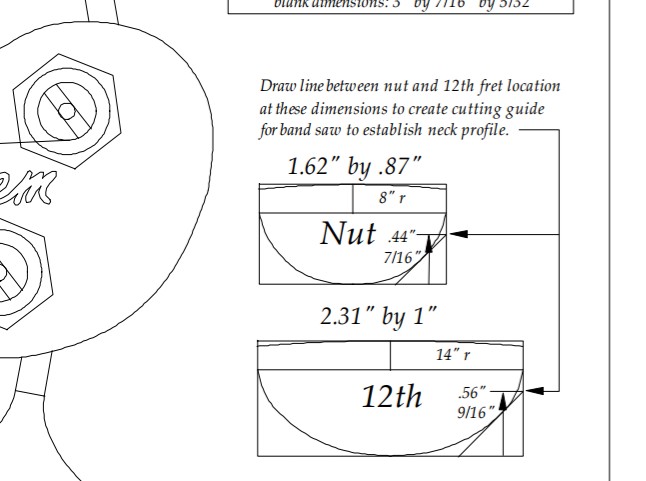
Mine are what is listed above in my first answer. I have a method of marking out two lines at each side of my neck blank that end up producing a tangent to the radius profile when they are used as guides to band sawing the basic shape. Blending in the remaining facets by rasp allow me to do an expedient job of producing a profile that meets my expectations.
In actuality, the longer I build the more I enjoy neck shaping by hand. In that regard, in one of the interviews done by Jason Romero he stated that the most enjoyable part of making a banjo was the 20 minutes he spends rasping and refining the neck profile. That was somewhere around 200 banjos produced by him at that time.
Too many times it seems like someone who wants to get into guitar, banjo, or other type of fretted instrument building gets hung up on some mechanical method of carving necks. It's really refreshing to hear someone say they get so much enjoyment from hand carving necks.
Those types of pursuits always remind me of hearing a preacher once tell someone, "Don't be so heavenly minded that you end up being no earthly good". I thought at the time what good advice that was, no matter what your goal in life might be.
That's my story, and as the old adage says, I'm sticking to it.
Dan Drabek - Posted - 09/24/2017: 19:51:38
Hi Ken,
Great stuff. I don't don't work to templates on my necks, but go mainly by feel. Generally speaking, my necks have gotten wider and thinner over time. The feel is more like an electric guitar neck as opposed to a steel string guitar neck. One of the reasons I like thin necks is because I play with the ball of my thumb on the back of the neck. The thinner neck allows me to fret more easily with the ends of my fingers coming straight in towards the neck. I never actually "grab" the neck, even when fretting the fifth string. The back of my necks are a flattened oval, which is also suited to the way I fret the banjo. Thick necks, and necks with a gothic arch on the back, are rather harder for me to play.
I just took measurements off one of my bluegrass necks and the thickness at frets 1/6/12 are: .80"/ .815/ .83 ( close to the same thickness all the way up the neck. )
The width on the same frets is 1.27"/1.68"/1.82" Overall, just a hair wider than the Gibson, and quite a bit thinner.
That's for bluegrass. I go just a little thicker on my frailing necks.
Thanks for taking the time to post this. It's good information and interesting to compare to what I'm used to playing.
DD
rudy - Posted - 09/24/2017: 20:13:39
Since there didn't seem to be any "edit time" for my posting, here's an example of the CAD drawing layout for producing two guide lines at each side of the neck that result in a cut that is tangent to the neck profile. After the cut is made it's fairly easy to make a quick and consistant neck profile.
All this related to the idea of producing profiles in a uniform and rapid way.
(This is a screen shot from the free CAD drawing I provided for the 30" semi-acoustic lined fretless bass for the Talkbass website.)
Mirwa - Posted - 09/25/2017: 00:58:01
Amazing how asymmetrical the ones you traced are.
i regularly draw necks up in cad, I think if I was to try and reproduce a Gibson one, I would make it symmetrical on the cnc and then carve to comfort knowing where he discrepancys exist
Great post
Steve
Gerrit - Posted - 09/25/2017: 03:05:57
quote:
Originally posted by MirwaAmazing how asymmetrical the ones you traced are.
i regularly draw necks up in cad, I think if I was to try and reproduce a Gibson one, I would make it symmetrical on the cnc and then carve to comfort knowing where he discrepancys exist
Great post
Steve
Yes, your hand is not symmetrical! So why should the neck be symmetrical?
I had a very thin and narrow neck, and some "thumb pain"
I tried this shape:

Easier support for the thumb. Besides, it makes the attachment of the 5th-string peg easier.
And, a rather wide neck, same thickness over the whole length.
It helped, hardly any thumb pain!
Note: this design was also inspired be one of Ken Levan's designs: the Eclectic Banjo (if I remember well)
Ken LeVan - Posted - 09/25/2017: 05:51:10
Here are some pictures of the asymmetrical neck profile,which looks odd,but is very comfortable.

The first time I did it, I did it backwards, and that didn't work at all. This is a thing that has to be felt with your hand.
This is done on some Japanese knife handles and Finnish ones designed by Tapio Wirkkaka. My wife has a left-handed Japanese cooking knife which works very well. It's really a sensible approach.

When someone wants to explore something unusual, for example the powerlifter who wanted a very large profile, I will make a "maquette" and send it to them so they can make sure that's what they want. If a picture is worth a thousand words,a 3-D model is worth a thousand pictures.

I'm not surprised at all to learn that Jason Romero's favorite building operation is the 20 minutes or so shaping the neck with files and rasps. That's my favorite as well, and I just did 4 in a row yesterday, which is what made me think so much about all this stuff. I don't see the joy in making a bunch of necks with a computer operated router. There's certainly no art or craft in that - just "business".
I think my second favorite thing is the design process, and after that, it's the metal parts, particularly the tension nuts. My least favorite part is tweaking neck setups while the banjo is strung and having to remove the neck while the strings are still attached to the peghead and tailpiece.Sometimes I do that 3 or 4 times to get the action where I want it to be.
It's 8:53 AM - I have to go to work making bracket bands and tone rings.
Edited by - Ken LeVan on 09/25/2017 05:53:32
rudy - Posted - 09/25/2017: 06:26:57
Partial Ken Quote:
"My least favorite part is tweaking neck setups while the banjo is strung and having to remove the neck while the strings are still attached to the peghead and tailpiece.Sometimes I do that 3 or 4 times to get the action where I want it to be."
I'm in total agreement with that, and it's why I focused my design ideas to elimination of that particular PITA aspect of building. Since I've been doing the "backstep" neck designs it's no longer a problem. Simply loosening the neck attachment nut allows me to set the neck angle to anything I like, without the need to lower the string tension. I'm as close to having an ultimate banjo design as I've ever been, but I'm obviously always on the lookout for any improvement I can make.
It's also most liberating (in my case) to arrive at a profile that I personally am comfortable with regardless of scale or neck length. I dislike all that fiddly profile stuff even more than heel refinement to get neck angle where I want it.
Ken LeVan - Posted - 09/25/2017: 09:34:48
quote:
Originally posted by FathandKen,
Do the neck profiles you show include the fingerboard?
Yes,they do.
This is because, the way I build necks the fully finished, fretted, bound, etc. fingerboard is glued to the neck before shaping, so I shape and sand right down to the binding. I usually make the binding a little too thick because I sand some of it off.
In the pictures below, you can see the template being used to gauge the fully assembled neck (and it still has about 1/4" more to go).

Edited by - Ken LeVan on 09/25/2017 09:35:50
Fathand - Posted - 09/25/2017: 10:25:34
quote:
Originally posted by Ken LeVanquote:
Originally posted by FathandKen,
Do the neck profiles you show include the fingerboard?Yes,they do.
This is because, the way I build necks the fully finished, fretted, bound, etc. fingerboard is glued to the neck before shaping, so I shape and sand right down to the binding. I usually make the binding a little too thick because I sand some of it off.
In the pictures below, you can see the template being used to gauge the fully assembled neck (and it still has about 1/4" more to go).
Thanks Ken
monstertone - Posted - 09/25/2017: 15:16:56
Damn, meant to edit & hit the delete button by mistake. To make a long story short, from wide, narrow, thick, thin, round, flat contour, flat bar reinforced, single, double action adjustable truss rods, flat & radiused fret boards, the most comfortable necks I have ever played on were slightly wider all the way down, radically thinner, not what I would call flat, but a very shallow contour on the back side, & a radiused fret board.
I play with an open left hand, off the ball of the thumb rather than the palm. I reach over, most of the time to fret the 5th string.
Off topic. That aside, I am kind of old school. I like three piece book matched necks, ebony fret boards & fiddle shape peg heads over a thin layer of white holly. And I prefer wood over celluloid binding, that very thin layer of white holly appearing as a white stripe below the neck binding. File a slight chamfer on the peg head & that white holly appears to be a very finely bound peg head. Abalone inlays & position markers. Can you even get Abalone anymore? 
Even though not a builder, I find this topic fascinating. Thank you all for your input.
Edited by - monstertone on 09/25/2017 15:30:03
Terms of Use | Privacy Policy | Privacy Consent (EU/GDPR Only)
Copyright 2026 Banjo Hangout. All Rights Reserved.


