DVD-quality lessons (including tabs/sheet music) available for immediate viewing on any device.
Take your playing to the next level with the help of a local or online banjo teacher.
Weekly newsletter includes free lessons, favorite member content, banjo news and more.
Premier Sponsors


|
Please note this is an archived topic, so it is locked and unable to be replied to. You may, however, start a new topic and refer to this topic with a link: http://www.banjohangout.org/archive/329839
RickNC - Posted - 04/14/2017: 11:40:34
I'm interested in learning about reading and writing clawhammer banjo tab. I see lots of information online about tab, but not a lot specifically about clawhammer tab.
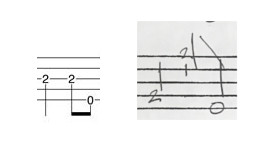
Take a look at the image I attached. On the left side is some tab I found online. The (handwritten) tab on the right side is from my banjo teacher.
It looks like the computer-generated tab is drawn from the middle down, and the handwritten tab goes from the middle up. By that, I mean the line that ties the 2nd and 3rd beat is at the bottom in the computer-generated tab but it's at the top in the handwritten tab. Do they mean the same thing? Can it be done either way?
Is this all explained in a book or online somewhere?
Edited by - RickNC on 04/14/2017 11:45:15
thisoldman - Posted - 04/14/2017: 12:07:59
short answer: No it doesn't matter whether the line is up or down. The timing of how the notes are played is the same, for example, a quarter note followed by 2 1/8th notes. Long answer: the examples are played differently, as the 2nd "note" in the handwritten example asks you to sound the 1st and 2nd strings at the same time. Plus on the printed computer tab has you playing the 2nd note on the 3rd string, 2nd fret (A) , and on the handwritten tab you are playing on the 1st (2nd fret) (E) and 2nd string (1st fret) (C) at the same time. At least that's how I read them. Then there is the first note in the measures, 2nd fret on the 3rd string (G) on the printed tab, and 2nd fret on the 4th string (D) on the handwritten one.
Edited by - thisoldman on 04/14/2017 12:12:28
WayneConrad - Posted - 04/14/2017: 13:36:56
That's the first time I've seen tab with the lines going up. That doesn't mean it's wrong. It just means that it's unusual, or at least it's unusual now. Once upon a time, as I understand it, there was more variation in how tab was written.
Edited by - WayneConrad on 04/14/2017 13:37:12
notbob - Posted - 04/14/2017: 13:51:40
RickNC,
Ima geezer of almost 70 yrs old and I've jes started learning banjo. I seem to be leaning toward clawhammer, also, despite my banjo having a resonator. Here's a link to the easiest clawhammer tab I've seen, to date.
nativeground.com/whiskey-before-breakfast/
It's from the same Wayne Erbsen book I recently purchased. Wayne's "clawhammer" tabs are the easiest I've found. I MAY buy his original book, as he has the simplest instructions I've yet to run across. I've already learned 3 songs from this one book. ;)
AndrewD - Posted - 04/14/2017: 13:54:11
Unlike notation there is no standard for tab - so there's no book. Some write it with sticks going up, some with sticks going dow. Means the same thing. Some have numbers on the line and some on the spaces. There is also no standard for indicating note length. Tabledit tab tries to mimic standard notation and gas sticks going down and that has become a common convention.
rowdyboy - Posted - 04/14/2017: 14:33:29
If you haven't already heard of him- a player/teacher named Josh Turknett- has taken it on himself to present videos and tabs of a large number of clawhammer tunes. His Brainjo pages not only have terrific tabs but he also has instructions on how to read the tab. In my mind he is a real banjo hero. Every week he presents another tune in both video and tab form. If you sign on to his site, you'll get a new one every week. I've learned a lot from him and I like I'm sure , many others, am very grateful.
Clawdan - Posted - 04/14/2017: 17:40:32
Not a simple gig. Tabledit and Tabwrite have been the two mainstays and both are pretty limited. Once I started writing tab for Mel Bay I ended up using Finale' which is quite powerful. A bit costly and can be a steep learning curve but well worth it. I've spent years developing my tab style and that is more of the issue than what is tab. Feel free to email me or pm me off list.
Play Nice,
Dan "Clawdan" Levenson
Clawdan.com
Author of Clawhammer Banjo From Scratch and 13 other titles on Mel Bay Publications.
R.D. Lunceford - Posted - 04/14/2017: 21:04:50
Suggestion:
Use the first example rather than the handwritten one.
Numbers on the line,
stems going down,
crossbeams beneath the staff and parallel to the bottom line.
Right-hand indications beneath the note, including left-hand technique, fingering as far which left-hand fingering to use, above the note.
For everything else use the standards of musical notation.
Edited by - R.D. Lunceford on 04/14/2017 21:07:55
Mooooo - Posted - 04/15/2017: 00:36:08
It doesn't matter as long as you can understand which notes to play and for how long to play them. There is an art to writing out music in standard notation that is really beautiful. Check some out
Edited by - Mooooo on 04/15/2017 00:39:40
ptgolfer - Posted - 04/17/2017: 04:36:09
I started playing my banjo about a year ago. I started with clawhammer, then switched to bluegrass 3 finger style. I found that playing clawhammer is what I want to do. So I recently switched back and I started writing out my own tab for songs that were in G and to difficult for me so, I made it simpler. If I found a song that I liked in a key other than G, I entered the song in the "original" key then highlighted the whole song and hit transpose and it would change the music and chords to G or the key of my choice.
My tool is Musecore, a free download on the internet. It works on both windows and mac computers musescore.org/en/download
There is a learning curve, as with all software, but once I set it up and became comfortable with the tools it became easy and I could do a song quickly. When the song was complete I save it as a Musecore file or save as a pdf. Some songs I use the piano part and just below it the banjo tablature, other songs just the banjo tablature part. I enter the song via the mouse or piano icon. I prefer the piano icon, as I played a piano in elementary school. It is easy to add chords above the line and lyrics below the line.
See the attachment. I included both piano and banjo tablature as a sample
This software works well for me, maybe it will for you.
Jerry
trapdoor2 - Posted - 04/17/2017: 08:00:13
quote:
Originally posted by RickNC
I'm interested in learning about reading and writing clawhammer banjo tab. I see lots of information online about tab, but not a lot specifically about clawhammer tab.
Take a look at the image I attached. On the left side is some tab I found online. The (handwritten) tab on the right side is from my banjo teacher.
It looks like the computer-generated tab is drawn from the middle down, and the handwritten tab goes from the middle up. By that, I mean the line that ties the 2nd and 3rd beat is at the bottom in the computer-generated tab but it's at the top in the handwritten tab. Do they mean the same thing? Can it be done either way?
Is this all explained in a book or online somewhere?
en.wikipedia.org/wiki/Stem_(music)
TablEdit (popular computer sofware for TAB) allows the user to set the stem default break point (where the stem will reverse from up to down or vice-versa) it is preset at B (the middle line of the staff). I have found that most TAB readers prefer to have all the stems "down". Part of that is simply that one gets used to looking below the staff (the horizontal lines) for note value (the flags). However, some of the special notations (like those for a pull-off or hammer-on) are usually better to have above the staff.
As most of the responder have said, it basically makes no difference...except to folks who care about such stuff (notational geeks like me).
notbob - Posted - 04/18/2017: 09:35:50
quote:
Originally posted by ptgolfer
So I recently switched back and I started writing out my own tab for songs that were in G and to difficult for me so......
The 2nd Wayne Erbsone clawhammer book has some great banjo jokes. I always loved the quote, allegedly by Stingbean, the famous Grand Ol' Opry clawhammer banjo star. He said: "There's only 2 chords on a banjo. G and Not G."
But, I know what you mean. I've learned enough that I can sometimes substitute a slide where someone else might use a hammer-on, etc. Basically, I've learned enough to make my own version, so when it comes around to me during a jam, I'll have my own unique version to play. Sometimes it's jes cuz I don't know enough to play it in some more complicated fashion.
I still have sooooo much to learn, though. ;)
Tobus - Posted - 04/18/2017: 10:32:33
Banjo players are one of the few groups who seem to prefer their tab by itself, without the accompanying notation above it. For this reason, I could see how it wouldn't matter whether the stems are up or down. But in tablature for other instruments, where the notation is above the tablature, I usually see it with the notation stems going up and the tablature stems going down. That way, they never interfere with each other or clog up the space between them.
R.D. Lunceford - Posted - 04/18/2017: 10:59:03
quote:
Originally posted by R.D. Lunceford
Suggestion:
Use the first example rather than the handwritten one.
Numbers on the line,
stems going down,
crossbeams beneath the staff and parallel to the bottom line.
Right-hand indications beneath the note, including left-hand technique, fingering as far which left-hand fingering to use, above the note.
For everything else use the standards of musical notation.
The key to tab (as with any other written medium) is that it is understandable and conveys what the writer is trying to get across. You could use letters instead of numbers, flags instead of beams, etc., etc.
The only reason I suggest the above (quote) method is because by consensus that seems to be what has percolated to the top over the years. This doesn't mean that you won't occasionally encounter other methods.
If you go back to books written pre--1980 you'll encounter some of these methods. Numbers in spaces, some stems up some down, measures not written to contain the proper amount of beats per the time signature, even some tab that does not indicate
the time values of the notes, and some with no right/left-hand indications. I think Ken Perlman was one of, if not the first to publish well-written tab that is self-explanatory and conforms to musical practice. That is basically the method I suggested above. If you're
looking to adopt a tab writing method, that is the one I'd recommend. Any one converting from musical notation will instantly understand it, and a tab reader of that method will have a much easier time learning musical notation.
Terms of Use | Privacy Policy | Privacy Consent (EU/GDPR Only)
Copyright 2026 Banjo Hangout. All Rights Reserved.