
DVD-quality lessons (including tabs/sheet music) available for immediate viewing on any device.
Take your playing to the next level with the help of a local or online banjo teacher.
Weekly newsletter includes free lessons, favorite member content, banjo news and more.
Premier Sponsors


|
Please note this is an archived topic, so it is locked and unable to be replied to. You may, however, start a new topic and refer to this topic with a link: http://www.banjohangout.org/archive/325798
easy - Posted - 12/20/2016: 14:04:41
Hello friends. I recently changed out the (presumably) zinc "L shaped" bracket shoes on my Gold Tone openback, replacing them with ball-type brass shoes from Rickard Banjo. While my motives were cosmetic in nature, I noticed a change in tone as well: brighter, harder attack with less sustain. This was a welcome change, as it is more the sound I've been looking for. While my first thought was that the change might be due to another adjustment that happened concurrently with the change in shoes (head tension, tailpiece angle, etc.), I've played with all these other variables before without being able to achieve this sound. So my questions are, has anyone else ever noticed anything like this before (the shoes effecting the banjo's sound), or does this even sound plausible to you (as I've never read or heard of the shoes playing a tone-producing role before)? Thanks,
Easy
rudy - Posted - 12/20/2016: 14:12:17
My guess is the change in sound is related to increased mass as presented by the Rickard brass shoes.
Dan Drabek - Posted - 12/20/2016: 14:33:56
I agree. Anything you add to the rim to increase the weight will tend to alter the sound much as you described, with the exception of sustain. In my experience, increased mass also results in increased sustain. However, stronger fundamentals and increased snap may also tend to overpower the sustain, or at least the perception of it. Hard to say for sure. The important thing is that you like the difference. Follow your ears.
DD
Ken LeVan - Posted - 12/20/2016: 16:23:21
All banjos are loud - I am not talking about volume per se. Increasing the mass of the pot can have an effect on the type of sound, and this can be done by:
(1) making the rim heavier by adding dimension or using a denser kind of wood or other material
(2) adding a metal tone ring on top of the rim
(3) adding mass to the center of the rim by heavier brackets or a bracket band
(4) a heavier tension hoop (normal ones are 3/16" x 9/16" but Vega used 5/8") the tension hoop becomes part of the tone ring to a large extent.
The old Vega tubaphone with a pot weight of 5.94#, has one of the greatest metal to wood ratios at 8.8:1, by using a skirted tone ring, a heavy 28 bracket bracket band, a 3/16" x 5/8" tension hoop and a very light, shallow rim. This produces the Tubaphone sound.The Whyte Laydie is similar.
A flathead Gibson Mastertone with a heavier 7.35# pot has a metal-to wood ratio of 6.7:1, putting most of the mass in the cast tone ring. The so-called "thin-rim" Mastertone rim reduces the mass of the wood and increases the ratio to almost 9:1 - similar to a tubaphone.
By contrast,a woodie with 24 bolted-through bracket shoes is 1.98:1 and a banjo with 24 bolted-through bracket shoes and a 1/4" brass tone ring is 2.35:1 This can be altered by the dimensions of the rim and number of shoes, hooks and nuts.
I am not suggesting that lightweight banjos don't sound good, just that they sound different, and there is probably a lower limit of rim weight, which I think is about 4.5# after which they can become "flighty" and hard to tune as opposed to "solid" - nebulous terms, I admit. As Dan says, follow your ears.
This is of course is all my own opinion based on my own observations, measurements of archetypal banjos, and the kind of banjo sound I like, so it's not to be interpreted as some kind of recommendation other than for me and may not apply to old-time banjos as much as bluegrass ones and jazz tenors.
As for sustain, I think adding weight to the neck adds more sustain than adding it to the pot, and longnecks, in my observation have more sustain.
easy - Posted - 01/08/2017: 07:44:11
Very interesting Ken, thank you (and to Dan and Rudy as well). So by this line of reasoning, a brass bracket band would have an even greater effect to this end (both by adding the metal band and routing out the wood that the band fits over)?
Ken LeVan - Posted - 01/08/2017: 08:23:36
quote:
Originally posted by easy
Very interesting Ken, thank you (and to Dan and Rudy as well). So by this line of reasoning, a brass bracket band would have an even greater effect to this end (both by adding the metal band and routing out the wood that the band fits over)?
Yes.
Helix - Posted - 01/10/2017: 00:31:02
I disagree that the bracket band is the soul producer, care should be taken not to make the bracket band have a wooden liner.
Lots of us get much the same result with all brass hardware, I tend to think of the whole banjo including the tension hoop/head/tone ring continuum, like it becomes one thing.
I jam often with various kinds of banjos, I get to know what to expect from different players, setups, and tonal limitations.
I know the feeling of what you describe, there is now meat with all those potatoes. I had a visitor the other day with a Deering Goodtime. The difference is very clear regardless of type of hardware.
I had a recent build where we used Rickard's smaller 5/8" spheres in nickel with nickel hooks and nuts, very clean, very nice, low carpal tunnel due to good dynamics.
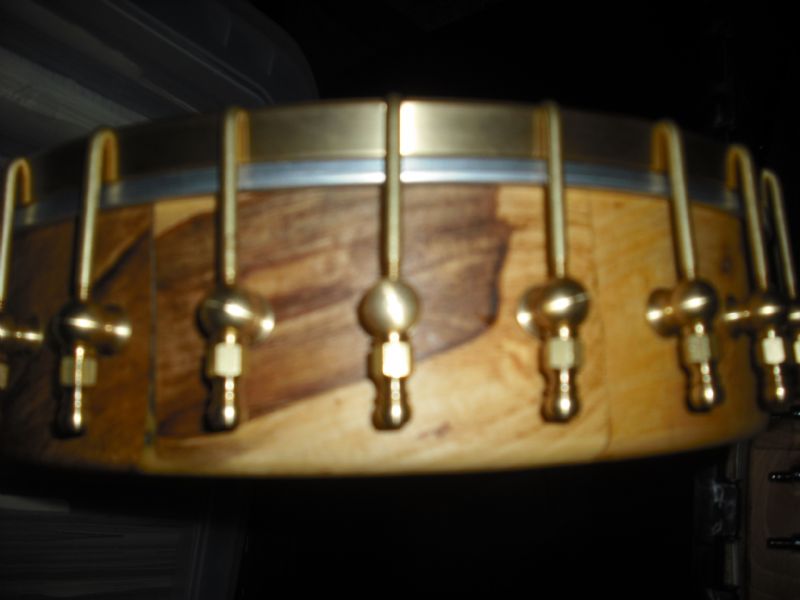
OldPappy - Posted - 01/10/2017: 08:01:39
Added mass is certainly the factor, and that can be shoes, tension hoop, tone ring, and the rim itself. The density of the wood in the neck, and the size (not the shape) of the peghead also have an impact.
I do not suggest this with the Gold Tone because the rim isn't thick enough, but one thing I have done to add mass to a thicker rim is to sink 1/4" X 1 1/2" brass rods into the rim between the shoes.
Another thing I have experimented with is the thickness of the truss I use for my tone rings. If I am looking for more "thump" I build with a 3/4" block rim and a 1/4" thick truss which adds a lot of mass. If I am after more response, and a bit more punch, I build with a 5/8" laminated rim and a 1/8" thick truss.
Edited by - OldPappy on 01/10/2017 08:03:35
OldPappy - Posted - 01/11/2017: 07:30:57
One of the tone rings I build consists of a tone ring rolled from 1/4" - 5/16 round brass rod sitting on another ring rolled from 5/8" X 1/4" (or 1/8") bar stock which has scallops ground into it so the hoop is supported on the points. This is the same idea as the WL tone ring, and others, just without a skirt.
The support ring is called a "truss".
OldPappy - Posted - 01/13/2017: 05:34:22
I have experimented with various tone ring designs, and this is the one I get the best result with.
I grind the scallops so that the points are 1/4".
Terms of Use | Privacy Policy | Privacy Consent (EU/GDPR Only)
Copyright 2026 Banjo Hangout. All Rights Reserved.


