DVD-quality lessons (including tabs/sheet music) available for immediate viewing on any device.
Take your playing to the next level with the help of a local or online banjo teacher.
Weekly newsletter includes free lessons, favorite member content, banjo news and more.
Premier Sponsors


|
Please note this is an archived topic, so it is locked and unable to be replied to. You may, however, start a new topic and refer to this topic with a link: http://www.banjohangout.org/archive/324400
Banjo Lefty - Posted - 11/07/2016: 00:43:01
Can anybody recommend a good source for very light gauge nylon strings? I need a first string and fifth string no thicker than .020. Most ukulele sets I've looked at (and bought) have strings starting at .023.
dhergert - Posted - 11/07/2016: 03:48:06
You can make your own set out of fishing line:
1st and 5th strings: 20 lb test Trilene XT (#XTVS20-22) .018" green line
2nd string: 30 lb test Trilene Big Game Supreme (BGSQ830-66) .023" steel gray line
3rd string: 40 lb test Trilene Big Game (BGQS40C-22) .024" green line
4th string: 50 lb test South Bend (M1450) .030" (approx) clear white line
I've also tested 30, 40, 50, 60, 30 pound test but I keep going back to the above strings for tone, volume and playability.
-- Don
csacwp - Posted - 11/07/2016: 05:52:40
The LaBella 17 sets have a .019 first and fifth, but I wouldn't call that "very" light. Historically banjoists were using .016-.017 firsts and fifths once nylon became available. To find gauges that small these days you have to order single lute strings.
Joel Hooks - Posted - 11/07/2016: 06:18:55
I'm not sure exactly when the trend in thicker nylon strings began. Historically, from about the mid 1880s to the wire era (about 1930), gut strings were much thinner than currently available banjo sets in nylon. I presume that is because modern banjoists are used to the non elastic nature of steel wire and are trying to get a similar tension from nylon, but I am not sure. I also could be that the sort scale banjos in fashion today.
It seems to me that many people have mistaken the small notches in nuts and bridges on pre 1930s banjo for having been cut for wire when they were actually cut for gut or silk strings. This has mislead people into thinking that wire was used earlier than it was.
LaBella's original set of nylon banjo strings were based on the historic gut sizes. They were called No. 17 for the size of the first and fifth. Because of the thick string trend they have made these thicker. Now the firsts are .019. Why they did not just keep the original set and add a new SKU of No. 19 I do not know.
Fishing line was the best option at one time. Just post WW2 Paul Cadwell started using it as soon as it hit the market for his firsts and fifths. The problem is that instrument strings are a different nylon-- developed for music not catching fish. They are also extruded to a much higher tolerance. Because fishing line tends to be uneven it notes false on fretted banjos (a problem I have also encountered with the polyester "Nylgut" strings).
I make up my sets from Strings By Mail. I buy LaBella lute singles. These are made of a very hard nylon and rectified, very good strings. The sizes I get are .017, .024W, .023, .019, .017. I always use wound fourths as did all banjoists from before the "Briggs' Banjo Instructor" of 1855 until it became folksy or cost cutting not to. The lute strings come in a lot of thicknesses so you should be able to make up any set you want.
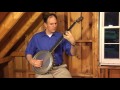
I'm playing on these string sizes in the below video.
Jonnycake White - Posted - 11/07/2016: 06:59:53
Wow Joel, that's incredible playing. And I never would have thought you could get such a bright sound from nylon strings. Of course the archtop tone ring doesn't hurt any either.
My experience with nylon strings is limited to strings made for guitar and cheap fishing line. Regarding the 4th string, I have gotten better results, both in tone balance and durability, from winding my 4ths from two strands of 50 lb. test, and my 3rds from two strands of 30 lb. test. I use single strands of 30 lb. for the 1st and 5th string, 50lb. for the second.
I also tried what I consider to be my best homemade set of nylon strings, where I wound them all from the "invisible thread" nylon monofilament. I think it was something like four strands for the 1st and 5th, 6 strands for the 2nd, 8 for the 3rd, and 12 for the 4th. I liked the tone and feel of these strings but they were a real pain to produce.
meritcooper - Posted - 11/07/2016: 07:10:38
I have a fishing line on one of mine and it has held up for years.
Brett - Posted - 11/07/2016: 07:45:55
I followed Don Hergerts' fishing line recommendations for my 12" Deering Americana that I put goat skin head on, and no knot tailpeice. Works good, except I might would go heavier on the 4th string weight in the future.
csacwp - Posted - 11/07/2016: 08:02:11
The only thing keep nylon strings from sounding bright are heavy, overbuilt modern bridges, thick modern heads, and the very short scale lengths some modern banjos have. Even without the archtop tone ring (or any tone ring at all) a historical setup will produce a bright tone.
banjered - Posted - 11/07/2016: 08:35:58
Thanks Joel! Great playing and great contributions to these nylon threads (bad pun). With appreciation! banjered
Joel Hooks - Posted - 11/07/2016: 15:27:32
Thanks!
FVE banjos are not archtop in the traditional form. There is a ring suspended by brackets that creates the raised head. It is a 12" rim with a 10" sounding surface. John is correct that any banjo can be set of for that clarity (within reason) with nylon and the proper bridge.
I have a 11 13/16" Tubaphone as well as a Eastman WL that are bright and clear too.
The thinner strings also give a crisper attack with no lost energy.
mb03557 - Posted - 11/07/2016: 17:09:11
Joel, WONDERFUL OLD TIME TONE! I first got interested in banjo as a child playing my grandparents Edison phonograph. I had to stand on a chair to reach it to put another record on or place the stylus. But I played every record they had to find the ones with banjo and put them all in the same place in the storage slots. Anyway...playing your video just now brought back such memories! Making some mental allowances for the acoustic nature of the Edison process your tone is dead on what is heard when I play these records (I inherited the Edison chipendale cabinet and a cylinder player as well).
I just ordered a couple of your brass thimbles to work on better tone from my c1890s L&H. I can't wait for them to arrive.
Thanks for the video.
Marc
Tom Berghan - Posted - 11/07/2016: 19:05:36
quote:
Originally posted by Banjo LeftyCan anybody recommend a good source for very light gauge nylon strings? I need a first string and fifth string no thicker than .020. Most ukulele sets I've looked at (and bought) have strings starting at .023.
Try these
elderly.com/aquila-6b-5-string...?___SID=U
Tom Berghan - Posted - 11/07/2016: 19:12:42
Addendum . . . and this PDF will help you. It lists the diameters of the various Aquila string sets
hangoutstorage.com/banjohangou...82013.pdf
Tom Berghan - Posted - 11/07/2016: 21:13:26
quote:
Originally posted by Banjo LeftyTom, thanks. That's exactly what I needed.
My pleasure Mr. Lefty. And by the way, the famous string maker Mimmo Peruffo . . . inventor of Nylgut, founder and CEO of Aquila Strings is a member of the Banjo Hangout . . . and a super nice guy. If you have specific questions you can contact him via his home page: banjohangout.org/myhangout/hom...p?id=6631
Mimmo is a pretty busy guy, but he tries to reply to questions in a timely manner.
I visited Mimmo's shop about six years ago, had fun visiting Mimmo and his family, and you might like to see some photos I took: Aquila Corde
Terms of Use | Privacy Policy | Privacy Consent (EU/GDPR Only)
Copyright 2026 Banjo Hangout. All Rights Reserved.