DVD-quality lessons (including tabs/sheet music) available for immediate viewing on any device.
Take your playing to the next level with the help of a local or online banjo teacher.
Weekly newsletter includes free lessons, favorite member content, banjo news and more.
Premier Sponsors


|
Please note this is an archived topic, so it is locked and unable to be replied to. You may, however, start a new topic and refer to this topic with a link: http://www.banjohangout.org/archive/321526
hman0217 - Posted - 08/10/2016: 17:38:21
Well here I am in this hot sticky new york weather with about five days of thunderstorms in the forecast. Sure enough, when I pulled out the banjo today, I got massive string buzz and, sure enough, the goat skin was down from a A# to a G# and I could both visibly see and fingerly feel the depression in the head. My first instinct was to just deal with it. But oh, it sounds crappy. My second instinct was to go grab the wrench and tighten the bad boy up. But there is this lingering fear in my head that I'll tighten it and a dry front will pass through and the dreaded KABOOM! will strike (ie my head exploding).
I was trying to comb through old topics to get a gauge of this and indeed some folks seem to advise against tightening and loosening the head in response to weather.
So then I was thinking about what I've read about the approach to tackhead banjos, which is that one would use a candle to "dry out" the head a bit. That way, it would take a little preparation but would then revert back to its natural tension once it's put away again and the head won't be at risk of being too tight ever.
What do you all think? Is tightening and loosening constantly a big deal or not? What about the candle-drying method? other suggestions? (I did also read about a fellow in one of these threads who keeps a humidifier in the banjo even when he's playing - opting for the constant moist approach over the constant dry approach, so to speak.
Interested to hear your thoughts!
revellfa - Posted - 08/10/2016: 18:27:09
Big pain. That's why top tensions were invented. Have you tried treating your head with wax paper and waterproofer?
hman0217 - Posted - 08/10/2016: 18:39:13
quote:
Originally posted by revellfa
Big pain. That's why top tensions were invented. Have you tried treating your head with wax paper and waterproofer?
No I haven't. I suppose I've been reluctant to use chemicals but it seems that a lot of players have used it and not noticed any adverse effects. So maybe that's the ticket.
Thanks
banjopickingman - Posted - 08/10/2016: 23:30:48
I would tighten it up, but not so much that it breaks when the weather changes. Find a happy medium that works in most weather conditions with some adjustments when needed.
Helix - Posted - 08/11/2016: 03:48:03
I hope this helps. Scotchguard would be a good friend, I have seen latex house paint in there, but it was more for overtone reduction.
Say we were street musicians in 1916, maybe Brooklyn, maybe New Orleans, spunover rim, 32 hooks, hardware of the day, maybe not Vega ballend nuts to keep the weather out and electrolysis at bay.
Those people were wrenching all the time.
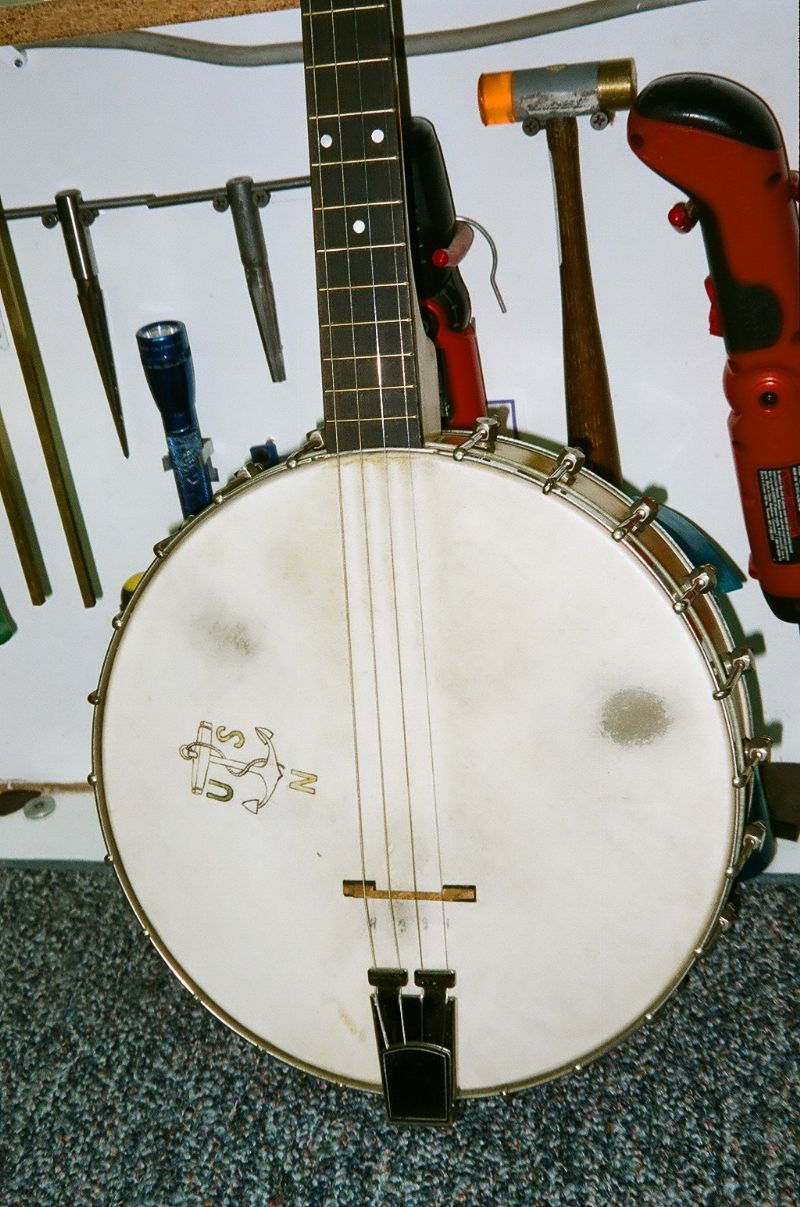
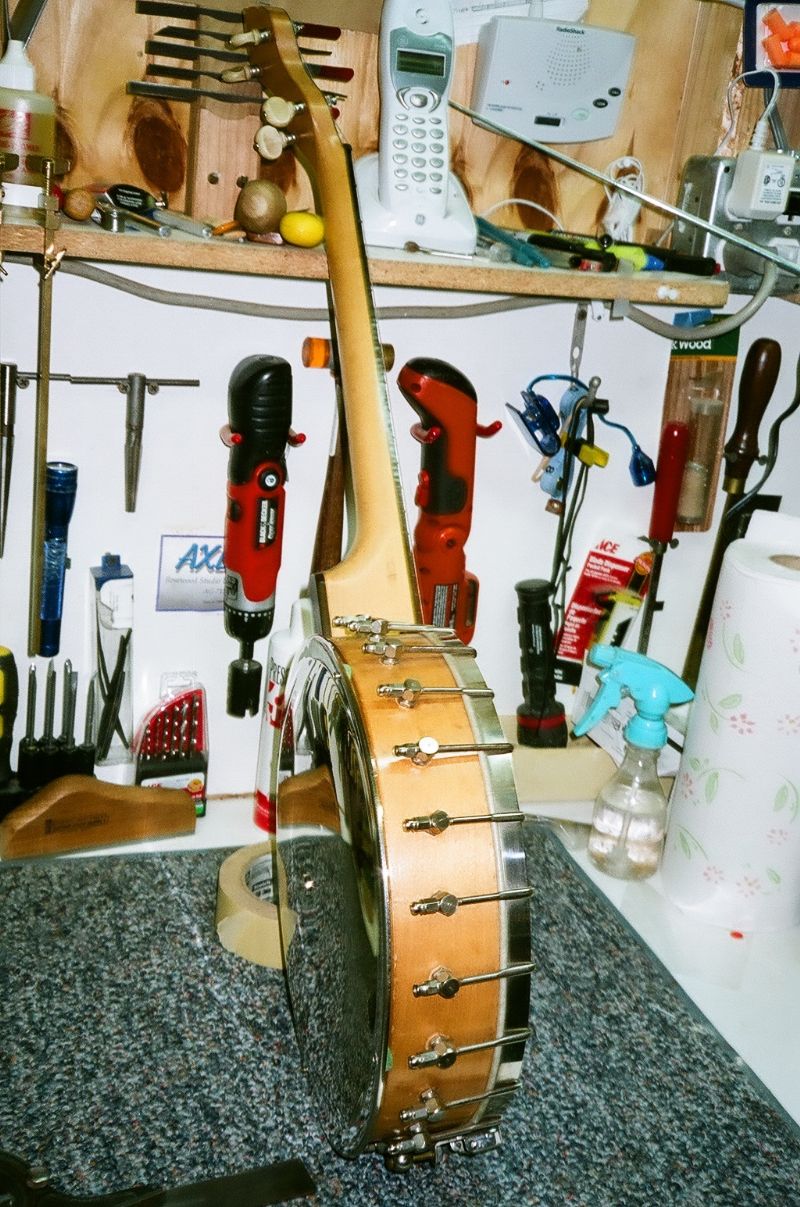
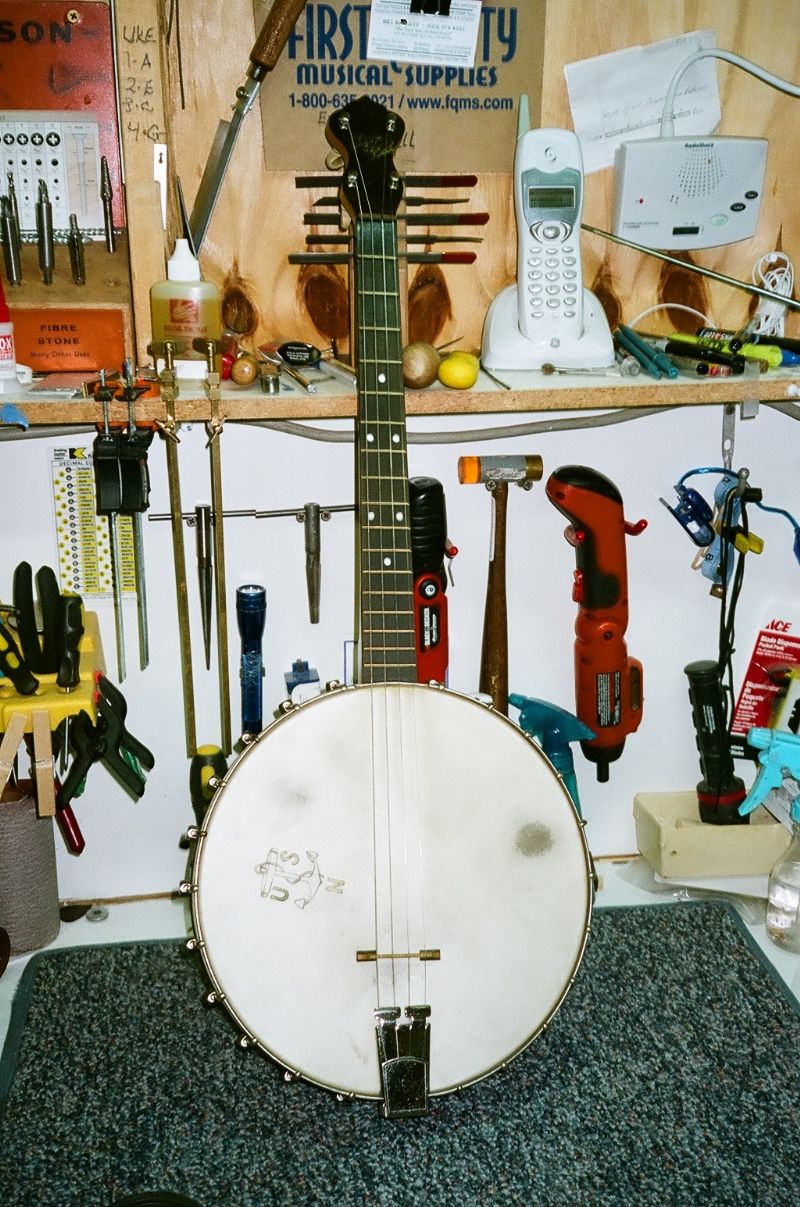
Here's a photo of a May Belle with a nickel rez, note the "tennis shoes" under the bridge, little ebony shoes for just such an occasion, pennies are known to work, popsicle sticks are quarter sawn lumber. but it's a buskers trick, who could afford to be off work with a broken head. This banjo was used aboard ship, so humidity was constantly changing, note the US Navy stamp from the quartermasters' desk.
Edited by - Helix on 08/11/2016 03:48:42
carlb - Posted - 08/11/2016: 03:52:03
I carry three bridges and use the one so that the strings don't buzz; 1/2", 5/8" and 11/16". I do not adjust the head tension. Two years ago, after having the head on for 10 years, at Clifftop it was so humid and cool that I had to tighten the head just a smidgen.
I feel that tightening and loosening the head by any means, either physical or heat, will shorten its life. It takes me about a minute to change a bridge. The tone will vary with the humidity but that doesn't bother me.
overhere - Posted - 08/11/2016: 04:27:26
I read somewhere where Earl used a light Bulb. I had a skin head back in the 50s and used the light bulb thing and it worked pretty good. Thank God for Mylar...
dculgan - Posted - 08/11/2016: 05:03:10
In my opinion, which is based on playing several large pot (12" +) minstrel style banjos outdoors in the summer at gigs on the humid east coast for over 20 years, external heat will only tighten a head up for so long. After a half hour or so the skin will have re-absorbed the abundant moisture from the air and again become loose. I keep the hooks / nuts lubricated and have waxed the top of the rim to make it easier for the head to move for frequent adjustments. You of course do have to make sure its not to tight when the weather dries out. Taller bridges yes, but in a performance setting you need a tight head for tone and volume. When its really bad I have had to dry the head artificially either by a flame source (campfire, small charcoal brazier) or a instrument stand with a built in electric spot light between sets, or sometimes songs. Placing the banjo in a bright sunny spot can also make it playable again. This is tough on a thin rim banjo with a minimal number of hooks and brackets but when you are being paid to perform the show has to go on so you have to do what you have to do. There isn't an easy solution.
The rate of moisture absorption can be slowed with treatments as mentioned, and likewise smaller diameter heads will have less surface area and so less of a change in head tension from a change in relative humidity. I also agree that as heads age they seem to stabilize a bit, perhaps the pores close up. At home I play a 10 3/4" Vega conversion and don't have much trouble with the head but I am usually playing indoors not out in the humid outdoors like we have right now in the mid-Atlantic region and if the tone is a little off, or the action becomes less than optimal its not a big deal.
Those early 20th century banjos with the built in electric lights show that this was something the professional players had to deal with too, I don't think they were there just for show and if I wasn't trying to provide a 19th century history informed performance I would have used them too. Dave
lucas73b - Posted - 08/11/2016: 05:21:04
I am afraid I can't be of much help, but I understand your problem: For weeks we have had unusually damp weather conditions over here in Amsterdam (over 80 percent humidity), and what makes it more difficult is that I have a brand new head which has not yet fully settled in. Anyway, I have the tension reasonably stable at a safe compromise, and I will leave it as is waiting patiently for the weather to change. Once the head has fully settled in, I expect that it will need adjustment only rarely.
I have no intention of swapping bridges or applying chemicals to the head. At most, I will raise the action a little just in case the bridge sinks in too much, too often in response to weather conditions.
Heating the head will work: I once saw drums (in the style of bodhrans) being kept in tune by regularly holding them over a campfire. Of course for a banjo a more subtle means would be in place.
Lucas
hman0217 - Posted - 08/11/2016: 07:12:29
thanks for the wonderful feedback as always. Seems like a coat of waterproofing and either different bridges or a shim are in my future, while only tightening sparingly, as absolutely necessary.
I should add that this is a medium-thickness goat skin head that I only put on in April, which makes it new-ish. So it also brings up the question of how much the slackening is the "setting in" of the head vs humidity absorption. Nonetheless, I'd rather deal with compensating for any setting in in a month or so when it's dryer, so I can separate the two different factors.
thanks.
Fathand - Posted - 08/11/2016: 07:31:15
Leatherwear shops often sell a water resisting aerosol sealer for leather coats and the like. I would be looking at this.
There was also the light bulb set up available once upon a time
 massresonator.com/wp-content/u...8x300.jpg 228w, massresonator.com/wp-content/u..._bulb.jpg 457w" title="banjo_whole_bulb" width="228" />
ClayTech - Posted - 08/11/2016: 11:01:16
A thin layer of any sort of liquid wax on both sides of the head will work wonders, and won't affect the sound. Just dry it out really well with a hair dryer before applying it. I did mine a few weeks ago and it held up great when playing it outside all day in high humidity.
hman0217 - Posted - 08/11/2016: 14:01:26
Just because it's somehow fun to make rocket science out of banjos... waterproofing, whether using the liquid wax or other products...Should this be done when the skin is moist, dry or somewhere in between? Or is that just a matter of tonal preference? I'm just wondering whether to get it nice and dry before I start.
rudy - Posted - 08/11/2016: 15:45:09
quote:
Originally posted by hman0217Just because it's somehow fun to make rocket science out of banjos... waterproofing, whether using the liquid wax or other products...Should this be done when the skin is moist, dry or somewhere in between? Or is that just a matter of tonal preference? I'm just wondering whether to get it nice and dry before I start.
There are lots of theories as to the "proper" way to install a head, but there's a lot to be said for experience, and Brooks Masten's technique for goatskin might be worth strong consideration, with no waterproofing used, or necessary. After installing hundreds of heads, you can see what he had to say brooksbanjos.com/index.php/babbling/">HERE. Scroll down to the area dealing with installing goatskin heads. The text is available here, but it's from the internet archive project so photos aren't displayed.
hman0217 - Posted - 08/11/2016: 20:05:56
quote:
Originally posted by rudy
quote:
Originally posted by hman0217Just because it's somehow fun to make rocket science out of banjos... waterproofing, whether using the liquid wax or other products...Should this be done when the skin is moist, dry or somewhere in between? Or is that just a matter of tonal preference? I'm just wondering whether to get it nice and dry before I start.
There are lots of theories as to the "proper" way to install a head, but there's a lot to be said for experience, and Brooks Masten's technique for goatskin might be worth strong consideration, with no waterproofing used, or necessary. After installing hundreds of heads, you can see what he had to say brooksbanjos.com/index.php/babbling/">HERE. Scroll down to the area dealing with installing goatskin heads. The text is available here, but it's from the internet archive project so photos aren't displayed.
See...I just like this because it is completely natural which, in addition to superior tone, draws me to skin heads in the first place. I do, however, think he might want to add one other warning: I don't claim personal expertise as a relative beginner but I read it elsewhere - Sudden exposure to cool dry AC coming in from the hot humid outdoors. For the moment though, it's not a concern for me as I am on the fan program and am not traveling to AC-cooled places to play. But if I were hypothetically one day performing and the venues were air-conditioned, I think I would be justified in my worry.
Again, thank you.
Helix - Posted - 08/12/2016: 02:32:26
Carlb: I would buy three bridges in a package, and I would like to spec. walnut, maple and cherry bridges with different heights, so a voice could be chosen.
I think that is the proper solution, working simple is hard.
Helix - Posted - 08/12/2016: 02:34:48
I personally wish to thank mankind for plastic,
But I reserve special thanks for the maker of the goat.
bartmcneil - Posted - 08/12/2016: 06:47:41
The tightness of a skin banjo head has been discussed many times on this site.
I use the adjustment method which says that when the skin head splits it is probably too tight.
I would not hesitate to experiment with head tightness on a skin head banjo in varying weather conditions. A banjo pot is very strong and if the head is tightened systematically and gradually then there is very little possibility of distorting the banjo pot. I have a number of skin head banjos and have never felt that I need to loosen the heads during dry weather. I will almost always fuss a little with the tightness or looseness of the the head when I pick it up to play.
An electric light bulb inside the pot of a skin head banjo was not uncommon in the early twentieth century banjo orchestras to help keep the skin head tight. It had the added advantage of lighting up the head of the banjo so that a band name or an image could be displayed to the public in a dance hall or theater.
Edited by - bartmcneil on 08/12/2016 07:01:45
Ira Gitlin - Posted - 08/12/2016: 09:46:00
My beat-up Salvation Army Gibson style 11 has a hole drilled in the resonator wall, and a corresponding hole in the shell. I'm pretty sure that was done to accommodate the cord from a light bulb. (Why the owner couldn't have simply run the cord out through the flange cutouts is one of the many mysteries connected with that banjo.)
TOMCAT - Posted - 08/12/2016: 12:51:48
This might be a stupid question, but is there a better time to put on a new hide head? Such as say a humid day as opposed to a dry day, or does it matter?
hman0217 - Posted - 08/12/2016: 18:32:36
quote:
Originally posted by TOMCAT
This might be a stupid question, but is there a better time to put on a new hide head? Such as say a humid day as opposed to a dry day, or does it matter?
Just my novice opinion but probably not. You're wetting the head completely so any moisture in the air is probably negligible.
bartmcneil - Posted - 08/12/2016: 18:51:17
quote:
Originally posted by TOMCAT
This might be a stupid question, but is there a better time to put on a new hide head? Such as say a humid day as opposed to a dry day, or does it matter?
You are thinking too much! Not a good idea for a banjo player.
Tom Berghan - Posted - 08/13/2016: 10:45:50
READ THIS
In my experience . . . which is pretty detailed . . . no treatment prevents a hide head from reacting to humidity and temperature changes. They help a little . . . but not much. Playing around the house is one thing . . . or in any air conditioned environment . . . that's not a big problem. But if you want to go from inside to outside and back again then you absolutely are going to have to get quick and accurate with your drum key. And this may even mean you sit our for a song in a performance and quickly tighten the head.
It is not just humidity . . . it is temperature as well. If you find yourself sitting in the sunshine and the sun is beating down on that hide head it will expand a little. It doesn't take much to put you out of tune. You can tune . . . start a song . . . and by the end of the song, you need to tune again. So, get thee to some shade if you can.
And then when you go back inside keep an eye on the tension. The head will tighten with cooler temps and less humidity and if it gets too tight it will rip. And even if you just play around the house, pay attention as the seasons change.
Be very careful with light bulbs, heating pads and hair dryers. These devices will absolutely work but be very careful because the hide will react quickly and if you go too tight you're gonna pop it!
What did they do in the old days? They used their drum keys (hex wrench). And as has been mentioned this was (and is) the reason that top tension hoops are desirable because you do not have to remove the resonator and you can get the job done faster.
BOTTOM LINE: Get quick and accurate with your hex wrench (drum key). Then you'll be fine.
Edited by - Tom Berghan on 08/13/2016 10:46:39
TOMCAT - Posted - 08/13/2016: 15:56:15
Well I'm off Monday with nothing to do but banjer tinker, and I'll install my new J Balch hide head. Looking forward to it.
Tom Berghan - Posted - 08/13/2016: 18:33:19
quote:
Originally posted by TOMCAT
Well I'm off Monday with nothing to do but banjer tinker, and I'll install my new J Balch hide head. Looking forward to it.
Those are the best. John personally selects and sorts the hides and expertly mounts them to the flesh hoop.
jbalch - Posted - 08/14/2016: 06:34:48
quote:
Originally posted by TOMCAT
Well I'm off Monday with nothing to do but banjer tinker, and I'll install my new J Balch hide head. Looking forward to it.
Looking forward to your visit.
Regarding the original questions, personally - when my heads need to be tightened - I go for the wrench. IF the looseness is caused by a sudden or big change in humidity, I will always check the head and loosen as needed before returning to "normal" conditions. Then when weather conditions have normalized, I will adjust again to restore the tone I want. Note: I also sometimes loosen heads in the winter when heat is running and humidity is super low in my home. Here in Tennessee, humidity can vary from near 100% in the summer to 20% or below in the heated house in winter. Note: I may not tension my heads as tight as some folks to begin with. I don't use a drumdial or try to tune to a note. I tension them by ear and feel to achieve the sound that I want.
There is always the risk of breaking a natural hide head. But I guess I've been lucky - after decades of using them I've only personally broken one (1). It was a bleached white goat hide that was just too thin to begin with. At the end of the day, it is just a piece of hide - if I break one and need to replace it I will. The only reason to use natural hide is the SOUND of it. So I adjust as needed.
In my experience, a good hide will naturally stabilize with age. After a few months of use and tension, they seem to handle a wider range of conditions with less need for adjustment. I have some older heads that rarely or never change.
The thickness, natural strength, and texture of the specific hide affect stability. When using goat skin, I prefer hides that are not less than .013 in thick. I think .013-.016 is ideal. Premium (sanded) calf hide can be a little thinner (if you want) - but not too much. Mottled hides seem to be very sturdy. Some of the "white" or bleached hides that are sold today are weak and less reliable (in my experience).
Several factors in the mounting process also affect stability. A head should be mounted with a proper amount of initial tension (not too much as to stress the hide - but enough so that it is well-stretched and not too loose). IMPORTANT: the initial crown height should be lower than where you want to to eventually settle (most heads will stretch an additional 1/8" -or more - over time). So the tension hoop should sit well above the top of the head or you may soon have problems maintaining tension as it pulls lower. The flesh hoop matters too. 1/8" square brass is standard for a stable mounting. But I recommend checking to make sure that the edges are not too sharp. MANY hides fail at the flesh hoop - if the corners are too sharp. I ease the sharp edges with sandpaper to help prevent this. I also like (and personally use) spiral-wrapped, round wire flesh hoops on some of my banjos. I think that type hoop is very stable with less possibility of cutting the hide under tension.
Regarding waterproofing:
I think treatment with a spray (from a shoe or sporting goods store) might help - especially when the hide is new. But the benefit is probably temporary and doesn't "solve" the issue. But - for what it is worth - I use "SofSole" brand spray that I buy at Dick's Sporting goods.
I also apply clear conservators' wax as a protectant and to assist with stability. The wax can help keep the head surface clean and it probably adds a bit of moisture resistance too.
On my pre-mounted heads, I offer an optional hard oil finish. The finish enhances the appearance of stained heads and it helps seal the surface for moisture resistance.
I can't tell any impact on sound when using the spray, wax or hard oil.
Best Wishes!
Edited by - jbalch on 08/14/2016 06:41:03
Helix - Posted - 08/14/2016: 08:38:18
Thank you Tom, well done. I get these 32 hook spun overs and such with a ripped head that people want restored, I pass these along to another friend, I would get lost.
It's the SOUND that attracts us, it's an older voice, too much modern times makes younger people look for the roots again, that's what us kids are doing, roots and branches.
Edited by - Helix on 08/14/2016 08:39:18
Terms of Use | Privacy Policy | Privacy Consent (EU/GDPR Only)
Copyright 2026 Banjo Hangout. All Rights Reserved.