
DVD-quality lessons (including tabs/sheet music) available for immediate viewing on any device.
Take your playing to the next level with the help of a local or online banjo teacher.
Weekly newsletter includes free lessons, favorite member content, banjo news and more.
Premier Sponsors


|
Please note this is an archived topic, so it is locked and unable to be replied to. You may, however, start a new topic and refer to this topic with a link: http://www.banjohangout.org/archive/319410
peterreynoldsuk - Posted - 06/12/2016: 08:50:34
As an experiment, I have fitted a set of John Hartford Low strings for D tuning to a Gibson RB250. Assuming I have done it properly, my tuning then becomes A - Fsharp - D - A - D (1st to 5th).
I find the 4th string a bit loose for my taste. Is there any reason why I shouldn't tune up to E or even F (to avoid a sharp/flat in the range)? Would this be too much strain on the neck?
The specs on the John Hartford Low strings are: .012; .014; .020w; 024w; .012. To me, these do not look much different from a set of regular 'heavies' for bluegrass (or am I missing something in the construction)?
I bought 4 sets of these and would like to make use of them. Any suggestions for the best performance? I also play clawhammer if anyone thinks there is mileage in using them there.
Cheers in anticipation, Peter
mikehalloran - Posted - 06/12/2016: 08:59:26
These are lighter than the old Vega Medium set from the '60s (012 015 020w 026w 012) or the recently discontinued Gibson Monel set (012 014 020w 025W 011), designed to be used at standard pitch.
The idea that the Pearse Hartford Low set can't be tuned up is ridiculous (not you for asking the question but the various armchair experts who don't know what they're talking about).
I've been using sets based on the old Vega Medium for nearly 50 years on 27" scale banjos even older. I like the stronger punch, increased separation and less sustain. The old Vega sets used stainless steel wound strings which I prefer for their brighter tone and longer life than nickel as found n the Pearse. My sets are made from GHS bulk strings.
One advantage of a wound third is improved intonation with a straight bridge.
Edited by - mikehalloran on 06/12/2016 09:16:13
mikehalloran - Posted - 06/12/2016: 09:22:19
I will give one caution. If you have a Presto tailpiece, do not adjust it all the way down. Let it float with the leading edge 1/8"–3/16" below the top of the bridge. This lessens the chance of metal fatigue that can break the tailpiece.
If you need a tailpiece to adjust all the way down with true medium strings, a Kershner or other cast tailpiece is a better choice.
Edited by - mikehalloran on 06/12/2016 09:31:26
R. Blakeslee Gilpin - Posted - 06/12/2016: 09:24:01
Yup, I'm with Mike. I've tuned these up on shorter scale banjos with no problem. With a well built modern neck, I just tune to comfort - sometimes I like a little slack in the strings, sometimes not. I wouldn't worry too much.
Tom Berghan - Posted - 06/12/2016: 12:16:33
Personally, I find the John Pearse John Hartford 1950D set too light . . . and I like light strings . . . but that set is just too dang light for me.
I make up my own sets by buying single strings (loop end - the brand doesn't really matter all that much) and my set is as follows: 14, 15, 22w, 28w, 14
Here is a sound clip. I am playing "single string style" so you will really be able to hear each string by itself . . . and the banjo, like yours, is a Gibson RB-250. Let me know what you think of the sound. If you try these gauges, I'm sure you will find the tension is still very light. Best Wishes, Tom
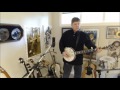 VIDEO: Possum up a Gum Stump (click to view) |
jonc - Posted - 06/12/2016: 12:54:09
I play in D and use gauges 13, 15, 22w, 30w, and 13. Since yours start at 12, I'd say they'd be good in E or F. It's my understanding that John Hartford tuned to E, not D.
I originally tuned my set to C, but after listening back to recordings they sounded too slack and muddy, so I tuned them up to D and I like the tone. One thing I noticed when trying different sets, when I decreased the gauges by one thousandth (two thousandths for the wound strings) tension seemed the same when I tuned up a full minor third, not just one step. So your set might be really good in F.
peterreynoldsuk - Posted - 06/12/2016: 12:55:51
Tom,
That was beautiful playing - lovely tones! I'll have to look into that - especially the 28w gauge!
Cheers,
Peter
peterreynoldsuk - Posted - 06/12/2016: 12:58:55
quote: Tom,
That was beautiful playing - lovely tones! I'll have to look into that - especially the 28w gauge!
Cheers,
Peter
Originally posted by Tom Berghan
Personally, I find the John Pearse John Hartford 1950D set too light . . . and I like light strings . . . but that set is just too dang light for me.
I make up my own sets by buying single strings (loop end - the brand doesn't really matter all that much) and my set is as follows: 14, 15, 22w, 28w, 14
Here is a sound clip. I am playing "single string style" so you will really be able to hear each string by itself . . . and the banjo, like yours, is a Gibson RB-250. Let me know what you think of the sound. If you try these gauges, I'm sure you will find the tension is still very light. Best Wishes, Tom
peterreynoldsuk - Posted - 06/12/2016: 13:02:21
Many thanks to all for the terrific advice I have received this evening.
Peter
bhniko - Posted - 06/12/2016: 13:03:38
Tom,
Nice demonstration...well picked...and my oh my...look at all those banjos...one for each day of the week! Can I be envious?
Pine Cone - Posted - 06/12/2016: 19:29:29
Great sound Tom!
I have been using 0.012" 1st and 5th strings but will have to check out 0.014" instead.
mikehalloran - Posted - 06/12/2016: 21:01:00
quote:
Originally posted by Tom BerghanI make up my own sets by buying single strings (loop end - the brand doesn't really matter all that much) and my set is as follows: 14, 15, 22w, 28w, 14
Ok, I'll bite: why such a light B string? I'd think a .016 would be better balanced. I could see a .017 being a little overpowering.
For years, I sent back and forth between a .014 and .015 in my set. I finally settled on .015 ... except when I went back to .014".
Tom Berghan - Posted - 06/12/2016: 23:12:24
quote:
Originally posted by mikehalloranOk, I'll bite: why such a light B string? I'd think a .016 would be better balanced. I could see a .017 being a little overpowering.
For years, I sent back and forth between a .014 and .015 in my set. I finally settled on .015 ... except when I went back to .014".
Hi Mike, it is extremely common to have 0.001" difference from the first string to the second string in commercially offered sets from the major brands. But yes, sometimes a difference of 0.002" or a difference of 0.0015". And of course we are not tuning to the pitch "B" but rather a fourth lower down to F#. But I think you meant to say that. I have not calculated the tensions between my first and second strings (tuned A and F#) but the tensions feel the same when I depress each string. They feel right and sound right to me. When tuned a fourth higher I use 0.010" and 0.011" (tuned D and B). Best wishes, Tom
mikehalloran - Posted - 06/13/2016: 16:02:18
quote:
Originally posted by Tom Berghan
quote:
Originally posted by mikehalloran
Ok, I'll bite: why such a light B string? I'd think a .016 would be better balanced. I could see a .017 being a little overpowering.
For years, I sent back and forth between a .014 and .015 in my set. I finally settled on .015 ... except when I went back to .014".
Hi Mike, it is extremely common to have 0.001" difference from the first string to the second string in commercially offered sets from the major brands. But yes, sometimes a difference of 0.002" or a difference of 0.0015". And of course we are not tuning to the pitch "B" but rather a fourth lower down to F#. But I think you meant to say that. I have not calculated the tensions between my first and second strings (tuned A and F#) but the tensions feel the same when I depress each string. They feel right and sound right to me. When tuned a fourth higher I use 0.010" and 0.011" (tuned D and B). Best wishes, Tom
Actually, I meant to say standard pitch. The OP was concerned about tuning up at all and I wanted to reassure that all the way up to standard pitch was quite alright.
The same goes for the string gauges that you use. For decades, I used .013 .017 .026w .036w on my Bacon and Vega 27" plectrum banjos tuned Chicago (same as guitar) — same gauges as a Medium guitar set. No neck warping, no other issues except for changing the tailpieces to Kershners. A .013 tuned to E has more tension than a .014 tuned to D, BTW. I played a lot of Broadway shows and liked my banjos and guitars to feel as close to each other as possible. It's less distracting that way when its not unusual to switch back and forth during a number. Never tried anything that heavy on my 5 strings, though as I had a string set I liked.
I'll concede that, when the tension is really loose, you can't feel the difference in gauges. In fact, when tight, I found it no big deal either. That may have come from being an upright bassist for 50 years in my case. My question was only about the tonal balance string to string.
One of my reasons for staying 'tight' as it were is that my banjos stayed in tune much better. My left hand was far less likely to push strings sharp. I had kind of the Vulcan Death Grip where my left hand was concerned due to my symphony gig, little doubt.
About 10 years ago, I went to .012 015 .024 .034 on my plectrums but not for the reason most think. I was tired with the continual adjustments I had to make with 4:1 planets—they just don't like that much tension on a 27" banjo and lightening up just a touch fixed the problem. It's the same issue that those guitarists wanting the '30s Martin OM look face.
mikehalloran - Posted - 06/13/2016: 16:12:48
I didn't expect to be the point person on this issue but, if this question had come up 50 years ago, the answers would be along the lines of, "strings are gauged and it matters?", "I use guitar strings".
Except for some professionals, we bought and installed what was in the packages. Sometimes the numbers were printed on the packages but we didn't pay that much attention. The Ernie Ball and D'Addario companies changed that for all of us in the 1970s.
Terms of Use | Privacy Policy | Privacy Consent (EU/GDPR Only)
Copyright 2026 Banjo Hangout. All Rights Reserved.


