
DVD-quality lessons (including tabs/sheet music) available for immediate viewing on any device.
Take your playing to the next level with the help of a local or online banjo teacher.
Weekly newsletter includes free lessons, favorite member content, banjo news and more.
Premier Sponsors


|
Please note this is an archived topic, so it is locked and unable to be replied to. You may, however, start a new topic and refer to this topic with a link: http://www.banjohangout.org/archive/316700
Aeromech - Posted - 03/28/2016: 17:32:41
ok i may have to much free time on my hands but i thought i would like to see what my banjo would sound like with a new goat skin head. while i'm at it i may as well try nylgut strings. So i'm doing a sound comparison of new strings and old skin and new head and new strings. I start with my 5th string and install the new nylgut string only to realize that the notches in the bridge are way to shallow to hold the strings in place. Now what? Can i modify my old bridge and just cut deeper notches (sounds way to easy) or do i have to buy a different bridge ?
John Gribble - Posted - 03/28/2016: 18:05:09
You can widen and deepen the old bridge slots and it will work fine. You may want to try a different bridge later.
i suggest you only make one change at a time. See if you like what that does first. It's more time-consuming that way. 
hughstrawn - Posted - 03/28/2016: 19:27:22
I'm sure it is bridge dependent as to whether or not the slots need widening. I've used a variety of Nylguts on all my banjos (all with Moon bridges) and have never had to widen or deepen the bridge or nut slots. Never had a problem with strings popping out of the slots (as I play now). Back in the days of playing square dances I always used steel strings--not so sure the Nylguts would have stayed put for that type of playing. If you need to widen/deepen slots it's best to use welding torch tip cleaners. You can probably pick one up at any hardware store for a couple bucks.
maneckep - Posted - 03/29/2016: 04:09:34
Personally I like a much lighter wood (poplar or pine) for Nylgut strings and a more standard maple/ebony topped for steel. You might want to try making a new one for your Nylguts yourself and keep the original one for steel. They are pretty easy to make.
hughstrawn - Posted - 03/29/2016: 04:49:39
quote:
Originally posted by maneckep
Personally I like a much lighter wood (poplar or pine) for Nylgut strings and a more standard maple/ebony topped for steel. You might want to try making a new one for your Nylguts yourself and keep the original one for steel. They are pretty easy to make.
Gonna give that a try. I might have a drawer full of Moons for sale soon........
steve davis - Posted - 03/29/2016: 07:14:27
Sycamore works good for nyl-gut string tone.A rosewood top adds a softer contact instead of ebony.
Aeromech - Posted - 03/29/2016: 09:07:58
quote: Thats a great ideal i would never have thought of using that thanks
Originally posted by hstrawn
I'm sure it is bridge dependent as to whether or not the slots need widening. I've used a variety of Nylguts on all my banjos (all with Moon bridges) and have never had to widen or deepen the bridge or nut slots. Never had a problem with strings popping out of the slots (as I play now). Back in the days of playing square dances I always used steel strings--not so sure the Nylguts would have stayed put for that type of playing. If you need to widen/deepen slots it's best to use welding torch tip cleaners. You can probably pick one up at any hardware store for a couple bucks.
mikehalloran - Posted - 03/30/2016: 19:38:42
I like using nut files to make half-round slots in bridges designed for NylGut.
Ken LeVan - Posted - 03/31/2016: 14:42:02
From old photos I have seen, it appears that the bridges used on early to mid 19th gut strung banjos were pretty simple, low, thin and two-footed.
It also seems as if bridge placement was all over the map - some were north of the center, but these banjos were fretless. Henry Dobson is the first mention of frets I can find, these were made of ivory, and it was 1874. Undoubtedly others used them earlier, but after they started using frets, it required some mathematical acumen or a pattern to follow, and they had to get serious about bridge placement as well.
Steel strings and better head tensioning methods probably led to the 3-footed bridge.
So, What IS the best kind of bridge for nylon strings? Is it the same as the best bridge for steel strings? Should it be heavier? lighter?
Just because they did something back in the 1860s doesn't mean they had any scientific basis or thought about it all that much, and doesn't mean that its the best way - just that it's the "old" way. in 1890,Electrics and Whyte Laydies had gut strings and created a sensation because they sounded so much better than the previous designs made by SS Stewart et al, ushering in the "modern banjo". I see some old pictures with 5 footed bridges, some 2-footed with the "buttress" thing in the middle, some without. There didn't seem to be a standard bridge - I think the builders made them, just as I do.
IF, in 2016, you wanted to build a banjo with nylon strings, using all the technology now available, and make it sound as good as a nylon strung banjo could sound, what would you do? It's an interesting question to me, because sooner or later someone is going to ask me to do it. Is it a "period instrument" like a gut strung cello, arrested in its historical place, or something current? "fundamentalist / originalist" or here and now? How do you decide how to design for a "sound", without knowing what it's supposed to be, or what it could be?
This is a question I have always pondered as an antiquarian and architectural historian. In terms of musical instruments, I have always gone for the sound in my ear
When my Son was learning the cello, the conductor of my Wife's orchestra told us to buy every available CD of the Bach unaccompanied cello suites and play them over and over - especially the prelude to the first suite, until we had internalized the sound - YoYo Ma, Mitislav Rostropovich, Janos Starker, Pierre Fornier, Pablo Casals and Anner Bylsma. The idea was that every world class cellist must master these, and they all have the finest instruments. The first four were playing cellos set up to modern Standards with modern strings - YoYo Ma's Strad is worth millions, but not set up in the original 1673 way, likewise whatever those other guys play. The Bylsma one with a (probably priceless) gut strung instrument set up to period setup. Is no comparison to the others despite fantastic playing and a fabulous instrument. In my opinion, Fournier was the best, but YoYo has the best instrument.
The player is very important, but you have to have some sound in your "mind's eye"
Anyway, vis-a vis nylon strings -what's a good comparative series to hear that would be similar to the Ma-Starker-Rostropovich-Casals - Bylsma example if you wanted to get a handle on what nylon strings on a banjo are supposed to sound like?
Sorry for belaboring this, but I would like to have a "sound target" to aim for. I read about this all the time in "word pictures" but somehow don't "hear the sound", and I am trainable.
Ken
Edited by - Ken LeVan on 03/31/2016 14:53:10
Joel Hooks - Posted - 03/31/2016: 18:31:58
Strange-- Good 5-string banjos were sold and shipped with gut into the 1920s. That is a fact. That is what people wanted. Cheap jobber goods are a different story-- like Chinese "remo" banjos on ebay.
The modern bridge was developed because when wire was used with tenor and plectrum the feet sunk too deep into the head. This was never a concern with 5-String banjos because they were still using gut (well, the people who were still playing them). Thus the flare legs used today.
The ebony cap was a direct response to the damage that wire did to all maple bridges.
I am attaching an interesting article by A. D. Grover on bridges.
Ken, if you are interested you can find pretty much any original document from the 19th century on banjo history with some creative searches online that you want. It helps to learn some more names of people involved. Electrics did not really create that much of a sensation. They were cool but other makes were still more popular with pros-- on the other hand, the WL did. By that time Stewart was dead and cold and George Bauer had done everything he could to ruin his quality and business. WLs were not competing with SSS banjos as none were being made (Stewart and Bauer banjos were not fooling anyone).
Bollman's book is really good. But he is a personal fan (and collector) of Boston banjos.
The Dobson family were self promoters and borderline con artists. I started to put together their history but found it tragic and sad so I dropped it. Smooth fretted banjos (and also raised frets) were available early in the 1860s. "False strings" (that is uneven gut) is what stopped people from using raised frets. Strings got better, frets became common. Strings got even better, three octave necks came along.
Back to bridges. The "period" bridges do in fact work very well. I have copied just about all the period patterns and the basic SSS pattern usually comes out on top. I just got another original bridge that I have not been able to measure before. I am going to do a run of these this weekend. They came out in the early1920s and are a little different design. I'll post when I get them made.
With all the various shapes sizes and patent bridges, the basic "SSS" pattern lasted for more than 40 years. Even longer because I still use them (as do other classic banjoists).
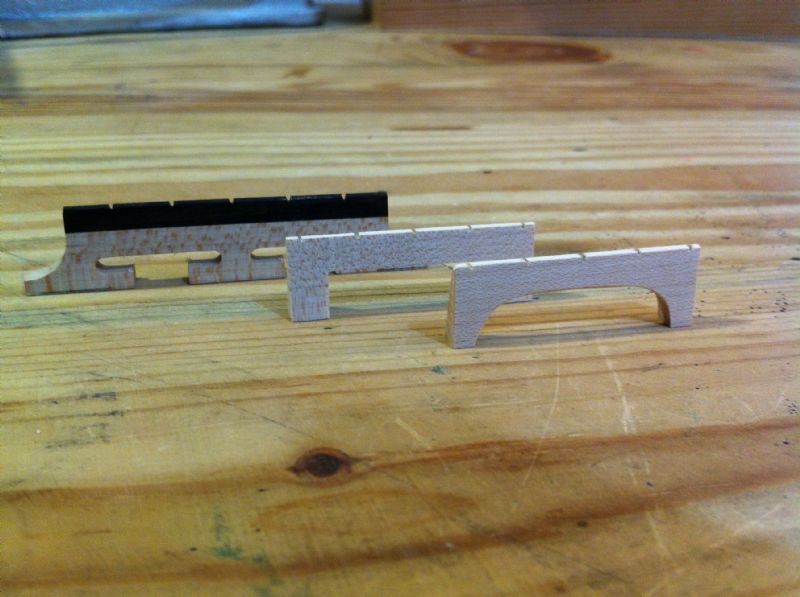 Bridges for Eastman Banjo | 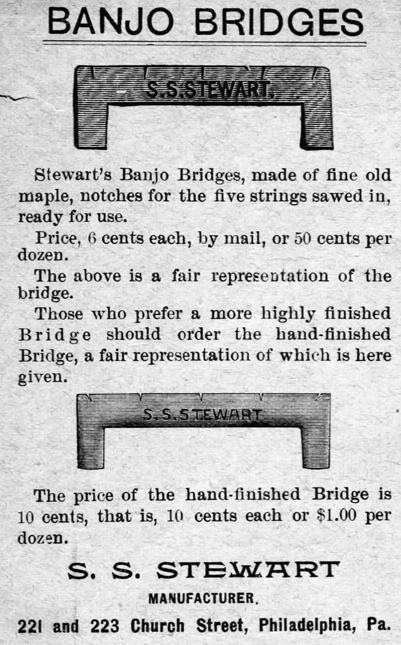 Stewart Bridges | 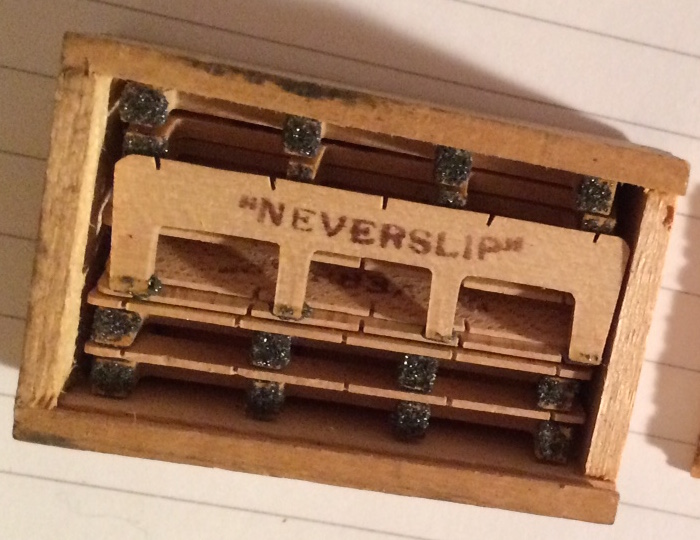 | 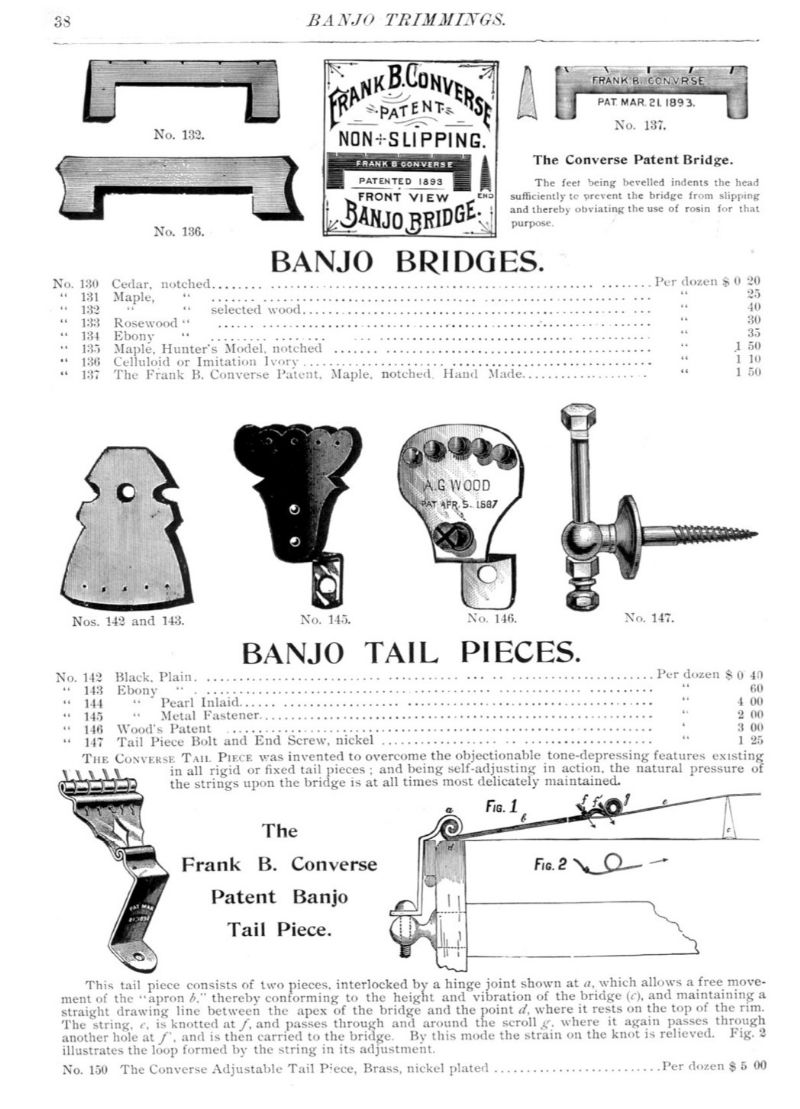 |
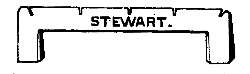 |  Bridge Tone |
ClayTech - Posted - 03/31/2016: 18:46:31
I'd go ahead and get the dozen for $1. Seems worth the extra cost to me.
Joel Hooks - Posted - 04/01/2016: 07:36:51
Funny, I went off on a tangent and did not address the "tone" question Ken had.
Here are some recordings that Fred Van Eps made around 1950 (the exact year escapes me now).
saggyrecordcabinet.blogspot.co...1952.html
This evening when I get home I will share a couple more that he made about the same time. I post these because it is an interesting comparison to his earlier recordings (youtube search "Fred Van Eps" and clear your evening). I also have some taped recordings of him playing casually (not in a studio but live) and he was a tone monster. He was using nylon strings on the 1950s recordings but gut on all of his early recordings.
Another banjoist to listen to is Fred Bacon.
youtube.com/watch?v=ZZZhHXFC4Uo
youtube.com/watch?v=umn6QMkZih0
Current masters of nylon strings include Clarke Buehling. His Studio recordings, while good, do not really capture his tone.
Various videos of him on youtube but here are a couple to get you started.
youtube.com/watch?v=nfVRnxIY6kQ
In the 1970s William Ball (a British banjoist) made a bunch of great recordings (I recommend them). He also made some video tapes too. While not the best, they do give a good idea of his sound. He has a different tone in that he uses heaver strings (which is consistent with today as overly thick strings are in fashion). He also does not "anchor" his little finger.
youtube.com/watch?v=O6Q_32s_8Ys
youtube.com/watch?v=6qlKQbq72R0
youtube.com/watch?v=boKvCRFrJpE
youtube.com/watch?v=ouPTd_3_K70
On the other extreme of tone is British banjoist Tarrant Bailey Jr. Very sharp and loud tone, but a master none the less. TBJ was a gut user that went to nylon as most did when they came out.
That is just a start. Once one learns how to listen to acoustic recordings it opens up a whole new world. Pretty much all recordings featuring 5 string banjo made before 1915+ were played on gut strings and most before 1920ish.
One of the advantages to nylon is the ability to really use dynamics and shading to a great advantage in playing (this is not evident on early recordings). Without moving the right hand you can play ppp all the way to fff. This seems to be very difficult to do with Hawaiian guitar picks and wire strings.
One of the biggest problems that people face is just "trying out" nylon. It might as well be a different instrument. The right hand attack is completely different. Hawaiian guitar picks are entirely unnecessary for finger style--in fact, they really just get in the way. One must dedicate time to learn to pull the tone out of the banjo. The touch of the fingertips will eventually act as rosin on a bow.
With stroke style (clawhammer or whatever) just the nail is all that is needed, but a thimble supercharges the tone. I usually try to stay out of "clawhammer pick" discussions as I make and sell reproduction banjo thimbles and don't like to be in peoples face about it (they speak for themselves). But they really do work-- the ones I make or the other fine products on the market.. Playing near the bridge creates a note separation and sharp tone that is just amazing.
On volume... I've had sound guys turn my microphone off at "open mics" it that tells you anything.
Edited by - Joel Hooks on 04/01/2016 07:40:32
csacwp - Posted - 04/01/2016: 08:43:32
I'll second that about volume. With the correct setup and proper technique, my nylon-strung banjos are much louder than wire-strung equivalents. I've used a decibel meter to check my Clifford Essex Weaver (11'' rim), which has no tone ring. With a skin head, very light nylon strings (.017 first and fifth), and a period 1/2'' bridge I was reading 110 decibels with the meter. My Blue Ribbon with an 11.5'' rim and my Van Eps with a 12'' rim are even louder.
Edited by - csacwp on 04/01/2016 08:44:34
Joel Hooks - Posted - 04/02/2016: 06:29:19
So here are a few more recordings from Fred Van Eps made in the 1950s. "Indian Summer" is one of my favorites.
 Silverheels | Ramshackle Rag | Indian Summer |
Terms of Use | Privacy Policy | Privacy Consent (EU/GDPR Only)
Copyright 2026 Banjo Hangout. All Rights Reserved.


