
DVD-quality lessons (including tabs/sheet music) available for immediate viewing on any device.
Take your playing to the next level with the help of a local or online banjo teacher.
Weekly newsletter includes free lessons, favorite member content, banjo news and more.
Premier Sponsors


|
Please note this is an archived topic, so it is locked and unable to be replied to. You may, however, start a new topic and refer to this topic with a link: http://www.banjohangout.org/archive/315657
JoeNoHats - Posted - 02/29/2016: 09:20:40
Hey all -- I've been playing two-finger thumb-lead for a year and a half, on a Goodtime with steel strings. I wanted to try out a completely different sound profile, so I ordered a Prust tackhead, fretless, with nylgut strings. It just arrived this weekend. What a beauty. I can't stop playing it!
I've noticed, however, that my picking hand has started to hurt. A vaguely arthritic pain near the top, between the knuckles and the wrist.
I was wondering if any of you have experienced something like this before -- switching from steel strings to nylgut strings and experiencing some hand pain?
And if so, if you have any advice about how to approach nylgut strings differently?
My guess is that I might be picking too hard...
Thanks for any help!
rudy - Posted - 02/29/2016: 09:30:40
Nylguts are very amenable to ultra-light pressure, and are a bit disconcertingly soft when getting used to them. If you go with Aquila reds you'll find that they have a better under hand feel and have a brighter tonality than standard Nylgut.
My guess would be that you're just experiancing minor discomfort from playing an increased amount due to the new toy syndrome.
Slow down and take a break, it'll still be there tomorrow.
Bill H - Posted - 02/29/2016: 09:32:09
You said you can't stop playing it, could it be that you just played longer than usual and your fingers are not quite in shape for extended time. Like muscle fatigue. I know if I play longer than usual I feel some tightening of muscles in the back of my hand.
banjo bill-e - Posted - 02/29/2016: 09:32:12
my guess is that your new Prust has a higher action and you are now holding and/or bracing your picking hand in a new and perhaps more awkward manner. Just a guess, as I don't believe the string material has anything to do with it.
banjered - Posted - 02/29/2016: 10:08:25
That banjo is way too much for you. You are going to end up hurting yourself. But being the nice guy that I am, you can just send it to me and I'll dispose of it in a proper fashion. Banjered
JoeNoHats - Posted - 02/29/2016: 10:16:16
Thanks for the responses! I think that you might be right, banjo bill-e. A higher action than I'm used to. I like a low action. The Prust came with three bridges -- I'm using the shortest, but maybe I need to scoot it back a little more?
JoeNoHats - Posted - 02/29/2016: 10:17:34
Banjered! Thanks for the generous offer. I'm glad you're looking out for me. :)
banjo bill-e - Posted - 02/29/2016: 10:30:28
Joe I doubt that you will get the action on a low-tuned nylon Tackhead as low as your steel-string Goodtime but it will be worthwhile to experiment. I have a Menzies Tackhead and the string height over the pot is much higher than any of my other banjos. That has required a technique adjustment whether playing clawhammer or Thumb Lead.
But don't hurt yourself! Play less and give yourself time to adjust with some rest between sessions, because playing through the pain is a very bad idea and could cause lasting issues. Good luck.
JoeNoHats - Posted - 02/29/2016: 11:17:56
Thanks for the advice, Bill! I'll think more consciously about how to anchor my hand while I play. And add a little rest, too --
bartmcneil - Posted - 02/29/2016: 13:00:41
deleted by author...
Edited by - bartmcneil on 02/29/2016 13:10:11
SoundsGoodToMe - Posted - 02/29/2016: 13:21:24
It may just be due to learning the lighter touch for Nylguts. Check how you're holding the new banjo compared to your old one to see if you're bending your wrist back more than you used to though, and if you are, try to correct that so that your wrist stays bent farther forward. Watch for and avoid that backward wrist angle if you do a lot of typing too.
If the pain persists or any numbness develops, have a doctor check it out. Repetitive stress/carpal tunnel/trigger finger type injuries are no joke.
bartmcneil - Posted - 03/01/2016: 04:19:12
I am assuming you are playing claw hammer and have recently switched from up-picking. If so that could account for your wrist and various pains. At least I found that the peculiar position of the picking hand in clawhammer was initially bothersome. I shouldn't think that merely switching from steel to Nylgut would cause the additional pain in the right hand wrist. Whatever the cause continued playing should allow greater relaxation as you get used to the slight variation in hand position. judging from your number of posts you may be fairly new to the banjo and techniques used and that could certainly account for unusual pains. In my case whenever I take on a new learning project technique-wise I often have to deal with new pains in wrist or fingers. Certainly this was true as I learned clawhammer picking as a technique.
Your Prust fretless tackhead sounds like a lot of fun. Too many banjos is never enough.
Edited by - bartmcneil on 03/01/2016 04:25:34
JoeNoHats - Posted - 03/02/2016: 05:24:54
quote:
Originally posted by banjo bill-e
my guess is that your new Prust has a higher action and you are now holding and/or bracing your picking hand in a new and perhaps more awkward manner. Just a guess, as I don't believe the string material has anything to do with it.
After resting for a day, and then returning to my Goodtime, I've figured out that you're 100% right, Bill -- it's the super-high action that I'm not used to.
Does anyone have any general advice/time-saving tips on how to adjust to a high action? I'm playing two finger thumb-lead.
(I'm guessing it's one of those things that you just need to kind of figure out on your own?)
banjo bill-e - Posted - 03/02/2016: 14:56:04
My only advice is not really brace hard, just lightly touch the head. You want your hand to be as relaxed as possible. Tension hurts and can cause damage. I brace with my two middle fingers but if starting from scratch today I would try bracing with third and pinky with "social finger" floating OR use middle finger for picking and let first finger float. Either way makes it real easy to sneak a handy third finger into your Two Finger! Experiment and find what works for YOU.
bartmcneil - Posted - 03/02/2016: 17:46:09
Are you positive your fretless has been set up by the manufacturer or the seller? A super high action makes little sense because it would mean that your instrument is playing out of tune much the time. A clear photo of the strings and neck (from the side) and also a photo showing bridge hight relative to the fret board would help us discuss this.
The pain you are experiencing sounds like something a complete beginner might experience. I certainly experienced pain when I began playing banjo but any pain has long since disappeared.
braungre - Posted - 03/02/2016: 18:40:34
I too experienced a similar pain when I first started playing CH banjo. Eventually I figured out that I was tensing up my hand, in an attempt to hit the strings harder and increase the volume put out by my poorly assembled, low quality instrument. I had to accept that I wasn't going to be as loud as I wanted; after that it got better. ;)
It happened again, years later, when I started playing a nylon-strung banjo clawhammer style. I felt as though the "sloppy" feel of the lower-tension strings was encouraging me to put a bit too much follow-through into my right hand. The "pushing under tension" action seems to aggravate my arthritis in my elbows and wrists, and this felt just the same. I've since learned to lighten my right-hand technique when playing with nylon or nylgut strings and I haven't experienced any pain for years.
Good luck!
JoeNoHats - Posted - 03/04/2016: 06:42:54
Thanks, everyone! I jammed with a buddy the other night, and switched between my Goodtime and my Prust -- the next morning, I was feeling fine. Bart and Greg, thanks for your points -- the pains I was experiencing with the Prust reminded me of the pains that I experienced when I first started, a year and a half ago, with the Goodtime. Maybe it's just a matter of my body adjusting.
That said, I'll get some pictures of the action, as suggested by Bart -- I'll post them later today.
Thanks so much!
oldwoodchuckb - Posted - 03/04/2016: 12:51:26
You might also think about the action of the Proust. It could very well be too high for real comfort. I'm not a fretless player so I don't know what they prefer - for fretted steel string banjo I like to keep the action under 1/2 inch at the 12th fret - which is slightly higher than I prefer my guitar action. My one nylon strung banjo is my antique Jackie-O, who has very high action. I never did get around to restoring her back when I could, so now I figure on leaving that little task to whoever gets it after I'm gone.
JoeNoHats - Posted - 03/04/2016: 16:37:09
quote:
Originally posted by bartmcneil
Are you positive your fretless has been set up by the manufacturer or the seller? A super high action makes little sense because it would mean that your instrument is playing out of tune much the time. A clear photo of the strings and neck (from the side) and also a photo showing bridge hight relative to the fret board would help us discuss this.
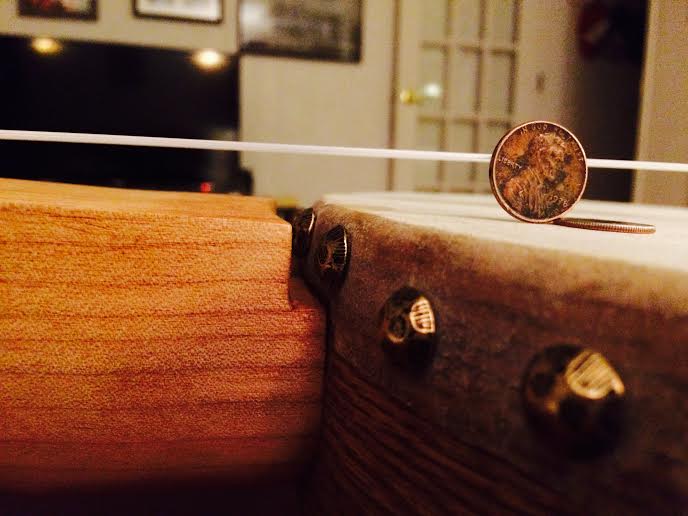
I measured the action -- at the end of the head, it's about a half an inch.
I double-checked the bridge placement. It's at the recommended spot.
Here's a picture! With Lincoln's likeness for scale.
 |
Chadbanjo - Posted - 03/04/2016: 16:53:05
The action for this kind of banjo looks normal to me. You can try a shorter bridge. For the pain, no doubt its over use. A drop of rum and then another will cure you.
bartmcneil - Posted - 03/05/2016: 03:14:40
Another consideration:
Do you play hard and aggressive or do you normally play lightly? You could try a shorter bridge if you play lightly. Many players of banjo have bridges of different heights, I have a few spare banjo bridges of different heights which I switch around if there appears to be a problem. My own banjo playing is generally light as I do not usually play publicly. That way if I am concerned I can switch to a higher bridge for more aggressive playing.
Edited by - bartmcneil on 03/05/2016 03:27:06
bartmcneil - Posted - 03/06/2016: 06:22:44
It used to be that new banjos came with more than one bridge for different preferences among players. This is particularly true with tack head banjos where the only adjustment available for banjo head is to use a taller bridge and thus give the skin head greater tension. This is particularly important in high humidity.
In any case a few spare bridges is a good idea to experiment with your instrument.
You might also try an intonated bridge which will give you a bit better intonation. Some folks swear by them. Others don't notice a difference.... I have one which I like because it looks cooler than a standard bridge but in fact I don't hear a difference.
Edited by - bartmcneil on 03/06/2016 06:32:20
JoeNoHats - Posted - 03/06/2016: 07:50:05
quote:
Originally posted by bartmcneil
It used to be that new banjos came with more than one bridge for different preferences among players. This is particularly true with tack head banjos where the only adjustment available for banjo head is to use a taller bridge and thus give the skin head greater tension. This is particularly important in high humidity.
In any case a few spare bridges is a good idea to experiment with your instrument.
You might also try an intonated bridge which will give you a bit better intonation. Some folks swear by them. Others don't notice a difference.... I have one which I like because it looks cooler than a standard bridge but in fact I don't hear a difference.
Thanks for these thoughts, Bart. The Prust came with three bridges. I'm currently using the shorter one (it's the one they recommend.)
A shorter bridge means a smaller action, right?
And does a taller bridge translate to greater string tension?
I've only been playing for a year and a half, but I'm finding -- after goofing around on a number of banjos in stores -- that I dig a low action and a high string tension. That said, I'm getting used to the opposite on the Prust. It encourages a different kind of playing.
(Apologies for these amateur-player questions!)
Marc Nerenberg - Posted - 03/06/2016: 08:27:27
quote:
Originally posted by bartmcneil
Are you positive your fretless has been set up by the manufacturer or the seller? A super high action makes little sense because it would mean that your instrument is playing out of tune much the time. ...
A fretless doesn't play out of tune with a high action because you just adjust the postion at which the strings are stopped by the left hand to compensate for the higher action.
It is not unusual for a fretless to have high action, and it is uncommon to play very high up on the neck where the high action would become problematic.
The advantage of a high action is that it allows the right hand to play comfortably over the neck, which produces a sound many people like in clawhammer.
Also,( responding to another post above): A compensated bridge makes no sense on a fretless. The entire point of the compensation is to compensate for the fact that different thicknesses of string have the notes come out at slightly different spots, but the fixed straight frets don't take that into account. Without frets, the compensated bridge loses its purpose. With a fretless, you do all the compensation by simply adjusting the spot at which you place your left hand fingers. You let your ears be your guide.
Edited by - Marc Nerenberg on 03/06/2016 08:34:19
bartmcneil - Posted - 03/06/2016: 09:04:38
The reason there are three bridges with a tack head is that in addition to how people like their action for comfort, humidity will expand the hide head and the head, not being adjustable will sag and lose its drum-like tone. Using a higher bridge will compensate to a small extent for that of the looseness of the head.... You will perhaps notice this on a rainy day. And on a dry day the head will shrink and become tight on its own and your banjo will sound fine.
You will find that your skin head, compared with your Goodtime with its mylar (plastic) head, needs to be tuned fairly frequently as the weather changes. That is not a problem, just a fact of life.
I have found a tuning fork very handy in tuning my instruments as it needs no batteries. An electronic tuner gives folks a lot more information than most folks need and can be confusing. I have both and use both, but I often find the tuner's batteries dead when I need it..
hurdy_gurdyman - Posted - 03/08/2016: 11:51:04
I didn't notice if anyone else pointed this out, but a fretless with synthetic strings needs a higher action. This helps eliminate buzzing of the strings over the fingerboard. Synthetic and gut strings vibrate with a higher wave/arc or whatever it's called. A low action will drive you crazy with the buzzing going on.
As for a bridge compensation, as someone mentioned, a straight standard type bridge is fine. However, if you slant the bass side of the bridge away from the neck a little more (around 1/4 inch to 1/2 an inch), the strings will play closer to in tune across all four strings. This is because the heavier strings stretch less and will play sharper, thus pushing the bridge a bit to increase scale length will compensate. If want to get really fussy, try picking one open string, then find the 12th fret position by doing a finger touch harmonic. Slide the bridge to get the same note harmonic. Once you get to where the first string harmonic matches the open string note (both, say, D open and D with harmonics), go to the bass string and repeat. The bridge will be at an angle with the bass side of the bridge going toward the tail piece. The in between strings will be close, but not perfect. This will keep the strings reasonably close to having an imaginary fret going across the fingerboard at every note and will make playing a fretless a lot easier.
Dave
R.D. Lunceford - Posted - 03/08/2016: 13:00:51
What is your preferred right-hand location?
The further from the bridge you get, the lower the strings will be (though not appreciably),
and the less the tension. Of course, the tone will be markedly effected.
Edited by - R.D. Lunceford on 03/08/2016 13:01:26
Terms of Use | Privacy Policy | Privacy Consent (EU/GDPR Only)
Copyright 2026 Banjo Hangout. All Rights Reserved.


