
DVD-quality lessons (including tabs/sheet music) available for immediate viewing on any device.
Take your playing to the next level with the help of a local or online banjo teacher.
Weekly newsletter includes free lessons, favorite member content, banjo news and more.
Premier Sponsors


|
Please note this is an archived topic, so it is locked and unable to be replied to. You may, however, start a new topic and refer to this topic with a link: http://www.banjohangout.org/archive/311634
jljohn - Posted - 11/23/2015: 14:48:34
I was reading this thread comparing Reiter Standard and Enoch Tradesman banjos ( banjohangout.org/archive/185031 ), and I came across this statement:
|
So, I got to wondering--since I have a Reiter Round Peak but also love that tubby 12" tradesman sound--short of trading one for the other, what changes in setup (head, bridge, tailpiece, head tension, etc) would have the effect of making the Reiter sound more like the Tradesman?
I'm curious both in the academic sense (simply to understand how different changes will impact the sound of a banjo) and in the practical sense (I really like the Reiter, but I want to shift it's sound a bit toward the characteristic Tradesman sound.)
Thanks so much!
Edited by - jljohn on 11/23/2015 15:38:25
the-fish - Posted - 11/23/2015: 16:24:41
Scale length different woods different rim diameter different
And two completely different styles of banjos
Maybe a skin head, a sponge, looser head may plunk it down a bit?
Owned several of each, different animals in my opinion
jbalch - Posted - 11/23/2015: 16:58:50
There is a lot of insight in that original thread. My comments there were:
These are extremely different banjos. Both are well made and dependable. Both have comfortable necks. But for tone and playability, they have very little in common.
Disclosure: I have owned both. But I'm on record as a player and fan of Bart Reiter banjos....
Some differences:
Rim size & type:
Tradesman: 11" and 12" rims available - very thin multi-ply
Reiter: 11" diameter - two-ply maple (1/2" thick)
Tone ring:
Tradesman: none (generally tubby sound)
Reiter: rolled brass (depending on set-up can produce a range of tones...generally brighter)
Set-up:
Tradesman: relatively high string action scooped for playing over the board
Reiter: lower string action (usually not scooped)
Scale length:
Tradesman: shorter - approx: 25 1/2" - I Think (if it is important...you should confirm)
Reiter: longer - 26 3/16"
Neck:
Tradesman: graphite re-inforced (non adjustable)
Reiter: truss rod (adjustable)
Bottom line: I personally like Bart Reiter banjos. I think they are very versatile. I love the sound and feel. I usually change the set-up to my own preferences (skin head and Sosebee bridge). Depending on set-up these banjos are useful for a wide range of playing styles.
I think Enoch tradesman is a truly great instrument for some styles. But I think they are less versatile.
Edited by - jbalch on 11/23/2015 17:03:45
jbalch - Posted - 11/23/2015: 17:01:37
Having repeated my comments above ... to make your Reiter sound more "tubby" (maybe more like a tradesman) the first thing to do is experiment with head tension. Start loose (more tubby) and tighten evenly all around the rim - in small increments - until you are pleased.
Head tension is BIG determinant of tone ... and it is free.
best wishes!
banjered - Posted - 11/23/2015: 18:01:51
Besides above, try non-metal strings - Nylguts, Sands, classical guitar strings. Play over the neck, different pot baffles and placements. Banjered
Patman - Posted - 11/23/2015: 18:09:31
I always think each banjo has it's best voice...the trick is to find it.
The best voice for a Reiter which is loosely a vega-ish style instrument, is probably not the same as the best sound for a Enoch..
Dale Morris - Posted - 11/23/2015: 18:28:14
I have had a few Bart Reiters through the years, and I recently bought a Reiter Standard that has a goatskin head on it. It definitely has more of a Tradesman sound (more woody or tubby sound).
jljohn - Posted - 11/23/2015: 18:32:57
quote:
Originally posted by jbalch
There is a lot of insight in that original thread. My comments there were:
These are extremely different banjos. Both are well made and dependable. Both have comfortable necks. But for tone and playability, they have very little in common.
Disclosure: I have owned both. But I'm on record as a player and fan of Bart Reiter banjos....
Some differences:
Rim size & type:
Tradesman: 11" and 12" rims available - very thin multi-ply
Reiter: 11" diameter - two-ply maple (1/2" thick)
Tone ring:
Tradesman: none (generally tubby sound)
Reiter: rolled brass (depending on set-up can produce a range of tones...generally brighter)
Set-up:
Tradesman: relatively high string action scooped for playing over the board
Reiter: lower string action (usually not scooped)
Scale length:
Tradesman: shorter - approx: 25 1/2" - I Think (if it is important...you should confirm)
Reiter: longer - 26 3/16"
Neck:
Tradesman: graphite re-inforced (non adjustable)
Reiter: truss rod (adjustable)
Bottom line: I personally like Bart Reiter banjos. I think they are very versatile. I love the sound and feel. I usually change the set-up to my own preferences (skin head and Sosebee bridge). Depending on set-up these banjos are useful for a wide range of playing styles.
I think Enoch tradesman is a truly great instrument for some styles. But I think they are less versatile.
Hey John,
Thanks for your response, but just to clarify one thing (because I see it repeated): Kevin is using an adjustable truss rod in the tradesman banjos these days. His website does not yet reflect that, but he has made the shift.
Thanks!
jljohn - Posted - 11/23/2015: 18:40:13
Thanks for all the responses so far. I do understand the differences: tone ring, mass, scale length, thickness of pot, woods used, head used, neck shape, etc., but if the quoted statement is even somewhat correct, I am simply curious what steps could be taken to pull the Reiter's tone toward the Enoch. Maybe most here simply disagree with the quoted statement?
That being said, I'm working with Round Peak (12" pot), so it sounds like my experimentation should start with (1) loosening the head and tightening it evenly to find the sweet plunky spot, (2) try a goatskin head, (3) try Nylguts? Would a Walnut bridge contribute?
Thanks so much!
Edited by - jljohn on 11/23/2015 18:43:49
mikehalloran - Posted - 11/23/2015: 21:51:45
One of the very few times that I would recommend nylon over NylGut.
jbalch - Posted - 11/24/2015: 04:29:57
Thanks for the update about the truss rod in the Tradesman. I was unaware of a change. But the one I owned was from the last batch Kevin made in his shop before increasing production...so it was quite a long while ago.
BTW - maybe Kevin should update his website because it still says the neck has a "graphite rod for reinforcement."
I really recommend experimenting with head tension before anything else. I think that will have the biggest impact - and best bang for the buck. The head is the banjo's soundboard. It's tension affects the sound in a HUGE way.
You can spend a fortune on bridges (believe me I know). The bridge is an important part of a final set-up. It is fun to swap bridges and experiment with the impact. But, the change in tone a bridge makes is often subtle compared to other factors (like head tension). I personally have not had good results with walnut or other woods. Many "exotic" wood bridges seem to make my banjos sound dull and dark. I usually prefer a high-quality. "standard" construction, bridge made of maple with ebony cap. There are plenty of good bridge makers. But I use and recommend bridges by Tim Purcell, Gary Sosebee, and Scorpion. Tim Purcell does produce non-maple bridges that work very well on some banjos. My friend David Emery uses Tim's Lucust and Spruce wood bridges with great results.
Tailpiece is also a significant factor. But I think both banjos in question are usually set up with no-knot. So - changing the tailpiece might not make them sound more similar. If you are using something other than no-knot on your Reiter, I recommend trying that style tailpiece for sure.
Nylgut strings totally change the nature of the banjo. Same is true of a Tradesman or Reiter. Use them if you like the sound (I do on one banjo). But I don't think Nylguts alone make a Reiter sound like a Tradesman per se.
I hesitate to recommend changing to hide heads - because I sell them (don't want to sound too self-serving). Like Nulgyts - natural hide totally transforms the nature of the banjo. If you like the sound of a skin head on a Tradesman - your would probably like one on your Reiter. But again - i don't think a hide head alone will necessarily make your Reiter sound more Tradesman-like.
Edited by - jbalch on 11/24/2015 04:53:31
jbalch - Posted - 11/24/2015: 05:07:10
Regarding tailpieces ... one more comment.
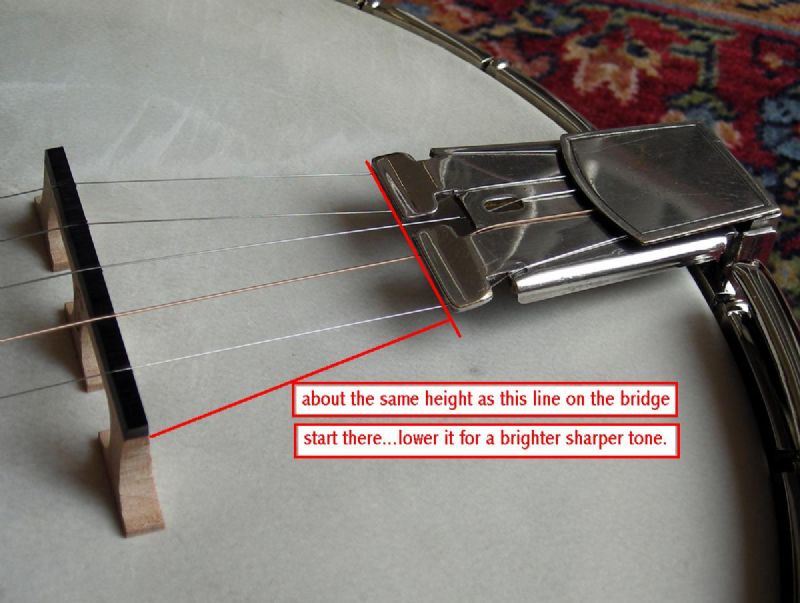
I use Presto tailpieces on most of my Reiter banjos. They are not too heavy - so that don't dampen the sound with too much mass.
Presto tailpiece are not really designed to be "adjustable" in the sense of many others. (because the angle of the string guide is fixed - not moveable). But depending on how high you set a Presto above the head, you can vary the amount of string pressure on the bridge and head quite significantly. A Presto set up high above the head , may actually put less pressure on the bridge than even a no-knot. Set that way, it can have a big, open, sound ... that might please you.
Edited by - jbalch on 11/24/2015 05:08:57
 |
rudy - Posted - 11/24/2015: 05:52:22
John, Thanks for re-posting your list of setup variables. This is the type of stuff that could be elaborated upon and used in a nice "FAQ" for open back players.
GrizClaw - Posted - 11/24/2015: 07:03:45
Would be interesting to know Kevin's rationale for changing to adjustable truss rod for the Tradesmen (assume this would apply to Dobson also). When I owned my Tradesmade he seem to be a pretty firm believer that the graphite rod was the way to go.
Parker135 - Posted - 11/24/2015: 07:50:52
I just bought a new 11" Tradesman through Bob Smakula about a month ago. He sent it to me as soon as it arrived from Kevin Enoch....the finish was barely cured. There is no truss rod. He's still using the traditional dowel arrangement with an ebony wedge to lock the neck to the pot.
banjered - Posted - 11/24/2015: 08:17:58
I noticed months ago, and posted it here, that Elderly was advertising that Tradesman banjos were now having the standard rods in the necks. I asked for confirmation and also if someone knew why Kevin decided to go that route? Never got an answer to either question. Perhaps someone at Elderly just assumed that rods were in the neck and just advertised as so. Since Smakula is a dealer, does he know? Anybody? Banjered
jljohn - Posted - 11/24/2015: 09:54:52
quote:
Originally posted by Parker135
I just bought a new 11" Tradesman through Bob Smakula about a month ago. He sent it to me as soon as it arrived from Kevin Enoch....the finish was barely cured. There is no truss rod. He's still using the traditional dowel arrangement with an ebony wedge to lock the neck to the pot.
I don't know about your banjo, of course, but I've spoken with both Kevin and Bob, and the banjos now have two-way truss rods. I don't know why it would have to change the dowel arrangement. You would just need to remove the neck to adjust the truss rod. I asked Kevin how to tell if any given banjo has one, and he mentioned that if you look into the heel from the side, you can see where the TR sits. Nothing else has changed visibly. So, take a look into the heel of your banjo and see what's there. Or give Bob a call--I'd bet you've got a TR.
Edited by - jljohn on 11/24/2015 09:57:10
OldPappy - Posted - 11/24/2015: 10:28:32
Being a builder myself, though on a much smaller scale, I would venture a guess that he changed to the adjustable truss rod to sell more banjos.
I don't know him, but even if he still holds the opinion that a graphite rod is the way to go, the buying public has been told otherwise over the years, and many of them firmly believe there is an advantage to the adjustable truss rod.
An adjustable truss rod is useful for correcting a bowed neck, but it won't help a bit if a neck develops twist, and it is not the best way to adjust action on an instrument.
I build banjos for the fun of it, I am not trying to make a living with it, and don't take "custom orders", so I can build mine the way I think is best.
I do not use adjustable truss rods because I have fixed enough broken necks on banjos to not want the hollowed out neck an adjustable truss rod requires. I put two carbon fiber (Graphite) rods in the neck which extend across the weak point of a neck into the peghead. This makes a very strong neck that is resistant to bowing and twist, and if a neck is built properly in the first place it won't need any "adjustments".
banjo bill-e - Posted - 11/24/2015: 10:37:36
Hummmm, this Tradesman lover is not sure he likes that "improvement". Will that make the neck noticeably heavier? I love the light weight and balance of my Tradesman and do not like neck-heavy banjos that I have to concentrate on keeping the neck from falling down.
GrizClaw - Posted - 11/24/2015: 10:37:58
You may have hit it OldPapy....before I bought my Pisgah Rambler I spoke with Patrick to verify it had a truss rod. He told me he had started building without adjustable truss rods but changed when he got pressure from retailers.
Parker135 - Posted - 11/24/2015: 10:40:27
quote:
Originally posted by jljohn
quote:
Originally posted by Parker135
I just bought a new 11" Tradesman through Bob Smakula about a month ago. He sent it to me as soon as it arrived from Kevin Enoch....the finish was barely cured. There is no truss rod. He's still using the traditional dowel arrangement with an ebony wedge to lock the neck to the pot.
I don't know about your banjo, of course, but I've spoken with both Kevin and Bob, and the banjos now have two-way truss rods. I don't know why it would have to change the dowel arrangement. You would just need to remove the neck to adjust the truss rod. I asked Kevin how to tell if any given banjo has one, and he mentioned that if you look into the heel from the side, you can see where the TR sits. Nothing else has changed visibly. So, take a look into the heel of your banjo and see what's there. Or give Bob a call--I'd bet you've got a TR.
Right you are! I stand corrected. I can just see a slot under the fret board, which I assume is for the truss rod. I was expecting to see something more obvious than that. The reason I mentioned the means of attaching the neck is that I assumed a truss rod would not work with that setup. Thank you!
GrizClaw - Posted - 11/24/2015: 10:41:23
I kind of agree with banjo-bill-e, although I like adjustable truss rods on most of my banjos....I liked the Tradesman just the way it was.
Edited by - GrizClaw on 11/24/2015 10:42:09
GrizClaw - Posted - 11/24/2015: 10:44:36
But then..... The old man keeps rambling on.....whatever Kevin does, I'm sure he will continue making beautiful banjos.
Edited by - GrizClaw on 11/24/2015 10:47:22
ClayTech - Posted - 11/24/2015: 10:50:08
quote:
Originally posted by banjo bill-e
Hummmm, this Tradesman lover is not sure he likes that "improvement". Will that make the neck noticeably heavier? I love the light weight and balance of my Tradesman and do not like neck-heavy banjos that I have to concentrate on keeping the neck from falling down.
That's exactly what I was thinking. The incredibly light weight of the Tradesman is awesome, and I'd hate to see that increase. If I remember correctly, his necks are one piece. I wonder if that scares people since laminated necks are considered more stable, and there was a demand for a truss rod to ease their fears. I'm kind of disappointed that he switched, because I think there are enough builders here that have proven that you can make a stable neck without an adjustable truss rod.
To get back on topic, though, the thin rim of the Tradesman is what defines the sound of that banjo. I think it would be hard to get a heavier, thicker rim to sound the same. Those rims have different mass, construction and interior diameters. I say let the Reiter sound like a Reiter and go buy a Tradesman!
You might also want to try a two footed minstrel style bridge to tone down the Retier. I got mine from Stringbean45 here on the Hangout and it is wonderfully plunky!
Edited by - ClayTech on 11/24/2015 10:52:50
GrizClaw - Posted - 11/24/2015: 10:54:04
I agree....I think the Keller drum shell rim on the Tradesman has to be the major factor to its unique tone.
ceemonster - Posted - 11/25/2015: 05:21:44
Why don't you put a skin head on your Round Peak? It confers a very different tone from the Renaissance-type heads.
FYI, I just took delivery of a 12-inch Walnut Bart Reiter brass hoop ring banjo with Bart's walnut "Buckbee" neck, and it's delicious. It's the 12-inch "Round Peak" pot, with the walnut "Buckbee" neck. It's been a long-time fantasy, achieved at long lost by order through Elderly, and it seems to have a couple of siblings---I see one recently in at Elderly and same at Spruce Tree Music. I'm a walnut nut, but also played the 12-inch mahogany Round Peak model not long ago, and that too was delish. I agree with you that it's not exacty "tubby," but I like some ring and shimmer to a braass hoop banjo. 12-inchers with the shorter, 25.5" scale are tubbier than those with the 26 1/4 scale that Bart Reiter uses. One hear this difference in youtube clips of banjos from the Ome openback line---its 26 1/4 scale Jubilee (woody) and Juniper (brass hoop) models are less tubby than their newer 25.5 scale Wizard, Tupelo, Flora, and North Star models.
Edited by - ceemonster on 11/25/2015 05:41:33
Terms of Use | Privacy Policy | Privacy Consent (EU/GDPR Only)
Copyright 2026 Banjo Hangout. All Rights Reserved.


