DVD-quality lessons (including tabs/sheet music) available for immediate viewing on any device.
Take your playing to the next level with the help of a local or online banjo teacher.
Weekly newsletter includes free lessons, favorite member content, banjo news and more.
Premier Sponsors


|
Please note this is an archived topic, so it is locked and unable to be replied to. You may, however, start a new topic and refer to this topic with a link: http://www.banjohangout.org/archive/310481/4
Dewdrop - Posted - 11/11/2015: 10:16:50
I first met Bill when he was playing steel with Maria but I was inspired with his work with Monroe and have a couple of old 45RPM records that I dang near wore out trying to figure out how to play his style. I was getting some help with the banjo and melodic style from Allen Shelton at the time and Bill's recordings of Shenandoah Breakdown, Devil's Dream, Sailor's Hornpipe and Salt Creek were ground zero! Bill was a hugely nice individual and was always one to readily answer questions, talk a long time on the phone and help in whatever way he could. His passing shook me just as it did when Allen passed a few years ago! I will miss getting to call him up at Woodstock and having a 'tech talk' over banjos and tuners etc. Yep, we have lost a great one.......R.I.P. Bill.
rfrizzle2 - Posted - 11/15/2015: 08:13:05
Rich Freeze
banjoy - Posted - 11/15/2015: 09:13:34
I've lost several close personal music friends over the last few months, among other stuff hitting me, it's been kind of tough, and Bill's passing kind of hits me a little too and I barely knew him at all. I can honestly say, though that I would not be picking banjo had he not put out those excellent instructional books years ago.
I only got to meet and hang out with Bill and his band once many years ago, in 1988 at the Tennessee Banjo Institute, in the wee hours of the morning after a long day at banjo camp. It's a memory I still cherish, because he made a nobody like me feel like someone, he was so kind and gracious, and I think, appreciative to talk with someone at that hour about anything but banjos. And talk we did, about what, who knows. It was a wonderful two or three hours spent. Many years later I would talk on the phone with Bill for some reason or another and he always remembered me. So, I'll do my small part to ensure he lives on inside of me, like everyone else who has posted here.
Thanks for being.
Edited by - banjoy on 11/15/2015 09:14:40
captbanjo - Posted - 11/15/2015: 09:33:17
Then there was the time a huge windstorm hit us at the Winterhawk Bluegrass Festival in NY (before it was called Grey Fox) just before dawn. Bill always pitched an Indian teepee tent and it was near my RV. My wife and I woke up to the screaming winds and discovered our awning had been ripped right off our RV.
Looking over, I saw Bill's teepee flying up into the air. Bill looked half-awake and disheveled. He gave me a half-grin and lit up his ubiquitous cigarette and shrugged.
Wayne
robbif - Posted - 11/15/2015: 11:57:00
molllydooka - Posted - 11/15/2015: 21:58:00
Condolences to your family, and may there be some banjo tunes close to you Mr Keith.
robbif - Posted - 11/17/2015: 13:17:47
I'm so sorry I missed posting this earlier...
Tribute for Bill Keith
Today, Tuesday November 17, 2015 at 8:00pm - 9:30pm
Cantab Lounge 738 Mass Ave Cambridge MA
A tribute to Bill Keith who passed away on Oct 23 to bring together some
of the many banjo players he inspired. Banjo players who will contribute
are Marc Horowitz, Marty Cutler, Rich Stillman, Peter LaBau with Mitch
Nelin, Gabe Hirshfeld, Ken Perlman, Dave Hollender and Gretchen Bowder.
The event will be videotaped and posted for those out of town. All are
invited to post their Bill Keith stories and music on the Banjotrek
Group hosted by Lauck Benson.
From John Lawless BlueGrass Today:
"Bill Keith, among the very few three-finger banjo players to
discernibly widen the scope of the instrument in bluegrass music since
Earl Scruggs, has died at the age of 75. Keith left a mark on the music
that started a new chapter in bluegrass banjo. Soon banjo players across
the country were pursuing his lead, incorporating this “melodic style”
into their playing."
darylearl - Posted - 11/18/2015: 08:24:14
quote:
Originally posted by captbanjo
Then there was the time a huge windstorm hit us at the Winterhawk Bluegrass Festival in NY (before it was called Grey Fox) just before dawn. Bill always pitched an Indian teepee tent and it was near my RV. My wife and I woke up to the screaming winds and discovered our awning had been ripped right off our RV.
Looking over, I saw Bill's teepee flying up into the air. Bill looked half-awake and disheveled. He gave me a half-grin and lit up his ubiquitous cigarette and shrugged.
Wayne
Wayne's story reminded me of the time that my wife and I were camped near Bill at Peaceful Valley festival in NY. Bill was stretched out in a lawn chair lounge while his dinner cooked on a small charcoal hibachi next to him. A fierce wind roared through "peaceful" valley and the hibachi (with Bill's dinner on it) went flying off into the distance. Bill didn't even leave his seat. He looked at us with a smile and a shrug like it was no big deal.
Bill Amatneek - Posted - 11/22/2015: 11:02:18
I've posted a remembrance of touring Europe with Bill Keith (and Dawg, Tony Rice & Darol Anger, together known as The Keith Unit) on my website here:
vineyardspress.com/Bill%20Keith
robbif - Posted - 11/27/2015: 10:42:32
Folks,
I'm happy to announce that yet another generous contributor has given me his recordings
of Bill Keith to share with you.
So here is the Hans Holzherr Collection: frobbi.org/holzherrcollection.html
Hans is one of the people Bill thanked during his IBMA Hall of Fame acceptance speech.
A link to Hans' recordings has been added to my Keith tribute frobbi.org/billkeith
and my recordings page frobbi.org/picking.html
Fred
davidcava - Posted - 11/27/2015: 14:20:19
Thank You Fred for all you do, and Thank You for passing along these AMAZING recordings! and everyone involved. A Treasure of Sound.
David
robbif - Posted - 12/09/2015: 18:33:34
Hi Folks,
I've just put together still images from my video of the Grey Fox 2015 Keith Style Banjo Summit...
frobbi.org/slides/keithsummit/
The original videos are at youtube.com/playlist?list=PL2Z...igpN6wUEV
I have to again thank so many involved in the historic, emotional event...
Additional Video - Steve Ide; Still Photography - Darwin Davidson, Jim McGuire,
Phil Zimmerman, Jon Herron, Wendy Cody; Sound - Cobra Sound;
Thanks To Banjoists - Bill Keith, Ryan Cavanaugh, Co-Hosts Béla Fleck & Tony Trischka,
Marc Horowitz, Mike Kropp, Mike Munford, Noam Pickelny, Eric Weissberg;
Creekside Stage Emcee - Kate McNally;
Coordinated by - Tom Lindtveit, Mary Burdette, Claire Armbruster
The great photos from my fellow Grey Fox media volunteers were recently made available on
the Grey Fox website at...
greyfox.zenfolio.com/2015/keith
Thanks, as always to all by volunteer friends, and especially Media Crew Chief Steve Ide for
the daunting task of culling and assembling all of this year's images at...
greyfox.zenfolio.com/2015
My tribute site is at frobbi.org/billkeith/
All my best for the holiday season,
Fred
howsy-bee - Posted - 12/12/2015: 16:40:23
Speaking of Bill Keith recordings, I would like to mention here that Bill played banjo on this recording of P.D.Q. Bach's (Peter Schickele's) Cantata 'Blaues Gras' (sung in German, of course):
robbif - Posted - 12/12/2015: 17:07:42
Hans, WOW! Thanks!
1. Peter Schicklele and PDQ are two of my heroes.
2. I'm ashamed I don't have that particular recording!
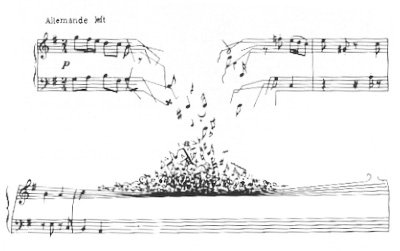
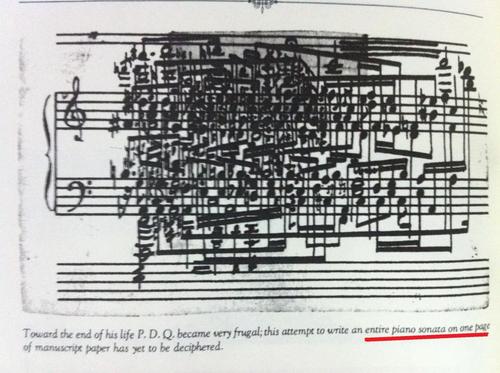
Maybe one of these PDQ documents is the tab for the above? ;-)
Jack Baker - Posted - 12/12/2015: 17:27:55
Hi Hans,
Do you know Thierry Schoysman? He is coming to visit with me next Wednesday and stay at my apt. in NYC through the weekend. He and Bill played a lot together in Belgium. Thierry is a wonderful player and we've lots of fun over the years...
We'll have a chance to play together and catch up on a lot of things with regards to Bill...I haven't seen Thierry in several years and it should be lots of fun when we get together...Jack p.s. then he goes to visit with Claire...pps. Peter Schickele's music has always fascinated me. 
Originally posted by howsy-bee
Edited by - Jack Baker on 12/12/2015 17:34:17
howsy-bee - Posted - 12/12/2015: 23:37:08
Jack, I was going to reply that I never heard of him, but on visiting his Facebook page I realize that I saw him play mandolin with the Sons of Navarone at the La Roche Bluegrass Festival in France, on 31 July, this year. Have fun!
robbif - Posted - 12/13/2015: 07:27:02
Boy, I am so lucky to have met and known some great musicians!
Marty Cutler told me in addition to Bill Keith, Eric Weissberg and Happy Traum were also involved.
Then Happy emailed me with confirmation via this great photo...
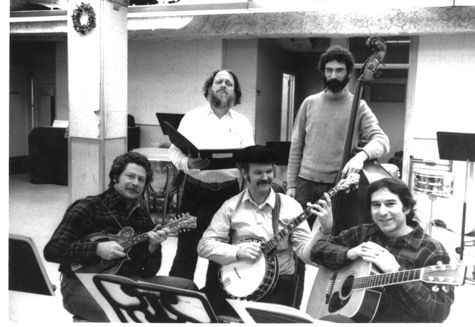
Standing: Peter Schickele, unknown bass player
Sitting: Eric Weissberg, Bill Keith, Happy Traum
(photographer unkown at this time)
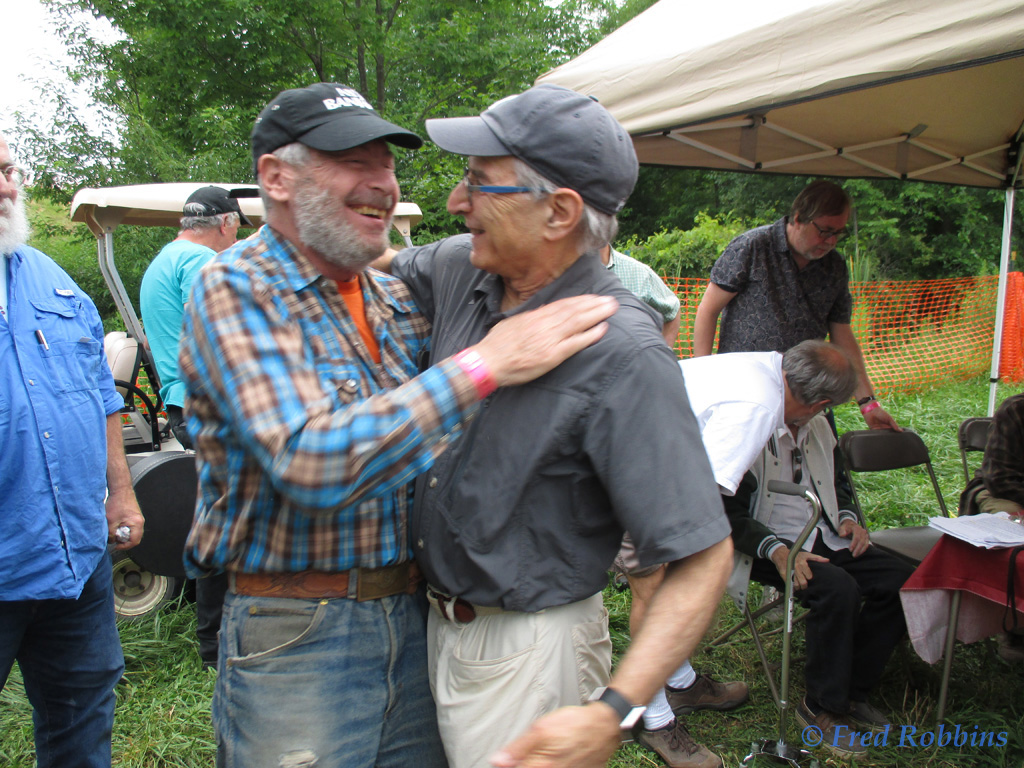
And here are longtime friends Eric and Happy at the Keith Style Banjo Summit, Grey Fox 2015...
robbif - Posted - 12/13/2015: 11:12:06
Thanks to Tom Lindtveit - the bass player in the PDQ Bach photo above is Don Palma.
howsy-bee - Posted - 12/13/2015: 11:45:15
Thanks, Fred, for the update! Most likely Bill told me about the involvement of Eric and Happy, but I have forgotten it.
robbif - Posted - 12/13/2015: 12:04:14
quote:
Originally posted by howsy-bee
Thanks, Fred, for the update! Most likely Bill told me about the involvement of Eric and Happy, but I have forgotten it.
Thanks to you Hans, for starting this entire "mini-project"!
Edited by - robbif on 12/13/2015 12:05:08
JAFO - Posted - 12/13/2015: 15:18:47
I asked Bill about the PDQ album several years ago. He smiled and laughed hard, said it was a 'lot of fun'. I can picture those guys working hard and having a blast.
On a side Note Thierry will be in Woodstock on Thursday, 12/17 sitting in with The Saturday Night Bluegrass Band, the one that Bill always played with. Eric Weisberg is their banjo player now. If anybody is n the neighborhood, stop on by. PM me for more info if you need it.
The Punch Brothers will be in Woodstock tomorrow for a one night gig on Monday. Big banjo week in this little town.
Tom
robbif - Posted - 12/14/2015: 06:20:21
Another cool bit of PDQ Bach history thanks to another banjoist, Ira Gitlin.
With permission...
Peter Schickele and I are both alumni of Swarthmore College in
Pennsylvania. I met him in '82, at his 25th anniversary reunion, two
years after I graduated. As I understand it, one year there he roomed
with Ralph Rinzler (Swarthmore '55), which contributed to his pretty
decent knowledge of bluegrass. A few years later I and my former
bandmates from my college days were back at Swarthmore performing
"Blaues Gras" with Schickele and the college's chorus and orchestra. It
was--how shall I put this?--a total hoot. Shickele was just as wacky in
person as his persona might lead you to believe, and the text of the
cantata gets funnier the closer you look at it!
robbif - Posted - 12/23/2015: 15:24:45
Hi Folks,
Recently Happy Traum posted my photo of him and and Eric Weissberg at Grey Fox 2015 before the Keith Style Banjo Summit..
Well, today, since the pre-Christmas scramble has quieted down, I was finally able to take some time
and put together the few photos I took before recording the historical event.
frobbi.org/slides/prekeithsummit/
I hope you enjoy the bittersweet memories as much as I have.
I want to repeat my sincere thanks for all the generous and talented members of our extended bluegrass family
that made this historic and emotional tribute possible.
And my wishes to all for a blessed holiday season and a healthy and musical New Year.
Fred
captbanjo - Posted - 12/23/2015: 16:13:45
Thanks Fred, great album. I love the shots of Tony with his arm around Bill!
This makes me realize how fortunate I've been to meet and know these stellar men and musicians.
Wayne
Jack Baker - Posted - 12/23/2015: 16:17:01
Wonderful post Fred,
Have a very Merry Christmas and Holiday...Jack
Originally posted by robbif
Hi Folks,
Recently Happy Traum posted my photo of him and and Eric Weissberg at Grey Fox 2015 before the Keith Style Banjo Summit..
Well, today, since the pre-Christmas scramble has quieted down, I was finally able to take some time
and put together the few photos I took before recording the historical event.
frobbi.org/slides/prekeithsummit/
I hope you enjoy the bittersweet memories as much as I have.
I want to repeat my sincere thanks for all the generous and talented members of our extended bluegrass family
that made this historic and emotional tribute possible.
And my wishes to all for a blessed holiday season and a healthy and musical New Year.
Fred
JAFO - Posted - 12/23/2015: 16:58:39
Fred, I thought I was done with the tears. Dammit. Such a stressful and wonderful day all at the same time, I wasn't even aware you were taking these photos. I show up in a couple and I can see the stress in my face. I have to work on that. But what I got out of them, that I missed with my tunnel vision in the moment was the Love that was present in that backstage moment. Claire, with Bill, both enjoying very dear friends that they truly love and Bill's face showing just a little bit of his apprehension at what was to come.
I thought I had gotten control of my emotions because when I sat in Bill & Claire's living room this past weekend listening to Thierry run through all the tough tunes in Bill's catalog, and even playing a little with him, it was nothing but joy. Matt, Theirry, and I swapped lots of 'Bill Stories' and laughed a lot. Now you bring this out and I .. well, lets just say I miss him. Please let me know if you have anymore surprises coming before they hit the public. I(we) have one for you, but I am sworn to secrecy and it will come out in about 6 months. Don't worry, you will know well before the rest of the world and no pre-planning or cameras are required like last year. It's a little thing just for our little Grey Fox family, not of too much interest to the public.
Tom
robbif - Posted - 12/23/2015: 18:11:48
Tom,
Thanks for your thoughts.
For me, in that final photo with Claire I personally see a twinkle in Bill's eyes.
The bad news, or good news: I don't think I have any more "surprises" of my own. But I will continue to add appropriate items to my Keith tribute page at frobbi.org/billkeith
Fred
robbif - Posted - 01/01/2016: 06:18:35
Auld Lang Syne
Bill Keith & Jim Rooney, Gerdes Folk City, 1965
Recorded by Marc Horowitz
frobbi.org/audio/horowitz/gerd...0Syne.mp3
robbif - Posted - 01/01/2016: 14:15:28
Banjo Newsletter editor Donald Nitchie started my new year off beautifully.
I'm thankful and honored that he used my photo of Bill Keith on the cover
of the January 2016 issue in Bill's memory. It's my favorite image of my friend
from his 2013 Grey Fox banjo workshop.
Donald also generously made two articles from that issue available to the public.
Excerpt from Keith Biography by Bob Carlin banjonews.com/2016-01/from_the...aphy.html
Callous Thumb: Remembering Bill Keith banjonews.com/2016-01/callous_...eith.html
I've added all of the above to my tribute page... http://frobbi.org/billkeith/
Edited by - robbif on 01/01/2016 14:28:45
banjoken - Posted - 01/02/2016: 16:22:11
Hi Fred,
I have been enjoying your site, and a lot of your fantastic videos of Bill, and others too without Bill!!!!
I want to thank you for sharing that moment between you and Bill. That is what I think that is. That obviously is not a pose for a camera, that expression is obvious respect and admiration for a friend with a camera and not for a "photographer."
Ken
robbif - Posted - 01/02/2016: 19:29:49
Hi Ken,
Thanks for you kind thoughts. I extremely blessed to have been one of Bill's literal thousands of friends and admirers to whom he left indelibly warm memories.
Fred
robbif - Posted - 01/03/2016: 10:18:55
Here's a group jam on the last day of the Hudson Valley Bluegrass Association's Evolution of Bluegrass
class series for the Marist Center for Lifetime Study in 2012...
Andy Bing-dobro, Kalia Yeagle-fiddle, Rick Brodsky-bass, Joan Harrison-banjo,
Wayne Fugate-mandolin, Korey Brodsky-guitar, Bill Keith-banjo
VIDEO: youtu.be/lsp2dy4W698#t=20m10s
robbif - Posted - 01/13/2016: 08:38:34
New Bill Keith Photo
Kevin Lynch just sent me one he took in 1995 of Bill, Wynn Fay, and Jim Rooney.
I created an additional page in my Bill Keith Tribute for great contributions like this.
frobbi.org/billkeith/photos.html
Thanks Kevin!
Fred
Retro - Posted - 01/13/2016: 15:10:00
quote:
Originally posted by robbif
New Bill Keith Photo
Kevin Lynch just sent me one he took in 1995 of Bill, Wynn Fay, and Jim Rooney.
I created an additional page in my Bill Keith Tribute for great contributions like this.
frobbi.org/billkeith/photos.html
Thanks Kevin!
Fred
Thanks Fred that Rich & Taylor that Bill is wearing is priceless!
robbif - Posted - 01/16/2016: 09:54:07
Hi Folks,
In just the last few days I've been blessed with several new Bill Keith treasures.
Tom Morgan sent me the result of his wonderful effort gathering tribute autographs...
frobbi.org/billkeith/BNL2016co...phed.html
Hans Holzherr contributed two full 1970s concert recordings from Switzerland...
frobbi.org/audio/hans/mahogany/index.html
I discovered Jim Rooney's podcasts which he generously allowed me to link...
frobbi.org/billkeith/rooneypodcasts.html
They're all available on my tribute page: frobbi.org/billkeith/index.html
My continued thanks to Tom, Hans, and Jim!
Fred
robbif - Posted - 01/25/2016: 18:11:27
Two New Bill Keith Finds
Thanks to heads-up from friends today, I located these...
Banjo Workshop, Grey Fox - Keith, Shelor, Trischka & Washburn, 2005
youtube.com/watch?v=xxS5-6Au2m0
Salt Creek tribute to Bill Keith, Midwest Banjo Camp, 2015
youtube.com/watch?v=FAnqtg1tLRg
They're now in my tribute page: frobbi.org/billkeith/
Edited by - robbif on 01/25/2016 18:16:51
robbif - Posted - 01/30/2016: 16:33:03
Another Bill Keith Find
Last weekend I saw Phil Zimmerman with his group Last Fair Deal
at Daryl's House in Pawling, NY. I finally got to meet him in person
after years of exchanging emails. He told me this Bill Keith story...
Marcia and I were at Banjo Camp North in May, 2003. We sat in on one of Bill's classes.
We were so impressed with his presentation and diagrams that when the class was over,
we asked him to sign the flip chart pages instead of tossing them. He was amused and,
I think, flattered. They've been kept safe in a mailing tube since then. When he passed,
we thought we should frame them and share them. We'll have them at Joe Val, and at Guitar
& Mandolin Camp North in April, and Banjo Camp North in May. musiccampsnorth.com/
I asked Phil to photograph them for my Bill Keith Tribute, and thanks to his generosity, here they are...
frobbi.org/billkeith/Keith-cha...phed.html
robbif - Posted - 02/06/2016: 08:28:55
robbif - Posted - 02/06/2016: 15:39:50
Larry Marschall Plays Bill Keith Tunes
I've been lucky, blessed, and busy in the last few days with so many contributions coming in.
Here's yet another one...
Larry just pointed these out to me, recorded at the Christchurch Folk Music Club in New Zealand in 2014,
along with Tony Hale and Neill Pickard
Devil's Dream/Sailor's Hornpipe (Larry speaks about Bill): youtube.com/watch?v=OfV_Aw-P5ek
Caravan: youtube.com/watch?v=dr-b0BQV34c
Salt Creek: youtube.com/watch?v=q1xaV65MqVc
I've added them to my tribute: frobbi.org/billkeith/
robbif - Posted - 02/08/2016: 10:43:50
More Bill Keith Recordings
Thanks to Thierry Schoysman who spotted more of Takehiko Saiki's recordings with Bill Keith than I knew about.
I now have the complete list and have made a separate page: frobbi.org/takehikokeithcollection.html
I've corrected the link in the Audio section of the main tribute page: frobbi.org/billkeith/index.html
Enjoy!
robbif - Posted - 02/12/2016: 10:46:36
Yet More Recordings with Bill Keith
Takehiko Saiki has just given me 5 more recordings with Bill, including 2 with Monroe.
I've added them to Take's page frobbi.org/takehikokeithcollection.html
and marked them with an asterisk*.
Note: On each YouTube screen, be sure to scroll down and
click on SHOW MORE to see complete song and performer lists!
robbif - Posted - 02/27/2016: 06:34:06
Here's a stunning super-star-studded version of "Caravan"...
I've added a link to it in the Video section of my tribute: frobbi.org/billkeith/
Edited by - robbif on 02/27/2016 06:35:48
robbif - Posted - 03/04/2016: 07:33:50
Another Bill Keith Recording Right Under My Nose
A couple days ago, Tekehiko Saiki asked me if I knew of the album "12-String Dobro - Tut Taylor & The Folkswingers".
I sure did. I remembered having the beautiful, translucent-red World Pacific vinyl. It still looks as good as day 1!
What I didn't remember was that "BILLY" Keith (as the liner notes called him) was on it!
Take just added a link to the album: youtube.com/watch?v=ylsPebkUm1s
I added the link to my page of Take's Bill Keith collection: frobbi.org/takehikokeithcollection.html
I still get a kick out of the series of World-Pacific "12-String Guitar" albums by Glen Campbell
where "The Folkswingers" were actually The Dillards.
From Greylock to Bean Blossom - Posted - 03/04/2016: 10:19:40
quote:
Originally posted by robbif
Another Bill Keith Recording Right Under My Nose
A couple days ago, Tekehiko Saiki asked me if I knew of the album "12-String Dobro - Tut Taylor & The Folkswingers".
I sure did. I remembered having the beautiful, translucent-red World Pacific vinyl. It still looks as good as day 1!
What I didn't remember was that "BILLY" Keith (as the liner notes called him) was on it!
Take just added a link to the album: youtube.com/watch?v=ylsPebkUm1s
I added the link to my page of Take's Bill Keith collection: frobbi.org/takehikokeithcollection.html
I still get a kick out of the series of World-Pacific "12-String Guitar" albums by Glen Campbell
where "The Folkswingers" were actually The Dillards.
Fred, this is the only Campbell 12 string guitar album I know of and it had Roy Clark on banjo. Were you referring to some else?
en.wikipedia.org/wiki/The_Asto..._Campbell
thanks,
Ken
robbif - Posted - 03/04/2016: 10:56:26
quote:
Originally posted by From Greylock to Bean Blossom
quote:
Originally posted by robbif
Another Bill Keith Recording Right Under My Nose
A couple days ago, Tekehiko Saiki asked me if I knew of the album "12-String Dobro - Tut Taylor & The Folkswingers".
I sure did. I remembered having the beautiful, translucent-red World Pacific vinyl. It still looks as good as day 1!
What I didn't remember was that "BILLY" Keith (as the liner notes called him) was on it!
Take just added a link to the album: youtube.com/watch?v=ylsPebkUm1s
I added the link to my page of Take's Bill Keith collection: frobbi.org/takehikokeithcollection.html
I still get a kick out of the series of World-Pacific "12-String Guitar" albums by Glen Campbell
where "The Folkswingers" were actually The Dillards.
Fred, this is the only Campbell 12 string guitar album I know of and it had Roy Clark on banjo. Were you referring to some else?
en.wikipedia.org/wiki/The_Asto..._Campbell
thanks,
Ken
Here's the first one: discogs.com/Folkswingers-12-St...e/2921110
If you Google: WORLD-PACIFIC 12-STRING you'll find more.
robbif - Posted - 05/26/2016: 18:12:04
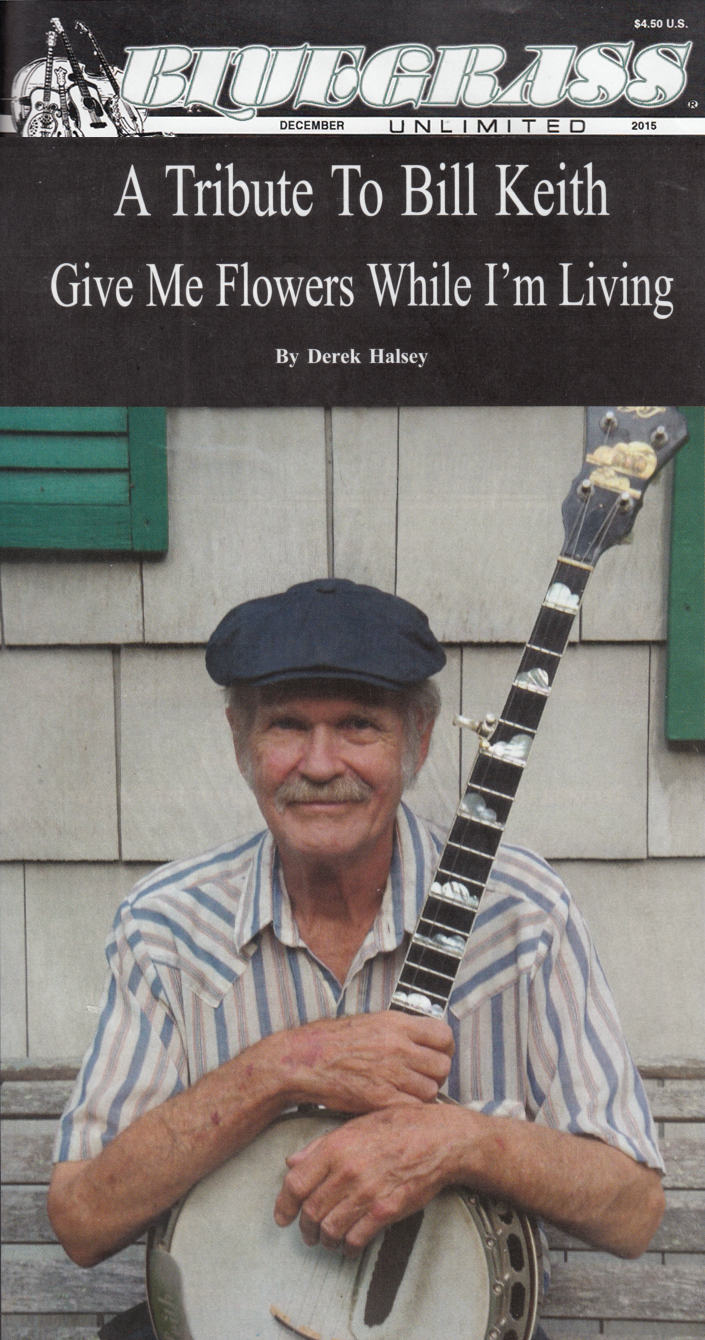
I'm very gratified that Bluegrass Unlimited Magazine and author Derek Halsey have granted me permission
at add Derek's December 2015 Bill Keith tribute article to my tribute pages.
frobbi.org/billkeith/BillKeith...y-Dec2015
robbif - Posted - 08/30/2016: 13:19:34
Jim Rooney has created a beautiful tribute to our mutual friend Bill Keith...
jimrooneyproductions.com/bill-...o-master/
I'm proud and honored Jim has allowed me to add a link to my tribute to Bill...
frobbi.org/billkeith/
I'd also like to thank Jim and congratulate him for being selected for the well-deserved
2016 IBMA Distinguished Achievement Award.
Fred
j2buttonsw - Posted - 09/03/2016: 01:43:14
I had the foresight to copy Bill Keith's BHO autobiography series he wrote in 2005. Here they are
20 Aug 2005
Hello everyone,
I recently got a copy of the new Earl Scruggs book and have been checking it out. And I welcome this opportunity to answer your questions, and maybe to ask a few of my own... I'll try to keep things short and factual, although the whole story is rather long and convoluted, too long for a single post. As I see it (and lived it), the story breaks down into several 'chapters':
* before meeting Earl (creating my big book of tabs)
* the meeting Earl describes in his first book (who was there, his"audition" of my tabs)
* going to Nashville at his request (staying at Earl's house and working on the book, 'jamming' with Earl, going to the "morning show" tapings, to the Opry and to other gigs)
* Bill Palmer's visit with Earl (recounted on his website)
* the "Scruggs-Keith" tuners (when and why his name was put on them, and when and why it was taken off; the letter from Louise)
* the confrontation about royalties (at Earl and Louise's house on Donna Drive)
* the lawsuit and settlement (maybe you never knew...)
* subsequent encounters (in Dayton OH, at the Grey Fox Festival, at the Johnny Keenan Festival)
* the new book (revisionist history? And are those Schaller tuners on page 20?)
* what next?
(There are also a few other 'chapters' concerning Earl that are not related to the book...)
First, in answer to the questions above:
Banjoman -- No, I didn't send the tabs in the mail -- Earl first saw them in Baltimore in 1962, as he mentions.
Banjoken -- I have a picture-and-songbook published by Peer with some of his tunes in music notation. These transcriptions are very inaccurate. You can take a look at Peer's book at http://www.bgcollector.net -- it's the one published in 1962.
Adk Rebel -- Thanks for the kind remarks and for mentioning my new book.
tomt -- In addition to the acknowledgement, I'm also mentioned on page 22 and page 60
randybartlett -- That's true, I never had the chance to proofread the first edition.
Howsy-bee -- That's also true, and remains true to the present day...
Herr_Grepper -- Yes, that's just one of the misprints in the first edition. Earl gave me two copies of the first edition (which I still have), signing one "to my good friend Bill Keith". This copy also has a stamped entry on the same page when it was entered as evidence...
I'll try to post again this weekend and cover the first 'chapter' or two for those who are interested. Thanks for your patience.
Bill Keith
21 Aug 2005
Hi everyone,
I hope you'll bear with me as I fill in a little background to my first meeting with Earl Scruggs, and what transpired there. I'll try to be as concise as possible...
______________________________
I bought my first 5-string banjo in September, 1957, after four years of piano lessons followed by several years of playing the tenor and plectrum banjos. I immediately got Pete Seeger's instruction book, and the first thing I learned from it was the tablature system. I worked my way through the book to the chapter on the 3-finger style, where Pete suggests getting an Earl Scruggs record and a Don Reno record, which I did. The Earl Scruggs record was "Foggy Mountain Jamboree", and as soon as I heard it, I knew I wanted to play like that. But there was no tab available, and the music notation that was available from Earl via his publisher, Peer International, was grossly inaccurate. So I decided to make my own tabs, following Pete Seeger's example.
Using a reel-to-reel recorder to slow Earl's recordings to half-speed, and thanks to my piano training, I was able to write down in music notation the notes that he played, then to 'reverse-engineer' the tablature from the notes. This process was very time-intensive -- at first it took me almost three hours to transcribe and tab about three minutes of music. So in the spring of 1958, I began transcribing and tabbing all of Earl's instrumentals from any and all recordings I could locate. I continued to add to the book over the next three years, and by the summer of 1961 I had 24 instrumentals (several had all the banjo breaks written out) and four vocals transcribed.
In the fall of 1961, I enlisted in the Air Force and after basic training I was on active duty until July, 1962. That fall I moved to Washington, D.C. to play banjo with Red Allen and Frank Wakefield and the Kentuckians. I was staying with Tom Morgan, a well-known and respected luthier and Gibson banjo authority, learning banjo luthiery, copying tapes of bluegrass shows, and working on my tabs during the day, and playing with Red and Frank in the evenings and on most weekends. When Tom and I heard in December that Flatt and Scruggs were appearing in concert at Johns Hopkins University in Baltimore we decided to go, and I took the Peer songbook and my book of tabs along with me. I worked on these tabs off and on for more than four years, and they were mostly complete before I met Earl for the first time -- they were not done at his request.
The show at Johns Hopkins University (Flatt & Scruggs were opening for Merle Travis) was produced by Manny Greenhill whom I'd known for several years, and when it was over Manny arranged for Tom Morgan and me to visit with Earl in the 'green room' backstage. That was my very first meeting with Earl and Louise Scruggs -- in mid-December 1962, just before my 23rd birthday. After the usual pleasantries, the first question I asked Earl concerned the accuracy of the transcriptions of his music that Peer had published in the most recent (1962) songbook. I played one or two of them as written, and he agreed that they were not at all accurate. He said he couldn't read music so he had had no way to check on the accuracy of these tunes, but he had trusted Peer International to do it right since they were music publishers.
So I showed him my book of tabs which he looked through carefully, then he asked what 'tab' was -- he had never seen it before. I explained how it works, so he handed me his banjo, opened my book to "Home Sweet Home", and asked me to play it from my tab. While I was playing he had his head turned more or less toward my book, but I could see that he was watching my right hand out of the corner of his eye. When I had finished, he said that I had played it absolutely correctly. Then he turned to page 76 in my book for "Sally Goodwin", which I also played for him. Except for one mistake that he pointed out, he said that I had played it correctly, too. (My mistake was holding the third string fretted at the 9th fret, instead of bouncing it on that fret only when that note was needed. The notes I was playing were correct, except that the E was being held too long...)
After consulting with Louise, Earl asked me for my name, address, and telephone number and he gave me his. Then they invited me to Nashville to work on his book. At that time the Air Force required me to report for duty one weekend a month, so my trip to Nashville didn't take place until January, 1963.
______________________________
I'll try to post the next part in a day or two...
Bill Keith
27 Aug 2005
Hey folks,
Thanks for your interest and the encouragement to continue; this part is a little longer; perhaps too long... (?)
______________________________
At Earl's request, I flew down to Nashville in early January, 1963, and stayed at his house for the next few weeks to continue working on the tab for his book. I had written some of my tab with the numbers below the lines so I could read it more easily, but Earl wanted the tab to be like it was in the Pete Seeger book, with the numbers above the lines, so I had to rewrite some tunes so everything was consistent. Earl also asked me to prepare a 'lead sheet' in music notation for an original unrecorded tune of his -- "Nashville Blues". He submitted this lead sheet as part of his application for his own publishing company and shortly thereafter, "Flatt and Scruggs Publishing Co., Inc." was born (see the bottom of page 96 in the first edition). Incidentally, it was Earl's decision to include both music notation and tablature in the first edition.
Work on the exercises consisted of isolating the important 'licks' and right-hand patterns and presenting them in short repeatable phrases. It was at that time when these patterns were named -- I suggested the names "forward roll", "backward roll", "reverse roll", and "alternating thumb". Not long ago I ran across this bit of history on Bill Palmer's website (billpalmer.com): "When I went to visit Earl in his home in Madison TN back in 1963, I asked him what he called a certain roll, because I wanted to use the "official Earl Scruggs name" for it. Bear in mind that this was before "Earl Scruggs and the 5-string Banjo" was published. He said, "I never heard of a roll until Bill Keith showed me all of those tablatures of my tunes he had taken off my records. I just play the melody with my thumb or index finger and fill in the gaps with whatever is left over." Bill Palmer also adds: "The teaching tape that Earl did was done to a script Bill Keith wrote for him."
I remember showing Earl the symbol for repeating a measure and saying that we could put a number above it to indicate how many times it should be repeated. I suggested putting '12' above these measures, but Earl said "How about a thousand?" So that's what we put in the book!
We didn't spend all our time at his house working on his book -- I went with him to the WSM radio studios and watched as he and Lester and the boys taped about a dozen of the early-morning Martha White radio shows, and to the WSM TV studios for recording some of the shows which are soon to come out on DVD (and are already being circulated among 'tapers' and CD traders). And I rode with Earl and the boys on the bus to attend several jobs out of town. He also drove me around Nashville to show me the sights -- including Roy Acuff's new tombstone (and Roy was still alive at the time!). And once or twice when the weather was good, we went for short flights in his plane. Sometimes we just sat in his office and picked -- trading breaks on his tunes and playing back-up for each other. He occasionally played my banjo and I played his. He also played some guitar back-up for me, and I played a few Carter Family tunes on the autoharp. I recorded a couple of these 'jams', and still have a copy on CD...
One of the trips I made with Earl during this period was to the Grand Ole Opry at the Ryman Auditorium in downtown Nashville. I took my banjo with me and was playing with some of the other musicians that were warming up backstage when Kenny Baker walked in, listened a bit, then left. He returned a few minutes later with Bill Monroe, and they both stayed a while to listen. When I was leaving at the end of the evening, Kenny Baker approached me and told me that Bill Monroe wanted me to join his band. To say the least, I was elated and decided to accept the offer. But first I had to return home for a Air Force weekend meeting and to apply for a transfer to a similar unit in Nashville.
Shortly thereafter I returned by car to Nashville and at Bill Monroe's suggestion, took a room at the Clarkston Hotel on 7th Avenue. At the time, the cheapest rooms were only $14 per week! And while waiting to pay my bill one day in the attached restaurant, I noticed that the Health Inspector who had signed the restaurant's certificate was none other than Kirk McGee! There's now a parking lot where the hotel used to be...
Del McCoury also arrived the same day as I did, and we met at the hotel. He had his banjo with him; it turned out that Bill had also asked Del to play banjo with him. We both auditioned on a Friday night, in the same studio that I had been in to watch Earl record the Martha White radio shows, and when Bill discovered that Del was also a fine guitar player and singer, he hired us both. During the next few days I joined the Musicians' Union in Nashville and the following Saturday night I played for the first time on stage at the Ryman. For some reason, Del didn't join the Union until a few weeks later.
Even at that time I was aware that Bill Monroe and Flatt & Scruggs were not talking to each other, and that each of them knew that I was working with the other. So I talked the situation over with both Earl and Bill (separately), and neither said that it was a problem.
The Bluegrass Boys mostly worked on the weekends -- playing either on the Opry or out of town -- so during the weeks I frequently went out to Earl's to continue work on the book, which began to take shape. I met Burt Brent at that time, and learned that he would be writing an article on 'how to build a banjo', would take some necessary photos, and would also be working with me on the text and the exercises. Louise would be writing an article about the history of the banjo, Earl would be writing about his musical history, and Nat Winston, a neighbor of Earl and Louise's, would write the Forward. But it was clear that the music notaton and the tablatures were my responsibility. During the ensuing weeks I drove to Fort Campbell, KY two or three times to visit with Burt Brent and his first wife, Belinda, and work with him on the text and the exercises. I don't recall that Earl accompanied me on any of these trips. Nor do I recall meeting Warren Kennison, Jr. during this time or hearing him play, but I do remember that Burt showed Earl and me a tab of "Sally Goodwin" that Warren had prepared. After looking it over and pointing out that all the measure lines were in the wrong places, I thought it best to use my tab which Earl had already approved. Check out Warren's tab of "Sally Goodwin" in the new book -- any musician that's familiar with the tune and with writing music will tell you that as it's written all the phrases start in the middle of the measure rather than at the beginning. This error in transcription is the first one I found in the new book, and there are others...
At some point, once the exercises were in final form and sequence, Earl decided that there should be a recording of them to accompany the book. So I brought in my reel-to-reel tape recorder, microphone, and a reel of blank tape and we set it up in Earl's guest bedroom. But there was a problem -- Earl couldn't read the tabs of these exercises, so he asked me to play each exercise and then record him playing what I had just played. (He didn't always get it right -- on several occasions, I had to rewind the tape and play the example again a few times, so he could record it as it was to appear in the book.) At the end of the day I handed him the reel of tape which, after a little editing, was turned over to Nashville Record Productions who pressed the "Earl Scruggs and the 5-string Banjo" album that many are familiar with. So it cost little or nothing to produce the tape, and from personal experience I knew that having a similar album pressed cost me less than 80 cents each...
At that time, Earl told me that he had decided that it was best to publish the book privately, and had several mock volumes made up with different grades of paper to see what it might look like and how thick it would be. He also said that since publishing and printing the book would be expensive, it would take some time to recoup the expenses, after which I would begin to receive my share of the profits. Of course I took him at his word, and we shook hands on the deal.
On one of my occasional trips to Boston for my monthly military meeting, I sat down with Dan Bump, a friend from college who shared a lot of interests with me, including the 5-string banjo. At the end of the afternoon we had drawings for the D-tuner that now bears my name. I returned to Nashville, and Dan had the prototype pair made by Loring Hall, another friend whose wife, June, taught me 'Devil's Dream'. She is also the great aunt of Jeff Coffin, who plays with Béla Fleck! Small world, or what?
Dan sent me the new D-tuners just before we left Nashville for a tour in California and I put them on my banjo out there and with the help of Walt Pittman, improved their appearance with better thumbscrews and hex nuts. He also made me a sliding 5th-string capo, which is still in use. Walt had worked on Earl's banjo; he replaced the old fingerboard with the bow-tie inlays with a new ebony fingerboard with the hearts-and-flowers pattern, and had made him an excellent pair of cam-style tuners, which Earl was then using. But the prototypes of my new D-tuners worked even better -- and still do -- so as soon as we got back to Nashville I showed them to Earl. He was very interested in them, and offered to help us market them.
The Air Force had somehow lost my records for several months which had left my weekends free, but I was finally assigned to a unit in Nashville and had to start attending meetings once a month, which interfered with my playing with Bill Monroe on certain weekends. For this and other personal reasons I decided that I would have to give notice before the end of 1963. In late November we left Nashville on what was to be my last tour as a Bluegrass Boy; our first concerts were in Miami, Florida, followed by an appearance in Town Hall in New York City on a Friday night, then an appearance on the Jamboree in Wheeling, West Virginia on Saturday night, then we were to open the following Tuesday in Hollywood California. Before leaving town I called Earl to let him know I would be away for a month, and he told me over the phone that John Kennedy had just been assassinated that morning...
The gig in Hollywood was at the Ash Grove -- the second time we had played there during my tenure. The first time, we appeared with Doc Watson, who was touring with Clint Howard and Fred Price at the time. During the week we were playing there, Bill and Doc started singing some songs together and by the end of the week they were doing a set on stage. Some of these appearances were recorded and issued later in Canada as a 'bootleg'. Also during that week we learned that the band that was supposed to play at the club the following week had cancelled, so Ed Pearl, the club owner, offered the additional week to Bill Monroe who accepted it. But since I had my last Air Force meeting in Nashville -- I had to report in or I would have been officially "AWOL". Since I was unable to play the last week at the Ash grove, Ed Pearl asked me to coach a young banjo player who would be taking my place. His name was... Ry Cooder!
So in mid-December I flew to Nashville for the Air Force meeting -- and to apply for another transfer back to Boston -- then returned to Brockton, Massachusetts, to spend Christmas with my family. During the next few days I finished the machining and assembly of the second prototype pair of Keith tuners, then left on a three-week vacation in Europe. (The highlight of that trip was seeing the Beatles play live at the Olympia Theatre in Paris!!) In mid-January I returned home and Dan Bump and I formed the Beacon Banjo Company, and I became it's first President. We invested some money, and started manufacturing the first Keith tuners (the first 100 pair were stamped with only my name). Earl had told us that we could only use his name to advertise the tuners if he were a part owner in the company, so we sold him some shares, added his and Dan Bump's names to the rest of the tuners, and began advertising them as "Scruggs-Keith Tuners". I'd point out that these tuners are pictured in the first edition of Earl's book mounted on a banjo as well as in parts, and the photo could not have been taken any earler than the spring of 1964. So at that time the book remained unfinished...
This seems like a good place to stop for now for now...
Bill Keith
6 Sep 2005
Hi folks,
Sorry to have taken so long to post again, but as some might say I've had 'other fish to fry'... And I can't post every day -- it takes me too long to write, reread, and edit each 'chapter' to be sure that I remain historically accurate and, to the best of my ability, objective. I appreciate all the encouragement to continue and to go into further detail, so I'll do just that.
But first, since it has to do with the development of the Keith tuners, I'd like to fill you in on my mechanical history up to 1964. It started when I was given an electric motor (110 volts!) when I was 5 years old. During my early years I took apart every motor, clock, and radio that I could get my hands on. In 1955 when I was 15 I bought my first car -- a 1931 Model A Ford that cost me $15! -- and spent part of the summer rebuilding the engine (rings, valves, and clutch) and chassis, (brakes, shocks, bushings, kingpins, etc.) and painting and preparing the car. I drove it the following year when I turned 16 and had my license. Two years later I sold the car and bought another Model A -- a 1930 roadster -- and rebuilt it. That was also the year (1957) that I saw someone playing a 5-string banjo for the first time, and shortly thereafter, bought one.
I sold the Model A roadster that year and bought a 1910 Brush car -- a rare single-cylinder car with a planetary transmission. I found a machinist willing to help me restore it, and ended up 'apprenticing' in his shop and learning how to operate lathes and horizontal and vertical milling machines. A year or two later I made the acquaintance of Dan Bump -- he had a Model T Ford, which also had a planetary transmission. One of my summer jobs during this time was working on a farm and maintaining the farm truck and tractor. And when I wasn't working, I was spending most of my time playing banjo.
When Dan Bump and I got together in 1963 to design the tuners, it seemed natural to us to incorporate a planetary gearset, since we were both familiar with it. By that time, both of us also had modern cars; I was driving a 1963 Chevy 327 with Isky hydraulic lifters, a high-performance cam, and headers. After totalling that car, my next one was a 1964 Jaguar 3.8S sedan, into which I'd stuffed another 327 Chevy engine with 12:1 compression, ported and polished heads, hot cam, headers, etc. Seven-inch wide Camaro wheels with Pirelli racing tires bolted right on, and on the end of the Muncie 4-speed close-ratio transmission I installed an adapter and a Ford R-11 overdrive (28%), which was a planetary unit. This fed via a shortened driveshaft into the Jaguar differential, in which I'd replaced the stock 3.56:1 differential gears with 3.96:1 gears from a Ford Thunderbird, which bolted right in. You do the math -- this gave great acceleration in town, and low RPM at highway cruising speeds. Yeah, I was a real 'car freak'...
__________________________________
On with the story:
After returning to Boston in mid-January 1964, there was a lot to do: I met with Dan Bump to discuss the performance of the 2nd prototype Keith tuners and to develop drawings for the first production run. We also went looking for a machine shop to produce the parts and found one nearby that would talk to us and that we felt comfortable with. The shop we found made high-precision small parts for the defense industry, but they were interested enough in our project to invest in an "automatic screw machine" (a cam-operated Swiss lathe) which could handle stock as large as 3/4". ( Incidentally, the tuners are still made in the same machine shop, although there have been many changes over the years -- the parts are now made on CNC machines, and the assembly is done at the machine shop. And the boss of the shop these days is the son of the man I talked with in 1964.)
I also got a call from Bill Nelson, the President of the Vega Company, who told me that Earl Scruggs would be endorsing the new Vega banjo (!) and he invited me to their factory in Boston to check it out. He had used a thin spun flange instead of a cast one, and when I saw it I thought to myself that it would never withstand the tension of the new plastic heads that were just coming into common use at the time, higher tension than the calfskin heads that I'd previously had to deal with. He shipped the banjo to Earl, and as it turned out I was right -- the flange failed during shipping, and when Earl opened the case, the pot assembly had fallen into the resonator and the banjo was unplayable. Earl returned it, and Bill Nelson added pieces of 1/8" brass plate to reinforce it before returning it to Earl.
Bill Nelson also asked me for the names of other well-known banjo players in Nashville -- he wanted to give them Vega banjos, too. I told him that in my opinion Sonny Osborne and Allen Shelton were the players most people were watching, and before long both of them also had Vega banjos. As it turned out, Earl kept his Vega on the bus with a broken head on it and told the folks who asked that the head had just broken the day before, so that tonight he'd be playing his Gibson...
By the end of January 1964, Dan and I had incorporated the Beacon Banjo Co., with myself as President and Dan as Vice President. We each invested about $2500 to get the ball rolling, and placed an order sufficient parts for 100 pair at the machine shop. Within a few weeks we had all the parts, and met at Dan's parents' house during the days to assemble and test the tuners before final knurling on a neighbor's lathe. These first tuners were stamped on the back edge with my name only. Earl and Louise had informed us that in light of Earl's agreement with the Vega Co. we could only use his name to advertise the tuners if he were part-owner if the company, so as I recall, Earl bought $1500 in Beacon Banjo shares. Once we had legal rights to use his name, we made another stamp to add the names "Bump" and Scruggs" to the tuners already stamped "Keith", and began to advertise "Scruggs-Keith" tuners in one of the few folk-music publications being published at the time -- Sing Out. Orders started to come in -- we were selling them direct to the customer at $50 per pair. By the end of 1964, we were ready to place our next order at the machine shop, this time for 500 pair.
When the Keith tuners were in production, we sent Earl a pair of them to try out. We soon heard from him that they didn't work! He sent them back, and we discovered that knurling the gearbox to close the tuner had caused the sides of it to "bell" slightly and the ring-gear was too loose in the housing; the gear would slip and the tuner couldn't bring the string up to pitch. The solution was to drill through the knurl along the parting line, and install a small roll-pin to prevent the ring-gear from turning. We subsequently changed the design, but the earliest Keith tuners all have these small pins in the knurl... We sent the tuners back to Earl, who reported that they now worked as they should. We also took a few photos of the tuners mounted on a banjo, and sent the photos to Earl for inclusion in the book.
Once the tuner business was up and running I asked Earl if he had any ideas for other products we could advertise and sell along with the tuners. He already had a deal with the Vega Company which included Earl Scruggs strings, so that option was out. But after giving this some thought, he mentioned that every time he happened to break a string onstage, someone always came up to him after the show and asked him for the broken string. My side of the conversation went something like this: "So Earl, are you suggesting that we should sell your broken banjo strings? What happens if we don't have enough? Should we break a few just to fill some orders?" Needless to say, we didn't pursue this idea. However, Earl had previously shown me three Flatt & Scruggs picure-and-songbooks originally published in 1950, 1951, and 1952. I thought there might be a demand for these so, with Earl and Louise's permission, Beacon Banjo Co. reprinted these three songbooks. I think I still have a few of them around here...
During this time in Boston I occasionally got together with David Grisman and Peter Rowan who had started an electric band called "Earth Opera"; the three of us appeared as the "Bluegrass Dropouts". For the most part I felt that playing bluegrass music was somewhat anticlimactical after playing with Bill Monroe, so when Jim Kweskin asked me if I'd like to play in his Jug Band, I accepted. For the next few years Dan Bump managed the Beacon Banjo Co.; I worked there during most weeks and went on the road with the Jim Kweskin Jug Band on the weekends. Life was good! I was having fun playing music with my peers, the Beacon Banjo Co. was doing well with the Keith tuners, and Earl's book with all my tabs in it had been completed and had come on the market.
But I was ill-prepared for the next development in the story; A few years later I happened to read an article in Time magazine that Earl's book had sold more than $1 million in retail sales, so the next time I was in Nashville I dropped in at Earl and & Louise's house at 201 Donna Drive in Madison to discuss the situation...
Sorry to have to stop here, but that's all for now...
BTW, I was interested to read Jack Baker's posts parrying questions about the identity of the Flint Hill Flash. I made a post or two on another thread concerning the Flash's identity, but received an e-mail from a friend of his asking me not to tell, saying "this man's contribution to the banjo world has been great." Can anybody tell me what this 'great' contribution is/was? Was it branding me "the Darth Vader of the banjo"? Or his incessant criticism of the melodic style? In the sense that the FHF is part of the story concerning Earl and the book, I'm reconsidering my silence...
Bill Keith
10 Oct 2005
Hello again,
Very sorry to have taken so long to follow up here. I was away on vacation for a week in Ireland -- got to play a tune with Tony Trischka and Béla Fleck at the Johnny Keenan Banjo Festival -- then had an unexpected bumpy detour on my way back to this thread via another. And "the gig from hell" last weekend. And some BeaconBanjo biz to take care of. And the results of my latest series of MRIs and the surgeeon's advice. But enough of all that for now -- I'm late with this installment...
First, thanks to one and all for your posts. I'll do my best to address all your questions in the near future.
And I'm looking forward to cripplecreeker's findings on the work of us 'scribes'. But in this regard let me quote Earl Scruggs from the opening pages of the first edition: (as much for the benefit of those who haven't read it as it is to establish the timeline)
"I would like to express my appreciation to Billy Keith (sic) and Burt Brent for the assistance they gave me in preparing this book.
"I first met Billy in 1962 when our show was appearing in concert at Johns Hopkins University. Billy came backstage after the concert and he had a notebook with him that contained the tablature to all my songs. We discussed the idea of Billy coming to Nashville to work with me on the book, which resulted in his spending several weeks with me working on the tablature.
"I met Burt Brent in the fall of 1964 when he was serving at the Fort Campbell Air Force Base in Kentucky. ..."
The notebook I had with me (which I still have) is a spiral notebook of music paper (about 140 pages), with most of the transcriptions written in pencil (easily correctible), in first draft. I wrote them out for myself, in order to learn to play the tunes. The book also contains tabs of tunes by Allen Shelton and J.D. Crowe and fragments from other players. All of the material is in music notation, with tab for much, not all. At that time in 1961 and '62, there were no photocopy machines -- no easy way to copy and distribute these tabs had that been my intent, which it wasn't. Randy B is correct. I was finishing school, then doing my time in the Air Force, then playing with Red Allen and Frank Wakefield -- I wasn't teaching.
Incidentally, I've been told that this notebook is copyritable in its present form, even today... Speaking of copyrights, I notice that some of the incremental exercises were copyrighted in 1966, but the first edition was copyrighted in 1968, the date of the first printing. What does this mean? You tell me...
Bear0422: I'm saying that one shouldn't distribute (which I believe is to "publish") someone's material without their permission. But I don't believe that to "produce in any printed form" -- which I take to include transcriptions (tabs) -- for one's own use requires permission. Let me add that there's a big difference between the recorded tunes and their representation on paper. Of course I have no claims on the recordings of the tunes or their arrangements, but I do feel that the tablature itself, a result of my efforts, has value. It certainly turned out to be valuable to Earl and Louise! And I agree with wkb28791 and oughtsix's conclusions -- the money was and is a major factor. But it couldn't be the whole story -- right or wrong, Earl and Louise already have the money, so why should they bother removing my name, the photos of the Keith tuners, the exercise I suggested, and attempting to revise history in the new book? In my opinion, it goes much deeper than the money...
The photos of the Keith tuners that appeared in the first book on page 22 have been replaced in the new book by a photo of the Schaller copies on page 20. Here's a recap of that story: after the Gibson Company was purchased from Norlen Industries by Henry Juskiewicz and relocated to Nashville, they introduced the Earl Scruggs model with Schaller tuners as standard equipment. A year or so later I got a call From Charlie Derrington, the gifted luthier who rebuilt Bill Monroe's mandolin who was working for Gibson at the time. Charlie told me that the Schaller tuners had proven to be unreliable, and he wanted to know if Gibson could purchase the Keith tuners for factory installation. I referred him to Dan Bump, acting president at the time, and they came to a deal; Gibson submitted a purchase order for 1000 pairs of Keith tuners. But shortly thereafter, Beacon Banjo received a letter from Louise Scruggs saying that our D-tuners were unacceptable, since they had the name "Keith" on them. Somewhere in the archives of Greg Rich's posts here on the Hangout, he mentions being present during a big argument between Earl & Louise and Gibson about this... (Can you give us any more details about this, Greg?) In any case, I informed Earl & Louise that we could supply tuners without the name Keith on them, but under no conditions would the name "Scruggs" appear on them, either. We compromised by stamping them "The Gibson Banjo Tuners". I heard later through the grapevine that Charlie Derrington had been fired... Could it have been because of this? Are you out there, Charlie? Could you please enlighten us? Incidentally, Gibson did purchase all 1000 pairs and then some more, but it took them a few years to do it, taking delivery of only 15 or 20 pairs at a time, and taking up to 90 days to pay for them. I finally had to put Gibson on COD terms, where they shall remain...
Along with those early Earl Scruggs models, Gibson furnished a small pamphlet in which Earl provided details about himself, the banjo and how to care for it, and the tuners. On one page he describes how he had come up with the idea for the tuners years previously, without specifiying that his idea was the cam-style tuners. On the next page of the pamphlet, Earl explains how to adjust the tuners, but he's describing how to set the Keith tuners, not the cams. To me, the clear and purposeful implication of this juxtaposition was that he had invented this new tuner design. Yet another attempt to co-opt someone else's work, and yet again, that someone was me. I fired off a letter to Gibson objecting to this implication, and I'm quite sure that the pamphlet was removed from circulation.
But we may be back to square one on the Gibson-Schaller connection; since seeing the photo of the Schallers in the new book, I've come to the conclusion that Earl & Louise are endorsing Schallers now. Consequently, I've advised Andy, the purchasing agent at Gibson OAI, that I could no longer fill their orders for Keith tuners unless each and every order came with a letter which I could make public, signed by Earl & Louise, that the Keith tuners were their choice for factory installation. Gibson hasn't placed any orders since then, and frankly, I could care less what tuners they choose to put on them -- Beacon Banjo is doing just fine without them. But since this thread is in the "Product Reviews and Shopping Advice", I'd advise any prospective customer of an Earl Scruggs model to inquire before buying, and think twice about what he or she is getting for the money.
Perhaps most of the above is of little or no interest to many readers who are waiting to hear what happened when I went calling on Earl & Louise at their home on Donna Drive in Madison after reading in Time Magazine that the book had enjoyed more than one million dollars in sales. Perhaps this part of the story will seem anti-climactical, but here goes: Earl opened the door and invited me in. We sat and chatted for a while about various things, then I raised the subject of the book -- and the money. {the following dialog may be approximate, but the meaning was unambiguous} Louise answered, chuckling: "You should have had a contract." I pointed out that I did have a verbal agreement with Earl and had shaken his hand -- and that was tantamount to a legal contract. Louse countered with: "Well, you can try to take that to the bank." and tried to change the subject. I began to get the picture -- I'd been had... During all this, Earl just sat there -- he never said a word, despite my further remonstrations. I finally decided that more conversation with them would lead nowhere, and I left, very disillusioned and angry, feeling betrayed by the man whom I had held in such high esteem. On my way home, I considered my options, including suing Earl & Louise for breach of contract and fiduciary trust...
But all that's going to have to wait until my next post later this week.
Bill Keith
and that was his last post (AFAIK). I met him a couple of times in 2005 (at the Johnny Keenan Banjo festival in Ireland as mentioned above) and he was an amazing fellow.
Terms of Use | Privacy Policy | Privacy Consent (EU/GDPR Only)
Copyright 2026 Banjo Hangout. All Rights Reserved.