DVD-quality lessons (including tabs/sheet music) available for immediate viewing on any device.
Take your playing to the next level with the help of a local or online banjo teacher.
Weekly newsletter includes free lessons, favorite member content, banjo news and more.
Premier Sponsors


|
Please note this is an archived topic, so it is locked and unable to be replied to. You may, however, start a new topic and refer to this topic with a link: http://www.banjohangout.org/archive/310406
Tom Hanway - Posted - 10/22/2015: 11:14:21
Celtic fingerstyle on a 5-string banjo refers to a broad set of fretting- and picking-hand techniques used to play traditional melodies from various Celtic lands, including Ireland, Scotland, and Wales, also ex-Celtic lands, e.g., Cumbria and border counties in the British Isles, and in the Celtic Diaspora.
It incorporates an emerging playing method, a vast repertoire not limited to ITM (Irish traditional music), and a tune-focused style that takes into account the sean nós (Gaelic for "old-style") that uses variation, ornamenting tunes as a rule, not the exception. While it can take on board ideas from the tenor banjo, the 5-string banjo does not have to imitate it, especially when playing slow airs, harp tunes, hornpipes, and tunes that have wide interval leaps.
In fact, the 5-string can borrow tunes and embellishment ideas from other traditional Irish and Celtic instruments, almost all of which have non-Celtic continental origins, including the human voice in its range of expressions, glottal stops, and the like. I'm not talking about dynamics (playing louder and softer); quite the contrary, it's about improvising and playing variations that stay close enough to the basic melody so as not to lose it. The decorations are the melody in action, improvised freely, and not something incidental to it.
Please see The Four Celtic Modes and Complex Tonality thread.
* * *
Seán Ó Riada, who gave us Ceoltóurí Chualann (later The Chieftains), wrote in Our Musical Heritage, "The sean-nós singer is unaccompanied. Sean-nós singing (like Ralph Stanley does - 'O Death') demands great skill and technique because a good deal of sean-nós song is improvised, and the singer must know how to improvise in the proper style." Harmony can come in later, but at the core of the tradition is the individual expressing himself using what Ó Riada terms the Variation Principle, "where the variations must not interfere with the basic structure of the song.... The variations of course are on a miniature scale."
It is my goal to help students, privately and online, once I get a few family things in order. It's a difficult time for the family since we lost mom, Elena (88), last month. She was my biggest fan and supporter when I first picked up the banjo back in the mid-'80s. I'll be traveling back and forth between Ireland and the States quite a bit to visit my dad, who turned 91 in October 2015.

I can be found in BHO, in private messages if you have any questions or need help with the tunes in any of the collections.
I will be doing Skype lessons once I get settled. It's also time to put together some beginning instructional videos demonstrating the Celtic fingerstyle banjo method.
All the Best ~ Tom
Edited by - Tom Hanway on 02/05/2017 03:53:22
islandgirl - Posted - 10/22/2015: 12:07:48
Alright!!! The perfect music to play on my Stelling Swallowtail.
Tom Hanway - Posted - 10/22/2015: 14:58:11
quote:
Originally posted by islandgirl
Alright!!! The perfect music to play on my Stelling Swallowtail.
Ah, you just made my day! Blessings to you!
All the best ~ Tom

Tom Hanway - Posted - 10/23/2015: 09:55:31
Tom Hanway - Posted - 10/24/2015: 22:00:31
Elderly Instruments is one of the many reliable dealers that stock and ship Tom Hanway’s 4 books and CDs virtually overnight. Here are the links and a product review by Bill Keith about the seminal Irish and Celtic 5-String collection, Complete Book of Irish & Celtic 5-String Banjo:
20 O'CAROLAN IRISH CLASSICS FOR 5-STRING BANJO AND ALL INSTRUMENTS (2015)
EASY IRISH AND CELTIC MELODIES FOR 5-STRING BANJO: BEST-LOVED AIRS AND SESSION TUNES (2013)
EASY IRISH AND CELTIC TUNES FOR 5-STRING BANJO: BEST-LOVED JIGS AND REELS (2012)
COMPLETE BOOK OF IRISH & CELTIC 5-STRING BANJO (1998)
Review by Bill Keith:
“With the publication of the Complete Book of Irish & Celtic 5-String Banjo, Tom Hanway has produced a remarkable resource. Far from being a simple collection of tablatures, this book is the fruit of years of Tom's research, and reveals his in-depth knowledge of and love for Irish music. And this feeling is contagious; as I read through the pieces in the book, I found myself wanting to play them.
As Tom explains in the introduction, many of the fiddle tunes familiar to old-time and bluegrass musicians were brought to the United States by the first Irish and Scottish immigrants, and became a part of American musical culture. Many tunes such as ‘The Red-Haired Boy’, ‘Miss McLeod's Reel’, ‘Leather Britches’, and one of my favorites, ‘Devil's Dream’ had their origins in Gaelic music. And with more than one hundred tunes in this book, Tom tempts the 5-string player with many more tunes from the Celtic Diaspora.
For most bluegrass banjoists, many Irish and Celtic tunes have been challenging to learn because of their melodic and rhythmic subtleties. But with a carefully structured series of exercises on ornamentation and rhythmic back-up, Tom demystifies the complexities of hornpipes, strathspeys, jigs and reels, making them accessible and a pleasure to learn. And the complete glossary of musical terms will be invaluable to the serious student.
The CD that accompanies the book is a treasure in itself. For many people who feel intimidated when learning music from the printed page, hearing Tom play most of the tunes in the book may remove the final obstacle preventing them from diving in and discovering this wonderful music.
Hats off to Mel Bay for publishing this attractive volume, and especially to Tom Hanway for sharing this music with us.” ~ Bill Keith (First published in the Banjo NewsLetter, May, 2000)
Tom Hanway - Posted - 10/25/2015: 02:10:03
I found this from an old friend, Marc Horowitz:
I had just arrived in Woodstock yesterday for a gig and had stopped for lunch before proceeding to the Woodstock Luthier's Invitational when my phone rang. It was Claire Keith, calling to tell me that her husband, my hero and mentor Bill Keith, had passed away early that morning. My mind instantly was flooded with memories of times with Bill; esoteric conversations on everything from the circle of fifths to the gold standard, musical interludes ranging from mentoring sessions to me actually playing mandolin with Keith & Rooney on a tour of the Northeast; road trips to see some guy's homemade pedal steel or to search for ancient vacuum tubes on Cortlandt Street; Bill arranging for me to audition for Bill Monroe (without me realizing what was up). So many memories from over fifty years of being in the orbit of one of the seminal figures in the lore of the five-string banjo and a musical genius of the first magnitude. His influence on the development and careers of thousands of musicians has been profound, and I (along with legions of others) will keep his memory alive with stories of his generosity of spirit and by echoing the stylistic nuances we all learned at his knee. Explore the cosmos, Bill! I'll see you out there...
Tom Hanway - Posted - 10/25/2015: 08:40:47
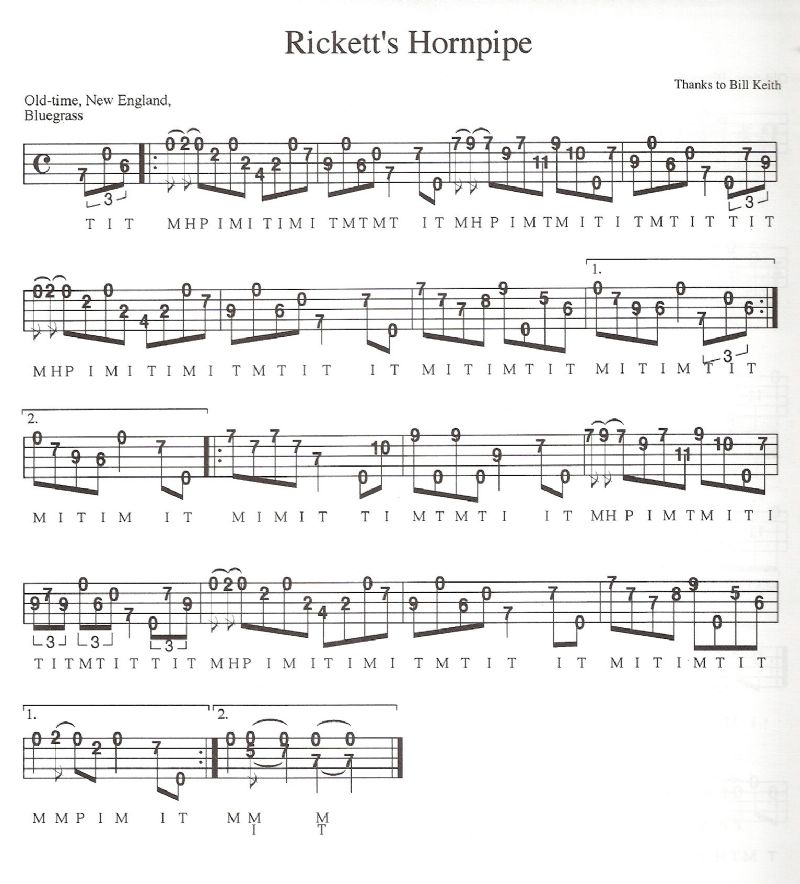
In honour of Bill Keith (December 20, 1939 - October 23, 2015), a hero, friend and mentor to legions of banjo acolytes, here's a lovely old Celtic hornpipe (aka 'Men of Wrexham's Hornpipe', 'Manchester Hornpipe') that I got from Bill. I later took in the direction of Celtic fingerstyle, adding rhythmic and melismatic variations in the form of triplets and double cuts (double-grace notes). This version is from Complete Book of Irish & Celtic 5-String Banjo (thanks to Mel Bay Publications, Inc.).
Tom Hanway - Posted - 10/25/2015: 21:57:23
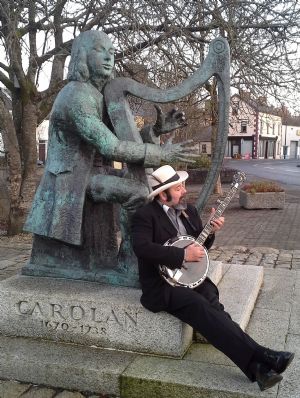
So many Bill Keith memories, and I remember when this photo was taken. We sat next to each other on the plane, our first trip together to Longford, Ireland, photo by Denise Conroy-Hanway, Viewmount House, 2002.
Bill asked me quite seriously on the plane, "Did you hear about the All-Girl Bluegrass Band?" "No," I said (not realizing he was telling a joke). "Nipple Creek!"

Mirek Patek - Posted - 10/25/2015: 22:25:53
Tom, why the open 2nd string in the 2nd full measure of part A of your Ricketts' Hornpipe tab is played by middle finger, while in the later occurrences of the same measure (6th full measure of part A and also of part B) it is played by index finger?
Tom Hanway - Posted - 10/25/2015: 22:30:27
Mirek, good man, play it with any finger you like, it hardly matters. Maybe it just felt good at the time, but it's irreciphalous.
There's an error of omission, did you spot it?
Hint: one can either slide or do a hammer-on.
Best ~ Tom
Tom Hanway - Posted - 10/26/2015: 11:00:43
What do I mean by Celtic fingerstyle banjo? Just as Celtic fingerstyle guitar gathers and synthesizes a wide variety of playing techniques in both the fretting and picking hands, so does Celtic fingerstyle banjo. What makes it Celtic is the approach, repertoire and sound of the music. It's not achieved simply by combining bluegrass techniques, i.e., Scruggs, melodic and single-string playing. It goes much deeper than that. We have to peel back the layers of the onion, listen to a lot of Celtic music, getting inside the living tradition itself.
In my first collection (1998), Complete Book of Irish & Celtic 5-String Banjo, I have defined and cross-referenced the three main types of variation used in Irish traditional and Celtic music: They are (1) melismatic variation that uses subtle ornaments like grace notes, grupettos or turns, two notes in the space of one, or using melisma – a series of notes hovering around and used in place of a single note; (2) rhythmic variation that substitutes a different rhythmic figure such as the triplet, or that involves lengthening, shortening or leaving out a note or notes; and (3) intervallic variation that substitutes a note (often much higher or lower) for a more commonly played note of a tune.
These types of variation often occur simultaneously in a musical phrase, so it is artificial to separate them, except to understand them on their own terms. Many triplets, for example, use melisma, with extra tones (melismata or melismas) added onto a main melody note. Some triplets, especially, are built into or have become the melody in particular reels, so a rhythmic variation would be to leave it out and instead play two eighth notes or a quarter note. That is common practice and may also be used to indicate that a tune or medley is coming to an end.
It is often the case that a particular note can be played on several strings, even the fifth string, so it is important to listen to the notes preceding and following it and to decide how one wants a particular note (or passage) to sound, also listening to overtones, before finally choosing a picking-hand or fretting-hand technique.
Similar to uilleann piping, in Celtic fingerstyle banjo, one can make use of both open (legato) and closed (staccato) fingerings. Thus, for certain passages, one can choose to play open strings and let the tones (and overtones) ring and blend into each other, mimicking the clàrsach or old Gaelic harp. Alternatively, one can opt for closed (fretted) positions to separate the notes. This is particularly effective if one wants the 5-string to mimic the sound of the 4-string banjo. I often combine both techniques in the same tune.
In 20 O'Carolan Irish Classics, it's usually the legato sound I'm striving to achieve, in emulation of the ancient clàrsach, using fretting-hand and picking-hand techniques that combine to produce the desired melodies, tones and resonances that I want to hear.
Of course, there are many possible ways of playing these tunes, for example, tending towards either a purely legato approach, known as melodic, Keith-style, or arpa (harp) style, or alternatively, a purely staccato approach, known as single-string or Reno-style in bluegrass. The former legato approach works beautifully for getting the steady streams of eighth-notes found in many American fiddle tunes, but tends to smooth out Celtic tunes, making them sound like melodic-style bluegrass, which they are not. The latter staccato approach works great for many styles of music, almost mimicking the sound of the tenor banjo, but because it avoids the fifth string, one is practically playing a plectrum banjo. The open sound of the 5-string banjo might be lost to overuse of single-string playing. So, in order to avoid these traps, I make technique serve the music – not the other way around – and I mix and match techniques based on how I want the tunes to sound. My approach to playing Celtic tunes is a very physical one, and sometimes I use a fretting-hand fingering just because I like the way it feels, and if it sounds right. Celtic fingerstyle techniques are used for Carolan’s music, a style that has taken me over two decades to develop and master. Still, I try to avoid being a slave to technique, and I tend towards sensation and intuition in making choices about technique.
As in Best-Loved Jigs and Reels (2012) and Best-Loved Airs and Session Tunes (2013), I employ fretting-hand techniques (slides, hammer-ons, and pull-offs) when it feels right. Please try to follow my fretting-hand fingerings: 1 = index, 2 = middle, 3 = ring, 4 = little finger, t = thumb. These are written to the left and above-left of the corresponding notes in standard notation. Using the indicated fretting-hand fingerings will make things a lot easier. Also consider my preferred picking-hand choices. The picking-hand choices are personal preference from years of experimenting, and I find them economical and the easiest to use.
Enjoy!
All the best ~ Tom
Tom Hanway - Posted - 10/27/2015: 02:09:34
Mel Bay has moved away from companion CDs inside their new books, so, for example, the recording to 20 O’Carolan Classics is an online audiio download, while my other books (all in stock) still are available with companion CDs inside the back cover: Best-Loved Jigs and Reels, Best-Loved Airs and Session Tunes, and Complete Book of Irish & Celtic 5-String Banjo. (All my books come as eBooks with online audio, so there's no panic.)
Okay, I mentioned the “fretting-hand” in Celtic fingerstyle banjo in the previous post. It is my conviction that it can (and should) bring with it all that it has learned from working out of standard G tuning, including positions for playing bluegrass, fiddle tunes, jazz tunes, scales, and the like. However, because this style is focused strictly on melody, one is not playing back-up patterns, licks, or rolling over chords, and the fretting-hand does a lot more work than it would in playing traditional bluegrass banjo. Nonetheless, the fretting-hand already knows where to go to grab certain pitches up the neck, especially on the first three strings, so having bluegrass chord positions and skills comes in handy.
Perhaps this is where the biggest learning curve is for bluegrass players moving over to Celtic fingerstyle playing. Bluegrass licks and clichés have few applications here. To resort to them would be to superimpose bluegrass tradition over Celtic tradition. This is ill-advised if one wants to play at a traditional session – and be asked back! To use bluegrass licks and roll patterns is the surest way to stick out like a sore thumb at a traditional session. I know: I started out this way, wanting to play ‘Little Maggie’ at sessions where folks were inclined to play ‘Drowsy Maggie’, lol. It was a learning curve, but not too steep. All I had to do was shift my playing habits away from bluegrass repertoire and focus on learning traditional Irish and Celtic tunes. A new set of social protocols had to be learned as well, particularly session etiquette.
Bluegrass picking patterns may transfer over to Celtic fingerstyle banjo, but they are no longer roll patterns per se. They are more like usable fingerings, and they are used differently, tightened up, often on one or two strings (not three). This happens because we are in pursuit of melody that happens in a small interval range. Jigs and reels don’t have the wide interval leaps that hornpipes, strathspeys and harp tunes have, and I have given examples of these in Mel Bay’s Complete Book of Irish & Celtic 5-String Banjo.
There are lots of interchangeable fingerings, sometimes employing the fingers of the fretting-hand, which can be used, just as in old-time or in bluegrass, to play hammer-ons, pull-offs, and slides, either to play a straightforward melody or to embellish it. The same musical phrase can be played lots of different ways on the 5-string banjo. Therein lies the beauty and challenge of it.
In Celtic fingerstyle, I have attempted to make it fun and easy while being faithful to the bare bones melodies, borrowing ideas from all the instruments in the living tradition of Celtic music. (Source: Mel Bay’s Easy Irish and Celtic Session Tunes for 5-String Banjo: Best-Loved Jigs and Reels)
All the best ~ Tom

Tom Hanway - Posted - 10/28/2015: 14:09:09
Tom Hanway - Posted - 11/03/2015: 02:22:39
20 O’Carolan Irish Classics (2015) is designed to convey the manner and spirit of traditional Gaelic harping – what Bill Monroe, a proud Celt himself, was alluding to when he spoke reverently of the “Ancient Tones.”
The companion audio is designed to bring the tunes to life and as a learning aid for beginners and intermediate players – not intended as a concert or showcase performance by me. It’s easily downloaded and uses steady, play-along and up-to-speed tracks, with each tune played through twice using a backing track which features chords that correspond to the chords in the book (also eBook). I also put in bass lines, and many of the tunes use some form of voice leading or contrapuntal motion. This requires the use of fretting-hand symbols which are written above the standard notation. The bass lines will also help tune backers (on any instrument), including bouzouki players, guitarists and pianists.
My arrangements echo those of the ancient clàrsach, the type of instrument O’Carolan played. Out of respect for his music, I incorporate harp-style and traditional ornamentation, including grace notes, appoggiatura, arpeggios, gruppettos, and basso continuo. I’ve made the tunes fun and kept them traditional and playable using fingerings that make use of legato and staccato sounds.
Notes on the Tunes is an appendix to the book that discusses tune histories, historic characters, and reveals playing tips and, sometimes, the special keys or modes used. Key signature is included in the standard notation, hinting at the modes used in Turlough O’Carolan’s most-played compositions.
Best-Loved Airs and Session Tunes (2013) uses protocols similar to 20 O’Carolan Irish Classics, with 32 tunes suited to beginner and intermediate players, each tune played once with practice tempo suggestions – all 68 tracks fitting on one CD (now an audio download where recording length isn’t an issue). Notable tunes include ‘Boolavogue’, ‘The Boys of Wexford’ (JFK’s favorite Irish rebel song), ‘Dawning of the Day’, ‘Down by the Salley Gardens’, ‘Loch Lomond’, ‘Raglan Road’ (two versions), ‘Rising of the Moon’, ‘Scotland the Brave’, ‘Skye Boat Song’, ‘The South Wind’, ‘The Spanish Lady’ (two versions), ‘The Star of the County Down’, ‘The Stack of Barley’, and ‘Whiskey in the Jar’.
Best-Loved Jigs and Reels (2012) features 68 of the most popular reels in Ireland, tunes I learned at sessions, particularly on the West coast, especially Galway town and parts of Clare. Additionally, it has Celtic tunes from Scotland, Shetland, Wales, and the Celtic Diaspora. Notable jigs and reels include ‘Gillian’s Apples’, ‘Happy to Meet and Sorry to Part’, ‘The Lark in the Morning’, ‘The Monaghan Jig’, ‘The Swallowtail Jig’, ‘Bucks of Oranmore’, ‘Castle Kelly’, ‘The Cup of Tea’, ‘The Earl’s Chair’, ‘The Gravel Walk’, ‘The High Reel’ (twice), ‘The Silver Spire’ and ‘Toss the Feathers’ (two versions). I was careful to pick tunes that one can usually find at sessions in Ireland and abroad.
Beir bua agus beannacht (Best wishes),
Tom
Tom Hanway - Posted - 11/09/2015: 07:05:35
My goal as a teacher is to encourage students to explore traditional tunes and to experiment with the ancient tones for themselves, one tune at a time. Over the course of four collections in nearly two decades, I've done my best to present learning tools in the form of tabs, standard notation (at times), and guide tracks for most of the tunes. In Complete Book of Irish & Celtic 5-String Banjo, I offered highly ornamented versions of tunes, whereas in subsequent collections I stuck to bare bones settings, but now adding chords at the publisher's request.
Most of the older Irish traditional music collections do not indicate chords, and Mel Bay didn't want them either when I put together the Complete Book (published 1998). We changed to meet consumer demand for playable chords. Of course, the chords are not written in stone and all of the tunes can be played as solo pieces, just as a sean-nós singer sings unaccompanied. This approach is the very core of the tradition. It's the idea that tunes should not be lost to chord changes or be subsumed by Western harmony practices, whether it be classical or jazz or some other exoteric tradition.
All in all, it's about getting inside the tunes for oneself, having fun with melodies and variations upon them, and playing them with others. It's about personal variation at the end of the day, not some stagnant or purist approach to music.
Everybody has a piece of it, and nobody has the whole thing!
All my Mel Bay Irish & Celtic 5-String collections are available as books and eBooks, with audio downloads demonstrating all kinds of tunes including reels, hornpipes, jigs, marches, strathspeys, airs, O'Carolan tunes, and lots more.
I am grateful to Mel Bay Publications, Inc. for putting out these Irish and Celtic collections, and thankful to all those who have purchased my products and given me their sincere support, feedback and encouragement.
Beir bua agus beannacht and kind regards ~ Tom
Tom Hanway - Posted - 11/26/2015: 21:15:40
Yesterday, in between preparing courses, I honed an arrangement of one of the greatest (and saddest) Irish laments of all time. It's a true story about a boating tragedy that took place in 1828, taking 20 lives, and immortalized in a poem ("Eanach Dhúin") by Anthony Raftery.
The poem was set to an Irish air, and the tune is now played many different ways (usually A Dorian or D Mixolydian, or E Dorian), and here are two versions; the first sung by Dolly MacMahon (sean-nós singer), the second played by Peter Browne on the uilleann pipes.
They may sound quite different to folks not used to this music, but these are the same tune and use the same key signature (G); however, Dolly's sung version has an A Dorian tonality, while Peter Browne's piped version has a D Mixolydian tonality. (Dolly also adds an alluring C# in the opening phrase.)
ANACH CUAIN as sung by Dolly MacMahon (sean nós)
ANACH CUAIN as played by Peter Browne (uilleann pipes)
ANACH CUAIN TAB (my arrangement
The lessons I learned putting together a collection of Turlough O'Carolan's music, also listening to lots of harpers and harpists, came in handy when deciding upon an arrangement for this slow air. The tempo setting is just a suggestion. It really needs to be played with rubato, and notice the fermata symbols indicating pauses and elongation of the rhythm. I've grouped the phrases (as sung) with long ties that go across measures. Also notice the picking-hand and fretting-hand fingerings, a convention I started using by necessity when I put together 20 O'Carolan Irish Classics for 5-String Banjo and All Instruments.
Happy Belated Thanksgiving and many happy returns! I've lived in Ireland for 13 years, and I've never missed cooking Thanksgiving dinner. Denise and I had a lovely one this year, and so did Mr. Hunter (our beast of a husky).
Enjoy!
Best ~ Tom

Tom Hanway - Posted - 12/01/2015: 07:23:14
All my Irish and Celtic collections use template settings that give basic outline to the tunes, sometimes bare bones settings, for example, in Best-Loved Jigs and Reels (Beginning-Intermediate: tab, chords, recording, 68 tunes; 2012); Best-Loved Airs and Session Tunes (Beginning-Intermediate: tab and standard, chords, recording; 32 tunes; 2013), either bare bones or highly ornamented settings; Complete Book of Irish & Celtic 5-String Banjo (Intermediate: tab and recording; 100 tunes; 1998); and 20 O’Carolan Irish Classics (Intermediate: tab and standard, chords, fretting- and picking-hand fingerings, recording; 20 tunes; 2015).
The latest collection combines Gaelic Harp and Baroque ornamentation, e.g., graces, triplets, trills, arpeggios, turns, and appoggiatura-mordent combinations. I attempted to breathe life into the Gaelic classical melodies of Ireland, and a goal for students would be to move beyond the tune templates and guide tracks, to improvise decorations for themselves, alone, at sessions or in small ensembles.
Once one has a built up a repertoire of Celtic tunes, such as jigs, reels, hornpipes, slides, polkas, marches, slip jigs, O’Carolan tunes, and the like, attention now can turn to how to improvise and ornament the tunes without straying from the melody. Improvising in a Celtic context – and the context varies considerably from music culture to music culture, subculture to subculture, even within regional styles and between instruments – is different from improvising in, say, bluegrass, jazz, country, or rock. Of course, one is always free to play across genres or develop a fusion-style, but that is not the goal of any of my Celtic collections.
The primary aim of my teaching methods is to get students to play within living tradition, to play whole tunes from beginning to end – not to trample on them or make them conform to exoteric, foreign, or even classical conventions. Each rendition of a tune is a whole, partially improvised but also the result of previous renditions, each influencing further renditions which might inform a playing culture’s general concept of that tune. The best players don’t simply copy others’ versions, but adding personal variations to them, making them their own.
As I quoted in the Complete Book, “The mastery of Irish trad or any Celtic music is a lifelong endeavor. The pan-Celtic tradition is so vast that the words of an Irish folk singer come to mind: ‘Everyone has a bit of it and no one has it all’.”*
I've been playing trad tunes since the mid-’80s and have mapped out a fairly sizeable body of material (220 transcriptions with Mel Bay Publications). I learned many of these tunes by hanging out at Irish sessions, staying up too late, camping on hurling pitches, sleeping on kitchen floors, recording tunes literally in the field, and seeking out the best pub sessions, also the best company and the best pint of porter. (It’s a long road that has no turning!)
I am also largely self-taught, and I did and still do a lot of home study, putting tunes together in sets, digging deeper, refining tunes and learning regional variations. This cannot be done by logging onto The Session, online forums, or social media. One has to travel to lots of different places, sometimes a one-pub-town, just a town away from the main event. One has to “break the bread” with the locals in order to find out what local style is all about.
I’ve sought out the best trad players on both sides of the Atlantic, also down under, and learned from many of them. Keeping “beginner's mind” is one of the things I got from Bill Keith, resting in peace.
Bill encouraged me to excavate the music of Turlough O'Carolan back when I was gathering tunes for my Complete Celtic collection. I am very much indebted to Bill for his many insights, wicked sense of humor, and endless wisdom.
All the Best ~Tom
*Source: Robin Morton, Come Day, Go Day, God Send Sunday (London: Routledge and Kegan Paul, 1973), 10. Quoted in James Cowdery, The Melodic Tradition in Ireland (Kent, Ohio: Kent State University Press, 1990), 79.
Tom Hanway - Posted - 04/11/2016: 07:47:20
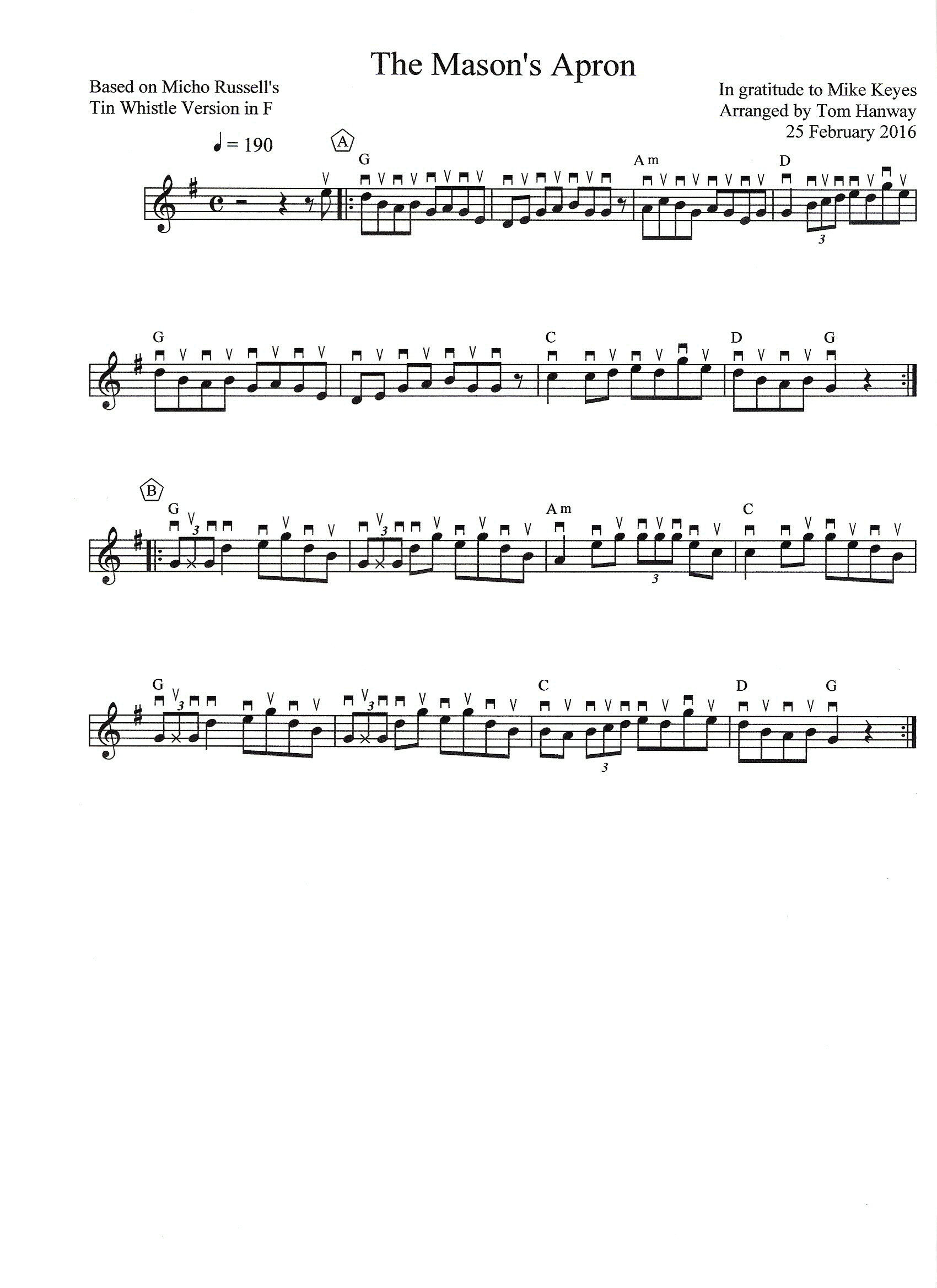
At Cryan's, Carrick-on-Shannon, Co. Leitrim, I've been playing a two-part version of 'The Mason's Apron' with James Wyckham, a box player (button accordionist). We do it in G major, and it's closely based on Micho Russell's tin whistle version in F major, a version which is famous in Doolin, Co. Clare and in many trad circles.
Please notice the trebles and ornamentation, also how I climb up the first string up to the fifth fret instead of hitting the open fifth string. Of course, there are many ways of getting these notes, and this is just one snapshot of how I might play this tune
Here is THE MASON'S APRON in 5-string tablature.
Here is an almost identical setting in standard notation but with stuttered triplets for tenor banjo:
MASON'S APRON (standard notation)
Enjoy!
Tom Hanway - Posted - 05/16/2016: 21:33:39
quote:
Originally posted by islandgirl
Alright!!! The perfect music to play on my Stelling Swallowtail.
Hey, thank you Sue ... a lot of love went into the design for that banjo!
I have traveled back and forth across the Atlantic for over two decades, making field recordings, playing at sessions, and collecting tunes at the source. Through my published materials (four books to date), I have sought to lay bare a virtual treasure trove of tunes from the proverbial "Celtic Nations" (Scotland, Ireland, Isle of Man, Wales, Brittany, and Cornwall) and the Celtic Diaspora (e.g., Cape Breton, Shetland, Prince Edwards Island, Appalachia, and New England).
The Celtic fingerstyle method goes beyond a simple synthesis of melodic, single-string and Scruggs techniques. It looks to sean-nós singing and dancing for grounding in the living tradition.
In order to stay true to the living tradition, one has to go back to sean-nós styles from places like Ireland and Scotland, much in the same way that Bill Monroe's music is about capturing melody and good rhythm in vocals, and playing what he affectionately termed the ancient tones (the modal system and modal harmony).
This is an individual quest open to all. In Irish music and Celtic trad in general, one focuses on capturing melody and making it one’s own.
We can be passive holders of the tradition, and that's fine, but we can also be creative collaborators, the highest form of the art, adding our personal variations to the music. Therein lies the real fun and challenge, where one can improvise as well as reinvent one’s approach to playing traditional tunes at the session or on the stage.
Beir bua agus beannacht ~ Tom
Tom Hanway - Posted - 06/20/2016: 15:17:05
Here's an enduring example of sean-nós singing, the pre-eminent traditional form in Irish music.
From the film, Brooklyn 2015 - Singing Scene HD (Iarla Ó Lionáird - Casadh An Tsúgáin)
Enjoy!
Beir bua agus beannacht ~ Tom
Tom Hanway - Posted - 10/14/2016: 11:42:01
On Thursday nights I have a residency at the Longford Arms Hotel, Co. Longford, playing with multi-instrumentalist Joe Meehan, who plays Celtic fingerstyle guitar on top of playing all manner of tunes on the mandolin. One of the things we like to do on "CBGBs Nights" is play duets, sometimes jazz tunes, sometimes old-time, bluegrass or Irish tunes, but quite often we play Carolan tunes on 5-string and guitar.
I want to put focus again on 'Carolan's Draught', which always gets respect from the audience. We love to play it, and last night was special (three times in a row), and we have gotten fairly used to each other's little quirks and tendencies, so we're really improvising on it (in the moment). (We need to make a recording of it, and then some, and maybe a video is in order!)
In any case, on the first recording below, I used a steel violin mute on the bridge in imitation of the ancient clairseach (Gaelic harp), which was tuned diatonically and had either brass, silver, gold or silver-gold metal wire for strings. (I wish I had that violin mute today, but it was stolen from me in a Houston St. bar when I used it as a money clip. I've never been able to replace it, and I've looked everywhere.)
My present-day version of this tune hasn't changed dramatically from earlier version recorded back in 1998; however, I notice that I have incorporated some of Gabriel Donohue's back-up ideas that he played on the nylon-string guitar. I have also added bass lines (contrary motion). Joe Meehan's accompaniment is slightly more complex than Gabriel's version, but both share a love for improvised counterpoint (melody). While both of my versions are transcriptions (the latter version in standard and tab with chord and tempo suggestions), in performance, I always improvise little variations while being faithful to the basic melody.
Tempos can vary with mood and context, so none of this is written in stone. (These two versions are quite different in some of their parts.)
So, here are two recordings from my earliest and latest Mel Bay Irish & Celtic 5-String banjo collections:
(1) The first is from Complete Book of Irish & Celtic 5-String Banjo (1998):
(2) The second is from 20 O-Carolan Irish Classics for 5-String Banjo and All Instruments (2015):
I hope that these examples might serve as springboards for students of Irish and Celtic fingerstyle banjo. Much gratitude to my earliest mentors Tony Trischka and Bill Keith who, back in the late '80s and '90s, encouraged me to give focus to Irish tune collections (Tony) and to develop a unified approach and publish a collection of popular Carolan tunes (Bill).
Much thanks to Paddy Kiernan (Dublin, Ireland) for reminding me to use voice-leading (with melody on top) and to consider basso continuo for accompaniment (found in the second example, the Irish Baroque version).
Enjoy!
Beir bua agus beannacht ~ Tom
Tom Hanway - Posted - 11/12/2016: 23:28:17
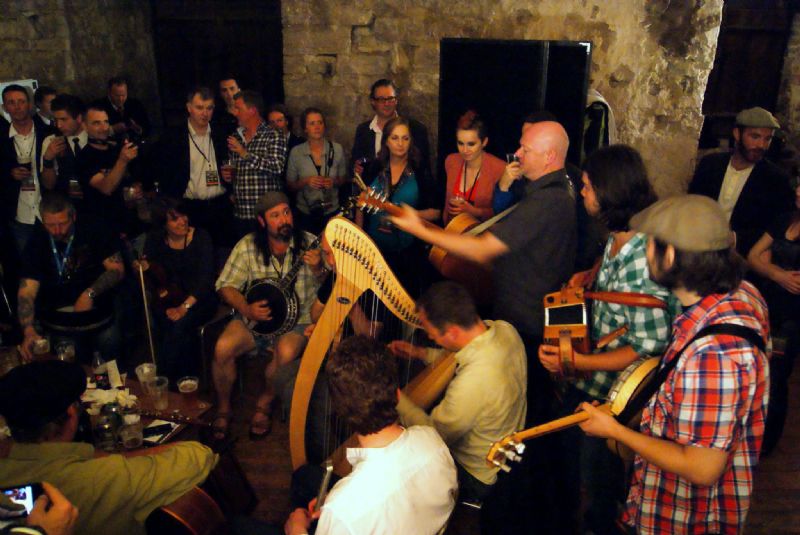
Below is a video with Clannad, featuring Moya Brennan, one of loveliest and most enduring female singers in Irish Music (known as the "First Lady of Celtic Music"). Here's a backstage shot from inside the ruins of Borgholm Castle, back in 2012 at the Oland Celtic Irish Music Festival, which took place on the island in the south of Sweden. It is one of the loveliest settings for a festival that I've ever seen. It was an honour for me to be asked to perform with so many Celtic artists from across Europe.
Behind me are Moya (aka Máire) Brennan (btw, she's older sister to Enya) with her daughter Aisling Jarvis, the former who got her start with the family band, Clannad - see video here of a young Moya with the band. That's legendary harpist Cormac de Barra, with whom I remember playing 'The Humour of Ballyloughlin' - see vid with Arty McGlynn and Paul Brady. I wish I had gotten Cormac to play more Carolan tunes, but there was a lot going on back stage.
Again, here is the video (1977) with lovely Moya Brennan, when she was only 25 years old:
I hope this inspires somebody to learn and sing in Irish. I met Moya, members of Clannad and Vinny Kilduff (tin whistle) at Paddy Reilly's Music Bar, and later ferried them around Manhattan one snowy night back in the 1990s. (It was a dirty night, almost a foot of snow, and I had a Volvo 240 wagon which we all piled into and went on our merry way into the cold white night. We wound up at The Baggot Inn and passed around a single Martin D-18 guitar, singing songs, and I had my Stelling banjo as well. I had no idea whom I was partying with, so I had no self-consciousness or fear. We had a ball, and I'll leave it at that.)
Beir bua agus beannacht ~ Tom
Tom Hanway - Posted - 02/05/2017: 04:00:05
For those who want to bring a 5-string to sessions, here is an entry from my first collection (1998) that bears repeating :
"Here is a comparison between Irish music and Irish dance revealing a difficult social problem that faces composers and choreographers who compose or choreograph something new and try to add it to the tradition. This common problem extends to contemporary Trad artists when they seek to add something new or original to the tradition.
Living tradition: The dynamic interplay of continuity and change, of repetition and variation, lies at the heart of the various Celtic traditions, as in all living tradition. It is possible to be an “original” and still be “traditional”—the terms are not mutually exclusive. Ironically, an original dance or tune may be traditional in style, but because it is new and unrecognized, the critic does not perceive it as “traditional.” It has no history in the tradition and has yet to be picked up by other performers. On the other hand, a new tune or dance may not be given a chance or get the appreciation it deserves because some connoisseur maligns it for being too much like a previous endeavour. The effect on the performer can be devastating. It is a catch-22 for performers who attempt to compose or choreograph in a traditional style; either their work is considered original and non-traditional, or a clever copy or adaptation. Consider Irish dancing. Form and footwork in céilí dancing is uniform, while set dancing allows individual style and footwork variation. Set dancing has never had a “book,” and some céilí dancers who go by their “book” would trivialize the work of set dancers who embrace a broader traditional range, including regional styles and original sets. Among some Celtic musicians and dancers then, one might recognize distinct attitudes. First is the curmudgeon, who, in seeking to uphold (or save) the tradition, views it anachronistically, overemphasizes certain aspects of it, and ignores or deprecates change—especially the work of contemporary Celtic artists who stray beyond his notions of what can properly be called “traditional.” Many brand the critic a “purist,” but, to his credit, he is merely trying to preserve certain aspects of the tradition (e.g., sean-nós singing or regional styles). Yet, sadly, the purist recognizes and enjoys only certain aspects of the living tradition. He believes, with good reason, that the encroachments of non-Celtic, other Celtic, and classical forms are jeopardizing the most subtle aspect of the tradition, and this bothers him. So he looks down his nose and sternly admonishes beginners and innovators who adapt traditional forms for personal enjoyment. In all likelihood, such a way of dealing with a perceived threat to the tradition only fuels the fires of imagination of the “sinners.”A second curious attitude is the know-nothing-know-it-all: an unaware but overeager performer who, lacking in experience, willy nilly ignores and tramples over the music or dance, or both. A third type is the creative standard-bearer: a performer or innovator who works steadfastly yet creatively within traditional forms and styles and, by freely contributing, keeps the tradition a living one. Last, is the interested beginner: one probably better off developing into the latter than ending up as one of the others.”
~ From the Glossary to Complete Book of Irish & Celtic 5-String Banjo
Terms of Use | Privacy Policy | Privacy Consent (EU/GDPR Only)
Copyright 2026 Banjo Hangout. All Rights Reserved.