
DVD-quality lessons (including tabs/sheet music) available for immediate viewing on any device.
Take your playing to the next level with the help of a local or online banjo teacher.
Weekly newsletter includes free lessons, favorite member content, banjo news and more.
Premier Sponsors


|
Please note this is an archived topic, so it is locked and unable to be replied to. You may, however, start a new topic and refer to this topic with a link: http://www.banjohangout.org/archive/308300
Nodrog - Posted - 08/29/2015: 03:44:50
I've got a Goldtone Bob Carlin open back and want to change from the steel strings (with loop ends) it came with to nylon strings, but the new strings I've bought are just straight with no ends for attaching to the tailpiece. I'm wondering if it's a matter of a particular technique for fitting the strings, if I've bought the wrong strings or whether to fit nylon strings I'll have to fit a different tailpiece. I'd much appreciate some advice.
bartmcneil - Posted - 08/29/2015: 04:10:35
Nylon strings do not require a new tailpiece and are easy to install... Google "Installing nylon banjo strings" and you should find lots of info on their installation... This has been covered many times on this site as well and someone might give you a link to the information. It is a matter of using the proper knot on the tailpiece end of the strings so that they do not self-unwind. If I recall frets.com has good instructions on the installation of nylon strings. You do need to learn the system because not just any old knot will work.
Edited by - bartmcneil on 08/29/2015 04:15:46
rmcdow - Posted - 08/29/2015: 05:30:18
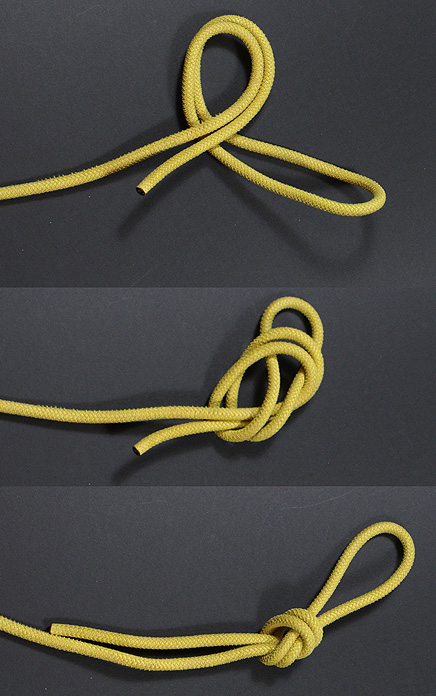
Here's the instructions for tying the knot. animatedknots.com/perfection/index.php
RV6 - Posted - 08/29/2015: 07:29:03
Gordon, It looks like your banjo comes with a "no knot" tailpiece. The lower cost no knots have burrs on the posts (and in the slot) that can cut nylon strings and these should be smoothed. You don't want to use these as designed as it's difficult to get the slots smooth and the slots, especially for the fourth string, would need to be widened. You also want to make sure there are no sharp edges on your tuner posts holes, nut or bridge.
I smoothed the rough edges of the posts by laying some nylon filament tape sticky side up and sticking some fine grit sandpaper down on it. I then cut strips the appropriate width for the posts and long enough so that you can "shoe shine" the strip around the posts. By using the tape, you gain considerable strength and the fine sandpaper won't continually break on you. I put the tailpiece in a vise and shoe shine away.
I use Chris Sands nylon strings on my banjos. I've thought about using Aquila Nylguts but the fourth string is .040" thick where the Sands fourth is .030". I think things would get pretty crowded using the Aquila's but plan on trying it someday. I think the consensus is that the Sands strings are more durable and stretch less than the Aquila's. I just bought a mountain banjo that came with Aquila "Super Nylguts" and I do think they have more stretch to them than the Sands.
I've used two methods for tying on the Sands strings and both have worked well for me. When installing the knot with the "stop knot" on the post, I grab the tag end with forceps, moisten the knot, place the loop over the post and pull both ends to tighten the knot on the post. (When tying mono line/tippet for fishing, I learned it was a good idea to moisten the knot to lessen friction and heat thus making for a stronger knot.) When tying the overhand knot, I moisten it as well before tightening and then I put it on the post.
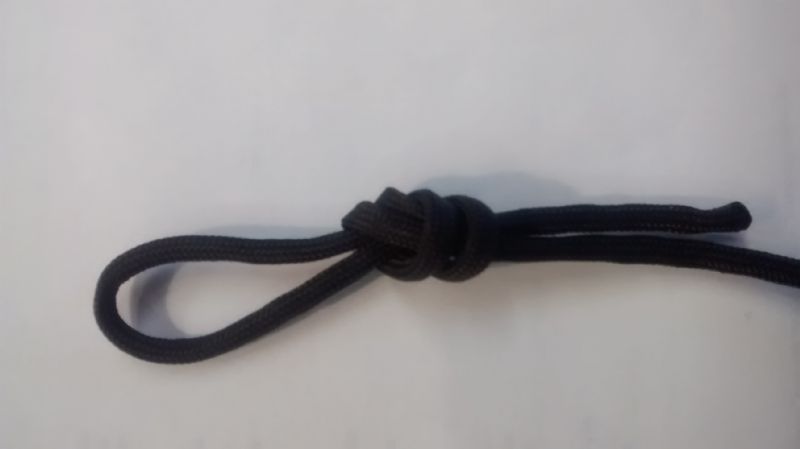 overhand loop knot |  Overhand with stop knot |
LWC - Posted - 08/29/2015: 11:04:12
This is how I was shown to tie nylon strings and never had any problems. Larry
 |
oldwoodchuckb - Posted - 08/29/2015: 12:44:13
In my experience the tailpiece sold as a No-Knot these days will eventually cut through nylon strings if you use the tailpiece in the recommended fashion. Original No-Knots were made of brass and had no sharp ends or surfaces. These modern ones are made of steel and rough machined, leaving nothing but sharp burrs behind. I would say that over 95% of the modern No-Knots on banjos are used on loop end steel strings anyway - so the problem never comes up.
If you can find an old No-Knot - use it, but for a modern one I suggest you loop over the posts not through them - and still you might come up with a cut string. Unless you have a Dremel Tool or something similar I doubt you will be able to completely de-burr every post. By looping around the post you at least avoid putting the string through the slot, which is inevitably going to be filled with wickedly sharp burrs.
I've found that Kershner Tailpieces (either original or the Stu-Mac reproduction) work better, as the angles of the posts are rounded and they have no burrs. They are not split however, so you mist knot them. I did smooth the front holes a bit, but I'm not at all sure that was necessary.
I tie a loop in the string end, big enough to slip over the post - to h*ll with fancy knots, a good ole reef (square) knot does Jes'Fine!
I use Chris Sands Classic Banjo Strings on my nylon strung banjos (one 5 string and one tenor). They are thinner and tougher than Nylguts which I found a disaster YMMV. By using Chris Sands Strings I have had to do far less filing on the nut of antique banjos. Since I always use modern Compensated Bridges the amount of filing necessary at that end has no real importance.
I find that among their other good features Sands strings last for years (I have a set that has been on Jackie-O (my avatar) for 4 years now - and they still sound good! When I tried Nylguts the 3 strings I managed to get on the banjo without them breaking were on for just a few months when the winding of the 4th string started to unravel. That was the end of That tune!
Edited by - oldwoodchuckb on 08/29/2015 13:01:08
oldwoodchuckb - Posted - 08/29/2015: 13:17:57
BTW I use the knot shown on the right in the post one or two above mine. I'm convinced the entire super-fancy knot for nylon strings most people recommend is a waste of time and fingernails. I put a loop in the string as above, and slip the loop over the posts of my tailpieces (No-Knot and Kershner alike). I NEVER run string through the heavily burred slot in the Chinese No-Knots on the market today - it is an invitation to disaster.
Original No-Knots were made of brass and they were poured to a mold. There were no sharp edges. Modern Asian No-Knots are machined from steel. All the edges are sharp and they will eventually cut through nylon strings no matter how much sanding you do. De-burring them is simply not a task the average banjo player has the tools to accomplish. Perhaps with a Dremel Tool, but if you should miss a spot - it Will inevitably show up - on stage, or some other time when you really don't need a broken string. For Asian No-Knots I de-burr them as much as possible and loop the strings around the whole post. There is simply no way I have available to me that de-burrs steel tailpieces enough to make them completely safe.
Edited by - oldwoodchuckb on 08/29/2015 13:24:35
OK-4 - Posted - 08/29/2015: 14:42:07
The noose shown above is OK for slipping around a post designed for a loop-end string, though it requires a lot of material that you may not have if re-using an old string.
But some old tailpieces require the string to pass through a hole. This bowline knot can be handy for that, and it's pretty easy to tie:
bf - Posted - 08/29/2015: 17:12:41
quote:
Originally posted by rmcdow
Here's the instructions for tying the knot. animatedknots.com/perfection/index.php
I recently switched from the bowline to the perfection knot, and really like it for nylon strings.
john bange - Posted - 08/30/2015: 06:10:10
you might find that you like some down force at the tail piece. this seems to ad volume to your nylon string banjo as well as keeping the bridge in place. all of the knots shown will work with a Kershner t/p.
Harp strings can be had in 25' loops in lots of diameters. You can make yourself a lifetime worth of string sets for about the cost of a couple of Sand's or Aquilla's. by using a nylon 4th string, you won't have to change for a long time. they stop stretching right away too...sound good on a BC350
RV6 - Posted - 08/30/2015: 07:01:43
John, Could you expand on this topic? Source of strings, diameters needed, etc.
I use Chris Sands strings: .024, .028, .032, .030 wound, .024. The Aguila Super Nylguts that I've thought about trying on one of my Reiter's (26 3/16 and 24 3/4 scale) are: .024, .025, .030, .039, .024
Would similar diameters of harp strings be equivalent to the Sands or Supers?
I looked at Dusty Strings website but their prices would be similar to buying the Sands or Aquila's.
Thanks, Bob
john bange - Posted - 08/30/2015: 08:54:18
you can get those diameters at Robinson's Harp Shop...they ship
I used an all nylon set on my long neck banjo so my strings might be heavier than you need for your BC350.
my gauges are .025, .032, .040, .045, .025 I started doing this because the string sets would not be long enough for my banjo, having to tie them to my tail piece. You would not have that problem so classical guitar strings could work as well. I like the crisp tone of the harps strings. they settle in very fast.
the best reason is they are cheap and without a wound string, I can leave them on for years...really! the tone and volume stays nice and bright
David Moore - Posted - 08/31/2015: 05:43:15
I took Johns' suggestion and ordered a set from Robinsons and they were very helpful with a tiny order like mine. The strings came in nicely labeled and sound bright but not harsh. I know some of that has to do with the pot on my banjo but I like them. Tying the .045 is a bit of a challenge but there are good suggestions above.
Terms of Use | Privacy Policy | Privacy Consent (EU/GDPR Only)
Copyright 2026 Banjo Hangout. All Rights Reserved.


