
DVD-quality lessons (including tabs/sheet music) available for immediate viewing on any device.
Take your playing to the next level with the help of a local or online banjo teacher.
Weekly newsletter includes free lessons, favorite member content, banjo news and more.
Premier Sponsors


|
Please note this is an archived topic, so it is locked and unable to be replied to. You may, however, start a new topic and refer to this topic with a link: http://www.banjohangout.org/archive/304672
LyleK - Posted - 06/04/2015: 22:16:13
Lovat: "Give us a tune piper."
Millin: "What tune would you like sir?"
Lovat: "Well, play The Road to the Isles."
Millin: "would you like me to march up and down sir?"
Lovat: "Yes, march up and down, that'd be lovely."
The above is transcribed from an interview with Bill Millin (youtube.com/watch?v=B4WZwz2C72M) about his involvement in the D-Day landing on 6/6/1944. So 71 years later, this week's BHO (Bagpipe Hangout?) TOTW is The Road to the Isles.
The Tune
There are many recordings of this tune with various instrumentation. Sadly, there are few (maybe only one?) recordings on banjo, but we can take care of that - eventually. Here is a smattering:
Trooping of the Colours at the Horse Guard Parade in 1997 - There are a number of tunes played here by massed band. The first four minutes (or so) are The Road to the Isles, though interspersed with another Hebrides tune (The Cockle Gatherer) from 1:30-2:05 and 3:18-3:52. At 4:10 the band strikes up Hieland Laddie, the tune that Millen played during the landing at Sword Beach.
Played by massed pipe band at Glengarry Highland Games, 2011
Played on "Shuttle Pipes" - These have all the drones in a single cylinder.
And on smallpipes
Fife Band
Fiddles (First 1:53 minutes)
The Song
Sir Harry Lauder (1926)
In Gaelic
Lyrics
The Road
These 1952 British Movietone reels should give you the general idea
And Some Tune History
The tune was an original highland pipe composition by John McLellan that went through a number of name changes (see pipetunes.ca/composers.asp?pg=...oserID=23). The tune's earliest name was The Bens of Jura. "Bens" is an Anglicization of the Gaelic word for mountains, and indeed the island of Jura (one of the Inner Hebrides Islands) has three prominent mountains.. In 1917 The Road to the Isles was published with lyrics in Volume 2 of Songs of the Hebrides. The melody was taken from "an air played by Malcolm Johnson, Barra, on the chanter." Said Air was indeed The Burning Sands of Egypt (McLellan's final name for his composition). and was arranged for harp (or piano) by Patuffa Kennedy- Fraser. Patuffa was the daughter of Marjory Kennedy-Fraser (en.wikipedia.org/wiki/Marjory_...dy-Fraser) who was the driving force behind the three volumes of Songs of the Hebrides. Lyrics were added by Kenneth MacLeod.
With the publication of Songs of the Hebrides this week's TOTW became quite popular. A number of the songs were adapted for symphonic band, and indeed I listened to this over, and over again on an LP called (cleverly) "Hi-Fi in the Highlands" when I was kid. The following is from a different album, but is quite similar:
(Hint: Road to the Isles doesn't start until 4:44, but listen to the whole thing if you have time. It is really pretty)
But up until a few months ago I didn't know the title for the tune that is Road to the Isles. The jacket notes for the LP gave no information. Anyhow, a few months ago I was going through Bayard's "Dance to the Fiddle, March to the Fife" and I came upon a tune (#346) that I clearly recognized from that old LP. Bayard had transcribed The Road to the Isles from a Pennsylvania fifer who had learned the tune from a West Virginia band in 1961.
What Key is it in? And What is a "Scotch Snap"?
I should avoid the whole issue of what key bagpipes are in. Well, quickly they are approximately in B-flat, but bagpipe music is written as if the pipes were in A. Actually, that's A-Mixolydian because they have F# and C# but no G#. So when you put this all together, Road to the Isles is in D-major (which will sound close to Eb on pipes). There's a nice bagpipe lesson at: bagpipelesson.com/road-to-the-isles.html that gives the notation and plays through a midi version. I play the tune in aDADE. And then there is the issue of "Scotch snaps," which are pretty common in highland pipe music. I've been droning on here (OK, intentional double entendre), so I'm hoping JanetB will pipe up (ouch) with some information on these snaps. We've been e-mailing the past few days about these. I do have tabs for this TOTW, but I'm not happy with them. I'm hoping something better will come along. So without further ado, I bid adieu.
Edited by - LyleK on 06/04/2015 22:19:16
 Road to the Isles | 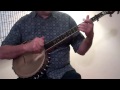 VIDEO: Road to the Isles (Clawhammer banjo) (click to view) |
Paul Meredith - Posted - 06/05/2015: 19:57:58
Lyle, interesting song, a fine melody. Your clawhammer version of this song is very well done! I really like celtic music, its nice to have one for the TOTW.
JanetB - Posted - 06/05/2015: 21:06:31
A TOTW like this one piques my geographical and historical curiosity. I like your version, Lyle, and can hear the Scottish snaps. I attempted to add some to my recording of Road to the Isles. I was recently introduced to that rhythmic technique while listening to a tune played from notation by William Sydney Mount in the 1840's. (He's the famous painter whose minstrel banjo and barn dance paintings are often reproduced. He was also a fiddler.) Lyle gave me a link to a rather long, but interesting, video by a musicologist who skillfully explains the Scottish snap. Beginning at about 7:30 he shows how Road to the Isles incorporates Scottish snaps heard in the accent and syllabic meter of the words in the lyrics -- including place names and words like heather and never. Scottish snaps are defined as 16th notes followed by dotted eighth notes -- the opposite order we usually play dotted notes. If you have some time, here's the link: youtube.com/watch?v=3BQAD5uZsLY. It's interesting that although the queen of England had the military band play Road to the Isles in 1952, they play it straight without Scottish snaps. The video addresses this linguistic swing away from the meter of a Scottish snap as a cultural and class phenomena.
So, here's my Road to the Isles. Perhaps one day I'll make it to Scotland....
Edited by - JanetB on 06/05/2015 21:07:52
Road to the Isles (TOTW) |  Road to the Isles (CH) tab |
LyleK - Posted - 06/06/2015: 18:23:45
Thanks Janet for a lovely (and snappy!) version, the tab, and the Scotch snap info.
For those who might want to start mining great highland pipe tunes, I came across a very useful site in researching this TOTW: bagpipetunes.intertechnics.com/index.php
It lists some 5,000+ tunes. You'll need to grab "Bagpipe Player" at: bagpipe.eotrs.dk/. Said player plays the tunes as midi files and puts out the musical notation.
Matt Buckley - Posted - 06/07/2015: 08:09:21
quote:
Originally posted by JanetBScottish snaps are defined as 16th notes followed by dotted eighth notes -- the opposite order we usually play dotted notes. If you have some time, here's the link: youtube.com/watch?v=3BQAD5uZsLY. It's interesting that although the queen of England had the military band play Road to the Isles in 1952, they play it straight without Scottish snaps. The video addresses this linguistic swing away from the meter of a Scottish snap as a cultural and class phenomena.
Here's another view regarding the Scottish "snap".
First, some background. My three musical obsessions are Irish fiddle, clawhammer banjo, and Scottish bellowspipes and Highand pipes. The Vermont Bellowspipe and Fiddle School is now in its 27th year, and for the first 22 years my wife and I hosted the School each August at our home and land in Vermont. The School has attracted many of Scotland's finest and well-known bellowspipe (Border pipes and Smallpipes) instructors, and students from all over North America and beyond. The School has, for the past few years, featured Scottish fiddle instruction, and the current instructor is Alasdair White, of the Battlefield Band. Top-notch teachers and players.
I mention the background because, in all the years of the School, and having had the amazing luck to have heard the finest Scottish traditional music on the planet in my own home for decades 10 days every August, I've never, even once, heard the term "Scottish snap" used. Some thoughts on this:
1. The term evokes, for many, the dorky end of the Scottish music specturm, e.g. Scottish Fiddle Orchestra, be-kilted Reel and Strathspey Society gatherings, US Highland Games, high Victorian fiddle and the like. There is another Scottish traditional music scene coming on very strong in the past 30-40 years which is the opposite of what one individual refers to as "Scottish Cheese", and this is the traditional ceili and session scene, e.g. buckle-your-seatbelt reels, jigs, close-to-the-floor strathspeys and beyond. Much like the serious Irish Traditional Music scene. Closer to the Cape Breton tradition, for those of you familiar.
2. The more common terms and indeed the more useful terms, are "cut-dot" or "dot-cut". Both techniques are used in Scottish traditional music. And within these terms is a world of nuance. Some "cut-dots" are hard, some soft, some very subtle, and everywhere in between. Even in competition Highland piping circles, a scene I was involved in for about a decade, I didn't hear the term "Scottish snap".
3. Depending upon the context, the music may be much less cut than the what many think of as standard Scottish traditional music. In certain circles, this is controversial, and many look down upon those who would round off the edges, so to speak.
Mind you, I'm not being critical of use of the term in this threat. Just reporting here. And I think Janet's subtle use of the "cut-dot" in her rendition is wonderful. But for many serious STM musicians, the term is nails-on-the-blackboard stuff. I myself avoid use of the term, because it tends not to convey nuance. Indeed, the very nuance that Janet evokes in her playing.
Cheers.
Matt
Edited by - Matt Buckley on 06/07/2015 08:12:00
LyleK - Posted - 06/07/2015: 08:38:13
quote:
Originally posted by Matt Buckleyquote:
Originally posted by JanetBScottish snaps are defined as 16th notes followed by dotted eighth notes -- the opposite order we usually play dotted notes. If you have some time, here's the link: youtube.com/watch?v=3BQAD5uZsLY. It's interesting that although the queen of England had the military band play Road to the Isles in 1952, they play it straight without Scottish snaps. The video addresses this linguistic swing away from the meter of a Scottish snap as a cultural and class phenomena.
Here's another view regarding the Scottish "snap".
I mention the background because, in all the years of the School, and having had the amazing luck to have heard the finest Scottish traditional music on the planet in my own home for decades 10 days every August, I've never, even once, heard the term "Scottish snap" used. Some thoughts on this:
Thanks Matt. I was unaware of the potential problem in using this moniker. I had picked the term up from Ken Perlman's "Everything You Wanted to Know About Clawhammer Banjo?" (but were afraid to ask?).
Thanks again
rudy - Posted - 06/07/2015: 09:44:08
Super nice, Lyle!
Matt, I'm terribly ignorant of general terminology, but is the "snap" equivalent to what I've always heard referred to as "grace notes" when pipe music is discussed?
Tamarack - Posted - 06/07/2015: 20:00:36
A most pleasant tune worthy of clawhammer treatment -- also enjoyed the renditions on various forms of pipes.
If there are 5,000+ pipe tunes to be mined by banjo players, I guess we had better get busy.
LyleK - Posted - 06/08/2015: 06:03:13
quote:
Originally posted by rudySuper nice, Lyle!
Matt, I'm terribly ignorant of general terminology, but is the "snap" equivalent to what I've always heard referred to as "grace notes" when pipe music is discussed?
Thanks Randy.
The "Lombard rhythm" (another name for said "snap") is different from grace notes. If you go to this page about strathspeys: educationscotland.gov.uk/nqmus...hspey.asp about half way down there is a link for "Scotch snap" and for "grace notes." The former is a short note followed by a longer one, with the longer second note being two to three times (or so) the duration of the shorter first note. A grace note (or notes) have no time value other than the miniscule part that they "steal" from the note with which they are associated.
Terms of Use | Privacy Policy | Privacy Consent (EU/GDPR Only)
Copyright 2026 Banjo Hangout. All Rights Reserved.


