
DVD-quality lessons (including tabs/sheet music) available for immediate viewing on any device.
Take your playing to the next level with the help of a local or online banjo teacher.
Weekly newsletter includes free lessons, favorite member content, banjo news and more.
Premier Sponsors


|
Please note this is an archived topic, so it is locked and unable to be replied to. You may, however, start a new topic and refer to this topic with a link: http://www.banjohangout.org/archive/298250
Ohio Senator - Posted - 01/24/2015: 10:54:02
Hello all,
Just picked up a used Reiter in need of a neck adjustment and, since there wasn't much available on the forum, I figured I'd muddle my way through it and document what it looks like for folks.
DISCLAIMER: I'm no set up expert. I worked in a music store for many years and have done a ton of truss rod adjustments, but I'm doing this pretty much by eye and feel from experience, so proceed at your own risk!
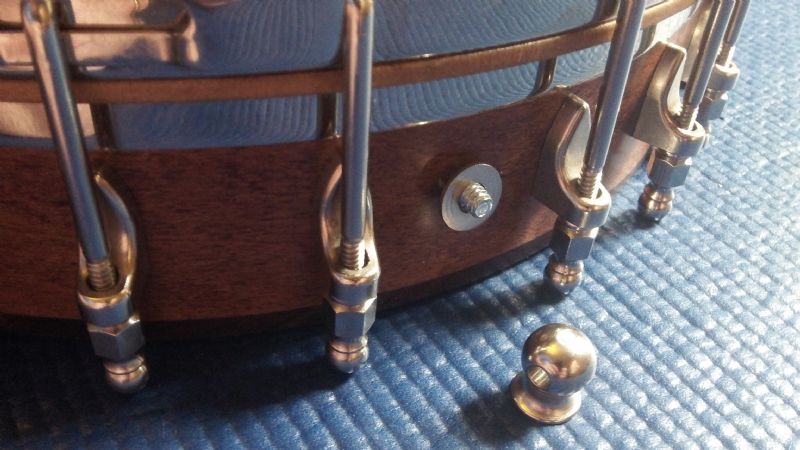
Pic 1: After slacking tension on the strings and removing the tailpiece, simply unscrew the end bolt that holds the tailpiece in place and remove it and its washer.
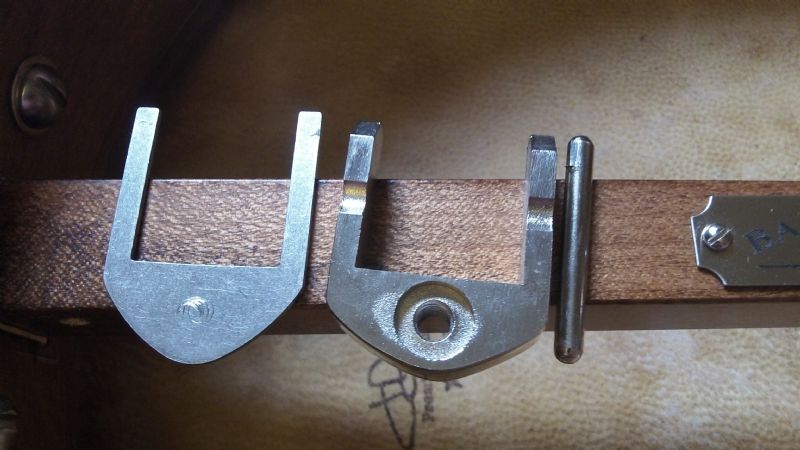
Pic 2: Making a mental note before proceeding on how tight the dowel stick hardware is screwed in, remove the screw from the hardware.
Pic 3: Remove the dowel stick hardware by sliding the shim against the pot (on the left) out first. Should be a breeze, use something like a toothpick to help you.
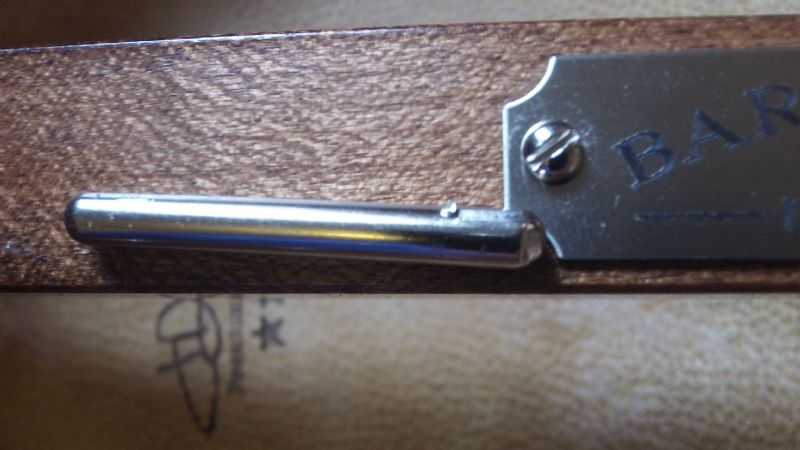
Pic 4: To reinforce the instructions in Pic 3, note the metal burr on the pin. If I had tried to punch that through rather than remove the shim, it would have gouged the wood within the dowel. Instead it slid right out.
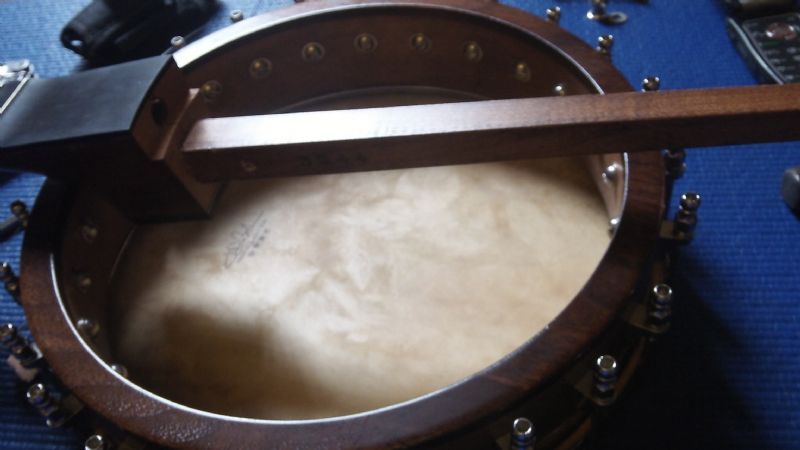
Pic 5: Slide the neck out, being careful to protect the end screw from damaging anything or getting damaged itself.
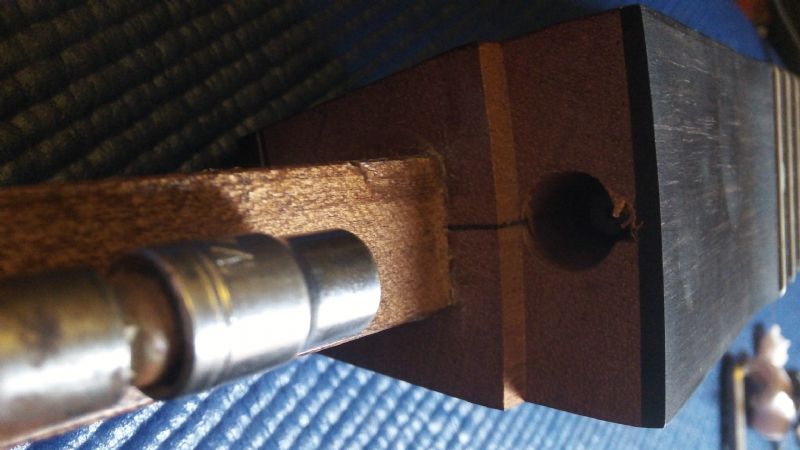
Pic 6: Truss rod adjustment. The rod is a bit far in there, you need a thin 1/4in socket with extension. Tightening straightens (flattens) the neck, loosening adds bow. Think of it this way, if you decrease the tension within the next (loosening the truss rod) this allows the strings to pull at the head stock more, creating more bow (relief) in the neck. If you are planning on doing this job, resign yourself to baby steps. You should expect to take the neck apart a few times to get to your end result, rather than rush it and crank the truss rod only to break something. 1/8-1/4 turns are the best intervals to work at. Then, put it all back together, tune up, and see how it went. Repeat if necessary.
In the case of this banjo, it had a whole lotta relief in the neck. Its a 2012 and was maybe never adjusted, so not exactly surprising. I actually went ahead and turned the truss rod a half turn, and there was not much tension. Put it all back together and then repeated the process because it wasn't enough. So my end result is after a full turn... gives you an idea just how badly this neck needed it.
I also made one critical, stupid mistake. I did not measure the bridge after I took it off. In my mind I was operating on the assumption that I was dealing with a 5/8 bridge, but in reality it was a bit taller. Catching this after a second truss rod adjustment, I then also swapped out bridges for a known 5/8 Moon.
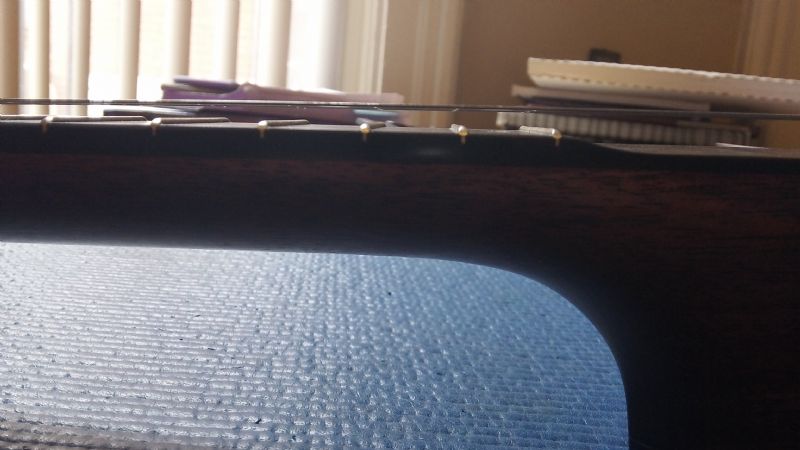
Pic 7: The end result is still a bit high right now for my tastes, but is fairly lower than it was. The neck is much more straight, but still has a nice, small amount of necessary relief. So I'll work with this for now, and maybe use a shorter bridge if I need to down the line. I want to at least give it time to settle in and then reconsider what to do.
One final note... humidity, season change, and temperature greatly affect musical instruments. So, its good to keep this in mind when deciding to make a neck adjustment, and to keep a close eye on things afterwards to make sure they don't go south on you once things change (such as a dry Winter into a wet Spring). It is also important to be sure that your head tension is right where you want it before starting a neck adjustment.
Hope this is useful for future and current Reiter owners... cheers!
Edited by - Ohio Senator on 01/24/2015 11:01:23
 |  |  |  |
 |  |  |
jbalch - Posted - 01/24/2015: 11:25:38
Well done! I've owned more than a dozen different Reiter banjos (at various times). Most have been very stable and not required truss rod adjustments. However when it has been needed, I have done the procedure you outline several times and found these banjo's to be very serviceable.
I think the presence of a two-way adjustable truss rod is a BIG plus for a Reiter (or any) banjo. I prefer an adjustable rod over the simple (non-adjustable) graphite or steel reinforcement that many builders use today. It is something that you never really think about - until you need it.
Here is what Bart says about truss rod adjustment on his website:
Your banjo has an adjustable truss rod. To access the adjustment nut remove the strings, neck brace and endbolt. Slide the neck out of the rim. The nut receives a 1/4 inch nut driver or head tightening wrench. Turning may be stiff and the nut can be broken by an inexperienced person. This adjustment is rarely necessary and only used to straighten a bowed neck and does not change the action or string height.
Edited by - jbalch on 01/24/2015 11:26:20
BDCA - Posted - 01/24/2015: 11:28:39
Another option to lower the action without changing the bridge would be a shim.
Cya!
Bob
Ohio Senator - Posted - 01/24/2015: 11:42:43
So, I should say first that I made this adjustment mainly because it clearly needed it. There was just obviously too much bow.
In such a case as this, reducing relief did make a difference in action. Wish I would have taken a "before" pic to clarify but its literally 1/8in lower now.
But, I do get that this shouldn't be the go to method to correct action for most.
This was just meant to help anyone making the call whether to attempt this, and to show the innards of what it all looks like. Honestly, this was an extremely easy job to do, as Jbalch points out. We're talking maybe 15min total for one adjustment.
Curious... Jbalch, does this amount of action I'm currently at (w a 5/8 bridge) seem average for the number of Reiters you've owned?
Edited by - Ohio Senator on 01/24/2015 11:46:20
jbalch - Posted - 01/24/2015: 13:01:12
I agree that a truss rod adjustment will lower the action - if there is too much relief to begin with. That is especially true over the middle frets - where the up-bow is centered. I think Bart's comment means - if the neck relief is correct - the purpose of the truss rod is NOT to raise or lower the action. You can't really use it for that without seriously messing up other aspects of playability.
Regarding bridge height:
Bart builds a lot of banjos. But they are not mass-produced. Each is individually hand-made. So there is variation among them. Generally when the neck is adjusted to proper relief (not too much), the action is low & comfortable. Your's doesn't look out-of-line to me.
But, every player has individual preferences. So I have seen Bart ship new banjos with two-or-three bridges for the player to choose based on what feels right. So, changing the bridge is a totally legitimate means of tweaking the set-up. I do it all the time. If 5/8" still feels tall, there is nothing wrong with trying a 19/32 or 9/16" bridge (or simply sanding small amounts off the bottom of the current bridge until the height feels right).
Don't forget that string height is also affected by head tension and tailpiece type and set-up. Those factors relate to head deflection which will determine the final bridge height under string tension. I don't recommend those as means of setting setting height - but head tension & tailpiece adjustment should be set where you want them (for sound) before changing the bridge.
Edited by - jbalch on 01/24/2015 13:06:49
Terms of Use | Privacy Policy | Privacy Consent (EU/GDPR Only)
Copyright 2026 Banjo Hangout. All Rights Reserved.


