
DVD-quality lessons (including tabs/sheet music) available for immediate viewing on any device.
Take your playing to the next level with the help of a local or online banjo teacher.
Weekly newsletter includes free lessons, favorite member content, banjo news and more.
Premier Sponsors


|
Please note this is an archived topic, so it is locked and unable to be replied to. You may, however, start a new topic and refer to this topic with a link: http://www.banjohangout.org/archive/297578
Page: 1 2
Mickey Gentry - Posted - 01/11/2015: 20:30:08
I'm mainly a guitar player, but also play 5 string CH banjo. I write songs and they're all in D,G,A or C,F,G, etc. (If they're good enough for Willie and Hank...) When I play my songs on banjo, no matter what tuning I seem to use, when I need and E it gets rough. Why do the banjo gods hate E?
RoBanJo - Posted - 01/11/2015: 20:36:50
Because the E just ain't natural.

Edited by - RoBanJo on 01/11/2015 20:40:48
chuckv97 - Posted - 01/11/2015: 21:16:00
Which chord shape are you using? The D shape at the 4 th fret ,or the 1 st position shape - 2nd fret ,1st string,, open 2nd string,, 1 st fret 3rd string ,, 2nd fret 4th string? Avoid the 5th string because it's a G natural which clashes with the G# of the E chord. Hope that helps.
Old Hickory - Posted - 01/11/2015: 21:24:15
Don't ignore the 5th string. Embrace it. That clash is part of the banjo's distinctive sound. The open 5th also clashes with the F# of the D chord, yet we play it all the time.
I know the following example is 3-finger rather than the clawhammer that you're playing, but Earl Scruggs used open 5th as he rolled on the E chord in Salty Dog, in G.
jswkingsfield - Posted - 01/11/2015: 21:30:05
"Hate" is a little strong. The key of E works great on guitar because on guitar, there are 2 open E strings, lends itself to nice resonance. But on banjo, the key of E, with the scale being E, F#, G#, A, B, and C#, there is only 1 open string -- the B string. Note that you're also not writing songs in the Key of B -- same problem, only 1 open string, again, the B string.
Try tuning your 5th string up to G# and see if that works for you.
Bunkie - Posted - 01/12/2015: 02:35:41
Assuming it's the 5th string clash you're hearing, re-tuning the 5th string as Janice suggested may help. Also, if you have access to an office supply store, a sacrificed ballpoint pen cap can be made into a "moveable pip" of sorts, for quick and easy re-tuning of the 5th string:

(That there's genuine Mother of Ballpoint, folks)
overhere - Posted - 01/12/2015: 02:45:13
capo the B play the C shape...no big deal? Bunkie get yourself a golden gate slider...you'll love it.
Edited by - overhere on 01/12/2015 02:45:51
Texasbanjo - Posted - 01/12/2015: 05:17:09
BlowingRockNC - Posted - 01/12/2015: 05:33:00
The Key of E is one of my favorite keys, without a capo. I also like B and D a lot too, also without a capo. Same on a tenor guitar. These Keys are frequently the best for my lousy voice when I need to lead a song at a jam. I also like E because it is used a lot in Blues-related songs. It tend to use E and related notes/chords mostly in the second position up the neck, but use E7 in the first position, and that combination seems to sound nice. I also tend to mostly play B in the second position up the neck, although D in the first position. This really only applies to when I also sing, if you can call what I do singing, which is highly debatable.
Edited by - BlowingRockNC on 01/12/2015 05:36:15
Jim Yates - Posted - 01/12/2015: 07:17:30
Is it the key of E, or E chords that you're trying to play? The common tunings like open G tuning and/or double C tuning are not designed for playing in the key of E, but E chords are quite possible in either tuning. Of course, it is possible to play in the key of E as well, but, without re-tuning the fifth string at least, you're just making things difficult.
It's also possible to play in the key of F# while in Sawmill tuning, but why?
Prescott - Posted - 01/12/2015: 07:22:13
I've played in E quite a bit over the years - capo at fourth fret, fifth under spike at ninth fret, double C tuning becomes double E tuning. The long - necked five string popularized during the folk revival gives you an open E at the nut with the regular G tuning intervals, at a lower pitch.
I think that what people are finding objectionable is the dissonant minor 2nd interval between the G# and the G on the 5th - just tune the 5th up a half step.
mmuussiiccaall - Posted - 01/12/2015: 08:32:35
Here's an E chord by sliding up a D shape and barring the 3rd finger to catch a g# on the 5th string.
 E chord |
Banjophobic - Posted - 01/12/2015: 09:18:47
Banjos don't hate anything. There is no difference in an E, F or any other chord on the banjo. They are all chords and the only thing making them sound 'bad' or 'wrong' is operator error.  . An E chord has a 'b' note in it, which means your open 'b' string can be left open for cool droning effects and for melody.. The open 5th string will have dissonance when used with the full chord, so you wil have to decide how much of it you like or need. An E chord is the same everywhere on the neck and capo doesn't change thier location-it only gives you open string options.
dannyp - Posted - 01/12/2015: 09:48:34
Well, my banjo (Sullivan Festival Deluxe) does actually seem to "hate" the E chord. This is likely a set up problem but it really rears its ugly head with the E chord for some reason and this could potentially be your banjo's problem as well. It seems my banjo frets sharp and this is especially true at the 1st fret. Yes, I've tried moving my bridge backwards towards the tailpiece but that does not help at all. So when I fret the G string (thicker one, second from the top) at the 1st fret to make the E chord it gives me a G# that is too sharp (haha, hard to say). This makes my E chord sound pretty horrible. My 1st position C and F chords all sound fine. So the problem really is at the bigger g string (I think). As I continue fretting that string up the neck it gets more in tune until I get up to the 12th fret where it finally frets in tune. Perhaps my nut height is too high at that fret and that is precisely what I am going to check on next as I believe that can cause a string to go slightly sharp when fretted. I don't mean to hijack your thread with my problem but I only bring it up b/c perhaps you have the same issue. BTW if anyone has any suggestions on how to resolve this issue I'd be glad to hear them!
Danny
Banjophobic - Posted - 01/12/2015: 10:34:45
quote:
Originally posted by dannypWell, my banjo (Sullivan Festival Deluxe) does actually seem to "hate" the E chord. This is likely a set up problem but it really rears its ugly head with the E chord for some reason and this could potentially be your banjo's problem as well. It seems my banjo frets sharp and this is especially true at the 1st fret. Yes, I've tried moving my bridge backwards towards the tailpiece but that does not help at all. So when I fret the G string (thicker one, second from the top) at the 1st fret to make the E chord it gives me a G# that is too sharp (haha, hard to say). This makes my E chord sound pretty horrible. My 1st position C and F chords all sound fine. So the problem really is at the bigger g string (I think). As I continue fretting that string up the neck it gets more in tune until I get up to the 12th fret where it finally frets in tune. Perhaps my nut height is too high at that fret and that is precisely what I am going to check on next as I believe that can cause a string to go slightly sharp when fretted. I don't mean to hijack your thread with my problem but I only bring it up b/c perhaps you have the same issue. BTW if anyone has any suggestions on how to resolve this issue I'd be glad to hear them!
Danny
A set-up check-up could be in order.
shamsterdam - Posted - 01/12/2015: 11:24:00
I like E chords better and better because you can do nice hammer-ons on the fourth string. (or combined with pull-off from third string).
But when you're playing an E/A/B song, I would suggest using the capo somewhere on the neck.
MrManners - Posted - 01/12/2015: 12:22:13
get above the fifth fret,anytime you make a full e,reach over with the finger fretting the heavy string and fret the fifth string also,it is the same note twice as high but just as much in tune.imo an open g with the e arpeggio [roll] ain't good,but to each their own
MrManners - Posted - 01/12/2015: 12:24:09
learning to bring the middle finger into the inside open b is good for e-blues shuffle walks
Jim Yates - Posted - 01/13/2015: 08:28:30
It seems that Mickey is talking about playing an E chord rather than playing in the key of E. I would assume that if a tuning is not mentioned, then the default tuning is open G, even though he does say that he is a CH player.
Am I right Mickey?
Mark Ross - Posted - 01/13/2015: 10:54:30
E isn't a problem if you play a long neck banjo.
Mark Ross
Mickey Gentry - Posted - 01/13/2015: 17:50:09
Wow, thanks for all the awesome input! It will take me a while to digest it all. I was talking about E chords, which to me seem challenging in most tunings. Lately I've been stuck on double C, I bar the fourth fret and fret the 5th and 1st strings at the 6th fret.
Banjos don't hate, I believe they surround hate and force to surrender, right!
antony60 - Posted - 01/14/2015: 05:42:20
Hi. This is my first post on banjohangout, .Hope you all welcome the musings of a Brit picker. If I play in the key of E ie E/A/B I tend to tune the 5th string to B. I find this gives a nice ring for upneck playing and also fits the B Chord. As well as playing the B string open, let the open high D ring out. Makes the E an E7....So nice for blues and ragtime stuff
Mickey Gentry - Posted - 01/14/2015: 13:08:09
quote:
Originally posted by Mark RossE isn't a problem if you play a long neck banjo.
Mark Ross
Another reason to buy more banjo!
maverickdallas - Posted - 01/14/2015: 18:41:17
I love that open "E" tuning that Bela Fleck uses on "Big Country", in fact so much that I dedicated my spare banjo to that setup!
MONSTER sound!!!
overhere - Posted - 01/15/2015: 03:42:29
Just in case beginners need this: Open E…=4- 2fret E, 3-1fretG#, 2-open B, 1-2 fret E.
I play E- B7-A7… for bluesy sound. B7…= 4-4fretF#, 3- 2fretA, 2-open B, 1- openD
A7… 4-2fretE,< I use thumb) 3-openG, 2-2fretC#, 1-2fretE....5th capoed 9 B
E has a nice deep drone sound…great for Folsom Prison Blues among similar stuff. Limited licks tho’ (me)!
Edited by - overhere on 01/15/2015 03:48:45
Banjophobic - Posted - 01/15/2015: 13:57:40
And just a tip here on playing in open G tuning, key of E, which is to remember that Blues for E comes from E minor pentatonic, and the relative major for that is good ol G. What does that mean? It means you can play G licks that resolve to an E, for blues ideas that work over the E chord.
Laurence Diehl - Posted - 01/15/2015: 14:06:41
When I play in G, G tuning I set my 2nd (B) string a little flat. I think the reason for that is well documented on the hangout forums. But when you play the first position E chord, the 3rd interval is now on the 3rd(G) string and I think it sounds a little sharp, especially in relation to the open B string. I think that is what you are hearing. It's a banjo....
Mickey Gentry - Posted - 01/15/2015: 21:01:45
quote:
Originally posted by Mickey GentryWow, thanks for all the awesome input! It will take me a while to digest it all. I was talking about E chords, which to me seem challenging in most tunings. Lately I've been stuck on double C, I bar the fourth fret and fret the 5th and 1st strings at the 6th fret.
Banjos don't hate, I believe they surround hate and force to surrender, right!
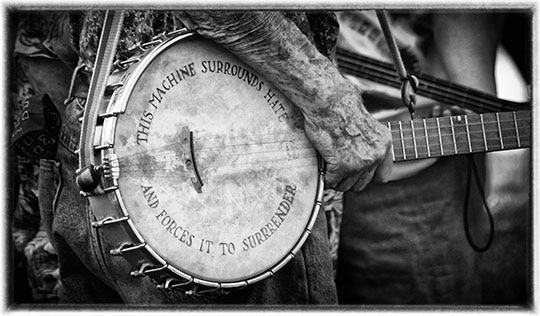 |
cbskibum - Posted - 01/22/2015: 08:45:17
Sometime if I am playing in the key of E often I will follow Mr Flecks example and tune the whole banjo down to E. Strings 1-5 would be... B G# E B E. Might require a little movement of the bridge to correct intonation and the strings are a little slack, but it creates a much nicer mellower sound to my ears than playing in E the other ways mentioned above...
Jim Yates - Posted - 01/22/2015: 10:49:15
quote:
Originally posted by cbskibum
Sometime if I am playing in the key of E often I will follow Mr Flecks example and tune the whole banjo down to E. Strings 1-5 would be... B G# E B E. Might require a little movement of the bridge to correct intonation and the strings are a little slack, but it creates a much nicer mellower sound to my ears than playing in E the other ways mentioned above...
Bela's Gold Tone Baritone Banjo is built for playing low (inspired by John Hartford) and has heavier guage strings, often tuned cGCEG. If you tune a standard strung banjo down to E, I'd think the strings would be awfully floppy and hard to keep in tune.
cbskibum - Posted - 01/22/2015: 13:47:28
quote:
Originally posted by Jim Yatesquote:
Originally posted by cbskibum
Sometime if I am playing in the key of E often I will follow Mr Flecks example and tune the whole banjo down to E. Strings 1-5 would be... B G# E B E. Might require a little movement of the bridge to correct intonation and the strings are a little slack, but it creates a much nicer mellower sound to my ears than playing in E the other ways mentioned above...Bela's Gold Tone Baritone Banjo is built for playing low (inspired by John Hartford) and has heavier guage strings, often tuned cGCEG. If you tune a standard strung banjo down to E, I'd think the strings would be awfully floppy and hard to keep in tune.
cbskibum - Posted - 01/22/2015: 13:54:22
Jim, I'm Not sure if Bela played the Gold Tone on the Big Country recording in the key of E or not. But searching YouTube videos of him playing live it appears maybe he did not.
It is true what you say about the strings being floppy but they stay pretty well tuned on my Nechville. I'm sure the floppyness could be remedied with thicker strings...if you haven't tried it, you may...
Take care
Keith
captbanjo - Posted - 01/23/2015: 13:07:18
Here's Bennett Sullivan with Bela's Down in the Swamp, banjo tuned down to E:
youtube.com/watch?v=HqKXOu6T21E
Wayne
3 finger ninja - Posted - 01/26/2015: 22:45:07
I pretty much just play in any key out of standard G tuning now. I "may" spike the 5th string time to time but I often love the dissonant clash I get from leaving it be....somebody here once told me that can allow you opportunity for some cool melodic licks and Im getting more and more into the frame of mind with my playing these days. I have noticed that an Emaj chord in the open position in G tuning sounds a little off to my ear but thats just the nature of the beast i guess...aint nothing a little adjustment wont fix.
Edited by - 3 finger ninja on 01/26/2015 22:47:00
steve davis - Posted - 02/02/2015: 05:05:20
I enjoy all keys.They each have their own personality.I love being able to play the entire key of E in the first 2 frets.I really like that low B7 chord..
Joe the banjo guy - Posted - 02/02/2015: 09:01:51
I usually tune the 5th up to a B if I'm playing in the key of E.
minstrelmike - Posted - 02/02/2015: 14:05:09
E is one of my favorite keys to play in on the banjo because I get more versatility from it than from most other keys.
I spike the 5th string up to B and will play blues and folk songs in "open" E,
I will capo 2nd fret and play bluegrass or old-timey style songs in E out of D shapes--my favorite key to pick in on the banjo.
And I will capo 4 and play more melodic stuff in the key of E out of C-shaped melodic scales and licks (as well as C-shaped bluegrass-type picking and old-time frailing).
steve davis - Posted - 03/03/2015: 10:37:24
quote:
Originally posted by Mickey GentryI'm mainly a guitar player, but also play 5 string CH banjo. I write songs and they're all in D,G,A or C,F,G, etc. (If they're good enough for Willie and Hank...) When I play my songs on banjo, no matter what tuning I seem to use, when I need and E it gets rough. Why do the banjo gods hate E?
I like exploring all keys and learning how to "navigate" them.I look for their strengths and weaknesses...or rather mine,concerning each key.
I don't want just one way of sounding such as a hard-driving aggressive style all the time.Each key demands something a bit different.
Edited by - steve davis on 03/03/2015 10:40:14
Aradobanjo - Posted - 03/04/2015: 14:04:17
Hello,
Tune to open D as in Reuben (Earl Scruggs) then capo up two frets and play in E. The 5th would be raised to G# from F#.
Edited by - Aradobanjo on 03/04/2015 14:06:11
h - Posted - 03/26/2015: 20:33:30
I play with an acoustic rock/pop/oldies band and we do some rock n roll in the key of E and key of A. Some songs use a bluesy E,D,A chord progression. Spike the fifth string up to A or B and it sounds just fine. Depends on the song and the notes you need whether to use A or B.
Helix - Posted - 03/27/2015: 13:57:41
Bakelite is the first banjo I ever played, but we never could have afforded the Grovers.
I suggest tuning down to open E and capoing back up to the 3rd fret for G. Your F and F# magically appear.
Then when you need E you take the capo off and lower the 5th string and play your regular G licks and patterns.
I use more spikes than others @ 7,8,9,10,12,14 so different roots can be used.
I play longnecks with bluegrass and clawhammer both for vamp, kind of like bluehammer.
Have fun with this
Rich Weill - Posted - 04/02/2015: 15:20:40
quote:
Originally posted by Banjophobic
The open 5th string will have dissonance when used with the full chord, so you wil have to decide how much of it you like or need.
Doesn't the open 5th string risk turning an E major chord (E-G#-B) into an E minor (E-G-B)? Won't that change the entire flavor of the chord?
Page: 1 2
Terms of Use | Privacy Policy | Privacy Consent (EU/GDPR Only)
Copyright 2026 Banjo Hangout. All Rights Reserved.


