
DVD-quality lessons (including tabs/sheet music) available for immediate viewing on any device.
Take your playing to the next level with the help of a local or online banjo teacher.
Weekly newsletter includes free lessons, favorite member content, banjo news and more.
Premier Sponsors


|
Please note this is an archived topic, so it is locked and unable to be replied to. You may, however, start a new topic and refer to this topic with a link: http://www.banjohangout.org/archive/296454
SpudHuskerBanjo - Posted - 12/21/2014: 14:35:30
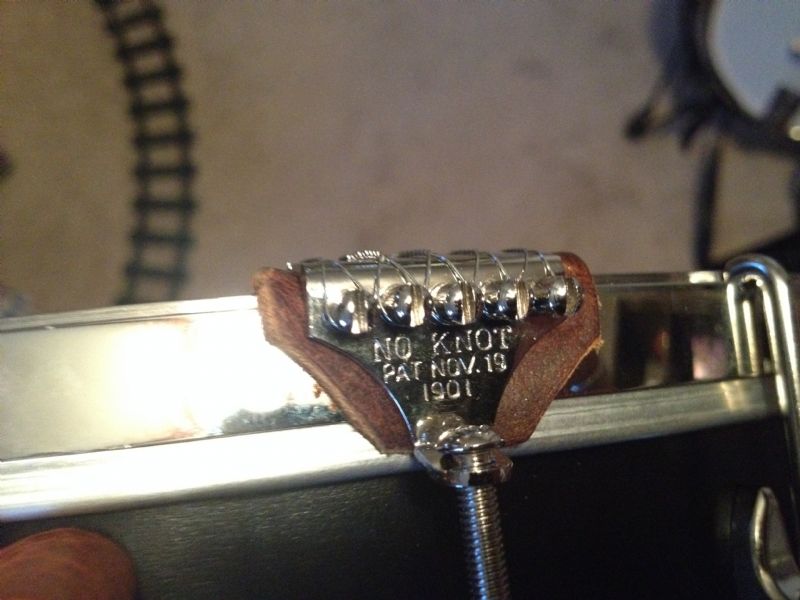
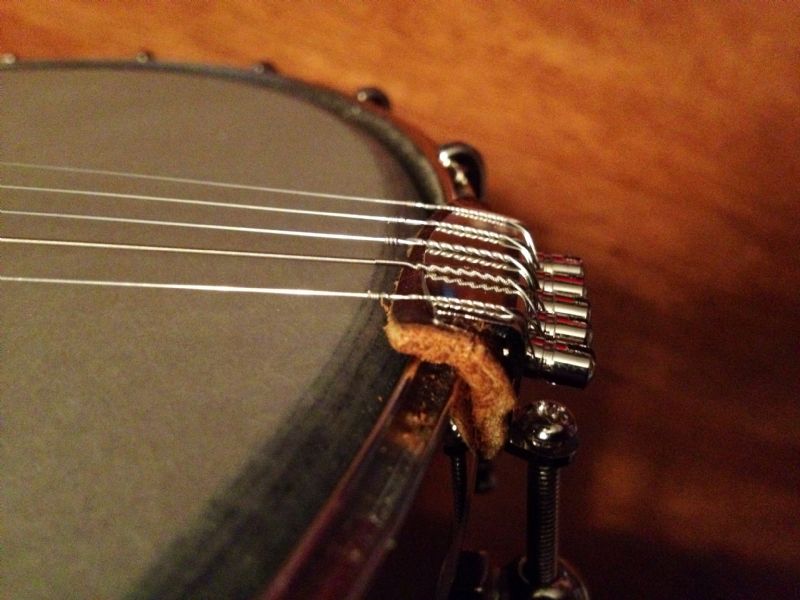
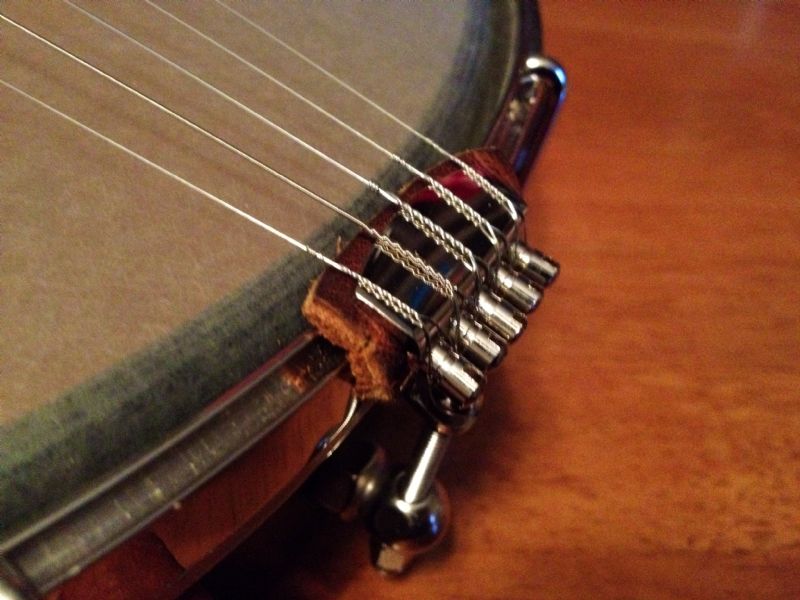
So I was changing strings today on my banjos, and I noticed that on the Enoch Tradesman the tailpiece was a bit loose. I have had a slight buzzing in the past, and after a bit of playing around and tightening things I noticed that the buzzing was coming from the tailpiece...even after tightening the T/P specifically. I cut and placed a small piece of scrap leather under the tailpiece itself and the buzzing went away completely. However, I am wondering what the unintended consequences of adding that piece of leather are going to be? At the moment, it appears that the side of the T/P that is perpendicular to the head is a bit far out...but everything still tightens up nicely and the sound is great. Any thoughts or suggestions?
- I used to booze a lot, and then I started playing the banjo… Now, I'm not sure which is worse -
 |  |  |
blm10jn - Posted - 12/21/2014: 14:43:38
I frequently send the banjos I build out with close cell foam or good felt under the strings in front of a No Knot tail piece like yours. So you could move the leather from under the tailpiece and slid it under the strings in front of the tailpiece. The No Knot tail piece was designed for old fashioned gut strings so twisted metal strings can make an annoying buzz.
Ernest M - Posted - 12/21/2014: 15:49:40
I use a small piece of leather under by tailpiece. It seems to help kill unwanted overtones, kind of like chenille on strings. This looks like it will do the same.
rudy - Posted - 12/21/2014: 17:12:33
THIN leather like a small piece of chamois is OK, but the leather you show will be detrimental to the sound. String energy is transferred to the banjo by solid contact points and the leather will absorb string energy like a sponge.
As others have said, the portion of the strings between the bridge and the tailpiece often create undesirable overtones, so it's beneficial to weave something between the strings directly in front of the tailpiece. Again, something light like chamois works, or even a pipe cleaner or heavy rubber band.
SpudHuskerBanjo - Posted - 12/21/2014: 18:50:11
quote:
Originally posted by rudyTHIN leather like a small piece of chamois is OK, but the leather you show will be detrimental to the sound. String energy is transferred to the banjo by solid contact points and the leather will absorb string energy like a sponge.
Rudy, thanks for the heads-up. Now you have me curious as to how the string energy is transferred via the tailpiece when it is touching the tension hoop(?). The way I understand it, string energy is transferred to the banjo most directly via the bridge...and the tailpiece CAN, indeed, have an affect on that sound by putting more or less pressure on the strings coming off of the bridge to the tailpiece. From Deering: "An adjustable tailpiece on a banjo will make the banjo sound “sharper” or “snappier” when it is adjusted to apply more string pressure on the bridge. When the adjustable tailpiece is adjusted to decrease the string pressure on the bridge, the banjo sounds mellower, or less snappy." (Quote taken from the Deering blog) With this being on a 12" Enoch Tradesman, I'm not overly concerned about snappier...but I am still curious!
rudy - Posted - 12/21/2014: 19:33:38
quote:
Originally posted by SpudHuskerBanjoquote:
Originally posted by rudyTHIN leather like a small piece of chamois is OK, but the leather you show will be detrimental to the sound. String energy is transferred to the banjo by solid contact points and the leather will absorb string energy like a sponge.
Rudy, thanks for the heads-up. Now you have me curious as to how the string energy is transferred via the tailpiece when it is touching the tension hoop(?). The way I understand it, string energy is transferred to the banjo most directly via the bridge...and the tailpiece CAN, indeed, have an affect on that sound by putting more or less pressure on the strings coming off of the bridge to the tailpiece. From Deering: "An adjustable tailpiece on a banjo will make the banjo sound “sharper” or “snappier” when it is adjusted to apply more string pressure on the bridge. When the adjustable tailpiece is adjusted to decrease the string pressure on the bridge, the banjo sounds mellower, or less snappy." (Quote taken from the Deering blog) With this being on a 12" Enoch Tradesman, I'm not overly concerned about snappier...but I am still curious!
It's true that the largest percentage of sound is transferred by the bridge and coupled to the head, but string energy is also coupled to the banjo at other key points. Another of those points is where the string passes over the nut, or where a string is depressed to a fret. The nut can be considered another bridge, it just doesn't do a very good job of energy conversion because it's sitting on a solid surface. The energy physically couples to the instrument at those points, as well as to both ends of the instrument at the string anchor points. At the peg head this coupling point is the string posts and at the other end the energy transfers through the tailpiece to the end of the rim. All these points contribute to the creation of sound by transferring the string energy to portions of the instrument where it is converted to sound waves when coupled to the surrounding air.
All of these points are contributory, and often more than they are given credit for.
An easy way for some of us "older folks" to understand the mechanics is to think back on what happens when we stretch two tin cans attached with a string between two people located some distance apart. As one speaks into the can the bottom causes the string to be excited longitudinally (along it's length) to the listener on the other end where it is converted back to sound energy so the listener can hear it. The exact same thing is happening along the length of the banjo string, and if you put an elastomeric material between the tail piece and tension band some of that string energy will be dissipated or absorbed.
The material quoted from the Deering site has to do with how we can "shape" the energy transferred to the bridge and doesn't pertain to energy transferred from the string's connecting point to the end of the instrument.
Perhaps you've had an electric guitar in the past and played while pressing the end of the instrument to a section of wall between studs. It couples the mechanical string energy quite nicely to the surrounding air so we can hear it plainly.
Do consider that string energy conforms to the law of energy conservation (as in physics, not the legal kind.)  String energy can be converted to other forms of energy, such as sound (or even heat), but has to resolve itself in some manner as it dissipates.
Edited by - rudy on 12/21/2014 19:37:00
Crusty - Posted - 12/22/2014: 08:11:43
I've experimented with leather between the tp and the tension rig and found similar effects Spud but ran into the problem that the tuning didn't remain stable. I achieve the same effect by weaving a short length of leather boot lace through the tailpiece side of the strings and the tuning stays put.
Terms of Use | Privacy Policy | Privacy Consent (EU/GDPR Only)
Copyright 2026 Banjo Hangout. All Rights Reserved.


