
DVD-quality lessons (including tabs/sheet music) available for immediate viewing on any device.
Take your playing to the next level with the help of a local or online banjo teacher.
Weekly newsletter includes free lessons, favorite member content, banjo news and more.
Premier Sponsors


|
Please note this is an archived topic, so it is locked and unable to be replied to. You may, however, start a new topic and refer to this topic with a link: http://www.banjohangout.org/archive/287465
Mark Johnson - Posted - 07/03/2014: 14:27:05
I like what Tom B. did in his thread/sticky. He's a smart dude, and I do think that his way of explaining modes is very helpful, particularly to people who are new to them or have limited need of them (like most OT musicians).
I, however, like a bit of madness, and have benefited from having an understanding of modes that allows me to look at them in a variety of ways. Tom's thread started to involve some of the other views of modes before it became a sticky. I thought it would be fun to pick that back up. But I'm comfortable forewarning everyone: I'm intentionally making things harder than they need to be, for those people who like to really dig in deep or go mad. If that's not for you, then I wholeheartedly agree with Tom and suggest you focus on that way of understanding modes.
So, without further ado, some other ways to think about modes (and a bit on how/why each way is useful):
1) Unique halfsteps. This ties in nicely with the way Tom presented the modes. Another way of viewing his charts is to point out that each mode has 2 half steps, but WHERE those half steps is unique from mode to mode. Take a look again:
Ionian | T-T-s-T-T-T-s |
Dorian | T-s-T-T-T-s-T |
Phrygian | s-T-T-T-s-T-T |
Lydian | T-T-T-s-T-T-s |
Mixolydian | T-T-s-T-T-s-T |
Aeolian | T-s-T-T-s-T-T |
Locrian | s-T-T-s-T-T-T |
You could learn the modes just by learning where the half steps are for each mode. It's not really a new way vs. what Tom was showing. It's just a unique way of looking at that same view? I like this way of thinking about them, because in my view a lot of the unique flavor of each mode is tied up in these half steps, and a lot of the potential ugly notes are there too.
2) Sound... Always important to think about modes by how they sound. Mixolydian is so funky, Lydian so light and airy. Ok, so those words aren't helpful for anyone, but the point is knowing a mode by it's notes or steps isn't as helpful as being able to identify it by ear. If you can tell it's a Mixolydian tune when you enter a jam, you'll know what notes and chords are likely to be used.
3) Derivative Here I mean knowing that G mixolyidan is C major starting on the fifth degree. C Ionian -> D Dorian -> E Phrygian -> F Lydian -> G Mixolydian -> A Aeolian -> B Locrian. This is the understanding that Tom was worried led to madness or lack of understanding. I find it occasionally helpful, particularly when someone is having trouble understanding why something is G Mixolydian when it seems so much like C Ionian. "Well, it's because they are comprised of the same notes."
I've also found that this view of the modes made the fretboard really open up quickly. I spent time learning the A Aeolian Scale, which now becomes useful even when I want to play in G mixolydian or C Ionian. That fretboard shape "A Aeolian" helps me play in other modes, provided I know which ones are derivative of A Aeolian.
4) Parallel Here I mean something like understanding them this way: "C Mixolydian is C major but I flat the 7". That is, what needs to change to get from one mode to another without changing the Key note. This can be helpful, again in learning the fretboard or learning a new tune. That B seems weird/not to fit? Oh, maybe it's mixolydian and it should be Bb.
5) By the chords Common and/or possible chord progressions are unique to each mode. This overlaps a bit with #3 Derivative, but the idea is that you can know what chords are likely to surround the tonic in each mode. If you are playing a song that just alternates between a D major chord and a C major chord, you know you're not in C major or D major (unless the tune is obviously changing keys). It starts to look like C Lydian or D Mixolyidan. Again, since we know (because of the derivative understanding from #3) that those modes are the same notes, we're not too worried about which it is. But we can determine which is likely based either on the #2 Sound, or if another chord comes in that makes it have a more standard progression/clear tonic.
Again, none of this is meant to disagree with Tom and his fine sticky. It is a great way to understand modes. But there are other ways of looking at them, and understanding them, and I have benefited from having those views in my toolbox. It has opened up the fretboard, opened up my ears, and been a fun mental task along the way. Either that or I have gone completely mad.
Oh, and it's also worth pointing out that, once you've learned a lot about the modes you must remind yourself that music frequently disregards them completely. Don't overtax your brain when you can't figure out what mode some crooked old time tune is in. Chances are the great great grandpa the tune came from didn't give 2 toots about Mixolydian, so he threw a G, a Gb, an F and an E in there for fun.
Mark
P.S. Some of my terminology, and a lot of my own understanding of these things, comes directly from Mick Goodrick and his crazy book "The Advancing Guitarist". I've owned that book for close to 20 years and I've only managed to scratch the surface of what is on the first few pages. It's a treasure trove, but it will also fry your brain.
JoeDownes - Posted - 07/03/2014: 23:13:51
The mods should move Mark's post to the sticky topic. Why is that locked anyway?
Klondike Waldo - Posted - 07/04/2014: 03:54:52
Mark makes the same points I did, but in more detail. However i would add one observation, that not only are there two half steps, but they are always in the same sequence, a fourth and a fifth away.
MrManners - Posted - 07/04/2014: 05:25:13
i never think in modes i just view music intervals as major or minor with accidentals,however i am always checking old melodies out for cool new to me sounds(intervals).A lot of the modes do not sound nice to me.Modes are in some ways artifacts,that can be used to make music,if one wants to see it that way,i just do not care to.
Tom Berghan - Posted - 07/05/2014: 13:11:21
Old Dock Boggs was quite naturally a "Modal Guy." (click on the photo)

Now . . . I'm pretty comfortable speculating that Dock did not "think" about the modes in any way shape or form. The modes (and just a few of them - not all of them) was just what Dock Boggs knew . . . it was his heritage . . . his DNA if you will.
pdbanjo - Posted - 07/28/2014: 14:32:17
I loved that little documentary on Doc Boggs. He didn't "play it like Earl" that's for sure . I wouldn't be surprised to find out that Earl stole a lick or two from him tho' and I'll betchca Dr. Stanley probably stole a vocal riff or 3 from him, too.
stringed - Posted - 09/01/2014: 16:23:53
A little late to the game but I think I'll throw in two cents.
The problem with referencing, say, "G mixolydian as the same as C major" is that you will naturally end up falling back on your C licks. This is a problem because, with C licks, you will usually end up resolving on C, E, or G. While G is obviously an important note in G mixolydian, C and E really aren't, and if you keep emphasizing them you are probably going to sound a bit silly! And overall, the licks are dialed into the C scale -- for the same reasons it sounds a bit weird to play C licks in an A minor song, it would sound weird to play C licks in a G mixolydian song.
This is why, in my mind, it is better to know, for example, that G mixolydian is the same as G major (Ionian) with a flat seven note. Then, a better strategy is to build off of what you already know in the key of G major, which is a lot of licks that resolve on "strong" notes like G, B, and D, and then to pay attention to the inclusion of the b7, the F.
This isn't very tricky, considering that, aside from the regular major/minor keys (ionian/aolian), there are only two somewhat popular options: mixolydian and dorian. Mixolydian has a flatted seven, and dorian has a non-flat six -- that is all you need to remember. Then just play how you usually do in major/minor keys and just keep in your head these small differences.
It is easier to build from this starting point than to learn how to emphasize a whole new set of notes in a weird position. Start with what you know, toy around with ideas with the color notes, and really emphasize the color notes to emphasize what mode you are in.
mmuussiiccaall - Posted - 09/01/2014: 17:05:10
quote:
Originally posted by stringedA little late to the game but I think I'll throw in two cents.
The problem with referencing, say, "G mixolydian as the same as C major" is that you will naturally end up falling back on your C licks. This is a problem because, with C licks, you will usually end up resolving on C, E, or G. While G is obviously an important note in G mixolydian, C and E really aren't, and if you keep emphasizing them you are probably going to sound a bit silly! And overall, the licks are dialed into the C scale -- for the same reasons it sounds a bit weird to play C licks in an A minor song, it would sound weird to play C licks in a G mixolydian song.
This is why, in my mind, it is better to know, for example, that G mixolydian is the same as G major (Ionian) with a flat seven note. Then, a better strategy is to build off of what you already know in the key of G major, which is a lot of licks that resolve on "strong" notes like G, B, and D, and then to pay attention to the inclusion of the b7, the F.
This isn't very tricky, considering that, aside from the regular major/minor keys (ionian/aolian), there are only two somewhat popular options: mixolydian and dorian. Mixolydian has a flatted seven, and dorian has a non-flat six -- that is all you need to remember. Then just play how you usually do in major/minor keys and just keep in your head these small differences.
It is easier to build from this starting point than to learn how to emphasize a whole new set of notes in a weird position. Start with what you know, toy around with ideas with the color notes, and really emphasize the color notes to emphasize what mode you are in.
I like this x10!
banjoboyd - Posted - 09/09/2014: 17:48:11
Just wanted to add something that hasn't been (and usually isn't) mentioned.
The diatonic scale can be interpreted as a chain of perfect fifths:
F-C-G-D-A-E-B
The diminished fifth or tritone occurs between the far ends of the chain, F and B. When we repeat the chain (or wrap it into a circle, either interpretation is fine), we get:
F-C-G-D-A-E-B / F-C-G-D-A-E-B / F-C-G-D-A-E-B etc.
The diatonic modes can be reached by selecting a 'frame' of 7 notes, and moving that frame around.
Dorian on D would be [F-C-G-D-A-E-B ]/ F-C-G-D-A-E-B / F-C-G-D-A-E-B
Aeolian on A would be F-[C-G-D-A-E-B / F]-C-G-D-A-E-B / F-C-G-D-A-E-B
Phrygian on E would be F-C-[G-D-A-E-B / F-C]-G-D-A-E-B / F-C-G-D-A-E-B
Locrian on B would be F-C-G-[D-A-E-B / F-C-G]-D-A-E-B / F-C-G-D-A-E-B
Lydian on F would be F-C-G-D-[A-E-B / F-C-G-D]-A-E-B / F-C-G-D-A-E-B
Ionian on C would be F-C-G-D-A-[E-B / F-C-G-D-A]-E-B / F-C-G-D-A-E-B
Finally, Mixolydian on G would be F-C-G-D-A-E-[B / F-C-G-D-A-E]-B / F-C-G-D-A-E-B etc.
At the next frame shift, we are back where we started. Notice that the tonic of each mode is the center of the frame. Structurally, the only thing that separates one mode from another is the position of the diminished fifth relative to the tonic (or center of frame). Presenting it in this way shows the relatedness of the modes; Dorian and Aeolian are structurally more similar than Dorian and Phrygian, because the former are separated by one "frame shift" as opposed to two. When we change the key, that is just moving the diminished fifth along the chain. Say the above example is a C/Am key, and we want to go to a F/Dm key:
F-C-G-D-A-E / Bb-F-C-G-D-A-E / Bb-F-C-G-D-A-E
We moved the diminished fifth one link down the chain. If we are thinking in terms of frames, what was a D Dorian is now a D Aeolian. What was a F lydian is now a F Ionian. Because we modulated keys down by one fifth (in moving from C/Am to F/Dm), all the modes are also shifted down one fifth, in the order shown above.
oldwoodchuckb - Posted - 11/02/2014: 11:41:06
My addition to The Modal Discussion is about the number of modal tunes that are played using 6 or 5 note scales (ie Hexatonic and Pentatonic).
If you graph out the notes to the original tune of Shady Grove (in A dorian) you will find these notes A, B, C, D, E, G. C'est Tout!
Because of this, when you attempt to accompany Shady Grove using the three chords Am, Dm and E you end up adding that note in where it has no business being. These 2 chords
A minor A, C, E,
G major G, B, D,
cover the entire scale - A, B, C, D, E, G
Of course you don't really need to use the chords at all, and in Sawmill tuning can simply play the melody over drones. Some people are afraid of dissonance but there is almost none if it is confined to passing tones. This is why a G or A drone on the top of the music sounds jes'fine in clawhammer. The thumb is hitting that string on the Off-Beat.
If your drone strings are the typical aEADE. the only open string that can even be considered dissonant is the D - and that is used constantly as a drone or as part of open string brushes. Slight dissonance is your friend. It makes the sound of Sawmill Tuning. It is the onions in the stew, the sausage in the tomato sauce, and whatever other food analogy you care to use.
To find out what notes are used and what are not just look at a music score of the tune and jot down each note actually used for a line or two. Any missing notes should show up by then. Don't bother to make note of the octave where a note is played. E is E no matter what. You want to determine the note names, not their positions.
Back when I played RnR I used a lot of Pentatonic scales. It was a good way to add "stuff" between the important notes of a tune without worrying about big clashes. Unfortunately it wasn't very interesting but I wasn't creative enough to do much about it. I soon decided I was more a rhythm man than a lead and thereafter let the other guitarist do most of the leads.
Edited by - oldwoodchuckb on 11/02/2014 11:44:21
jonc - Posted - 11/27/2014: 00:07:39
I have a book that gives 36 modes, which I believe are all that are mathematically possible. It gets a little silly at that point. I see them as reflections of chord changes, when you are over a G chord, play the G mode with one sharp, when over the C, play the mode with f natural, when over the D, play the mode that has two sharps. I tend to think in chords though. To me melodies are chord progressions with a few connecting notes.
steev - Posted - 11/27/2014: 07:07:17
from what I've read-
some members do not really have 'digested' their understanding of modal relationships to keys or chords. Indeed there are few here trying to divulge that modes aren't nonsense and patterns -but fall into examples.
Really, to use the modes as a tool at all you need to learn them all from the beginning of the fretboard starting on the fist note usually C but it doesn't matter. if you learned them in G you would still learn where EVERY note is on the fretboard and be able to FIRE of licks like nothing whether you're putting a mixilodian, ionian or whatever major add or melodic accent scale.
The point of voicings are so much easier by having the patterns to call on like you use rolls- they are in your memory - you don't have to be conscious about them- also you can easier jump intervals about the fretboard for fantastic instrumental solos that have 'garlic' accents thats off key- this is the power of having the modal system really- it gives you the feedom to perhaps become a better artist musician.
The jargon and names of the modes are unimportant, so are the patterns too after a point because it will all blend together within the realm of I 'can' do this or I'm playing that odd pattern because it sounds cool- and know you can resolv as it or move forward in a progression. Everything isn't ever always neat and tidy as modes may first look to someone. It never is tidy, the mind is always thinking of something when you're playing it helps the know the 'road' or the fretboard like it's your punching bag and destroy it when you feel to or make a simple solo break.
in the end you have 7 patterns, usually within 3 octaves of the diatonic note used to learn your fretboard. If you learn melodic or pentatonic or various add 5/9 or other things such as inversion as opposed to triads you toss the whole idea of playing specifically in any mode- you are probably a very decent shedder on the banjo. If one has the confidence and knowledge knowing what is useful to you; a modal system is good for learning the fretboard. if you don't use that system, then how do you know your options for 3'rds or 5ths for resolving instead of the root? how about playing the blue note or the 9th and then the root on the second time round.
Knowledge gives you the power to do, it is useless to discuss it - save to say if you still don't understand try to learn the 3 minor scales and then pentatonics- use them over a blues progession and substitute the aleoan for the dorian mode or the phygrian for the dorian and mix it up till you get it and the pentatonic pattern fits over it freely. Then you have an idea hopefully. You have to do the work, it comes form years working on it, and then only if digested will it be any use, and not merely a structured exercise of fixed sterile scales. Also, it doesn't matter which patterns you like or prefer in the end because you know how to get from any point to another within the context of any pattern and all it takes is an added semi step (chromatic) or accent to make any major or minor/etc pattern work for your music. you could sound like frank zappa or mozarts's turkish march. I learned the modes and more decades before I ever touched a banjo, it occurs to me that there aren't any really great players out there doing anything differn't everyone's trying to play like EARL...
don't dismiss it because it's not useful as you understand, try and learn more by using what you know even if it is something small.
one additional point I see recurring is the confusion of the modes in relation to the first diatonic note regarding c, and that G is the key that's played so they don't go together or if learning the first mode from g would give a f# instead of the flat 7 in the mixylodian- you guys think too much. just use it. you have a major on a major you don't like it then learn another major mode. If you so fixed that if you can't do unless it's right in theory of academia then you'll never learn anything in the art of music or anything creative. get an ear full.
Rick McKeon - Posted - 11/28/2014: 16:54:11
This can be a pretty complex topic, so I try to simplify it by defining each mode as it relates to the major scale. This chart gives a simple definition of each mode. rickmckeon.com/guitarlessons/modes.pdf
Note: "Cautionary" means "use with caution" i.e. these notes can work in many situations but maybe not all. Also, the "-" in jazz terms means "minor."
Rick
Edited by - Rick McKeon on 11/28/2014 16:58:40
TomJoad - Posted - 12/29/2014: 09:09:30
If you want to hear what modes sound like, here is well presented webpage that will enable you to experience them.
key-notes.com/music-modes.html
Listen to the Dorian mode. Remind you of anything you played or heard on the banjo, especially when tuned in "mountain minor"?
The webpage explains how the layout of the piano keyboard developed historically from modes. Modes are played only on what today we call the white keys.
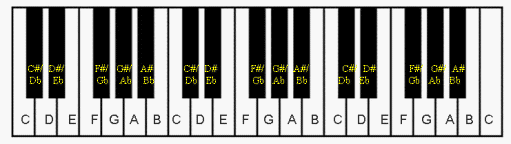
Look at the image above of the central part of a piano keyboard. Modes are only played on the white notes.
So to play the:
Ionian mode start on a C note (the second one from the left) and play up the keyboard using only the white notes until you get to the next C note to the right.
Dorian mode start on the D note to the right of the C note you began from above and stay on the white notes only until the next D note.
Phrygian mode start from the E note to the right of the D note you began from above and stay on the white notes only until the next E note.
Lydian mode start from the F note to the right of the E note you began from above and stay on the white notes only until the next
Mixolydian mode start from the G note to the right of the F note you began from above and stay on the white notes only until the next G note.
Aeolian mode start from the A note to the right of the G note you began from above and stay on the white notes only until the next A note.
That's is it in a nutshell.
Edited by - TomJoad on 12/29/2014 09:24:40
TomJoad - Posted - 12/29/2014: 09:31:35
I missed out the:
Locrian mode which starts from the B note to the right of the A note you began from above and stay on the white notes only until the next B note.
Edited by - TomJoad on 12/29/2014 09:31:49
Klondike Waldo - Posted - 12/29/2014: 17:09:29
The white keys are often used to explain modes, because it's an easy visual to comprehend and that's fine...
...Except you can start the entire series of modes from anywhere on the keyboard using white and black keys: B Flat dorian: B flat, C, D flat, E flat, F, G, A flat B flat :: F# mixolydian: F#, G#, A#, B#, C#, D# E, F#:: E Lydian: E, F#, G#, A#, B, C#, D#, E etc.
Modes played only on the white keys are modes "In The System of C Major" in my samples above, The B flat Dorian scale would also be correctly called Dorian mode in the system of A flat Major. The F# Mixolydian scale would also be called Mixolydian in the System of B Major, and the E Lydian scale would be " Lydian mode in the System of B major"
Edited by - Klondike Waldo on 12/29/2014 17:16:01
jackhatfield - Posted - 01/10/2015: 20:11:06
Not one post here or in the previous locked topic mentions a relationship between modes and keys. A couple of the posts actually state that modes are to be considered only by themselves, not related to any scales. Scales are related to a key. One could argue that keys are generated by scales...so does this mean keys do not exist in a relationship to modes? The diatonic chords of a key are built by stacking thirds on each scale note of the root scale. I'm my view, a "key" is the combination of a scale and the chords generated by that scale. Modes are scales. So, are not modes related to specific keys? If we stack Major or minor thirds on each note of a mode, do we generate the "legal" chords to harmonize melody lines played in this mode? Or if we play, for example, in G Mixolydian, are we supposed to use diatonic chords from the G Major (Ionian) to harmonize the melody lines and when the flat 7 chord is used, (as in "Little Maggie" with the F Major in the key of G for example) consider that simply an "accidental" chord? I'm only asking because I'm too lazy to work it out and see for myself.
Has anybody noticed how hard it is to find (even in musical dictionaries and textbooks), a definition for this term "key" that we all throw around that is not vague and circular, one that does not use other undefined musical terms? .... definition that a non-musician would understand?
Edited by - jackhatfield on 01/10/2015 20:27:02
jackhatfield - Posted - 01/10/2015: 20:21:10
I would define a musical key as an environment generated by and including a scale and the diatonic chords derived from that scale...for what it's worth. I realize this definition does use terms specific to the musical vocabulary, but this is probably unavoidable. At least I think using the term "environment" paints a better picture than the definitions I find by googling the word. Sorry to digress.
Edited by - jackhatfield on 01/10/2015 20:39:25
JoeDownes - Posted - 01/11/2015: 01:00:50
Here's what the Grove dictionary writes on 'key':
In tonal music (see Tonality), the abstract arrangement of musical phenomena such as melodies, harmonies and cadences around a referential or tonic pitch class. While the French ton and the German Tonart stress the importance of the tonic, the English term has a broader meaning: as a metaphorical ‘key’, the tonic ‘unlocks’ or clarifies the arrangement of pitch relations that underlies the music. A tonic thus unifies and coordinates the musical phenomena within its reach: in the key of C major, for example, there is an essential ‘C-ness’ to the music.
The idea that a piece or a passage lies ‘in’ a given key may reflect a cultural inclination to conceptualize key as a musical container. A key in this sense involves certain melodic tendencies and harmonic relations that maintain the tonic as the centre of attention; the tonic controls melodic contours in both smaller and larger musical contexts, determines the immediate succession of harmonies, and coordinates the overall succession of medial cadences and modulations in a piece.
Also crucial to the concept of key is the idea that there are two basic modal genera, major and minor, each with different musical characteristics arising largely from the disposition of tones and semitones within thier respective scales. Since each tonic governs both a major and a minor mode, there are (given equal temperament and enharmonic equivalence) a total of 24 keys, two for each of the 12 semitones within the chromatic octave. (...)
The modes are further interrelated as follows: the ‘parallel’ major and minor (e.g. C major and C minor) share the same tonic but have different diatonic collections, while the ‘relative’ major and minor (C major and A minor) share the same diatonic collection but have different tonics. Within a given diatonic collection, all pitch classes (and the harmonies rooted in them) are subdominant to the tonic, some more so than others. Moreover, a key is not limited to the pitch classes within its particular diatonic collection. In certain circumstances (melodic chromaticism, mixture, tonicization, modulation), the music can use pitch classes from outside its tonic major or minor scale without weakening its sense of orientation towards the tonic.
jackhatfield - Posted - 01/11/2015: 07:37:06
Wow see how much information was required to define the term "key"? Also, the compound/complex sentence structure Grove used? That's fairly high-brow language and wordy, even assuming the Grove definition ends before your last paragraph which begins "The modes..."
I was going for a definition the average non-musician or at least novice or self-trained musician can understand. I suppose my simplistic definition should include information about a tonic or root or "home base", but I think that is understood when the term "scale" is introduced.
Edited by - jackhatfield on 01/11/2015 07:37:24
jackhatfield - Posted - 01/11/2015: 07:38:36
yeah, why WAS that original post locked? it had barely begun...
Edited by - jackhatfield on 01/11/2015 07:38:58
jackhatfield - Posted - 01/11/2015: 07:54:38
In spite of it's wordy-ness the Grove definition fails to mention a feature I feel is important to fully understand what a key is: A key type can elicit a specific emotional response. For example, a Major key elicits a happy or content state of being. A minor key elicits a sad or somber emotional state.
Also, certain tonal centers elicit specific moods or emotions. The key of C Major is stately. Many marches are in C Major, and what's that tune they always play when the President is about to appear? That tune MUST be in the key of C Major, I would bet on it. E Major and A Major, the popular blues keys, are, for lack of a better term, "nasty, gritty, E a little more so than A IMO. The keys of B and B flat seem bright and happy to me, but that may be because of my bluegrass perspective...capoed on a banjo or guitar they are high in pitch. The key of F seems peaceful, content.
JoeDownes - Posted - 01/11/2015: 08:11:49
Yes, I left out the last paragraph. Here it comes:
"Keys are often said to possess characteristics associated with various extra-musical emotional states. While there has never been a consensus on these associations, the material basis for these attributions was at one time quite real: because of inequalities in actual temperament, each mode acquired a unique intonation and thus its own distinctive ‘tone’, and the sense that each mode had its own musical characteristics was strong enough to persist even in circumstances in which equal temperament was abstractly assumed. Though highly specific with respect to different repertories and listeners, these expressive qualities fall into two basic categories, which conform to the basic difference – often asserted as an opposition – between major and minor: major is heard to be brighter and more cheerful than minor, which in comparison is darker and sadder."
I'm not sure I associated different feelings with different keys, except for the major/minor difference of course. I think blues in C major sounds gritty still, and the presidents march would sound just as stately to me in C as in B or E,
Lew H - Posted - 01/11/2015: 09:59:35
Jack and Joe, First, I'm going to guess that using a capo on an open tuned banjo makes the emotional response differences moot? Second, as an atheoretical musician, the piano imagery gets the message most clearly to me. Still, I understand that you could start on any note, and with the proper steps and half steps produce the same mode.
JoeDownes - Posted - 01/11/2015: 10:18:24
When I play a piece without and than with capo at the first fret, my emotional response is not really different. How does it feel for you? It's very subjective I guess.
jackhatfield - Posted - 01/11/2015: 10:29:17
I would suggest the grittiness is attributable more to the flat 3rds and 7ths or the minor penatonic played over major chords, no matter what key blues is played in. I still think blues and E or A is nastier than in the key of C.This is a banjo discussion group Lew. Dont expect many piano keyboard examples. Haha
Edited by - jackhatfield on 01/11/2015 10:30:54
Lew H - Posted - 01/11/2015: 15:43:52
I didn't expect any piano discussions, but I've seen several and plunked on a few, but I don't play one. The keyboard imagery for me is a great way to visualize the modes. I asked about capoing, because even though you switch to a different key, all the string intervals are the same, so the sound should be replicated but higher in pitch.
jackhatfield - Posted - 01/12/2015: 07:48:39
I agree raising the pitch should make any key sound happier, brighter, ESPECIALLY on a banjo which has a bright tone anyway compared to most other instruments. It would be interesting to see a scientific study on the emotional / mood aspect of hearing different keys. Surely there has been something written on it by educated musicians. Maybe at least a thesis somewhere/at some time?
Edited by - jackhatfield on 01/12/2015 07:50:01
Rawhide Creek - Posted - 01/12/2015: 09:34:30
quote:
Originally posted by jackhatfieldI agree raising the pitch should make any key sound happier, brighter, . . .
"Raising the pitch" doesn't automatically correspond with changing key.
Example: Playing the first Bach suite for cello (key of G) on the cello, then again on the viola (an octave higher but still in G). Another example: Same instruments, second Bach suite (key of D minor).
I have played both pieces on both instruments. I heard nothing to suggest that the viola rendition was "happier, brighter".
Banjophobic - Posted - 01/12/2015: 09:39:42
I find that the way the piece is written, with the chords used for harmony, makes me 'feel' certain things..not so much the key. We tend to over simplify things, as in saying 'minor key songs are 'sad'. Some of the hippest, swingiest/ happy feet songs are minor keys,haha. We all 'feel and hear things differently which is whats so great about music..subjectivity rules/
jackhatfield - Posted - 01/12/2015: 09:49:30
If you raise the pitch by at least a half step you ARE changing the key, If you raise it an octave you are not technically changing the key but it is still vastly higher in pitch. duh.
ANY arrangement on banjo sounds happier/brighter to me when I capo up and play it exactly the same, with same tempo. This is subjective and only a large sampling would yield a meaningful answer. My or Russ's opinion means nothing all by itself as far as scientifically, but common sense and forty years experience practicing, performing and sensing audiences responses, and teaching tells me the vast majority of others would agree with me
I agree with John that the way a musician interprets a piece: the tempo, phrasing, use of dynamics, etc have much MORE effect on emotions than the key chosen. Minor Swing for example, is by NO means a "sad" piece. It's tempo/energy, the stop on the 5 chord and the improvised B part make it exciting and happy.
However, I believe the choice of key does have a subtle effect on the mood evoked from the listener.
Edited by - jackhatfield on 01/12/2015 10:04:43
Rawhide Creek - Posted - 01/12/2015: 09:59:11
quote:
Originally posted by jackhatfield. . . Surely there has been something written on it by educated musicians. Maybe at least a thesis somewhere/at some time?
Here's a fairly recent (2010) thesis on the subject:
scholarworks.umass.edu/cgi/vie...xt=theses
Edited by - Rawhide Creek on 01/12/2015 10:03:23
jackhatfield - Posted - 01/12/2015: 10:03:15
Thanks Russ I'll read that tonight. Got to get some work done now. Guess we have totally strayed from the topic...
sonofhop - Posted - 01/12/2015: 10:42:44
My favorite way to play around with and get to know various modes is to sing them over a drone. A great resource for this is W. A. Mathieu's book The Harmonic Experience. His approach draws on Hindustani music, so may not seem like a natural fit for the banjo. But to me a drone is a drone, whether it's produced by a sruti box or by a 5th string.
Rawhide Creek - Posted - 01/12/2015: 11:08:48
quote:
Originally posted by jackhatfieldThanks Russ I'll read that tonight. Got to get some work done now. Guess we have totally strayed from the topic...
Probably not so much as you might think, since the concept of "affect" and musical keys has its root in modes!
I think you'll find the thesis interesting. It more or less begins with modes . . .
jackhatfield - Posted - 01/12/2015: 12:56:40
I agree about the drone, or harmonized with chords, same idea. Then the sense of the tonal center is always present, otherwise you would need to get to the end of phrases to really recognize which mode is being used. This harks back to one of my original points. do modes generate chords that are supposed to be used to harmonize the melody as scales do? Of course they MUST, it's simply mathematics...but does one ever use the modal harmonized chords or the chords from the related Major scale behind the modal melody? Seems like the Major scale chords would "bring out" the characteristics of the mode because of the contrast...correct? Any time I have heard modal tunes they use chords from the Major scale, diatonic triads, but for example in Mixolydian as in "Little Maggie" the F major is used. Is F major the chord generated from second degree F Mixolydian scale or is it simply "suitable"or "desirable" when the melody goes to an F Major note? Does one F natural note in an entire phrase make the entire arrangement Mixolydian or is it just considered an accidental in the key of F Major?
mmuussiiccaall - Posted - 01/12/2015: 14:10:38
quote:
Originally posted by jackhatfieldI agree about the drone, or harmonized with chords, same idea. Then the sense of the tonal center is always present, otherwise you would need to get to the end of phrases to really recognize which mode is being used. This harks back to one of my original points. do modes generate chords that are supposed to be used to harmonize the melody as scales do? Of course they MUST, it's simply mathematics...but does one ever use the modal harmonized chords or the chords from the related Major scale behind the modal melody? Seems like the Major scale chords would "bring out" the characteristics of the mode because of the contrast...correct? Any time I have heard modal tunes they use chords from the Major scale, diatonic triads, but for example in Mixolydian as in "Little Maggie" the F major is used. Is F major the chord generated from second degree F Mixolydian scale or is it simply "suitable"or "desirable" when the melody goes to an F Major note? Does one F natural note in an entire phrase make the entire arrangement Mixolydian or is it just considered an accidental in the key of F Major?
Here's a chart I made a while back on this subject Jack, and welcome back.
 chords In modes |
pearcemusic - Posted - 01/12/2015: 14:17:23
yes all of the diatonic chords from the parent major key are good to go as "harmonizers" in a modal tune. the exception is usually whatever 5 chord is in the modal tonal center.
in ur example, G and F exist in the parent key of C major, but if it goes to the 5 chord of G ... D, then the F# in that chord is an "accidental".
this same thing is common in phrygian and aeolian minor modes as well.
in jazz, you have little chunks of "modes" flowing thru key centers all over the place .... many tonal centers thruout a single tune ... that will eventually come back to the original key center of the tune.
jackhatfield - Posted - 01/12/2015: 21:15:19
quote:
Originally posted by jackhatfieldI agree about the drone, or harmonized with chords, same idea. Then the sense of the tonal center is always present, otherwise you would need to get to the end of phrases to really recognize which mode is being used. This harks back to one of my original points. do modes generate chords that are supposed to be used to harmonize the melody as scales do? Of course they MUST, it's simply mathematics...but does one ever use the modal harmonized chords or the chords from the related Major scale behind the modal melody? Seems like the Major scale chords would "bring out" the characteristics of the mode because of the contrast...correct? Any time I have heard modal tunes they use chords from the Major scale, diatonic triads, but for example in Mixolydian as in "Little Maggie" the F major is used. Is F Major the chord generated from seventh degree F Mixolydian scale or is it simply "suitable"or "desirable" when the melody goes to an F Major note (in the key of G)? Does one F natural note in an entire phrase make the entire arrangement Mixolydian or is the F natural just considered an accidental in the key of G Major?
Rawhide Creek - Posted - 01/13/2015: 09:26:38
quote:
Originally posted by jackhatfield. . .
Also, certain tonal centers elicit specific moods or emotions. The key of C Major is stately. Many marches are in C Major, and what's that tune they always play when the President is about to appear? That tune MUST be in the key of C Major, I would bet on it. . . .
Collectively, the majority of marches are in F, Bb, Eb, and Ab, in about that order of frequency. Few are in C. When you think about typical instrumentation, this is predictable.
You would lose your bet, Jack. According to retired Col. Arnald Gabriel, former Commander and the Conductor Emeritus of the United States Air Force Band, "Hail to the Chief" is in Bb. Interesting historical note: It was first published in D.
Edited by - Rawhide Creek on 01/13/2015 09:30:29
Banjophobic - Posted - 01/13/2015: 09:34:49
quote:
Originally posted by RawhideCreekquote:
Originally posted by jackhatfield. . .
Also, certain tonal centers elicit specific moods or emotions. The key of C Major is stately. Many marches are in C Major, and what's that tune they always play when the President is about to appear? That tune MUST be in the key of C Major, I would bet on it. . . .
Collectively, the majority of marches are in F, Bb, Eb, and Ab, in about that order of frequency. Few are in C. When you think about typical instrumentation, this is predictable.
You would lose your bet, Jack. According to retired Col. Arnald Gabriel, former Commander and the Conductor Emeritus of the United States Air Force Band, "Hail to the Chief" is in Bb. Interesting historical note: It was first published in D.
I would think flat keys prevail because of the instrumentation used.
jackhatfield - Posted - 01/13/2015: 09:43:48
Didn't think about typical marches being written in horn keys. Makes sense. As a bluegrass player, when I think of marches I think first of tunes like "Under the Double Eagle" played in C by bluegrass guitar players. However, the key of F Major seems almost as stately and reserved as C Major... so if you agree with that opinion, then yo agree somewhat with original observations. Of course "Under the Double Eagle" is not really played as a march by grassers because the rhythm is usually in 4/4 time instead of 2/4.
Edited by - jackhatfield on 01/13/2015 10:01:54
Rawhide Creek - Posted - 01/13/2015: 11:43:18
quote:
Originally posted by RawhideCreekquote:
Originally posted by jackhatfield. . .
Also, certain tonal centers elicit specific moods or emotions. The key of C Major is stately. Many marches are in C Major, and what's that tune they always play when the President is about to appear? That tune MUST be in the key of C Major, I would bet on it. . . .
. . .
. . . According to retired Col. Arnald Gabriel, former Commander and the Conductor Emeritus of the United States Air Force Band, "Hail to the Chief" is in Bb. Interesting historical note: It was first published in D.
Just to be absolutely sure, I queried the United States Marine Band. Here is the reply:
Dear Mr. Martin,
We perform "Hail to the Chief" in the key of B-flat major.
Respectfully,
Jane Cross
Master Gunnery Sergeant, USMC
Chief, US Marine Band Library
Terms of Use | Privacy Policy | Privacy Consent (EU/GDPR Only)
Copyright 2026 Banjo Hangout. All Rights Reserved.


